
BuddhistCatholicContemplativeEvangelicalGeneral ChristianHinduJewishLatter-day SaintMuslimNew VisionsProgressive Christian
Beliefs
- Buddhist
- Catholic
- Contemplative
- Evangelical
- General Christian
- Hindu
- Jewish
- Latter-day Saint
- More Voices
- Muslim
- New Visions
- Pagan
- Progressive Christian
Topics
- Religion News
- Food and Religion
- Sports and Religion
- Religious Art
- Religious Music and Entertainment
- Religious Events
- History and Religion
- Style and Religion
- Politics and Religion
- Women in Religion
- Recreation Outdoors and Religion
- Business Finance and Religion
- Careers Workplace and Religion
- Education and Religion
- Family Parenting and Religion
- Health Fitness and Religion
- Home and Religion
- Relationships and Religion
- Technology and Religion
- Travel and Religion
Columnists
- Buddhist Columnists
- Business Finance and Religion Columnists
- Careers Workplace and Religion Columnists
- Catholic Columnists
- Contemplative Columnists
- Education and Religion Columnists
- Evangelists Columnists
- Family Parenting and Religion Columnists
- General Christian Columnists
- Health Fitness and Religion Columnists
- Hindu Columnists
- History and Religion Columnists
- Home and Religion Columnists
- Jewish Columnists
- More Voices Columnists
- Latter Day Columnists
- Muslim Columnists
- New Visions Columnists
- Nonreligious Columnists
- Pagan Columnists
- Politics and Religion Columnists
- Progressive Columnists
- Recreation Outdoors and Religion Columnists
- Relationships and Religion Columnists
- Religion News Columnists
- Religious Art Columnists
- Religious Events Columnists
- Religious Music and Entertainment Columnists
- Sports and Religion Columnists
- Style and Religion Columnists
- Technology and Religion Columnists
- Travel and Religion Columnists
- Women in Religion Columnists
Resource Library
- 2026 Calendar
- Library of World Religions
- The 100 Most Holy Places on Earth
- Patheos Answers
- Podcasts
- Videos
- Faith Leaders Database
- Anglican Episcopalian
- Bahai
- Baptist
- Buddhism
- Christianity
- Confucianism
- Eastern Orthodoxy
- Hinduism
- Holiness and Pentecostal
- ISKCON
- Islam
- Judaism
- Lutheran
- Methodist
- The Church of Jesus Christ of Latter-day Saints
- New Age
- Paganism
- Presbytarian and Reformed
- Protestantism
- Religion Behind the Scenes
- Roman Catholic
- Scientology
- Shia Islam
- Sikhism
- Sufism
- Sunni Islam
- Taoism
- Zen
- See all religions
Research Tools
 Ad-Free & Subscriber Log-In Subscription Support
Ad-Free & Subscriber Log-In Subscription Support
Follow Patheos 

- Trending:
- Forgiveness
- |
- Marriage
- |
- Consciousness
- |
- Death Penalty
- |
- Election
- |
- Halloween

-
Articles
- Home
- Religious Music & Entertainment
- Bible movie of the week: Slaves of Babylon (1953)
Bible movie of the week: Slaves of Babylon (1953)
Last updated on: November 27, 2013 at 5:17 pm by Peter T. Chattaway
Bible movie of the week: Slaves of Babylon (1953) 2013-11-27T17:17:22-08:00 Peter T. Chattaway
Patheos Explore the world's faith through different perspectives on religion and spirituality! Patheos has the views of the prevalent religions and spiritualities of the world.
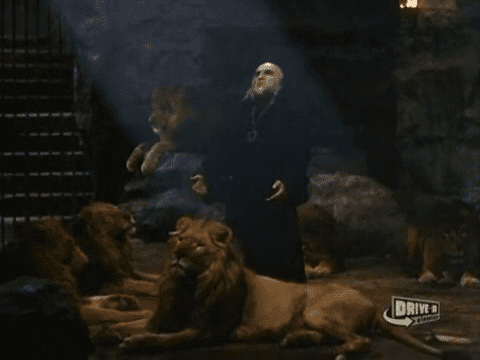 By now you may have figured out that I’m using the “Bible Movie of the Week” series as an excuse, or opportunity, to focus on some of the more obscure films out there, rather than the blockbusters that everyone knows and loves (most of which I have already written about at some length anyway). And so today I come to Slaves of Babylon (1953), a sort of adaptation of the Book of Daniel that I had barely even heard about until very recently.
In fact, I only bothered to go looking for this film a few weeks ago, after I had written a post about the Persian King Cyrus, who is celebrated in the Old Testament (Isaiah even calls him “the Lord’s Messiah”) for letting the Jews return to Jerusalem following their exile in Babylon. Cyrus might not be the most prominent of biblical figures, but he did play a significant role within the history of the Jewish people, and it seems a shame that there haven’t been more than a couple of films about him.
Slaves of Babylon is one of those films. While it dramatizes some of the better-known stories from the Book of Daniel, it also revolves around a mostly made-up story in which Cyrus becomes king of Persia with help from one of Daniel’s followers. I say “mostly made-up” because it seems the film’s depiction of Cyrus’s early life is derived in part from a legend passed down to us by the Greek historian Herodotus. So basically, Slaves of Babylon represents a pop-cultural attempt to bridge religious and secular history — and those are the kinds of films I find particularly interesting, whatever their aesthetic merits may or may not be. (Another example would be the 1985 mini-series A.D.: Anno Domini, which alternated between the Book of Acts and the lives of the Caesars, with a bit of Josephus thrown in for good measure.)
So, without further ado, here are my first impressions of the film, which you can watch (in English but with foreign subtitles) at this website.
 Slaves in Babylon? The title is a reference to the fact that the Jews lived in exile after their nation was conquered multiple times by the Babylonians.
But were the Jews actually “slaves” in Babylon? Were they compelled to build the Hanging Gardens and the other great construction projects of that city, as the film’s introduction suggests? Maybe some of them were, but I have never had the impression that this was true of the Jewish exiles as a whole.
The film goes on to say that the Jews were hated by their Babylonian masters for not worshipping the Babylonian god Bel Marduk. Again, I am not aware that any Babylonians concerned themselves much with who the Jews worshipped as a whole.
On a personal, individual level, Daniel and his friends certainly faced their share of religious hostility, but that was because they served in the Babylonian court; they were advisers to the very king who had defeated their people in the name of his gods. And no doubt there were the usual sort of ethnic tensions dressed up in religious language.
In general, though, I suspect most Babylonians were content to know that they and their gods had defeated the Jews and (seemingly) the Jewish God as well.
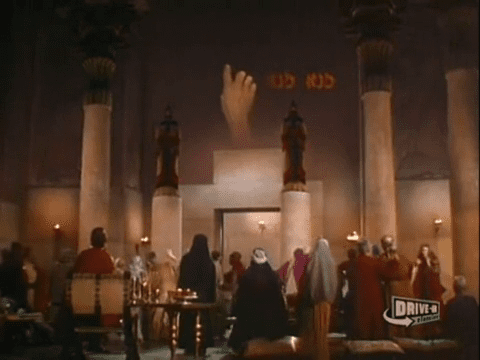
Daniel, remixed. Leaving out the episodes that are omitted from this film, the chronology of the biblical Book of Daniel goes something like this: Daniel’s friends are thrown into a fiery furnace by Nebuchadnezzar (chapter 3); Nebuchadnezzar goes insane and then recovers his sanity (chapter 4); Belshazzar sees the handwriting on the wall (chapter 5); Daniel is thrown into the lions’ den (chapter 6).
In the film, however, this order is altered, so that Daniel is thrown into the lions’ den during Nebuchadnezzar’s reign, not Cyrus’s; then his friends are thrown into the fiery furnace by Belshazzar, not Nebuchadnezzar; then Nebuchadnezzar goes insane and dies, without recovering; and then Belshazzar sees the handwriting on the wall.
 As you can see, the order is mostly unchanged, except that the episode in the lions’ den has been moved from the end of this sequence to its beginning — and if I had to guess as to why, I would say it’s because the filmmakers wanted to include the lions’ den story (which is, after all, very famous), but they also wanted to conclude the film on a happy note with Cyrus’s defeat of the Babylonians.
To put this another way: The mini-series The Bible kept the lions’ den story where it belonged, during the reign of Cyrus, so that it could suggest a connection between Daniel’s miraculous survival and Cyrus’s decision to let the Jews go home to Jerusalem. But Slaves of Babylon wants Cyrus to send the Jews home as soon as he conquers Babylon, so it had no time to sandwich another story of religious persecution in there. So the film moves the story to a much earlier part of the chronology, figuring it won’t matter to the audience which ruler sentenced Daniel to death.
Side note: The film depicts Belshazzar as Nebuchadnezzar’s son and heir. But the real Belshazzar was actually the son of a king who had assassinated Nebuchadnezzar’s grandson, so he probably wasn’t related to Nebuchadnezzar at all. But it’s not too hard to understand why the filmmakers might have simplified things here.
Get that boy a throne! While the film borrows heavily from the Book of Daniel, the major narrative thread in this film actually concerns Cyrus, a shepherd boy who ascends to the throne of Persia with the help of one of Daniel’s followers.
The fact that Daniel is not the central focus of this film makes me wonder if the filmmakers were suffering from a reluctance similar to that of the people who made King of Kings (1961), the first major Jesus movie of the sound era; instead of getting too close to the film’s central biblical hero, it was arguably “safer” to spend the vast bulk of the movie’s screen time on the quasi-fictionalized supporting characters.
The film links the stories of Daniel and Cyrus by showing how Daniel deliberately helps Cyrus take the throne so that Cyrus will feel grateful towards Daniel and let his people go home. Much of the legwork, however, is done by a follower of Daniel’s named Nahum (no apparent relation to the prophet of that name), who schemes with various people to trick Cyrus into doing what needs to be done — and who, at one point, gets involved in a love triangle with the object of Cyrus’s affections.
 In this film, Cyrus is presented as a shepherd who discovers that he is actually the grandson of the Persian king Astyages, and that his grandfather tried to have him killed at birth because of a prophecy that Cyrus would one day take the throne away from him — but instead of being left to die at the side of the road, the infant Cyrus was taken in by a shepherd and his wife, who raised him as their own.
Once this secret is revealed, Cyrus is officially welcomed back into Astyages’ court, but Astyages still tries to have him killed — so their armies go to war and Cyrus becomes king, in fulfillment of the prophecy. (The battle is interrupted by a solar eclipse, which may be a nod to the so-called Battle of the Eclipse that was fought in 585 BC, which actually marked the beginning of Astyages’ reign and not the end of it.)
And then Cyrus gets the Persian army to march on Babylon because a woman that he is obsessed with, named Panthea, has gone there to be with the Babylonian prince Belshazzar. (This attack is foreshadowed by a scene in which Cyrus says Panthea is beautiful like Helen, the queen whose adultery sparked the Trojan War.)
But what Cyrus doesn’t know is that Panthea has actually gone to Babylon at Nahum’s behest. That’s right: Nahum, a follower of Daniel’s, tells a beautiful woman to feign interest in the Babylonian prince so that her jealous Persian lover will follow her there and conquer the city, thereby putting him in a position to set the Jews free. Cheesy, no? And strangely devious on the part of our biblical heroes.
 Femme fatales. Speaking of Panthea, the first time we see her, she is lying on a couch and stroking her pet leopard, which harks back to a similar scene that introduced Mary Magdalene in Cecil B. DeMille’s The King of Kings (1927).
Interestingly, though, this film does not punish Panthea in the end, the way that many other Bible films have punished their more overtly seductive female protagonists. (Consider, for example, the fate of the title character in Sins of Jezebel, who lavished her attention on multiple men in a manner not entirely unlike what Panthea does here.) Instead, Panthea is allowed to have her happy ending: she gets to be a real queen sitting on a real throne next to a real king, i.e. Cyrus.
(The actress who plays Panthea, Linda Christian, went on to become the very first Bond girl ever just one year later, when she played Valerie Mathis — the Vesper Lynd character, basically — in the original 1954 TV adaptation of Casino Royale.)
The film also features Julie Newmeyer — better known today as Julie Newmar — as a dancer who turns out to be an assassin working for Astyages. This was one year before she played one of the brides in Seven Brides for Seven Brothers (1954), and thirteen years before she first played Catwoman on the Batman TV show (1966-1967).
I must confess I was also amused by the way Nahum tries to tempt Cyrus with the prospect of marriage. Nahum tells Cyrus that, as king of Persia, he will have “luxuries like you have never imagined. Slaves, armies at your command. Rich raiment. Every maiden in the land…” He pauses, then adds: “…will be eager to be your bride.”
To this, Cyrus replies, “I can marry whoever I choose?” Um, well, yes he can. Indeed, in that day and age, he could have had as many women in his harem as he wanted. But neither Nahum nor anyone else in the film gets around to mentioning that.
(Incidentally, why is Nahum tempting Cyrus with the prospect of slave ownership, when the whole point of Nahum’s mission is to ensure that Cyrus will set the Jews free from slavery? Is the enslavement of others okay as far as Nahum is concerned?)
I was also amused by the scene where Nahum tells Panthea that he will accompany her on a journey, and she replies, “You and me, together, for five days?” This line is soon followed by the narrator declaring in his usual serious-narrator voice, on Nahum’s behalf, that “the fall of Babylon could not arrive too soon.” Funny.
 Jewish identity. This film was made only eight years after the Holocaust, and only five years after the creation of the modern state of Israel, and it reflects these facts in a number of ways.
First, several of the Jewish characters, including Daniel, wear Stars of David — the symbol that appears on the modern Israeli flag — rather prominently.
Later, there is a sequence in which Belshazzar plots to kill the Jews in a fiery act of genocide, but unbeknownst to him, the fire is put out by a sudden rainstorm.
Then, when the Jews leave Babylon at the end of the film, Daniel says, “This captivity is over. There may be others, but now we will be able to withstand all suffering.”
Elements like these would have had special resonance so soon after modern-day Jews had survived an even worse persecution (the word “holocaust” actually comes from a Greek word that means to “burn something whole”), and so soon after Israel became a nation in its own right — thereby, in a sense, ending another period of exile.
Beyond that, it is also worth noting that Daniel’s friends are identified in this film by their Hebrew names (Hananiah, Mishael, Azariah), and not by their more famous Babylonian names (Shadrach, Meshach, Abednego). Interestingly, this was the same approach taken by The Bible mini-series a few months ago.
Bible connections. The film begins by telling us that Jerusalem was destroyed 300 years after the death of Solomon, which is more or less accurate. His death is generally dated to 931 BC, and Jerusalem was conquered by the Babylonians on three occasions between 606 BC and 587 BC, the last of which resulted in the destruction of the city and its temple. So the gap was arguably more like 344 years, but why quibble.
 The characters also talk about how the exile has lasted “almost fifty years”, which suggests that the film is dating the exile to the period between the final destruction of Jerusalem in 587 BC and the Persian conquest of Babylon in 538 BC. Daniel himself had actually been in exile for almost seventy years by that point, though, because he was part of the first wave of deportees following Babylon’s first defeat of Jerusalem in 606 BC.
(It is possible, I suppose, that the film is meant to span two decades; the historical Cyrus defeated Astyages in 550 BC, or about a dozen years before he conquered Babylon and was in a position to let the Jews go home. But the film moves pretty fast, and no one ages notably, so the filmmakers probably weren’t thinking about that.)
The film makes a few other references to Israel’s past, as well. For example, Nahum tells Panthea the story of Ruth, and also the story of Joseph and his brothers.
And when Cyrus and Panthea decree that Nahum is free to join the exiles in returning home to Jerusalem, Panthea almost seems to be quoting a prophecy, though as far as I can tell the sentence she speaks does not come straight from the Old Testament but, rather, incorporates bits and pieces from different passages (note in particular how the bit where she says “your God will surely visit you” echoes Jeremiah 29).
The film also borrows elements from other Bible stories that some audience members may subconsciously associate with the genre as a whole. For example, the notion that the Jews were “slaves” in Babylon harks back to Israel’s enslavement in Egypt prior to the Exodus. And as the Jews leave Babylon at the end of the film, a rainbow appears in the sky, which harks back to the symbol of hope at the end of the story of Noah.
Foreign gods. On the one hand, the film takes a dim view of the Babylonian god Bel Marduk and the people who insist on worshipping him. But the film largely gives Cyrus a pass for worshipping the Persian god Mithras.
 Odds and ends. The film isn’t exactly made very well. I was particularly struck by the rather lazy way Nahum waves his sword at the enemy troops during the battle scenes. But it’s not the most incompetently made of films, either. It’s just sort of blandly mediocre.
That being said, I did like a few bits, such as the line of dialogue when Daniel tells Nebuchadnezzar, “Age has set his levelling hand on both of us,” or the shot at the end of the episode in the lions’ den, when Daniel walks right up to the camera in a way that suggests how imposing he might have seemed to the bewildered Babylonians standing outside.
The film has an interesting pedigree as far as its cast and crew go. I have already mentioned the appearances of Julie Newmar and Linda Christian.
Beyond that, the film was directed by William Castle, who went on to become famous as the maker of gimmicky B-movies like the original House on Haunted Hill (1959), screenings of which were accompanied by a plastic skeleton that swooped over the heads of the audience during one scene, and The Tingler (1959), screenings of which were accompanied by hidden buzzers that vibrated the audience’s seats.
At least three of the actors appeared in other Bible films as well.
Daniel is played by Maurice Schwartz, who played an adviser to king Herod Antipas in Salome (1953), the same year Slaves of Babylon came out.
Daniel’s assistant Nahum is played by Richard Conte, who went on to play Barabbas in The Greatest Story Ever Told (1965). (Conte might be best-known nowadays for playing the rival mafia don Barzini in 1972’s The Godfather.)
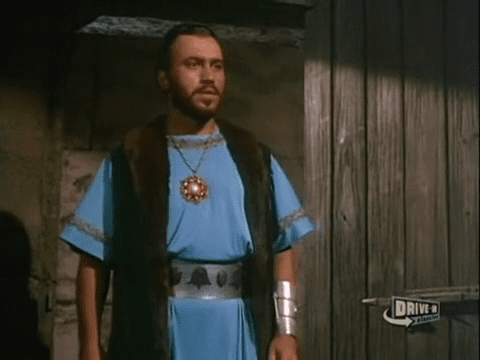 And Belshazzar is played by Michael Ansara, who had already played someone named Zubal in a 50-minute film called Queen Esther (1948), and who also had a bit part as Judas Iscariot in The Robe (1953) the same year Slaves of Babylon came out. After this, he went on to play a taskmaster in The Ten Commandments (1956) and Haman in an episode of Greatest Heroes of the Bible (1979). Most fun of all, for a Trekkie like me, is the fact that Ansara also went on to play a Klingon named Kang in three episodes of the Star Trek franchise between 1968 and 1996!
Previous Post

November 25, 2013
Son of God -- the trailer is now online
Next Post
November 29, 2013 The Nephilim are coming! The Nephilim are coming!
Browse Our Archives
Select a Category Anglican Planet Articles BC Christian News BC Report Bible Movies Bible Review Blog Books & Culture Campus Times CBC Radio Christianity Today ChristianWeek Essays Faith Today Festival Cinemas Guide Film Journals Georgia Straight Interviews MB Herald National Catholic Register Salvationist Today's Christian Two Chairs Ubyssey Uncategorized Vancouver Courier Vancouver Sun
Select a Month August 2025 April 2025 January 2025 December 2024 November 2024 May 2024 February 2024 December 2023 May 2023 March 2023 November 2022 July 2022 June 2022 May 2022 April 2022 February 2022 January 2022 December 2021 November 2021 October 2021 September 2021 August 2021 July 2021 June 2021 April 2021 March 2021 February 2021 January 2021 December 2020 November 2020 October 2020 August 2020 July 2020 June 2020 May 2020 March 2020 February 2020 January 2020 December 2019 November 2019 September 2019 July 2019 May 2019 April 2019 March 2019 February 2019 January 2019 December 2018 November 2018 October 2018 September 2018 July 2018 June 2018 May 2018 April 2018 March 2018 February 2018 January 2018 December 2017 November 2017 October 2017 September 2017 August 2017 July 2017 June 2017 May 2017 April 2017 March 2017 February 2017 January 2017 December 2016 November 2016 October 2016 September 2016 August 2016 July 2016 June 2016 May 2016 April 2016 March 2016 February 2016 January 2016 December 2015 November 2015 October 2015 September 2015 August 2015 July 2015 June 2015 May 2015 April 2015 March 2015 February 2015 January 2015 December 2014 November 2014 October 2014 September 2014 August 2014 July 2014 June 2014 May 2014 April 2014 March 2014 February 2014 January 2014 December 2013 November 2013 October 2013 September 2013 August 2013 July 2013 June 2013 May 2013 April 2013 March 2013 February 2013 January 2013 December 2012 November 2012 October 2012 September 2012 August 2012 July 2012 June 2012 April 2012 January 2012 January 2011 December 2010 November 2010 October 2010 September 2010 August 2010 July 2010 June 2010 May 2010 April 2010 March 2010 February 2010 January 2010 December 2009 November 2009 October 2009 September 2009 August 2009 July 2009 June 2009 May 2009 April 2009 March 2009 February 2009 January 2009 December 2008 November 2008 October 2008 September 2008 August 2008 July 2008 June 2008 May 2008 April 2008 March 2008 February 2008 January 2008 December 2007 November 2007 October 2007 September 2007 August 2007 July 2007 June 2007 May 2007 April 2007 March 2007 February 2007 January 2007 December 2006 November 2006 October 2006 September 2006 August 2006 July 2006 June 2006 May 2006 April 2006 March 2006 February 2006 January 2006 December 2005 November 2005 October 2005 September 2005 August 2005 July 2005 June 2005 May 2005 April 2005 March 2005 January 2005 December 2004 November 2004 October 2004 September 2004 August 2004 July 2004 June 2004 May 2004 April 2004 March 2004 February 2004 January 2004 November 2003 October 2003 August 2003 July 2003 June 2003 May 2003 January 2003 December 2002 November 2002 August 2002 July 2002 June 2002 May 2002 March 2002 January 2002 December 2001 November 2001 September 2001 August 2001 July 2001 June 2001 April 2001 March 2001 February 2001 December 2000 November 2000 October 2000 September 2000 August 2000 July 2000 June 2000 May 2000 April 2000 March 2000 January 2000 October 1999 August 1999 May 1999 April 1999 February 1999 January 1999 December 1998 November 1998 October 1998 August 1998 July 1998 June 1998 April 1998 March 1998 January 1998 November 1997 September 1997 July 1997 June 1997 April 1997 March 1997 February 1997 January 1997 December 1996 October 1996 September 1996 June 1996 March 1996 February 1996 January 1996 April 1995 November 1994 September 1994 September 1991
Follow Us!
TAKE THE
Religious Wisdom Quiz
According to Paul, nothing in all creation can separate you from me—not death, not life, not angels or demons. What am I?
Select your answer to see how you score.
The love of God God's mercy Salvation God's grace
Related posts from FilmChat

Joseph of Egypt – the Chosen spin-off announces...

Exclusive: A clip from Angel Studios' The King...

Exclusive: Watch a clip from Angel Studios' Brave...

Exclusive: Watch a clip from Angel Studios' Homestead
TRENDING AT PATHEOS Religious Music & Entertainment

"Les Diabolique" and Transgression
Alongside something like Arrival, Vertigo, or Charade, Les Diaboliques is a...

"The Plague Dogs" and Mortality
So, flashback to the late 70s, early 80s. Walt Disney Studios is...

With the recent and highly successful release of Christopher Nolan’s epic film,...

"L'avventura" and Human Weakness
Today's piece is going to be a little different for a few...

I first want to apologize for not posting or writing anything. I'm...

I've engaged in the multi-year project of reading through the Church Fathers,...
view all Religious Music & Entertainment blogs
Ad-Free & Subscriber Log-In Subscription Support
- About Us
- 2026 Calendar
- Videos
- Podcasts
- Library of World Religions
- Faith In Media Tracker
- Advertise With Us
- Write for Us
- Privacy Policy
- Terms of Service
- Do Not Sell My Data
- Contact Us
- Radiant Digital
- Manage Newsletter Subscriptions
- Unsubscribe From Notifications
- Sitemap
Copyright 2008-2026, Patheos. All rights reserved.
Subscription Support Ad-Free & Subscriber Log-In
Follow Patheos