
BuddhistCatholicContemplativeEvangelicalGeneral ChristianHinduJewishLatter-day SaintMuslimNew VisionsProgressive Christian
Beliefs
- Buddhist
- Catholic
- Contemplative
- Evangelical
- General Christian
- Hindu
- Jewish
- Latter-day Saint
- More Voices
- Muslim
- New Visions
- Pagan
- Progressive Christian
Topics
- Religion News
- Food and Religion
- Sports and Religion
- Religious Art
- Religious Music and Entertainment
- Religious Events
- History and Religion
- Style and Religion
- Politics and Religion
- Women in Religion
- Recreation Outdoors and Religion
- Business Finance and Religion
- Careers Workplace and Religion
- Education and Religion
- Family Parenting and Religion
- Health Fitness and Religion
- Home and Religion
- Relationships and Religion
- Technology and Religion
- Travel and Religion
Columnists
- Buddhist Columnists
- Business Finance and Religion Columnists
- Careers Workplace and Religion Columnists
- Catholic Columnists
- Contemplative Columnists
- Education and Religion Columnists
- Evangelists Columnists
- Family Parenting and Religion Columnists
- General Christian Columnists
- Health Fitness and Religion Columnists
- Hindu Columnists
- History and Religion Columnists
- Home and Religion Columnists
- Jewish Columnists
- More Voices Columnists
- Latter Day Columnists
- Muslim Columnists
- New Visions Columnists
- Nonreligious Columnists
- Pagan Columnists
- Politics and Religion Columnists
- Progressive Columnists
- Recreation Outdoors and Religion Columnists
- Relationships and Religion Columnists
- Religion News Columnists
- Religious Art Columnists
- Religious Events Columnists
- Religious Music and Entertainment Columnists
- Sports and Religion Columnists
- Style and Religion Columnists
- Technology and Religion Columnists
- Travel and Religion Columnists
- Women in Religion Columnists
Resource Library
- 2026 Calendar
- Library of World Religions
- The 100 Most Holy Places on Earth
- Patheos Answers
- Podcasts
- Videos
- Faith Leaders Database
- Anglican Episcopalian
- Bahai
- Baptist
- Buddhism
- Christianity
- Confucianism
- Eastern Orthodoxy
- Hinduism
- Holiness and Pentecostal
- ISKCON
- Islam
- Judaism
- Lutheran
- Methodist
- The Church of Jesus Christ of Latter-day Saints
- New Age
- Paganism
- Presbytarian and Reformed
- Protestantism
- Religion Behind the Scenes
- Roman Catholic
- Scientology
- Shia Islam
- Sikhism
- Sufism
- Sunni Islam
- Taoism
- Zen
- See all religions
Research Tools
 Ad-Free & Subscriber Log-In Subscription Support
Ad-Free & Subscriber Log-In Subscription Support
Follow Patheos 

- Trending:
- Forgiveness
- |
- Marriage
- |
- Consciousness
- |
- Death Penalty
- |
- Election
- |
- Halloween

-
Articles
- Home
- Religious Music & Entertainment
- Abraham and the Three Visitors: five filmed interpretations
Abraham and the Three Visitors: five filmed interpretations
Last updated on: January 27, 2016 at 10:36 am by Peter T. Chattaway
Abraham and the Three Visitors: five filmed interpretations 2016-01-27T10:36:43-08:00 Peter T. Chattaway
Patheos Explore the world's faith through different perspectives on religion and spirituality! Patheos has the views of the prevalent religions and spiritualities of the world.
 Fred Clark posted an item last night in which he expressed surprise that the story of Abraham and the three visitors in Genesis 18 is a lot stranger than he had thought. For one thing, Abraham and the visitors eat a meal that mixes meat and dairy, and would therefore be regarded as non-kosher by many of Abraham’s descendants. But, more crucially, Clark notes that one of the three visitors — who are often called “angels” — seems to be God himself. A walking, talking, eating God.
Personally, I’m surprised that Clark is surprised by that last bit, partly because it has always seemed clear to me that one of the three visitors is God himself. It’s certainly implicit in the text: God and Abraham “stand” together and discuss the fate of Sodom while the other men make their way to that city, and only two of the three visitors arrive in Sodom itself. Presumably God himself was the third visitor.
But beyond the text itself, nearly every single dramatized version of this story that I have seen has suggested that there was something different about one of the three visitors. So I had always assumed that that was a standard interpretation of the text, if not the standard interpretation of the text.
Here is how five different films and TV shows have dealt with this story.
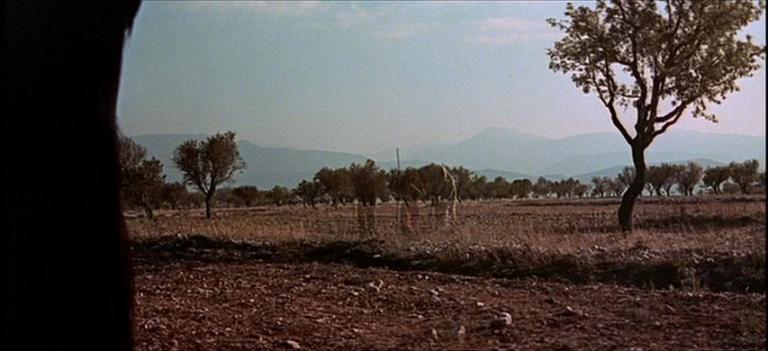
First, The Bible: In the Beginning… (1966) creates an eerie, mysterious mood with its music as Abraham watches the visitors approach from a distance. As they walk towards the camera, they seem to fade in and out:
Finally, the visitors stand before Abraham, close enough that we can see that the one in the middle is played by Peter O’Toole; the faces of the others are hidden in shadow or behind their hoods:

The visitors sit down, and Peter O’Toole is still sitting in the middle:
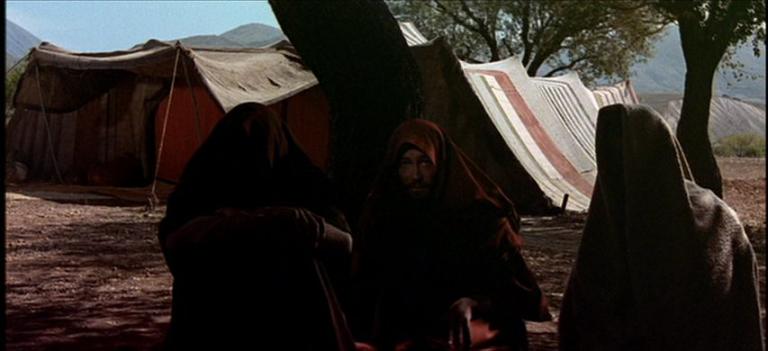
But wait? What’s this? Peter O’Toole is also sitting on the left:

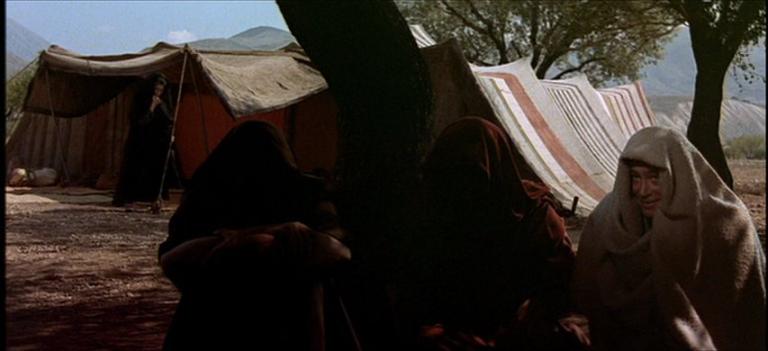
And he is also sitting on the right — and this time, he’s clean-shaven:
Finally the visitors get up to go, and the middle visitor pauses before saying, “Shall I hide from Abraham that thing which I do?”:
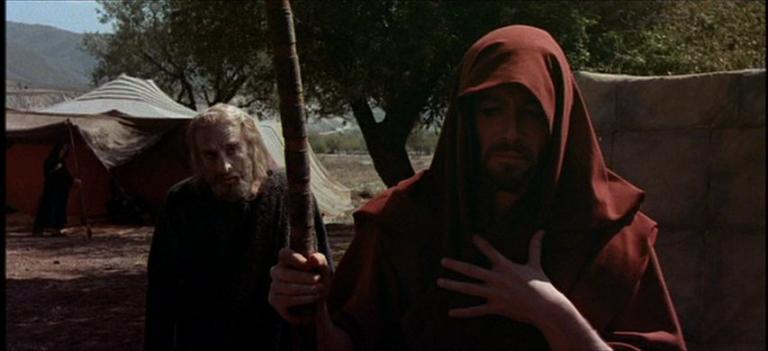
The middle visitor turns around to speak with Abraham (George C. Scott), and we see that the other two visitors have already walked a fair bit into the distance:

Abraham begins to plead with the middle visitor for the lives of the people of Sodom, and as they near the end of their negotiations, the middle visitor fades away:
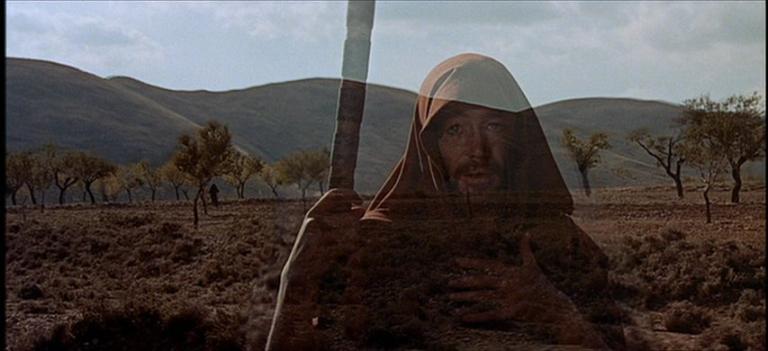
After this, Abraham asks one last time if God might spare the city of Sodom for the sake of ten righteous men, and this time we hear the voice of the middle visitor on the soundtrack while the camera continues to look at the landscape, with the other two visitors walking even further into the distance.
There’s an interesting ambiguity to this sequence, as it seems to treat the middle visitor as somewhat special, yet it also blurs the line between the three visitors by getting one actor to play all three of them. (When the other two visitors walk through the streets of Sodom, the film does a very good job of cutting from one angle to another so that it alternates between the two O’Toole characters.)
The sequence is made even more ambiguous by the fact that at least one of these visitors speaks as though he was God himself, yet the voice of God throughout the rest of the movie is provided by director John Huston, not Peter O’Toole. So, even as the film suggests that the three visitors share a common identity, it also suggests that they are not to be identified with the God of the rest of the film.
So are the three visitors angels? Is one of them God? Are all of them God? The film takes a mysterious approach to a mysterious passage, but the clear use of the first person singular on the middle visitor’s part, when he negotiates with Abraham, does lend at least some support to the idea that he is uniquely divine.
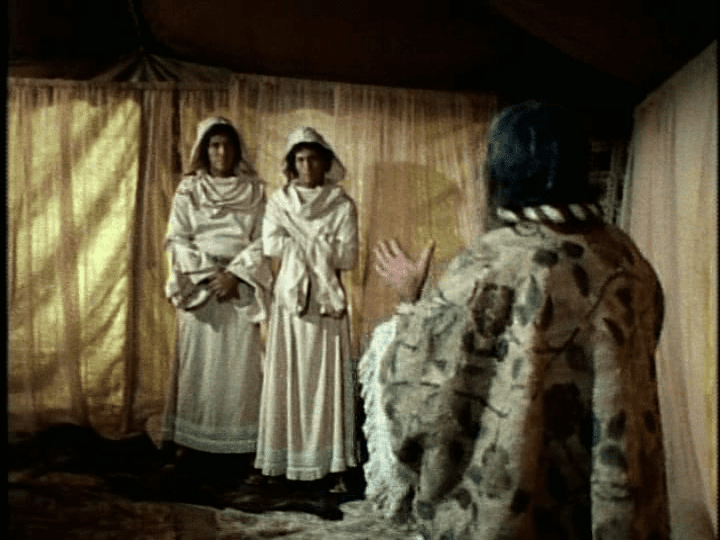
The next four examples were all produced for television, starting with the NBC series Greatest Heroes of the Bible (1978). And what’s notable about this example is that it reduces the number of visitors from three to two — possibly to streamline things (after all, only two of the visitors went on to visit Sodom), but also, perhaps, to draw a sharper line between God and his messengers. In this dramatization, the two angels speak very clearly in the third person about what “the Lord God” will do:
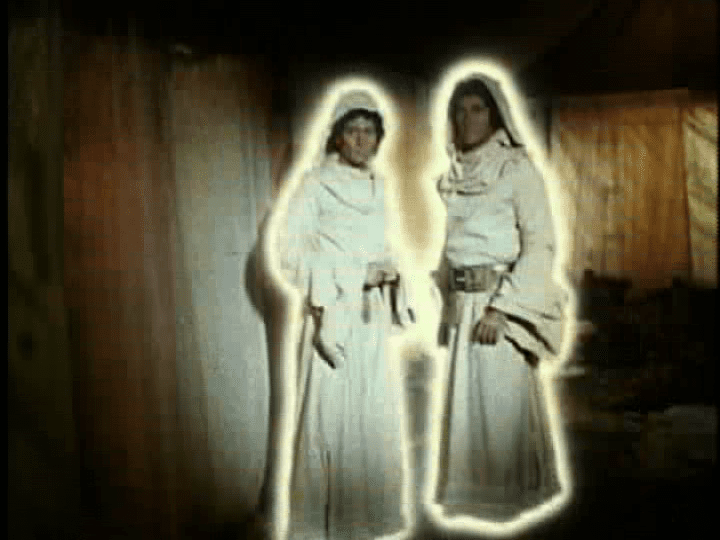
And then, just to make things a little goofy, the angels seem to “beam out” of Abraham’s tent using a cheap 1970s special effect:
The next major depiction of this episode comes in Abraham (1993), one of the first films produced as part of The Bible Collection. This time, the angels are first seen out-of-focus, almost like a mirage appearing behind the livestock, but this is how the camera sees them, not how Abraham (Richard Harris) sees them:
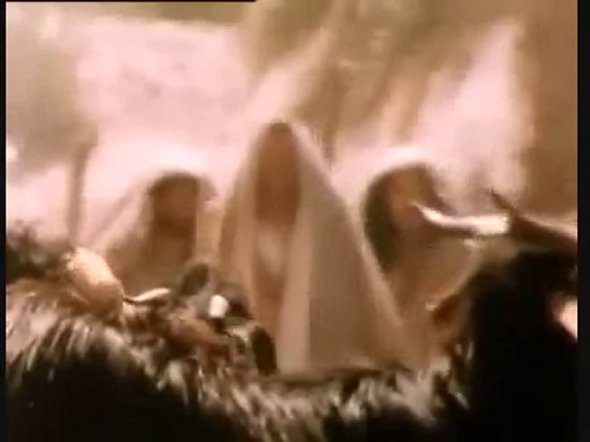
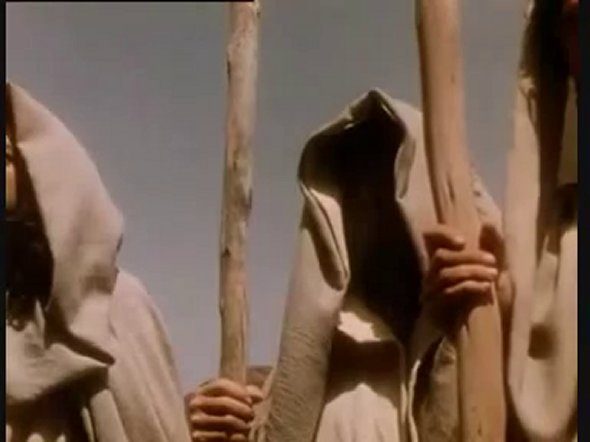
When the visitors stand where Abraham can see them, the camera points up at them, and this time the face of the middle visitor is the only one we don’t see:

When the middle visitor calls Abraham by name, Abraham is startled to realize who these people are, and the camera comes in even tighter for a close-up on that particularly mysterious face-that-isn’t-there in the middle:
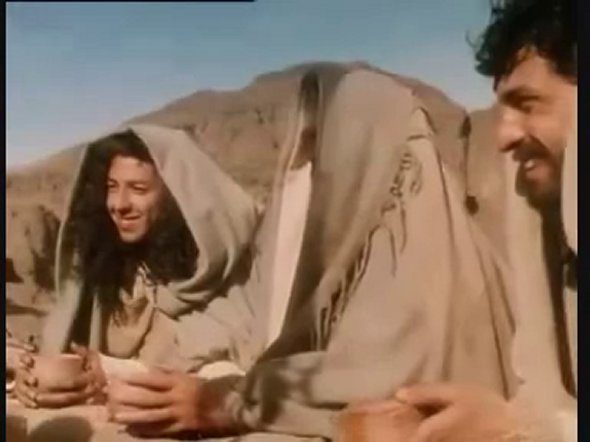
But, in keeping with the general tone of The Bible Collection, things don’t stay too reverent for long. The three visitors sit and talk to Abraham and his wife Sarah (Barbara Hershey), and when they comment on the fact that she laughed — and that she will have a son whose name means “laughter” — the two visitors whose faces we can see smile too. Does the middle visitor smile as well? Who knows:
This film, incidentally, is the only one I can think of that shows Abraham washing the visitors’ feet, which is perfectly in keeping with the text yet seems oddly demystifying compared to some of the other films. And instead of showing the visitors leave Abraham’s tent mere minutes after they arrived, the film dissolves from their initial conversation with Abraham and Sarah to their departure some time later. So the film allows for the possibility that their visit wasn’t necessarily a short one.
Finally, as the other two visitors leave for Sodom, the middle visitor stays and talks to Abraham:
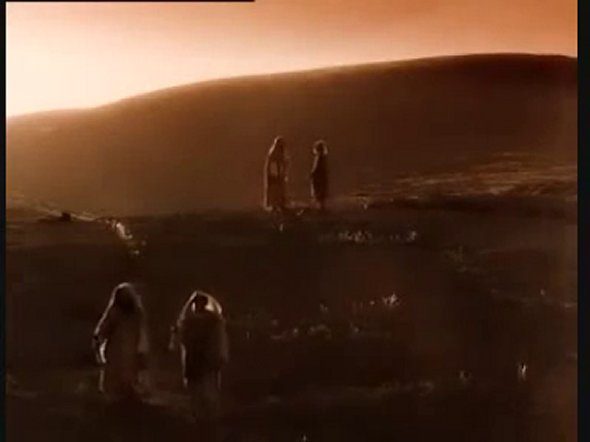
The middle visitor himself begins to walk down the hill as Abraham negotiates for the lives of the people of Sodom. But when the camera cuts to Abraham’s point of view, the middle visitor is gone — and the rest of the conversation between God and Abraham consists of Abraham looking around himself and talking to a disembodied voice. (So a much greater chunk of this conversation takes place between Abraham and a disembodied voice than was the case in The Bible: In the Beginning…)
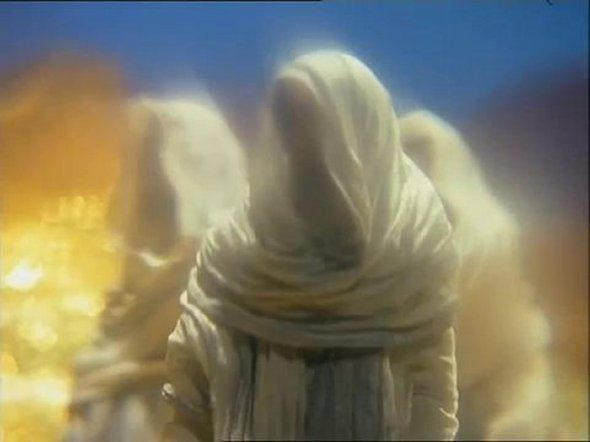
Then, a few years later, there was Testament: The Bible in Animation (1996). Here, the visitors seem to arrive from heaven like winged angels…
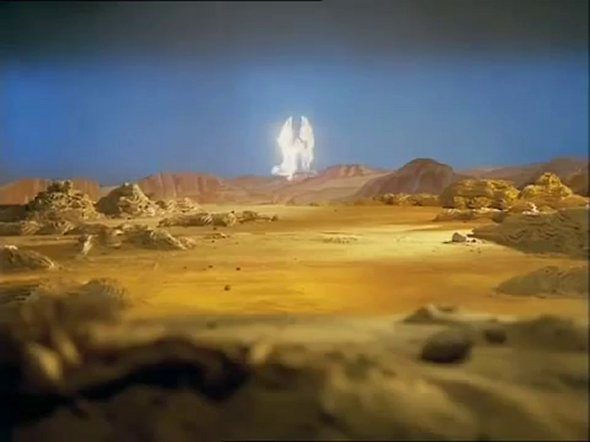
…before arriving on the ground, where they are initially semi-transparent, just like the visitors in The Bible: In the Beginning…:
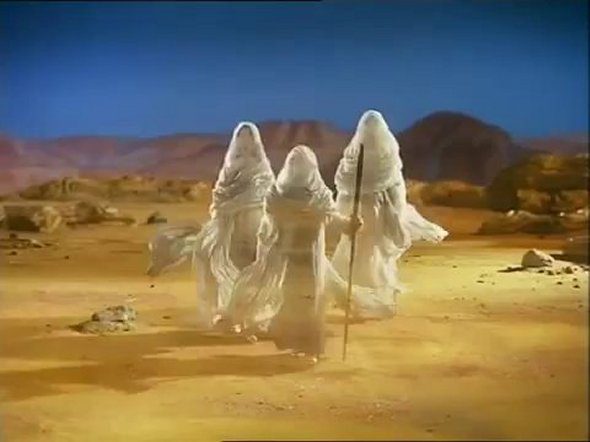
When the visitors speak to Abraham, they never lose their ethereal quality, thanks to their bright white clothing and the Vaseline-on-the-lens camerawork:
When the visitors leave, one of them hangs back to talk to Abraham:
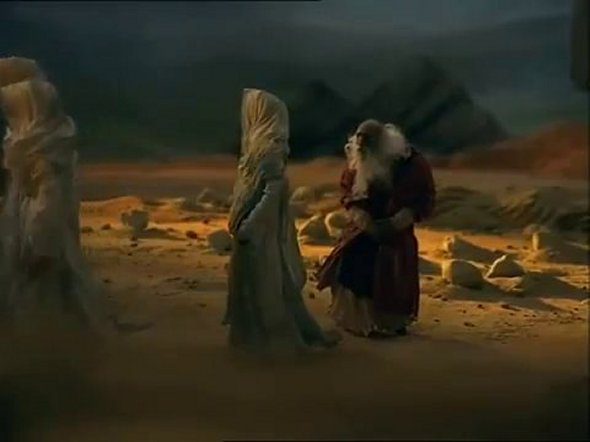
As Abraham begins his negotiations with God, the visitor he is speaking to fades from our sight:
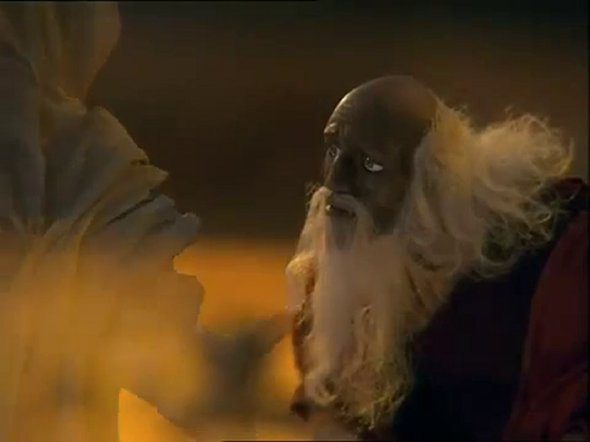
Curiously, the other two angels fade from our sight too, shortly after this, even though we go on to see them again in the city of Sodom. So of the five films I am considering here, this one makes the least distinction between the three visitors.
Finally, there is the first episode of this year’s hit mini-series The Bible, which not only makes a distinction between one of the visitors and the others, but goes so far as to hint very strongly that this extra-special visitor might be Jesus himself.
This time, the sequence begins as Abraham hears a voice call his name, prompting him to look up at a nearby hill, where he sees three mysterious hooded figures:
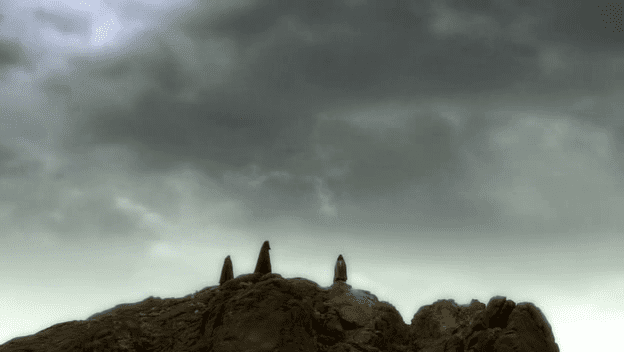
The three figures then approach Abraham’s camp…

…and sit down at Abraham’s tent. There, they remove their hoods, but we can see only two of their faces:
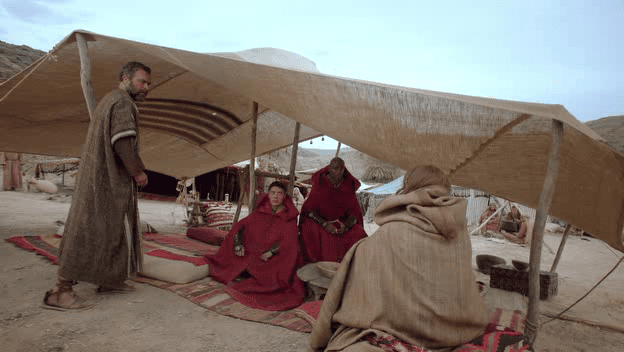
Two points are worth noting about the visitors’ appearance here. First, they represent different ethnic groups, in a manner that almost suggests the traditional division of the Wise Men into Asian, African and European (aka descendants of Shem, Ham and Japheth). Second, the two visitors in red are wearing the exact same outfit that the angels in later episodes of The Bible will wear — which confirms their identification as angels — but the visitor in white is wearing something rather different.
The mini-series then does something rather clever — indeed, uniquely cinematic, compared to the other dramatizations being considered here — when Sarah overhears the prediction that she will bear a son.
Sarah is sitting inside a tent when she laughs, and in two of the shots that follow, we see the visitor in white walk between Sarah and the camera in a way that makes no spatial sense within the tent but hints at the visitor in white’s ability to transcend spatial boundaries; indeed, for all we know, Abraham is still talking to the visitor in white outside the tent while this figure speaks to Sarah inside the tent:

Genesis 18 is pretty clear that it is God himself who responds to Sarah’s laughter — but where the text has God ask Abraham why Sarah laughed, the mini-series has the visitor in white ask Sarah directly (though she never actually sees him; instead, like the Abraham played by Richard Harris in the 1993 film, she looks around as though she were addressing a disembodied voice and trying to locate its source).
Then, when Abraham asks where the two visitors in red are going, one of them looks at the visitor in white and waits for him to nod before turning back to Abraham and telling him that they are going to Sodom. So not only is the visitor in white different from the visitors in red, but he has some sort of authority over them:

After that, Abraham negotiates with the visitor in white for the lives of the people of Sodom while the two angels go and visit the city — and the visitor in white certainly looks like an out-of-focus Jesus:
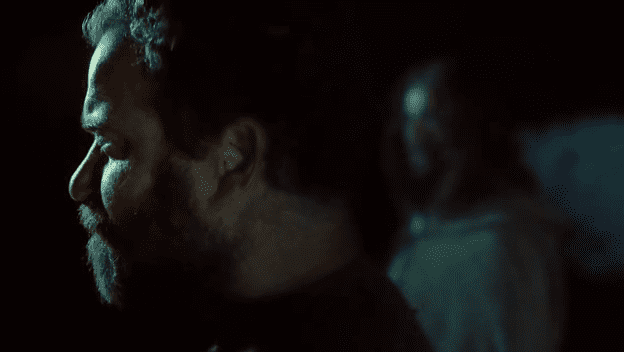
We also get a look at the back of the visitor in white’s head:
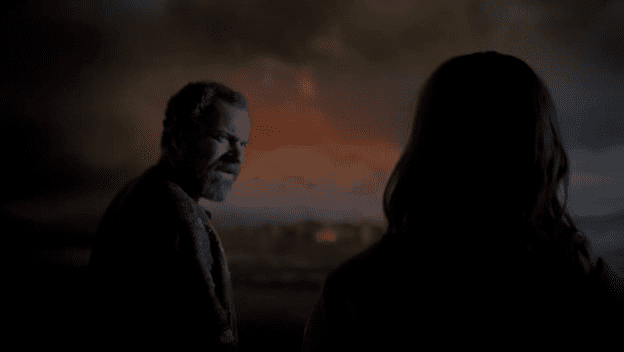
And then, as Abraham weeps over the fate of the city, the visitor in white turns to the side and walks out of the frame — which is a surprisingly prosaic (dare I say pedestrian?) way to handle his departure from the scene, given the cinematic finesse the mini-series had used when Sarah laughed a few minutes earlier, and given how the other films that we’re looking at here have handled this visitor’s departure:
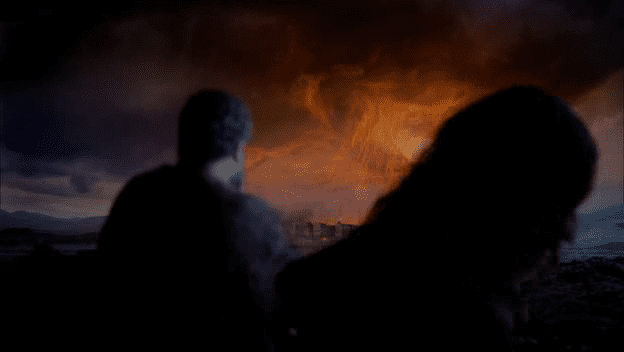
The idea that one of the visitors was Jesus himself is not original to this mini-series; Christians down through the years have speculated that Jesus may have appeared to people before the Incarnation, and that this may have been one of those occasions.
It is striking, though, to see Abraham weep over the fate of Sodom — possibly because it means losing contact with his nephew Lot more than for any other reason — while Jesus stands there and presides over the destruction of the city. How does this square with the weeping that Jesus does over other cities in the New Testament?
I can’t recall whether the New Testament section of the mini-series ever shows Jesus weeping over those other cities, but it certainly emphasizes his love and compassion — and so, in this as in other ways, the mini-series taps into the tension that exists between different parts of the Bible without necessarily finding a way to resolve that tension. (See also my comments on the “Israel! Israel! Israel!” scenes.)
In any case, as you can see here, there is a consistent thread running through filmed interpretations of this story from Genesis. The three visitors are all clearly at least angelic on some level, and one of them, it is strongly hinted, may be even more. How this is communicated varies from film to film, but the basic idea — that one of the visitors who predicted the birth of Isaac was also the God who discussed the fate of Sodom and Gomorrah with Abraham — seems to be pretty standard.
testament the bible in animation
Previous Post

November 4, 2013
Bible movie of the week: The Big Fisherman (1959)
Next Post
November 6, 2013 Peter O'Toole repeating himself in his 1960s films
Browse Our Archives
Select a Category Anglican Planet Articles BC Christian News BC Report Bible Movies Bible Review Blog Books & Culture Campus Times CBC Radio Christianity Today ChristianWeek Essays Faith Today Festival Cinemas Guide Film Journals Georgia Straight Interviews MB Herald National Catholic Register Salvationist Today's Christian Two Chairs Ubyssey Uncategorized Vancouver Courier Vancouver Sun
Select a Month August 2025 April 2025 January 2025 December 2024 November 2024 May 2024 February 2024 December 2023 May 2023 March 2023 November 2022 July 2022 June 2022 May 2022 April 2022 February 2022 January 2022 December 2021 November 2021 October 2021 September 2021 August 2021 July 2021 June 2021 April 2021 March 2021 February 2021 January 2021 December 2020 November 2020 October 2020 August 2020 July 2020 June 2020 May 2020 March 2020 February 2020 January 2020 December 2019 November 2019 September 2019 July 2019 May 2019 April 2019 March 2019 February 2019 January 2019 December 2018 November 2018 October 2018 September 2018 July 2018 June 2018 May 2018 April 2018 March 2018 February 2018 January 2018 December 2017 November 2017 October 2017 September 2017 August 2017 July 2017 June 2017 May 2017 April 2017 March 2017 February 2017 January 2017 December 2016 November 2016 October 2016 September 2016 August 2016 July 2016 June 2016 May 2016 April 2016 March 2016 February 2016 January 2016 December 2015 November 2015 October 2015 September 2015 August 2015 July 2015 June 2015 May 2015 April 2015 March 2015 February 2015 January 2015 December 2014 November 2014 October 2014 September 2014 August 2014 July 2014 June 2014 May 2014 April 2014 March 2014 February 2014 January 2014 December 2013 November 2013 October 2013 September 2013 August 2013 July 2013 June 2013 May 2013 April 2013 March 2013 February 2013 January 2013 December 2012 November 2012 October 2012 September 2012 August 2012 July 2012 June 2012 April 2012 January 2012 January 2011 December 2010 November 2010 October 2010 September 2010 August 2010 July 2010 June 2010 May 2010 April 2010 March 2010 February 2010 January 2010 December 2009 November 2009 October 2009 September 2009 August 2009 July 2009 June 2009 May 2009 April 2009 March 2009 February 2009 January 2009 December 2008 November 2008 October 2008 September 2008 August 2008 July 2008 June 2008 May 2008 April 2008 March 2008 February 2008 January 2008 December 2007 November 2007 October 2007 September 2007 August 2007 July 2007 June 2007 May 2007 April 2007 March 2007 February 2007 January 2007 December 2006 November 2006 October 2006 September 2006 August 2006 July 2006 June 2006 May 2006 April 2006 March 2006 February 2006 January 2006 December 2005 November 2005 October 2005 September 2005 August 2005 July 2005 June 2005 May 2005 April 2005 March 2005 January 2005 December 2004 November 2004 October 2004 September 2004 August 2004 July 2004 June 2004 May 2004 April 2004 March 2004 February 2004 January 2004 November 2003 October 2003 August 2003 July 2003 June 2003 May 2003 January 2003 December 2002 November 2002 August 2002 July 2002 June 2002 May 2002 March 2002 January 2002 December 2001 November 2001 September 2001 August 2001 July 2001 June 2001 April 2001 March 2001 February 2001 December 2000 November 2000 October 2000 September 2000 August 2000 July 2000 June 2000 May 2000 April 2000 March 2000 January 2000 October 1999 August 1999 May 1999 April 1999 February 1999 January 1999 December 1998 November 1998 October 1998 August 1998 July 1998 June 1998 April 1998 March 1998 January 1998 November 1997 September 1997 July 1997 June 1997 April 1997 March 1997 February 1997 January 1997 December 1996 October 1996 September 1996 June 1996 March 1996 February 1996 January 1996 April 1995 November 1994 September 1994 September 1991
Follow Us!
TAKE THE
Religious Wisdom Quiz
Which book of the Bible has a talking tree?
Select your answer to see how you score.
Proverbs Judges Ezekiel Genesis
Related posts from FilmChat

Joseph of Egypt – the Chosen spin-off announces...

Exclusive: A clip from Angel Studios' The King...

Exclusive: Watch a clip from Angel Studios' Brave...

Exclusive: Watch a clip from Angel Studios' Homestead
TRENDING AT PATHEOS Religious Music & Entertainment

"Les Diabolique" and Transgression
Alongside something like Arrival, Vertigo, or Charade, Les Diaboliques is a...

"The Plague Dogs" and Mortality
So, flashback to the late 70s, early 80s. Walt Disney Studios is...

With the recent and highly successful release of Christopher Nolan’s epic film,...

"L'avventura" and Human Weakness
Today's piece is going to be a little different for a few...

I first want to apologize for not posting or writing anything. I'm...

I've engaged in the multi-year project of reading through the Church Fathers,...
view all Religious Music & Entertainment blogs
Ad-Free & Subscriber Log-In Subscription Support
- About Us
- 2026 Calendar
- Videos
- Podcasts
- Library of World Religions
- Faith In Media Tracker
- Advertise With Us
- Write for Us
- Privacy Policy
- Terms of Service
- Do Not Sell My Data
- Contact Us
- Radiant Digital
- Manage Newsletter Subscriptions
- Unsubscribe From Notifications
- Sitemap
Copyright 2008-2026, Patheos. All rights reserved.
Subscription Support Ad-Free & Subscriber Log-In
Follow Patheos