
BuddhistCatholicContemplativeEvangelicalGeneral ChristianHinduJewishLatter-day SaintMuslimNew VisionsProgressive Christian
Beliefs
- Buddhist
- Catholic
- Contemplative
- Evangelical
- General Christian
- Hindu
- Jewish
- Latter-day Saint
- More Voices
- Muslim
- New Visions
- Pagan
- Progressive Christian
Topics
- Religion News
- Food and Religion
- Sports and Religion
- Religious Art
- Religious Music and Entertainment
- Religious Events
- History and Religion
- Style and Religion
- Politics and Religion
- Women in Religion
- Recreation Outdoors and Religion
- Business Finance and Religion
- Careers Workplace and Religion
- Education and Religion
- Family Parenting and Religion
- Health Fitness and Religion
- Home and Religion
- Relationships and Religion
- Technology and Religion
- Travel and Religion
Columnists
- Buddhist Columnists
- Business Finance and Religion Columnists
- Careers Workplace and Religion Columnists
- Catholic Columnists
- Contemplative Columnists
- Education and Religion Columnists
- Evangelists Columnists
- Family Parenting and Religion Columnists
- General Christian Columnists
- Health Fitness and Religion Columnists
- Hindu Columnists
- History and Religion Columnists
- Home and Religion Columnists
- Jewish Columnists
- More Voices Columnists
- Latter Day Columnists
- Muslim Columnists
- New Visions Columnists
- Nonreligious Columnists
- Pagan Columnists
- Politics and Religion Columnists
- Progressive Columnists
- Recreation Outdoors and Religion Columnists
- Relationships and Religion Columnists
- Religion News Columnists
- Religious Art Columnists
- Religious Events Columnists
- Religious Music and Entertainment Columnists
- Sports and Religion Columnists
- Style and Religion Columnists
- Technology and Religion Columnists
- Travel and Religion Columnists
- Women in Religion Columnists
Resource Library
- 2026 Calendar
- Library of World Religions
- The 100 Most Holy Places on Earth
- Patheos Answers
- Podcasts
- Videos
- Faith Leaders Database
- Anglican Episcopalian
- Bahai
- Baptist
- Buddhism
- Christianity
- Confucianism
- Eastern Orthodoxy
- Hinduism
- Holiness and Pentecostal
- ISKCON
- Islam
- Judaism
- Lutheran
- Methodist
- The Church of Jesus Christ of Latter-day Saints
- New Age
- Paganism
- Presbytarian and Reformed
- Protestantism
- Religion Behind the Scenes
- Roman Catholic
- Scientology
- Shia Islam
- Sikhism
- Sufism
- Sunni Islam
- Taoism
- Zen
- See all religions
Research Tools
 Ad-Free & Subscriber Log-In Subscription Support
Ad-Free & Subscriber Log-In Subscription Support
Follow Patheos 

- Trending:
- Forgiveness
- |
- Marriage
- |
- Consciousness
- |
- Death Penalty
- |
- Election
- |
- Halloween

-
Articles
- Home
- Religious Music & Entertainment
- After Earth isn’t great, but it’s not that bad, honestly.
After Earth isn’t great, but it’s not that bad, honestly.
Last updated on: May 31, 2013 at 9:56 pm by Peter T. Chattaway
After Earth isn’t great, but it’s not that bad, honestly. 2013-05-31T21:56:54-07:00 Peter T. Chattaway
Patheos Explore the world's faith through different perspectives on religion and spirituality! Patheos has the views of the prevalent religions and spiritualities of the world.
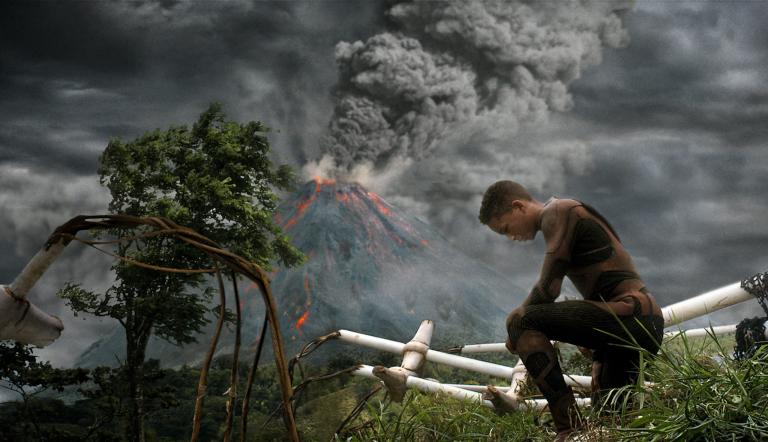 The performances in M. Night Shyamalan’s films have often had a stilted, solemn quality, and Will Smith’s performance in After Earth is no exception. There are a couple reasons for the woodenness this time, though.
First, the story is set in the distant future, a thousand years after humanity has fled the Earth — more on that in a moment — and it stands to reason that speech patterns might have changed in the interim. Indeed, according to co-writer Gary Whitta, the filmmakers “worked with a dialect coach to come up with an original accent, because the idea of the characters speaking with an American accent or a British accent one thousand years in the future, after you’ve left Earth, would seem kind of preposterous.”
One could also note, in response to Whitta’s argument, that it’s kind of preposterous that the language would have stayed the same for a thousand years — have you tried reading Shakespeare (400+ years ago) or Chaucer (600+ years ago) lately? — but still, the basic idea behind the accent is both plausible and interesting, and contributes to the sense that this film is taking place in another time, another place.
Indeed, if memory serves, the dialogue broke its spell only once, for me, when Will’s son Jaden — who has had to trek across hostile terrain ever since he and his father crash-landed on our planet — remarks in a particularly stressed-out moment that his situation “sucks”. That felt a tad too colloquial, though I could accept even that, on some level, as a sign of the awkwardness that the Jaden Smith character feels as he endures the series of physical trials that mark his coming of age.
The second reason for Will Smith’s sombre performance is the fact that his character is one of the elite in his society — a “ranger” who has mastered the art of feeling no fear when confronted by a certain alien monster that is blind but can follow people based on the pheromones they secrete when they are afraid. Will Smith has mastered the art of self-control to a fault, and wants his son to master it too, and if he seems a bit stiff and lacking in charisma as a result, then, well, so be it.
From a celebrity-politics point of view, there is a fair bit riding on After Earth. For one thing, it brings together two artists who have become renowned for their egos.
Will Smith’s last non-sequel, Seven Pounds, was critically lambasted for bearing traces of a “messiah complex” on Smith’s part, and he has since been mocked for revealing that he turned down the title role in Django Unchained because Quentin Tarantino wouldn’t make it more heroic just for him.
Similarly, Shyamalan is still smarting from the critical drubbing he got three movies ago, when he cast himself as not a messiah itself, per se, but a future messiah’s inspiration in The Lady in the Water. Shyamalan’s subsequent films have done okay at the box office, but the critics have kept right on slamming them — and that includes After Earth, which has a 13% Rotten Tomatoes rating as I write this.
The thing is, After Earth really isn’t all that bad. It’s not great, either, but I’d say it’s Shyamalan’s best film since the Bruce Willis days, and it actually has a number of things going for it, not the least of which is its relative modesty.
Emphasis on “relative”. The film does begin with the entire planet being depopulated, after all, which is a somewhat grandiose conceit — and all the more so because the film, after giving us real-world footage of environmental devastation, ignores both the messy politics that would accompany any evacuation scheme (where are the oppressive class structures of Elysium, or the rebels of Oblivion?) and the damage that these same humans would undoubtedly do to whatever planet they colonize in this one’s place. As far as the movie’s concerned, the world that awaits us after we leave this planet will be one in which technology does only good, not harm.
Even stranger, although we are told that humanity had to leave the Earth because it had become uninhabitable, the lifeforms that we see once the Smiths crash-land on our planet seem to be thriving rather well. They have certainly changed since humanity left the planet, but not that much, and certainly none of the plants or animals we see look like they are suffering all that much.
(Incidentally, the English language doesn’t change after a thousand years, but the plants and animals of this world do? Really? I suppose we could blame their accelerated evolution on all that human pollution, but still…)
But I digress. My point here is that, even within these grand premises, the film itself is actually a fairly small and personal affair — and that is all to the film’s credit.
For one thing, the film avoids some of the clichés endemic to this genre: there are no shots of ruined landmarks, for example. (Why should spaceships always crash-land near major urban centres?) And the score, by Shyamalan regular James Newton Howard, has a tender quality that emphasizes the father-son relationship as much as the interplanetary goings-on.
I also rather liked the production design, from the landscape behind Jaden’s early jog with his classmates, complete with nearby planet or large moon looming on the horizon, to the seemingly organic curvature of the floors and walls within the spaceship before it crashes; in this and other details, After Earth gives us a vision of the future that is just different enough from what we’ve seen before to be kind of interesting.
I also didn’t mind the frequent medical asides. (Shyamalan’s parents are doctors, and he has played doctors of one sort or another in a couple of his films.) As Jaden Smith makes his trek across jungles and rivers, looking for the other half of the crashed spaceship and the beacon inside that will summon the rescuers, Will Smith sits in his half of the crashed spaceship and takes care of his two broken legs — and the medical advice he receives from the medical computers seems reasonably well-informed.
A few plot points did puzzle me. There’s a bird that seems to attack Jaden as he swoops down a cliff in his wingsuit, but what the bird wants to do with Jaden is not particularly clear — especially in light of what happens after the attack. And the moment when Jaden finally confronts the alien monster — the moment when he finally mans up, as you know he must — seemed a little abrupt, to me.
I suppose I could also quibble with the film’s insistence that “fear is a choice”, which some critics have speculated might be some sort of latent Scientologist message. I have long taken the view that we cannot control our feelings, only our actions, and to the extent that the film suggests it is possible not to feel fear in the first place, I don’t buy into that message. Indeed, it is only because we feel fear that any of our actions can be considered brave. But self-control? I can certainly get behind that message, at least to a point. So I’m not going to quibble too much with that, here.
So, the film’s certainly not perfect, but it’s certainly not the disaster that some critics have made it out to be. (How Joe Morgenstern can call this “the worst movie ever made” when it isn’t even the worst Shyamalan movie ever made is beyond me.) And in a summer that has already seen such overblown, incoherent (and overpraised!) messes as Iron Man 3 and Star Trek into Darkness, it boggles the mind that something as merely mediocre as this would get trashed so thoroughly.
Previous Post

May 29, 2013
Bible movie of the week: Samson and Delilah (1949)
Next Post
June 4, 2013 Making Superman, Jesus and other iconic figures "relatable"
Browse Our Archives
Select a Category Anglican Planet Articles BC Christian News BC Report Bible Movies Bible Review Blog Books & Culture Campus Times CBC Radio Christianity Today ChristianWeek Essays Faith Today Festival Cinemas Guide Film Journals Georgia Straight Interviews MB Herald National Catholic Register Salvationist Today's Christian Two Chairs Ubyssey Uncategorized Vancouver Courier Vancouver Sun
Select a Month August 2025 April 2025 January 2025 December 2024 November 2024 May 2024 February 2024 December 2023 May 2023 March 2023 November 2022 July 2022 June 2022 May 2022 April 2022 February 2022 January 2022 December 2021 November 2021 October 2021 September 2021 August 2021 July 2021 June 2021 April 2021 March 2021 February 2021 January 2021 December 2020 November 2020 October 2020 August 2020 July 2020 June 2020 May 2020 March 2020 February 2020 January 2020 December 2019 November 2019 September 2019 July 2019 May 2019 April 2019 March 2019 February 2019 January 2019 December 2018 November 2018 October 2018 September 2018 July 2018 June 2018 May 2018 April 2018 March 2018 February 2018 January 2018 December 2017 November 2017 October 2017 September 2017 August 2017 July 2017 June 2017 May 2017 April 2017 March 2017 February 2017 January 2017 December 2016 November 2016 October 2016 September 2016 August 2016 July 2016 June 2016 May 2016 April 2016 March 2016 February 2016 January 2016 December 2015 November 2015 October 2015 September 2015 August 2015 July 2015 June 2015 May 2015 April 2015 March 2015 February 2015 January 2015 December 2014 November 2014 October 2014 September 2014 August 2014 July 2014 June 2014 May 2014 April 2014 March 2014 February 2014 January 2014 December 2013 November 2013 October 2013 September 2013 August 2013 July 2013 June 2013 May 2013 April 2013 March 2013 February 2013 January 2013 December 2012 November 2012 October 2012 September 2012 August 2012 July 2012 June 2012 April 2012 January 2012 January 2011 December 2010 November 2010 October 2010 September 2010 August 2010 July 2010 June 2010 May 2010 April 2010 March 2010 February 2010 January 2010 December 2009 November 2009 October 2009 September 2009 August 2009 July 2009 June 2009 May 2009 April 2009 March 2009 February 2009 January 2009 December 2008 November 2008 October 2008 September 2008 August 2008 July 2008 June 2008 May 2008 April 2008 March 2008 February 2008 January 2008 December 2007 November 2007 October 2007 September 2007 August 2007 July 2007 June 2007 May 2007 April 2007 March 2007 February 2007 January 2007 December 2006 November 2006 October 2006 September 2006 August 2006 July 2006 June 2006 May 2006 April 2006 March 2006 February 2006 January 2006 December 2005 November 2005 October 2005 September 2005 August 2005 July 2005 June 2005 May 2005 April 2005 March 2005 January 2005 December 2004 November 2004 October 2004 September 2004 August 2004 July 2004 June 2004 May 2004 April 2004 March 2004 February 2004 January 2004 November 2003 October 2003 August 2003 July 2003 June 2003 May 2003 January 2003 December 2002 November 2002 August 2002 July 2002 June 2002 May 2002 March 2002 January 2002 December 2001 November 2001 September 2001 August 2001 July 2001 June 2001 April 2001 March 2001 February 2001 December 2000 November 2000 October 2000 September 2000 August 2000 July 2000 June 2000 May 2000 April 2000 March 2000 January 2000 October 1999 August 1999 May 1999 April 1999 February 1999 January 1999 December 1998 November 1998 October 1998 August 1998 July 1998 June 1998 April 1998 March 1998 January 1998 November 1997 September 1997 July 1997 June 1997 April 1997 March 1997 February 1997 January 1997 December 1996 October 1996 September 1996 June 1996 March 1996 February 1996 January 1996 April 1995 November 1994 September 1994 September 1991
Follow Us!
TAKE THE
Religious Wisdom Quiz
Who was the mother of John Mark, whose house was a place of prayer in Jerusalem?
Select your answer to see how you score.
Priscilla Tabitha Mary Lydia
Related posts from FilmChat

Joseph of Egypt – the Chosen spin-off announces...

Exclusive: A clip from Angel Studios' The King...

Exclusive: Watch a clip from Angel Studios' Brave...

Exclusive: Watch a clip from Angel Studios' Homestead
TRENDING AT PATHEOS Religious Music & Entertainment

"Les Diabolique" and Transgression
Alongside something like Arrival, Vertigo, or Charade, Les Diaboliques is a...

"The Plague Dogs" and Mortality
So, flashback to the late 70s, early 80s. Walt Disney Studios is...

With the recent and highly successful release of Christopher Nolan’s epic film,...

"L'avventura" and Human Weakness
Today's piece is going to be a little different for a few...

I first want to apologize for not posting or writing anything. I'm...

I've engaged in the multi-year project of reading through the Church Fathers,...
view all Religious Music & Entertainment blogs
Ad-Free & Subscriber Log-In Subscription Support
- About Us
- 2026 Calendar
- Videos
- Podcasts
- Library of World Religions
- Faith In Media Tracker
- Advertise With Us
- Write for Us
- Privacy Policy
- Terms of Service
- Do Not Sell My Data
- Contact Us
- Radiant Digital
- Manage Newsletter Subscriptions
- Unsubscribe From Notifications
- Sitemap
Copyright 2008-2026, Patheos. All rights reserved.
Subscription Support Ad-Free & Subscriber Log-In
Follow Patheos