
BuddhistCatholicContemplativeEvangelicalGeneral ChristianHinduJewishLatter-day SaintMuslimNew VisionsProgressive Christian
Beliefs
- Buddhist
- Catholic
- Contemplative
- Evangelical
- General Christian
- Hindu
- Jewish
- Latter-day Saint
- More Voices
- Muslim
- New Visions
- Pagan
- Progressive Christian
Topics
- Religion News
- Food and Religion
- Sports and Religion
- Religious Art
- Religious Music and Entertainment
- Religious Events
- History and Religion
- Style and Religion
- Politics and Religion
- Women in Religion
- Recreation Outdoors and Religion
- Business Finance and Religion
- Careers Workplace and Religion
- Education and Religion
- Family Parenting and Religion
- Health Fitness and Religion
- Home and Religion
- Relationships and Religion
- Technology and Religion
- Travel and Religion
Columnists
- Buddhist Columnists
- Business Finance and Religion Columnists
- Careers Workplace and Religion Columnists
- Catholic Columnists
- Contemplative Columnists
- Education and Religion Columnists
- Evangelists Columnists
- Family Parenting and Religion Columnists
- General Christian Columnists
- Health Fitness and Religion Columnists
- Hindu Columnists
- History and Religion Columnists
- Home and Religion Columnists
- Jewish Columnists
- More Voices Columnists
- Latter Day Columnists
- Muslim Columnists
- New Visions Columnists
- Nonreligious Columnists
- Pagan Columnists
- Politics and Religion Columnists
- Progressive Columnists
- Recreation Outdoors and Religion Columnists
- Relationships and Religion Columnists
- Religion News Columnists
- Religious Art Columnists
- Religious Events Columnists
- Religious Music and Entertainment Columnists
- Sports and Religion Columnists
- Style and Religion Columnists
- Technology and Religion Columnists
- Travel and Religion Columnists
- Women in Religion Columnists
Resource Library
- 2026 Calendar
- Library of World Religions
- The 100 Most Holy Places on Earth
- Patheos Answers
- Podcasts
- Videos
- Faith Leaders Database
- Anglican Episcopalian
- Bahai
- Baptist
- Buddhism
- Christianity
- Confucianism
- Eastern Orthodoxy
- Hinduism
- Holiness and Pentecostal
- ISKCON
- Islam
- Judaism
- Lutheran
- Methodist
- The Church of Jesus Christ of Latter-day Saints
- New Age
- Paganism
- Presbytarian and Reformed
- Protestantism
- Religion Behind the Scenes
- Roman Catholic
- Scientology
- Shia Islam
- Sikhism
- Sufism
- Sunni Islam
- Taoism
- Zen
- See all religions
Research Tools
 Ad-Free & Subscriber Log-In Subscription Support
Ad-Free & Subscriber Log-In Subscription Support
Follow Patheos 

- Trending:
- Forgiveness
- |
- Marriage
- |
- Consciousness
- |
- Death Penalty
- |
- Election
- |
- Halloween

-
Articles
- Home
- Religious Music & Entertainment
- The naked Christ in film: birth, death and resurrection
The naked Christ in film: birth, death and resurrection
Last updated on: December 22, 2015 at 4:50 pm by Peter T. Chattaway
The naked Christ in film: birth, death and resurrection 2015-12-22T16:50:38-08:00 Peter T. Chattaway
Patheos Explore the world's faith through different perspectives on religion and spirituality! Patheos has the views of the prevalent religions and spiritualities of the world.
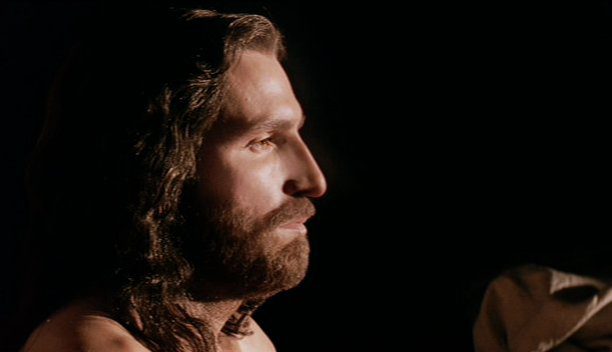 “The Word became flesh,” according to John 1:14, but that flesh has been hidden, for the most part, in movie portrayals of Jesus. At certain key points in his life, history and even tradition would dictate that Jesus ought to be depicted nude — and there are good theological reasons for doing so. But most films have tended to shy away from nudity in their own portrayals of those parts of the Jesus story.
There are some obvious reasons for this reticence, of course, starting with the fact that film, for much of its history, has been forced to skirt around images of nudity in general, and images of male nudity in particular. Plus, when a film does show someone’s nudity, it does not merely show us the character’s nudity; it shows us the actor’s nudity as well, and the knowledge that we are seeing an actor’s naked body can sometimes distract us from the character he is playing. This is especially true when the character is meant to be an embodiment of divinity like Jesus.
There have been at least three significant exceptions, though — three films that each depict the nudity of Jesus at a different key point in his story.
First, The Nativity Story (2006) shows Joseph holding the naked baby Jesus up in the air immediately after the child is born:
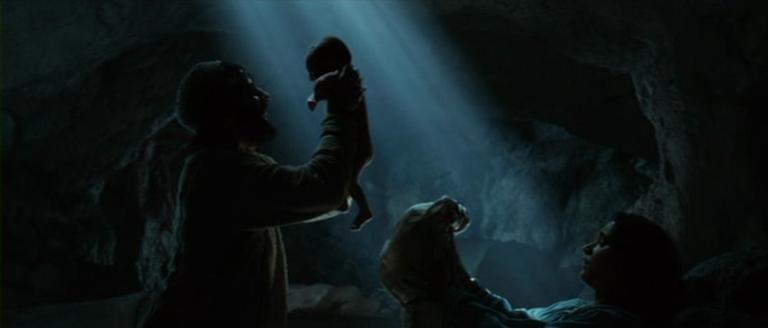
There is actually another shot before this one, which gives us an even clearer look at the baby’s naked backside, but I’d rather not post it here. I will note, though, that the nudity here underscores the fact that God, in Jesus, has become both human and vulnerable — and that this film makes a point of showing not only the baby himself but a bit of the muck that you typically get on a baby when it has just been born. (Someone who saw an unfinished rough cut of the film once told me that there was originally less muck on the baby, so some of it might have been added digitally.)
In this film, the baby is shown in all its messy nakedness for more or less the same reason the filmmakers made a point of casting actors of a certain ethnicity or showing the details of everyday life in a first-century village; it’s all part of a general effort to be “realistic”. But the “realism” of this scene only goes so far. While this film, like a few others, does show Mary experiencing labour pains, it does not show Joseph or anyone else cutting an umbilical cord; the baby seems to have come out of the womb untethered. Even more interestingly, there is a point during the delivery of Jesus when the film suddenly fades to white. Details like these, intentionally or not, seem to hark back to a tradition that is at least as old as the 2nd-century Infancy Gospel of James, which holds that “a great light appeared in the cave so that their eyes could not bear it. And a little while later the same light withdrew until an infant appeared.”
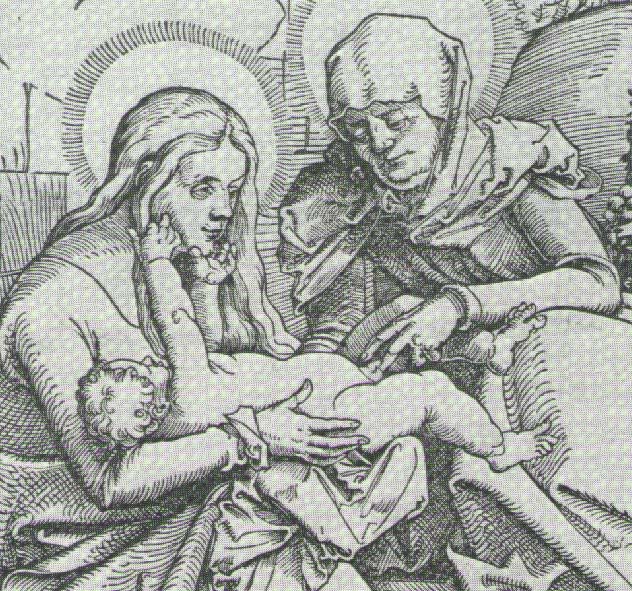 Be all that as it may, the main point here is that The Nativity Story does, in fact, show the baby Jesus naked, and it is the only film I can think of right now that does this. In other artforms, however, especially in the west, there is a long tradition of showing the infant naked — and of even drawing our attention to his genitalia — as a way of showing that God has become human. See, e.g., the detail here from Hans Baldung Grien’s Holy Family (1511). Leo Steinberg documented this pattern extensively in The Sexuality of Christ in Renaissance Art and in Modern Oblivion, where he noted that “the sex of the newborn is a demonstrative sign” which verifies “the humanation of God”.
The Nativity Story doesn’t go so far as to draw our attention to the genitalia of the Christ child — they’re actually obscured throughout the scene, which limits our vision to his back and side — but, believe it or not, I can think of one film that does draw our attention to them, though it does so without nudity. Specifically, I am thinking of Franco Zeffirelli’s Jesus of Nazareth (1977), which is the only film I can think of that devotes a significant bit of screen time to the circumcision of Christ:
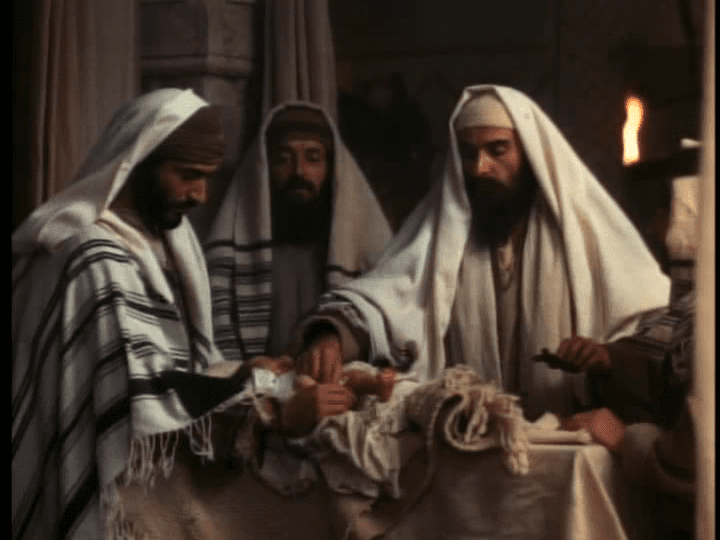
The circumcision of Jesus is mentioned briefly in Luke 2, and it has its own feast day on the Christian liturgical calendar, but it is virtually ignored in Jesus films — even The Nativity Story omits it — and on the rare occasion that a film does include it, as in Jesus (1979), it merits little more than a quick mention by the narrator.
Zeffirelli’s film, on the other hand, pays significant attention to the Jewish customs within which Jesus was born and raised; the man who is about to perform the circumcision even declares that “this is the seal in flesh of the covenant between the Lord and his people.” So even if the film does not show any flesh during this scene, it certainly encourages us to think about the flesh, and what it means.
As shown in this film, the moment of Jesus’ circumcision — the moment when the baby Jesus cries — is also what catches the attention of Simeon, the old man who was told by God that he would not die until he had seen the Messiah. In Luke’s gospel, Simeon speaks to Joseph and Mary on a separate occasion, when they go to perform the purification rites required 33 days after the circumcision, as per Leviticus 12. But Zeffirelli conflates the two episodes, so that Simeon hears the child cry and then approaches the table, where he directs our attention to the child once more:

The second episode from Jesus’ life that warrants depicting him in the nude is the Crucifixion, and the one film I can think of that actually does this — as I mentioned in my recent post on depictions of the Cross — is The Last Temptation of Christ (1988):
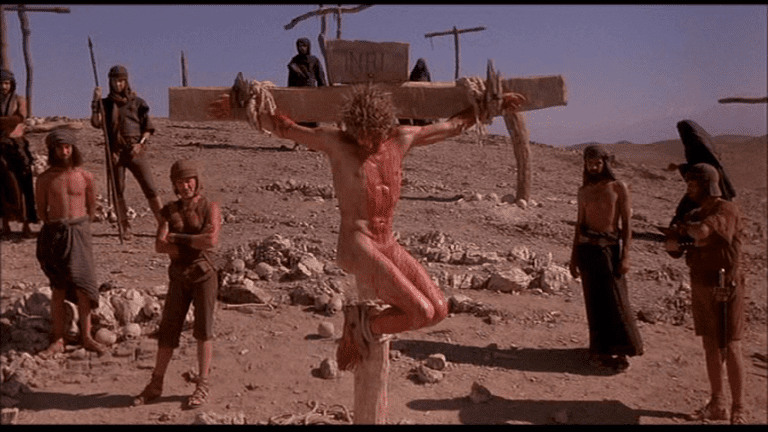
This film features quite a bit of nudity, of course — some of it male, some of it female — so it is not surprising that it turns up here, too. Jesus appears nude in one earlier scene, as well, when the Roman soldiers beat him in prison. Scenes like these are remarkable because nearly every other depiction of Jesus in film lets him wear at least a loincloth at this point in his story. And yet, early Christian tradition tells us that Jesus was crucified naked. St. Cyril of Jerusalem — who may have witnessed crucifixion himself, since he was already in his 20s when the emperor Constantine abolished the practice — wrote in his Catechetical Lectures that early Christians, who were baptized in the nude, did so partly to identify with Christ in his death.
 Director Martin Scorsese claims in an opening title card that The Last Temptation of Christ is based on a work of fiction, with no direct ties to the Jesus of history or the gospels, but he strove for historical accuracy in this one area, at least, and he based his depiction of the crucifixion of Jesus (but not the crucifixion of the thieves) on an illustration that was first published in the Israel Exploration Journal in 1970. Two years earlier, archaeologists had discovered the bones of a crucified man named Yehohanan, and osteologists were able to reconstruct Yehohanan’s position on the cross by studying his wounds — and as you can see, the artist who drew the accompanying picture assumed that Yehohanan was naked when he was crucified, too.
Finally, there is the Resurrection. Most of the films that do depict it in some way usually show Jesus wearing a robe, not unlike the robes he wore earlier in the film, or not unlike the glowing white robes that the angels might wear. But one striking exception to this is Mel Gibson’s The Passion of the Christ (2004).
In this film, the camera moves across the tomb before settling on a tight close-up of Jesus, who has apparently been resurrected in a sort of crouching position. We can see right away that his shoulders are bare. Then his eyes open, and he stands up, and we get a quick but clear glimpse of his naked thigh through the hole in his hand:

A split-second later, he begins to walk, and although our glimpse of the back of his thigh is blurred, we get the distinct, if brief, impression that Jesus might not be wearing anything at this point in the story — not even a loincloth:
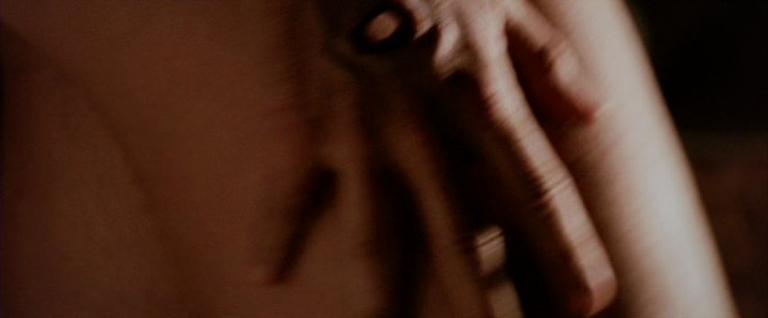
Note: It would not matter for our purposes if the actor was actually wearing something on the set that day. What matters is the image — and it seems that Gibson, after following all the artistic conventions that show Jesus wearing a loincloth on the cross, decided to suggest that Jesus might not be so adorned in his life after death.
 Again, there’s a theological reason for this. As Steinberg notes, artists like Michelangelo sometimes depicted the resurrected Jesus fully nude — a fact that later curators have sometimes tried to cover up, as you can see from the picture to the right — and the reason for this nudity is that the resurrected Jesus has restored humanity to the innocence that Adam and Eve once enjoyed before the Fall: “How then could he who restores human nature to sinlessness be shamed by the sexual factor in his humanity?”
This link between the innocence of Adam and the nudity of the resurrected Christ is echoed in the baptismal practices of the early Church. As noted above, converts were baptized in the nude back then, and St. Cyril of Jerusalem says they did this in imitation of Christ’s death; but he also says that they were baptized nude in imitation of “the first-formed Adam, who was naked in the garden, and was not ashamed.” Similarly, St. John Chrysostom, in his Baptismal Instructions, told the early Christians that they were baptized naked to “remind you of your former nakedness, when you were in paradise and you were not ashamed.”
All this talk of baptism raises an interesting point that I hadn’t considered when I started writing this blog post. Early Christians were baptized in the nude, and you can find some very old depictions of the baptism of Jesus in which he, too, is nude — but I can’t think of any films that have depicted his baptism this way. Even in The Last Temptation of Christ, which imagines that John the Baptist was surrounded by naked and half-naked people chanting and swaying and cutting themselves, Jesus keeps his loincloth on when he kneels in the water and asks John to baptize him.

In any case, it is intriguing to think that Christian baptism once incorporated the key paradox of nudity: It can sometimes be used to shame people, as the Roman soldiers tried to shame their victims, but it can also be used to express a kind of purity for which no one needs to be ashamed of anything. And just as genitalia reflect the animal side of human nature, and are thus typically thought to be “lower” than the things which make us spiritual, the fact that God became man and redeemed humanity is expressed most potently in the fact that, yes, he now has genitals too.
The four films I’ve cited here are too discreet to depict the actual genitalia — which is only fitting, as that would draw our attention to the actors as much as it would to the character that they are playing. But in showing Jesus’ nudity the way they do, they encourage us to think about this aspect of the mystery that is the Incarnation.
Previous Post

April 22, 2013
The Bible to get shorter running time, bigger screens
Next Post
April 25, 2013 James T. Kirk and the mind-body-spirit relationship
Browse Our Archives
Select a Category Anglican Planet Articles BC Christian News BC Report Bible Movies Bible Review Blog Books & Culture Campus Times CBC Radio Christianity Today ChristianWeek Essays Faith Today Festival Cinemas Guide Film Journals Georgia Straight Interviews MB Herald National Catholic Register Salvationist Today's Christian Two Chairs Ubyssey Uncategorized Vancouver Courier Vancouver Sun
Select a Month August 2025 April 2025 January 2025 December 2024 November 2024 May 2024 February 2024 December 2023 May 2023 March 2023 November 2022 July 2022 June 2022 May 2022 April 2022 February 2022 January 2022 December 2021 November 2021 October 2021 September 2021 August 2021 July 2021 June 2021 April 2021 March 2021 February 2021 January 2021 December 2020 November 2020 October 2020 August 2020 July 2020 June 2020 May 2020 March 2020 February 2020 January 2020 December 2019 November 2019 September 2019 July 2019 May 2019 April 2019 March 2019 February 2019 January 2019 December 2018 November 2018 October 2018 September 2018 July 2018 June 2018 May 2018 April 2018 March 2018 February 2018 January 2018 December 2017 November 2017 October 2017 September 2017 August 2017 July 2017 June 2017 May 2017 April 2017 March 2017 February 2017 January 2017 December 2016 November 2016 October 2016 September 2016 August 2016 July 2016 June 2016 May 2016 April 2016 March 2016 February 2016 January 2016 December 2015 November 2015 October 2015 September 2015 August 2015 July 2015 June 2015 May 2015 April 2015 March 2015 February 2015 January 2015 December 2014 November 2014 October 2014 September 2014 August 2014 July 2014 June 2014 May 2014 April 2014 March 2014 February 2014 January 2014 December 2013 November 2013 October 2013 September 2013 August 2013 July 2013 June 2013 May 2013 April 2013 March 2013 February 2013 January 2013 December 2012 November 2012 October 2012 September 2012 August 2012 July 2012 June 2012 April 2012 January 2012 January 2011 December 2010 November 2010 October 2010 September 2010 August 2010 July 2010 June 2010 May 2010 April 2010 March 2010 February 2010 January 2010 December 2009 November 2009 October 2009 September 2009 August 2009 July 2009 June 2009 May 2009 April 2009 March 2009 February 2009 January 2009 December 2008 November 2008 October 2008 September 2008 August 2008 July 2008 June 2008 May 2008 April 2008 March 2008 February 2008 January 2008 December 2007 November 2007 October 2007 September 2007 August 2007 July 2007 June 2007 May 2007 April 2007 March 2007 February 2007 January 2007 December 2006 November 2006 October 2006 September 2006 August 2006 July 2006 June 2006 May 2006 April 2006 March 2006 February 2006 January 2006 December 2005 November 2005 October 2005 September 2005 August 2005 July 2005 June 2005 May 2005 April 2005 March 2005 January 2005 December 2004 November 2004 October 2004 September 2004 August 2004 July 2004 June 2004 May 2004 April 2004 March 2004 February 2004 January 2004 November 2003 October 2003 August 2003 July 2003 June 2003 May 2003 January 2003 December 2002 November 2002 August 2002 July 2002 June 2002 May 2002 March 2002 January 2002 December 2001 November 2001 September 2001 August 2001 July 2001 June 2001 April 2001 March 2001 February 2001 December 2000 November 2000 October 2000 September 2000 August 2000 July 2000 June 2000 May 2000 April 2000 March 2000 January 2000 October 1999 August 1999 May 1999 April 1999 February 1999 January 1999 December 1998 November 1998 October 1998 August 1998 July 1998 June 1998 April 1998 March 1998 January 1998 November 1997 September 1997 July 1997 June 1997 April 1997 March 1997 February 1997 January 1997 December 1996 October 1996 September 1996 June 1996 March 1996 February 1996 January 1996 April 1995 November 1994 September 1994 September 1991
Follow Us!
TAKE THE
Religious Wisdom Quiz
What does Paul say godliness with what is great gain?
Select your answer to see how you score.
Prayer Faith Contentment Love
Related posts from FilmChat

Joseph of Egypt – the Chosen spin-off announces...

Exclusive: A clip from Angel Studios' The King...

Exclusive: Watch a clip from Angel Studios' Brave...

Exclusive: Watch a clip from Angel Studios' Homestead
TRENDING AT PATHEOS Religious Music & Entertainment

"Les Diabolique" and Transgression
Alongside something like Arrival, Vertigo, or Charade, Les Diaboliques is a...

"The Plague Dogs" and Mortality
So, flashback to the late 70s, early 80s. Walt Disney Studios is...

With the recent and highly successful release of Christopher Nolan’s epic film,...

"L'avventura" and Human Weakness
Today's piece is going to be a little different for a few...

I first want to apologize for not posting or writing anything. I'm...

I've engaged in the multi-year project of reading through the Church Fathers,...
view all Religious Music & Entertainment blogs
Ad-Free & Subscriber Log-In Subscription Support
- About Us
- 2026 Calendar
- Videos
- Podcasts
- Library of World Religions
- Faith In Media Tracker
- Advertise With Us
- Write for Us
- Privacy Policy
- Terms of Service
- Do Not Sell My Data
- Contact Us
- Radiant Digital
- Manage Newsletter Subscriptions
- Unsubscribe From Notifications
- Sitemap
Copyright 2008-2026, Patheos. All rights reserved.
Subscription Support Ad-Free & Subscriber Log-In
Follow Patheos