
BuddhistCatholicContemplativeEvangelicalGeneral ChristianHinduJewishLatter-day SaintMuslimNew VisionsProgressive Christian
Beliefs
- Buddhist
- Catholic
- Contemplative
- Evangelical
- General Christian
- Hindu
- Jewish
- Latter-day Saint
- More Voices
- Muslim
- New Visions
- Pagan
- Progressive Christian
Topics
- Religion News
- Food and Religion
- Sports and Religion
- Religious Art
- Religious Music and Entertainment
- Religious Events
- History and Religion
- Style and Religion
- Politics and Religion
- Women in Religion
- Recreation Outdoors and Religion
- Business Finance and Religion
- Careers Workplace and Religion
- Education and Religion
- Family Parenting and Religion
- Health Fitness and Religion
- Home and Religion
- Relationships and Religion
- Technology and Religion
- Travel and Religion
Columnists
- Buddhist Columnists
- Business Finance and Religion Columnists
- Careers Workplace and Religion Columnists
- Catholic Columnists
- Contemplative Columnists
- Education and Religion Columnists
- Evangelists Columnists
- Family Parenting and Religion Columnists
- General Christian Columnists
- Health Fitness and Religion Columnists
- Hindu Columnists
- History and Religion Columnists
- Home and Religion Columnists
- Jewish Columnists
- More Voices Columnists
- Latter Day Columnists
- Muslim Columnists
- New Visions Columnists
- Nonreligious Columnists
- Pagan Columnists
- Politics and Religion Columnists
- Progressive Columnists
- Recreation Outdoors and Religion Columnists
- Relationships and Religion Columnists
- Religion News Columnists
- Religious Art Columnists
- Religious Events Columnists
- Religious Music and Entertainment Columnists
- Sports and Religion Columnists
- Style and Religion Columnists
- Technology and Religion Columnists
- Travel and Religion Columnists
- Women in Religion Columnists
Resource Library
- 2026 Calendar
- Library of World Religions
- The 100 Most Holy Places on Earth
- Patheos Answers
- Podcasts
- Videos
- Faith Leaders Database
- Anglican Episcopalian
- Bahai
- Baptist
- Buddhism
- Christianity
- Confucianism
- Eastern Orthodoxy
- Hinduism
- Holiness and Pentecostal
- ISKCON
- Islam
- Judaism
- Lutheran
- Methodist
- The Church of Jesus Christ of Latter-day Saints
- New Age
- Paganism
- Presbytarian and Reformed
- Protestantism
- Religion Behind the Scenes
- Roman Catholic
- Scientology
- Shia Islam
- Sikhism
- Sufism
- Sunni Islam
- Taoism
- Zen
- See all religions
Research Tools
 Ad-Free & Subscriber Log-In Subscription Support
Ad-Free & Subscriber Log-In Subscription Support
Follow Patheos 

- Trending:
- Forgiveness
- |
- Marriage
- |
- Consciousness
- |
- Death Penalty
- |
- Election
- |
- Halloween

-
Articles
- Home
- Religious Music & Entertainment
- The Bible / What works and what doesn’t in the ambitious mini-series
The Bible / What works and what doesn’t in the ambitious mini-series
Last updated on: November 28, 2013 at 9:44 am by Peter T. Chattaway
The Bible / What works and what doesn’t in the ambitious mini-series 2013-11-28T09:44:22-08:00 Peter T. Chattaway
Patheos Explore the world's faith through different perspectives on religion and spirituality! Patheos has the views of the prevalent religions and spiritualities of the world.
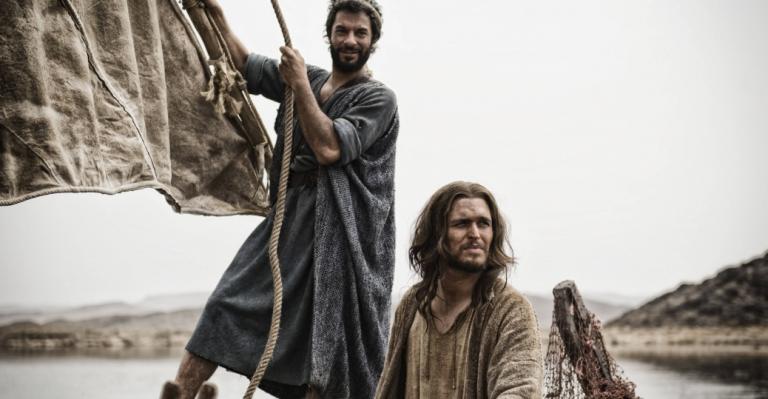 It’s common these days for each new episode of a TV series to begin with a montage that sums up all the relevant plot points from previous episodes. So it was only natural that, when the History Channel aired its five-part mini-series The Bible over the month of March, all but one of the episodes began with narrator Keith David intoning, in his deep baritone voice, “Previously, on The Bible…”
All of the show’s strengths and weaknesses are captured in that one phrase. Produced by Mark Burnett (a TV mogul best known for unscripted “reality” shows like Survivor and The Apprentice) and his wife Roma Downey (who once starred in Touched by an Angel), the mini-series rushes through the whole Bible, from Genesis to Revelation, in ten hours — though it’s more like seven, once you bracket off the commercial breaks — and it zips through the stories so quickly that you barely notice when they are compressed even further in those opening sequences. But the mini-series also makes a point of emphasizing the continuity between Bible stories in a way that is quite rare among Bible films, and in a way that sometimes allows individual stories to shed light profitably on others.
So, praise where praise is due. The Bible covers some awfully familiar territory — there have been many films about Moses and Jesus over the years, and there are more in development as we speak — but it also covers stories that aren’t brought to life on the big or small screen all that often, such as the Babylonian exile and the rise of the early church. Even better, the mini-series connects the familiar and unfamiliar stories, so that, for example, the Peter who followed Christ around Galilee and the Peter who led the church in Jerusalem are played by the same actor. Very few films have allowed for that. (The Visual Bible’s adaptations of Matthew and Acts featured the same actor as Jesus, but changed most of the rest of the cast.)
Even more intriguingly, The Bible comes from an unabashedly Christian perspective, so that, for example, when Abraham speaks to “the LORD” (as per Genesis 18), it is strongly hinted that the person he is speaking to might actually be a pre-incarnate version of Christ. (We never get a good look at the person’s face, but his voice and hair seem awfully familiar.) Later, when Daniel describes his prophetic vision of “a son of man coming on the clouds,” it allows the mini-series to segue quite smoothly into the New Testament.
The mini-series also features several scenes in which characters from a later Bible story are conscious of the characters who have come before them. Moses, for example, says on a few occasions that he is leading the Israelites out of Egypt in order to fulfill a promise that God made to Abraham — a point that other Moses movies don’t always make.
Sometimes the enhanced continuity leads the filmmakers into more dubious territory. For example, the Ascension marks the traditional end of Jesus’ post-Resurrection appearances in bodily form, but in the mini-series, Jesus makes a number of appearances after the Ascension that are indistinguishable from the ones he made before it: the Book of Acts describes what Paul saw on the road to Damascus as a bright light from heaven, but the mini-series has Jesus stand by the side of the road, like someone waiting to hitch a ride; and where the Book of Acts says “the Spirit” gave instructions to Peter regarding the conversion of Cornelius, the mini-series has Jesus pay Peter a visit instead. Later on, Jesus appears to the elderly apostle John on Patmos and raises the hole in his hand for our contemplation, just as he did on the first Easter.
Still more problematic is the way the mini-series smoothes over certain tensions within the Bible until it cannot hide them any longer, at which point it doesn’t really give us any way to deal with them. The Old Testament pulls in different directions on a number of issues, such as whether foreign races ought to be exterminated and/or excluded from the assembly of Israel (compare Deuteronomy 23:1-8 and its ruthless enforcement by Ezra and Nehemiah with Isaiah 56:1-7 and the punchline to the Book of Ruth), and, if anything, the mini-series seems to tilt in favor of ancient Israelite chest-thumping when, say, the soldiers led by Joshua wave their swords and chant “Israel! Israel! Israel!” But then, a couple of episodes later, Jesus feeds the multitude and the crowd replies by chanting “Israel! Israel! Israel!” and demanding that Jesus be their king — and this greatly disturbs Jesus, who protests, “No, this is not the way! Not by force!” A suppler film might have offered some way to understand this apparent change in divine tactic, but this mini-series isn’t up to the task.
The nationalism itself is sometimes expressed in ways that are problematic for the current viewer. One of the show’s recurring themes is that “God is with us” — but this sometimes seems to carry the connotation that God is, therefore, not with someone else, not with them. Violent acts that receive no particular divine sanction in the Bible, such as the raid Abraham stages to rescue Lot and his family, are here presented as evidence of what you can do when you “trust in God.” And where the Bible depicts the miracle in the fiery furnace as something that forced Nebuchadnezzar to acknowledge the sovereignty of God, the mini-series depicts it as a morale-booster for the Jewish exiles — while leaving Nebuchadnezzar to languish in the ancient Babylonian equivalent of an insane asylum, without reprieve.
This last detail, of course, is symptomatic of an even larger problem, which is the way the mini-series loses much of the narrative and emotional nuance of the Bible by rushing through it so quickly, especially with regard to the Old Testament stories. The Pharaoh yells “No!” to Moses’ demands for liberation after each and every plague, instead of sometimes saying “yes” and then breaking his word, as he does in Exodus. Samson, for some reason, is played by a black actor even though virtually every other Israelite is not — so the Philistines kill his wife just because they’re racist, and not because of any escalating antagonism between them and him. (Later, Samson tells Delilah the secret to his strength the very first time she asks, which itself is an oversimplification of the story.) John the Baptist is sent to prison and executed immediately, so that we never experience his moment of doubt. And so on.
And yet, despite all these narrative short-cuts, the mini-series still finds time to insert a fair bit of violence, some of it warranted by the biblical source material and some of it not. The angels who visit Sodom do not merely blind the crowd outside Lot’s house, but pull out swords and start slashing away. The spies in Jericho get into a swordfight in the streets and, ducking into Rahab’s house, actually hold swords to both her throat and that of her son to keep them quiet. Herod personally stabs a Jewish rebel in the neck and lets him bleed to death. The angel Gabriel appears to Mary while her fellow Nazarenes are fighting the Romans in the streets. Pilate, while practicing his swordplay at home, deliberately slashes his partner’s chest after he has already defeated him — and the camera and the soundtrack linger for a few seconds on this moment of pain. Other examples abound.
Some of this can be justified on the basis that it provides historical context — it is especially helpful to be reminded that Pilate could be quite brutal at times, as Luke 13 attests — but the sense one gets is that the producers were constantly looking for opportunities to make the show “exciting,” and that the easiest way to do this was to keep jacking up the “action.”
The mini-series caters to modern sensibilities in other ways, too. Aesthetically, it borrows from other Bible movies — most notably Mel Gibson’s The Passion of the Christ — and it employs a soundtrack by Hans Zimmer that sounds virtually identical to the music he and his associates have written for popular movies like Gladiator and the Pirates of the Caribbean series. The dialogue also leans towards banal anachronisms, such as when Delilah tells her fellow Philistines that Samson has “changed. He’s a different man since he met me!”
More significantly, when Jesus first meets Peter and gives him a miraculous catch of fish, the script omits any reference to Peter’s awareness of his own sinfulness (as per Luke 5) and, instead, has Jesus make bland pronouncements such as, “Give me an hour, and I will give you a whole new life.” Later, Jesus tells Peter he’s giving him “the chance to change your life” and says that, together, they will “change the world.” This is the language of talk shows and infomercials, not the language of first-century Jews and Christians.
That being said, the mini-series does put some clever spins on these stories. For example, while the Book of Daniel generally refers to Daniel’s three friends by their Babylonian names (Shadrach, Meshach and Abednego), the mini-series has one of them insist on using his Hebrew name, Azariah, and it builds up the relationship between Daniel and Azariah in a way that allows each of them to bear witness as the other is put to the test: first Azariah in the fiery furnace, and then, years later, Daniel in the lions’ den.
Later, in the episodes based on the gospels, Nicodemus is depicted as an early critic of Jesus — it is he who asks Jesus whether the Jews ought to pay taxes to Caesar — who gradually turns around and comes over to Jesus’ side. The mini-series even makes a point of cross-cutting between Nicodemus’ encounters with Jesus and Judas’ meeting with the high priest, so that Nicodemus, in a sense, “betrays” Caiaphas just as Judas betrays Jesus.
There is also a striking moment when Jesus calls on Matthew, the tax collector, to join him and his followers. When the scene begins, Jesus is surrounded by disciples and critics who agree on little except that tax collectors are “vermin” — so Jesus tells the parable of the publican and the Pharisee, and as he reaches the words that the publican spoke in humble prayer, Matthew recites them in sync with Jesus and starts to cry. The parable, it seems, is more than just a story; it is evidence of Jesus’ prophetic or divine knowledge, and it gives Matthew, who now knows that his prayers have been heard, an emotionally compelling reason to drop his work and join the Jesus movement right then and there.
There are several other moments like these scattered throughout the mini-series, and they are sometimes quite brilliant, even if the filmmakers never quite know how to follow through on them. (Jesus’ temptation in the wilderness is accompanied by flash-forwards to the Passion — but he seems to be caught off-guard when he has yet another set of premonitions during the Last Supper.) Bible adaptations like this are at their best when they hit on an aspect of the story that the viewer might never have considered before, or when they juxtapose texts in a way that prompts the viewer to think about the story from a fresh angle. In a nutshell, they work best when they open the story up for the viewer. (One excellent recent example is the Oscar-nominated animated short film Adam and Dog, which re-imagines the story of Creation and the Fall from the point of view of man’s first best friend.)
But the rush-rush-rush of this particular mini-series, which relies heavily on the narration to smoothe over narrative gaps and explain the meaning of individual scenes, runs the risk of closing the stories and their meaning to the average viewer. Instead of coming away changed, the viewer comes away feeling good about a story of “change.” And that is not quite the same thing.
Peter T. Chattaway is a freelance film critic and blogger at Patheos.com with a special interest in Bible movies. His episode-by-episode blog posts on The Bible can be found here. He lives with his family in Surrey, B.C.
— A version of this article was first published on the Books & Culture website.
Previous Post

April 11, 2013
An open letter to the makers of the next Bible series
Next Post
April 12, 2013 The Bible -- the article's up!
Browse Our Archives
Select a Category Anglican Planet Articles BC Christian News BC Report Bible Movies Bible Review Blog Books & Culture Campus Times CBC Radio Christianity Today ChristianWeek Essays Faith Today Festival Cinemas Guide Film Journals Georgia Straight Interviews MB Herald National Catholic Register Salvationist Today's Christian Two Chairs Ubyssey Uncategorized Vancouver Courier Vancouver Sun
Select a Month August 2025 April 2025 January 2025 December 2024 November 2024 May 2024 February 2024 December 2023 May 2023 March 2023 November 2022 July 2022 June 2022 May 2022 April 2022 February 2022 January 2022 December 2021 November 2021 October 2021 September 2021 August 2021 July 2021 June 2021 April 2021 March 2021 February 2021 January 2021 December 2020 November 2020 October 2020 August 2020 July 2020 June 2020 May 2020 March 2020 February 2020 January 2020 December 2019 November 2019 September 2019 July 2019 May 2019 April 2019 March 2019 February 2019 January 2019 December 2018 November 2018 October 2018 September 2018 July 2018 June 2018 May 2018 April 2018 March 2018 February 2018 January 2018 December 2017 November 2017 October 2017 September 2017 August 2017 July 2017 June 2017 May 2017 April 2017 March 2017 February 2017 January 2017 December 2016 November 2016 October 2016 September 2016 August 2016 July 2016 June 2016 May 2016 April 2016 March 2016 February 2016 January 2016 December 2015 November 2015 October 2015 September 2015 August 2015 July 2015 June 2015 May 2015 April 2015 March 2015 February 2015 January 2015 December 2014 November 2014 October 2014 September 2014 August 2014 July 2014 June 2014 May 2014 April 2014 March 2014 February 2014 January 2014 December 2013 November 2013 October 2013 September 2013 August 2013 July 2013 June 2013 May 2013 April 2013 March 2013 February 2013 January 2013 December 2012 November 2012 October 2012 September 2012 August 2012 July 2012 June 2012 April 2012 January 2012 January 2011 December 2010 November 2010 October 2010 September 2010 August 2010 July 2010 June 2010 May 2010 April 2010 March 2010 February 2010 January 2010 December 2009 November 2009 October 2009 September 2009 August 2009 July 2009 June 2009 May 2009 April 2009 March 2009 February 2009 January 2009 December 2008 November 2008 October 2008 September 2008 August 2008 July 2008 June 2008 May 2008 April 2008 March 2008 February 2008 January 2008 December 2007 November 2007 October 2007 September 2007 August 2007 July 2007 June 2007 May 2007 April 2007 March 2007 February 2007 January 2007 December 2006 November 2006 October 2006 September 2006 August 2006 July 2006 June 2006 May 2006 April 2006 March 2006 February 2006 January 2006 December 2005 November 2005 October 2005 September 2005 August 2005 July 2005 June 2005 May 2005 April 2005 March 2005 January 2005 December 2004 November 2004 October 2004 September 2004 August 2004 July 2004 June 2004 May 2004 April 2004 March 2004 February 2004 January 2004 November 2003 October 2003 August 2003 July 2003 June 2003 May 2003 January 2003 December 2002 November 2002 August 2002 July 2002 June 2002 May 2002 March 2002 January 2002 December 2001 November 2001 September 2001 August 2001 July 2001 June 2001 April 2001 March 2001 February 2001 December 2000 November 2000 October 2000 September 2000 August 2000 July 2000 June 2000 May 2000 April 2000 March 2000 January 2000 October 1999 August 1999 May 1999 April 1999 February 1999 January 1999 December 1998 November 1998 October 1998 August 1998 July 1998 June 1998 April 1998 March 1998 January 1998 November 1997 September 1997 July 1997 June 1997 April 1997 March 1997 February 1997 January 1997 December 1996 October 1996 September 1996 June 1996 March 1996 February 1996 January 1996 April 1995 November 1994 September 1994 September 1991
Follow Us!
TAKE THE
Religious Wisdom Quiz
What does "Amen" originally mean?
Select your answer to see how you score.
Let it happen Praise God Be true So be it
Related posts from FilmChat

Exclusive: A clip from Angel Studios' The King...
Oscar Isaac, Forest Whitaker join animated Jesus movie

Watch: The Chosen's creators on Season 4's big...
Which Bible movies are getting the most views...
TRENDING AT PATHEOS Religious Music & Entertainment

"Les Diabolique" and Transgression
Alongside something like Arrival, Vertigo, or Charade, Les Diaboliques is a...

"The Plague Dogs" and Mortality
So, flashback to the late 70s, early 80s. Walt Disney Studios is...

With the recent and highly successful release of Christopher Nolan’s epic film,...

"L'avventura" and Human Weakness
Today's piece is going to be a little different for a few...

I first want to apologize for not posting or writing anything. I'm...

I've engaged in the multi-year project of reading through the Church Fathers,...
view all Religious Music & Entertainment blogs
Ad-Free & Subscriber Log-In Subscription Support
- About Us
- 2026 Calendar
- Videos
- Podcasts
- Library of World Religions
- Faith In Media Tracker
- Advertise With Us
- Write for Us
- Privacy Policy
- Terms of Service
- Do Not Sell My Data
- Contact Us
- Radiant Digital
- Manage Newsletter Subscriptions
- Unsubscribe From Notifications
- Sitemap
Copyright 2008-2026, Patheos. All rights reserved.
Subscription Support Ad-Free & Subscriber Log-In
Follow Patheos