
BuddhistCatholicContemplativeEvangelicalGeneral ChristianHinduJewishLatter-day SaintMuslimNew VisionsProgressive Christian
Beliefs
- Buddhist
- Catholic
- Contemplative
- Evangelical
- General Christian
- Hindu
- Jewish
- Latter-day Saint
- More Voices
- Muslim
- New Visions
- Pagan
- Progressive Christian
Topics
- Religion News
- Food and Religion
- Sports and Religion
- Religious Art
- Religious Music and Entertainment
- Religious Events
- History and Religion
- Style and Religion
- Politics and Religion
- Women in Religion
- Recreation Outdoors and Religion
- Business Finance and Religion
- Careers Workplace and Religion
- Education and Religion
- Family Parenting and Religion
- Health Fitness and Religion
- Home and Religion
- Relationships and Religion
- Technology and Religion
- Travel and Religion
Columnists
- Buddhist Columnists
- Business Finance and Religion Columnists
- Careers Workplace and Religion Columnists
- Catholic Columnists
- Contemplative Columnists
- Education and Religion Columnists
- Evangelists Columnists
- Family Parenting and Religion Columnists
- General Christian Columnists
- Health Fitness and Religion Columnists
- Hindu Columnists
- History and Religion Columnists
- Home and Religion Columnists
- Jewish Columnists
- More Voices Columnists
- Latter Day Columnists
- Muslim Columnists
- New Visions Columnists
- Nonreligious Columnists
- Pagan Columnists
- Politics and Religion Columnists
- Progressive Columnists
- Recreation Outdoors and Religion Columnists
- Relationships and Religion Columnists
- Religion News Columnists
- Religious Art Columnists
- Religious Events Columnists
- Religious Music and Entertainment Columnists
- Sports and Religion Columnists
- Style and Religion Columnists
- Technology and Religion Columnists
- Travel and Religion Columnists
- Women in Religion Columnists
Resource Library
- 2026 Calendar
- Library of World Religions
- The 100 Most Holy Places on Earth
- Patheos Answers
- Podcasts
- Videos
- Faith Leaders Database
- Anglican Episcopalian
- Bahai
- Baptist
- Buddhism
- Christianity
- Confucianism
- Eastern Orthodoxy
- Hinduism
- Holiness and Pentecostal
- ISKCON
- Islam
- Judaism
- Lutheran
- Methodist
- The Church of Jesus Christ of Latter-day Saints
- New Age
- Paganism
- Presbytarian and Reformed
- Protestantism
- Religion Behind the Scenes
- Roman Catholic
- Scientology
- Shia Islam
- Sikhism
- Sufism
- Sunni Islam
- Taoism
- Zen
- See all religions
Research Tools
 Ad-Free & Subscriber Log-In Subscription Support
Ad-Free & Subscriber Log-In Subscription Support
Follow Patheos 

- Trending:
- Forgiveness
- |
- Marriage
- |
- Consciousness
- |
- Death Penalty
- |
- Election
- |
- Halloween

-
Articles
- Home
- Religious Music & Entertainment
- The Bible: second episode, first impressions
The Bible: second episode, first impressions
Last updated on: May 29, 2013 at 11:42 am by Peter T. Chattaway
The Bible: second episode, first impressions 2013-05-29T11:42:40-07:00 Peter T. Chattaway
Patheos Explore the world's faith through different perspectives on religion and spirituality! Patheos has the views of the prevalent religions and spiritualities of the world.
 Another week, another episode of the mini-series The Bible. These are my first impressions of the second episode.
The pacing, redux. The second episode is 86 minutes long, and the first six minutes consist of footage from the first episode, so that leaves only 80 minutes for the second episode to take us all the way from the spies in Jericho to the birth of King Solomon — a period that covers about two or three centuries.
Each episode so far has begun with a title card proclaiming that this mini-series is true to the “spirit” of the Bible, but the more this show zips through the Old Testament, the more I wonder how accurate this claim can possibly be.
For one thing, there are all the really important stories that the mini-series seems to be skipping entirely, like the ones about Job and Ruth. More importantly, though, there are tensions and even contradictions within the Old Testament — and sometimes within the very same text! — that are squelched entirely as this series rushes from one quick battle scene to the next.
For example, in Deuteronomy 24, Moses says parents should not be put to death for the sins of their children, and children should not be put to death for the sins of their parents — each generation will pay for its own sins and no others — but in Deuteronomy 25, just one chapter later, Moses commands future generations of Israelites to wipe out the Amalekites for the sins of their ancestors. And, as it happens, this last command becomes a key plot point in this week’s episode, when Samuel orders Saul to obliterate the Amalekites and condemns him for failing to do a thorough job of it.
Or consider how Deuteronomy 23 says that no descendant of a Moabite or Ammonite may enter the assembly of the Lord, “not even in the tenth generation” — a law that was ruthlessly enforced centuries later by Ezra and Nehemiah — whereas the book of Ruth not only celebrates a Moabite woman’s marriage to an Israelite man, but ends with the possibly startling revelation that King David was her descendant, and was indeed only three generations removed from her.
(Note, too, incidentally, how the passage from Deuteronomy bars not only foreigners from the assembly of the Lord but eunuchs, too; and note how Isaiah 56 seems to counter this by welcoming both eunuchs and foreigners into the Temple. And note, too, that it is this Isaiah passage which Jesus is quoting, centuries later, when he “cleanses” the Temple and calls it “a house of prayer for all nations.”)
Different religious traditions have different ways of dealing with these tensions, but they’re there in the text, and any representation of the text that claims to be true to the “spirit” of the text should probably try to address that somehow. But no, this mini-series has little interest in any sort of intentional ambiguity, or indeed in anything that would get in the way of making these stories “exciting”, and so it blitzes right past all that stuff.
The violence, redux. There’s a lot more hacking and slashing in this episode than there was in the previous one, but it doesn’t seem so gratuitous this time, if only because the stories of Joshua, the Judges and the early Kings are indeed largely concerned with the wars fought between the Israelites on the one hand and the neighbouring nations on the other hand. (The Bible also talks about civil wars between the Israelite tribes, but the mini-series skips over those.)
Even so, as justified as the violence might be, the mini-series does ramp things up a bit.
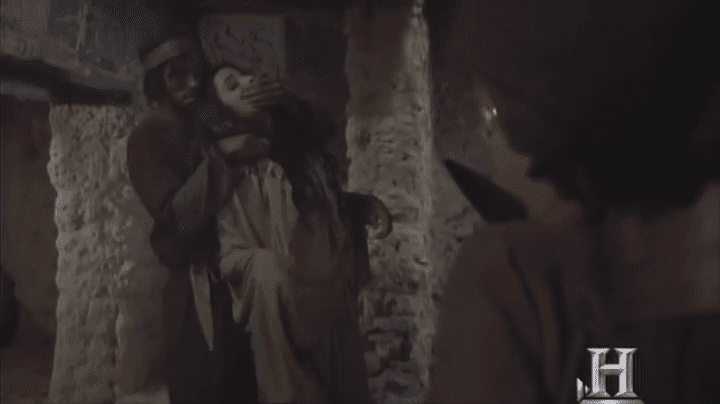 Last week, I mentioned the gratuitous swordfight between Joshua’s spies and the inhabitants of Jericho; this week’s episode continues with the Israelite spies invading Rahab’s house and holding a sword to the throat of her child in order to keep Rahab quiet. And then the spy goes on to say that God “saved us from slavery. We are his chosen.”
Now how would you react if someone invaded your home, threatened your child and then said he was on a mission from God? At times you wonder if the makers of this series are actually trying to make the Israelites look like villains.
I think there’s another explanation for this, though. In the Bible, Rahab is a prostitute and the spies “stay” at her house before the king of Jericho sends soldiers looking for them. What the spies actually do in Rahab’s house, we are not told — but it doesn’t necessarily look all that good.
So, apart from the fact that the filmmakers wanted to keep things “exciting”, I think they were also trying to find a way to explain how the spies got inside Rahab’s house without suggesting that there was anything untoward about their arrival there. Better, apparently, to say that they were running from a swordfight — and holding Rahab’s family hostage — than to say that they might have paid her for sex.
The mini-series goes further than the Bible in depicting divinely-sanctioned violence in other ways, too.
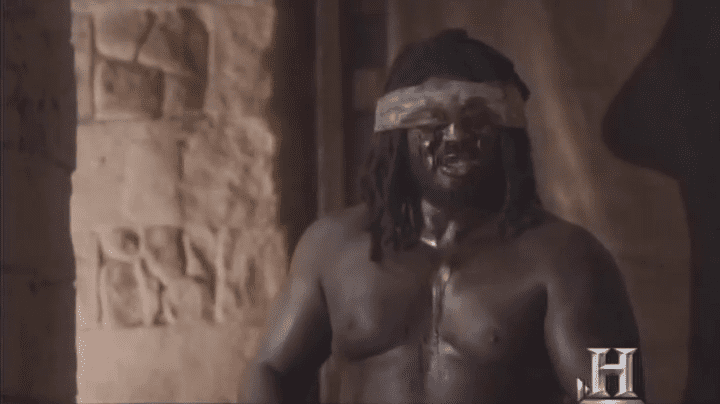 In Judges 16, when Samson is about to knock down the pillars of the Philistine temple, thereby killing both himself and the thousands of Philistines who have gathered to mock him there, Samson directs all his words at God and asks God for the strength to get his revenge; but in the mini-series, Samson directs his words at the Philistines and taunts them by saying that God “wants me to destroy you all!”
Then there is the bit where David brings Saul a bag full of Philistine foreskins, and Saul asks, “From a hundred men?” and David replies, “Two hundred. God was with me.” This is a reasonable extrapolation from I Samuel 18, where David’s general success in battle is taken by Saul as a sign that “the LORD was with David”, but it is not something that David himself claims, at least in this particular context.
It is also interesting to hear Uriah tell David that the reason he won’t go back to his house and sleep with his wife, after David calls him back from the battlefront, is because the war he and his fellow soldiers are fighting is a “holy war”. That isn’t quite the reason he gives in II Samuel 11.
Prostitution. I have already noted how this episode downplays the idea that Joshua’s spies might have sought the services of a prostitute. I can’t help noting that the episode mitigates this theme in other ways, too.
First, it’s not even clear that the Rahab of this mini-series is a prostitute. She is accosted by a man in the street who calls her “my little whore”, but the impression one gets is that she is, at most, the victim of a sexual aggressor. What the text treats as a matter-of-fact description of her profession becomes just an insult uttered by some bit player.
Second, the episode completely omits Samson’s visit to a prostitute in Gaza. His visit there led to an almost-confrontation with the local Philistines which culminated in one of Samson’s more impressive feats of strength, but the mini-series skips this entirely, thereby allowing us to think that Samson’s later dalliance with Delilah was a one-time display of weakness, rather than part of a recurring pattern.
Nationalism. Last week’s episode ended with Joshua’s spies crying “For Israel!” as a swordfight began in the streets of Jericho. That moment is repeated at the beginning of the second episode, and, interestingly, it is also echoed in a scene set a couple centuries later, when David and his men capture Jerusalem.
I am also struck by how, when Joshua conquers Jericho, the Israelites around him began to chant “Israel! Israel! Israel!” Echoes of how modern Americans chant “U.S.A.! U.S.A.! U.S.A.!” perhaps? I can’t help thinking that the ancient Israelites would have been likely to chant something a little more theologically inflected, but I could be wrong about that.
Note, too, how enthusiastic the Israelite leaders are in their calls to subjugate the other nations. When the walls of Jericho fall, Joshua cries, “We give this city to the Lord! Destroy everything!” And when David kills Goliath, King Saul tells his soldiers to attack the Philistines, and cries, “Let us make slaves of them!”
This is not an inaccurate depiction of how the Israelites and other nations of that era would have dealt with each other. But it is also the sort of thing that other Bible movies would try to get around, somehow, either by toning it down or making it clear that the other nations had earned such treatment. It is striking that The Bible doesn’t go either route, despite the fact that it is trying to popularize the Bible for a mass audience.
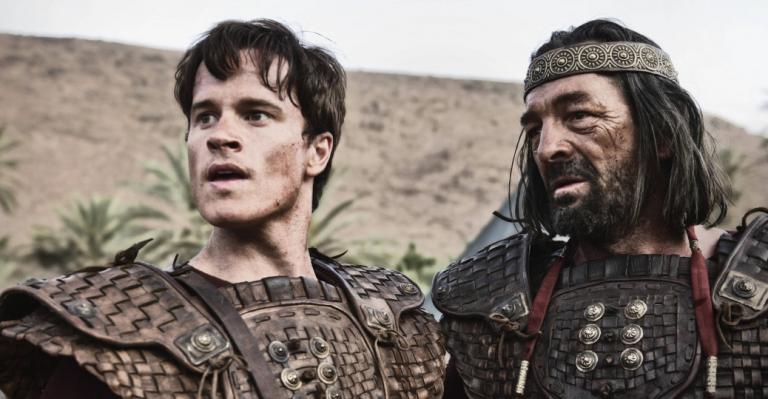 Continuity between Bible stories, redux. In addition to the two “For Israel!” scenes, this episode includes a bit where Jonathan says he loves David, and Saul tries to dampen this by saying, “As Abel no doubt once loved Cain.”
What’s interesting about this particular reference to an earlier Bible story is that Saul is actually wrong to draw the parallel that he does. All of the other references to earlier Bible stories have maintained some sort of continuity between them — God made a promise to Abraham, and now it is being fulfilled by Moses, etc. — but here there is no parallel at all between the genuine, mutual love between Jonathan and David on the one hand and the fratricide that Cain commits against Abel on the other hand.
Ethnicity. I devoted an entire blog post two months ago to the fact that Samson, unlike virtually every other Israelite character in this series, is portrayed by a black actor. Now that I have seen the episode itself, I don’t think we can chalk this up to “colour-blind” casting.
For one thing, you can’t help but wonder if there is a certain amount of racial stereotyping involved in the fact that the mini-series’ only significant black character (not counting his mother, who is family after all, or a couple of the angels, who aren’t even human) happens to be the one biblical character who is best-known for his brute strength.
But the mini-series also grossly oversimplifies the story of Samson — and plays on modern racial subtexts — by suggesting that Philistine antagonism towards him was racism pure and simple. When (black) Samson marries his (white) Philistine wife, a Philistine villain in the background declares, “We need to send these Israelites a message, make it clear to them they cannot take our women. Our people should never mix.”
 Oversimplification. In the Bible, Samson’s interactions with the Philistines are a long, complicated affair (or series of affairs, considering his penchant for Philistine women). But virtually all of the detail that makes these interactions interesting is left out of the episode altogether.
Take Samson’s wedding. In Judges 14-15, Samson gives his guests a riddle to solve, and they pressure his wife into getting the answer from him. Samson reacts by killing a bunch of Philistines and abandoning his wife, but when he tries to get her back, he is told that she has been given to another man. So then Samson destroys the Philistines’ wheat fields and vineyards, after which the Philistines get their own revenge by killing Samson’s wife and her father.
This cycle of violence (and betrayals) is completely written out of the mini-series, so that Samson’s wife and father-in-law are now murdered almost immediately after the wedding, simply because she married someone of the wrong race.
Then there is Samson’s relationship with Delilah. In Judges 16, Delilah asks Samson for the secret of his strength multiple times, and, like an idiot, he doesn’t give her the correct information until after she has demonstrated — twice! — that she is willing to use the information against him. In the mini-series, however, Samson gives her the correct answer the first time she asks.
 Banal or problematic dialogue. David tells Saul he didn’t sneak up on Saul and kill him, even though he could have, because “only evildoers do evil deeds.” In the hands of better filmmakers, I would think that the mini-series was going to challenge this idea, given David’s later actions (especially in the Bathsheba affair). But I’m not sure the makers of this series were thinking that far ahead; instead, it sounds like just another trite would-be truism.
Also, when the Philistine leaders first approach Delilah to ask her to betray Samson, she protests, “He’s changed! He’s a different man since he met me!” Again, quite apart from the fact that we barely spend enough time with Samson to actually notice any changes, something about the wording here seems a little off, a little anachronistic, to me.
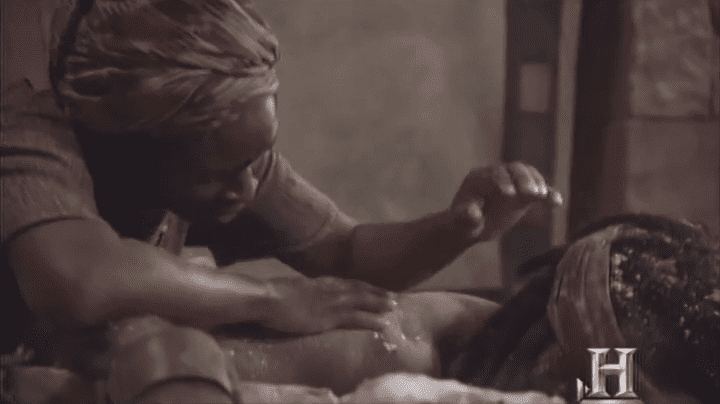 Minor quibbles. The angel who appears to Joshua tells him, “The Lord parted the waters for Moses. For you, he will split rock.” Actually, by this point in the story, the Lord had already parted — or at least blocked — the waters for Joshua, too.
It’s also interesting how the mini-series amplifies the part of Samson’s mother — even allowing her to search through the rubble of the Philistine temple after Samson dies — while completely ignoring his father and other kinsmen.
 And is David really writing that letter to Joab in modern Hebrew? Click here to see the sort of alphabet David or his scribes would have really used back then.
Things I liked. As rushed as things might be in this mini-series, the jump cut from young David fighting Philistines to the older David fighting Philistines was actually quite effective, and neatly sums up the fact that, yup, David did a lot of fighting.
I also liked the way Saul gets the line about David slaying “thousands”, and the way his son Jonathan gets the line about David slaying “tens of thousands”. The way it’s played here, the extra praise for David doesn’t seem like it should have been anywhere near as threatening as Saul makes it out to be, which just underscores the fact that Saul, in his paranoia, was out of sync with his own family.
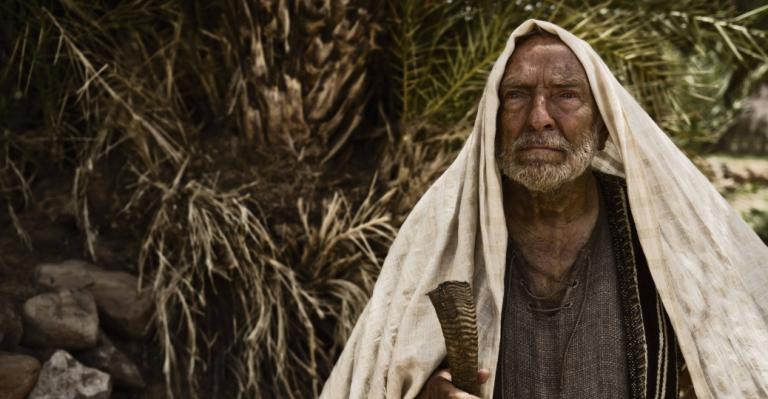 I also get a kick out of the fact that the prophet Samuel is played here by Paul Freeman, who may be best known to movie buffs as Belloq in Raiders of the Lost Ark (1981), i.e. the rival archaeologist who dresses up as a high priest and opens the Ark of the Covenant, after which his head explodes.
For a Bible-movie buff like me, it is kind of fun to note that Freeman previously played Cornelius — the first Gentile convert to Christianity — in the mini-series A.D. Anno Domini (1985), and that the apostle Peter, who baptizes Cornelius, was played in that mini-series by Denis Quilley, who also played Samuel in Bruce Beresford’s King David (1985). So from now on, whenever I see Peter meet Cornelius in A.D., it will be like watching a meeting of Samuels.
Here endeth my post on episode two. Episode three — which will finish the Old Testament section of the mini-series and begin the New Testament section — airs Sunday night.
Previous Post

March 14, 2013
Spielberg out, Ang Lee in, for life-of-Moses movie?
Next Post
March 15, 2013 He played Jesus, now he might play Moses.
Browse Our Archives
Select a Category Anglican Planet Articles BC Christian News BC Report Bible Movies Bible Review Blog Books & Culture Campus Times CBC Radio Christianity Today ChristianWeek Essays Faith Today Festival Cinemas Guide Film Journals Georgia Straight Interviews MB Herald National Catholic Register Salvationist Today's Christian Two Chairs Ubyssey Uncategorized Vancouver Courier Vancouver Sun
Select a Month August 2025 April 2025 January 2025 December 2024 November 2024 May 2024 February 2024 December 2023 May 2023 March 2023 November 2022 July 2022 June 2022 May 2022 April 2022 February 2022 January 2022 December 2021 November 2021 October 2021 September 2021 August 2021 July 2021 June 2021 April 2021 March 2021 February 2021 January 2021 December 2020 November 2020 October 2020 August 2020 July 2020 June 2020 May 2020 March 2020 February 2020 January 2020 December 2019 November 2019 September 2019 July 2019 May 2019 April 2019 March 2019 February 2019 January 2019 December 2018 November 2018 October 2018 September 2018 July 2018 June 2018 May 2018 April 2018 March 2018 February 2018 January 2018 December 2017 November 2017 October 2017 September 2017 August 2017 July 2017 June 2017 May 2017 April 2017 March 2017 February 2017 January 2017 December 2016 November 2016 October 2016 September 2016 August 2016 July 2016 June 2016 May 2016 April 2016 March 2016 February 2016 January 2016 December 2015 November 2015 October 2015 September 2015 August 2015 July 2015 June 2015 May 2015 April 2015 March 2015 February 2015 January 2015 December 2014 November 2014 October 2014 September 2014 August 2014 July 2014 June 2014 May 2014 April 2014 March 2014 February 2014 January 2014 December 2013 November 2013 October 2013 September 2013 August 2013 July 2013 June 2013 May 2013 April 2013 March 2013 February 2013 January 2013 December 2012 November 2012 October 2012 September 2012 August 2012 July 2012 June 2012 April 2012 January 2012 January 2011 December 2010 November 2010 October 2010 September 2010 August 2010 July 2010 June 2010 May 2010 April 2010 March 2010 February 2010 January 2010 December 2009 November 2009 October 2009 September 2009 August 2009 July 2009 June 2009 May 2009 April 2009 March 2009 February 2009 January 2009 December 2008 November 2008 October 2008 September 2008 August 2008 July 2008 June 2008 May 2008 April 2008 March 2008 February 2008 January 2008 December 2007 November 2007 October 2007 September 2007 August 2007 July 2007 June 2007 May 2007 April 2007 March 2007 February 2007 January 2007 December 2006 November 2006 October 2006 September 2006 August 2006 July 2006 June 2006 May 2006 April 2006 March 2006 February 2006 January 2006 December 2005 November 2005 October 2005 September 2005 August 2005 July 2005 June 2005 May 2005 April 2005 March 2005 January 2005 December 2004 November 2004 October 2004 September 2004 August 2004 July 2004 June 2004 May 2004 April 2004 March 2004 February 2004 January 2004 November 2003 October 2003 August 2003 July 2003 June 2003 May 2003 January 2003 December 2002 November 2002 August 2002 July 2002 June 2002 May 2002 March 2002 January 2002 December 2001 November 2001 September 2001 August 2001 July 2001 June 2001 April 2001 March 2001 February 2001 December 2000 November 2000 October 2000 September 2000 August 2000 July 2000 June 2000 May 2000 April 2000 March 2000 January 2000 October 1999 August 1999 May 1999 April 1999 February 1999 January 1999 December 1998 November 1998 October 1998 August 1998 July 1998 June 1998 April 1998 March 1998 January 1998 November 1997 September 1997 July 1997 June 1997 April 1997 March 1997 February 1997 January 1997 December 1996 October 1996 September 1996 June 1996 March 1996 February 1996 January 1996 April 1995 November 1994 September 1994 September 1991
Follow Us!
TAKE THE
Religious Wisdom Quiz
How old was Joseph when he became a ruler in Egypt?
Select your answer to see how you score.
25 years old 30 years old 35 years old 40 years old
Related posts from FilmChat

Joseph of Egypt – the Chosen spin-off announces...

Exclusive: A clip from Angel Studios' The King...

Exclusive: Watch a clip from Angel Studios' Brave...

Exclusive: Watch a clip from Angel Studios' Homestead
TRENDING AT PATHEOS Religious Music & Entertainment

"Les Diabolique" and Transgression
Alongside something like Arrival, Vertigo, or Charade, Les Diaboliques is a...

"The Plague Dogs" and Mortality
So, flashback to the late 70s, early 80s. Walt Disney Studios is...

With the recent and highly successful release of Christopher Nolan’s epic film,...

"L'avventura" and Human Weakness
Today's piece is going to be a little different for a few...

I first want to apologize for not posting or writing anything. I'm...

I've engaged in the multi-year project of reading through the Church Fathers,...
view all Religious Music & Entertainment blogs
Ad-Free & Subscriber Log-In Subscription Support
- About Us
- 2026 Calendar
- Videos
- Podcasts
- Library of World Religions
- Faith In Media Tracker
- Advertise With Us
- Write for Us
- Privacy Policy
- Terms of Service
- Do Not Sell My Data
- Contact Us
- Radiant Digital
- Manage Newsletter Subscriptions
- Unsubscribe From Notifications
- Sitemap
Copyright 2008-2026, Patheos. All rights reserved.
Subscription Support Ad-Free & Subscriber Log-In
Follow Patheos