
BuddhistCatholicContemplativeEvangelicalGeneral ChristianHinduJewishLatter-day SaintMuslimNew VisionsProgressive Christian
Beliefs
- Buddhist
- Catholic
- Contemplative
- Evangelical
- General Christian
- Hindu
- Jewish
- Latter-day Saint
- More Voices
- Muslim
- New Visions
- Pagan
- Progressive Christian
Topics
- Religion News
- Food and Religion
- Sports and Religion
- Religious Art
- Religious Music and Entertainment
- Religious Events
- History and Religion
- Style and Religion
- Politics and Religion
- Women in Religion
- Recreation Outdoors and Religion
- Business Finance and Religion
- Careers Workplace and Religion
- Education and Religion
- Family Parenting and Religion
- Health Fitness and Religion
- Home and Religion
- Relationships and Religion
- Technology and Religion
- Travel and Religion
Columnists
- Buddhist Columnists
- Business Finance and Religion Columnists
- Careers Workplace and Religion Columnists
- Catholic Columnists
- Contemplative Columnists
- Education and Religion Columnists
- Evangelists Columnists
- Family Parenting and Religion Columnists
- General Christian Columnists
- Health Fitness and Religion Columnists
- Hindu Columnists
- History and Religion Columnists
- Home and Religion Columnists
- Jewish Columnists
- More Voices Columnists
- Latter Day Columnists
- Muslim Columnists
- New Visions Columnists
- Nonreligious Columnists
- Pagan Columnists
- Politics and Religion Columnists
- Progressive Columnists
- Recreation Outdoors and Religion Columnists
- Relationships and Religion Columnists
- Religion News Columnists
- Religious Art Columnists
- Religious Events Columnists
- Religious Music and Entertainment Columnists
- Sports and Religion Columnists
- Style and Religion Columnists
- Technology and Religion Columnists
- Travel and Religion Columnists
- Women in Religion Columnists
Resource Library
- 2026 Calendar
- Library of World Religions
- The 100 Most Holy Places on Earth
- Patheos Answers
- Podcasts
- Videos
- Faith Leaders Database
- Anglican Episcopalian
- Bahai
- Baptist
- Buddhism
- Christianity
- Confucianism
- Eastern Orthodoxy
- Hinduism
- Holiness and Pentecostal
- ISKCON
- Islam
- Judaism
- Lutheran
- Methodist
- The Church of Jesus Christ of Latter-day Saints
- New Age
- Paganism
- Presbytarian and Reformed
- Protestantism
- Religion Behind the Scenes
- Roman Catholic
- Scientology
- Shia Islam
- Sikhism
- Sufism
- Sunni Islam
- Taoism
- Zen
- See all religions
Research Tools
 Ad-Free & Subscriber Log-In Subscription Support
Ad-Free & Subscriber Log-In Subscription Support
Follow Patheos 

- Trending:
- Forgiveness
- |
- Marriage
- |
- Consciousness
- |
- Death Penalty
- |
- Election
- |
- Halloween

-
Articles
- Home
- Religious Music & Entertainment
- The Bible: fourth episode, first impressions
The Bible: fourth episode, first impressions
Last updated on: April 3, 2017 at 3:21 pm by Peter T. Chattaway
The Bible: fourth episode, first impressions 2017-04-03T15:21:56-07:00 Peter T. Chattaway
Patheos Explore the world's faith through different perspectives on religion and spirituality! Patheos has the views of the prevalent religions and spiritualities of the world.
 Alas, there was no Transfiguration in this episode. But there was quite a bit of other stuff that I found interesting, for better and for worse, so here again, as before, are my first impressions.
The pacing, redux. It says something about this show that, when it finally devotes an entire two-hour episode to a single protagonist, it still feels kind of rushed, like it’s over far too quickly and we haven’t had a chance to really get to know anyone.
The protagonist in question, of course, is Jesus, and the series actually started his story last week, with his birth and baptism, and will finish it next week, with his death and resurrection. What’s interesting about the structure of these Jesus episodes is the way they basically seem to devote half their running time to the events of Holy Week — i.e. the period between Jesus’ arrival in Jerusalem on Palm Sunday and his resurrection from the tomb one week later — as well as, possibly, the resurrection appearances that occurred afterwards. In this, the series is not unlike John’s gospel, which devotes 10 of its 21 chapters to this narrow period of time. (By comparison, the Holy Week part of the story takes up maybe about a third of Matthew and Mark’s gospels, and only about a fourth or even a fifth of Luke’s gospel.)
In fact, when you consider that the mini-series spent only 14 minutes on the adult Jesus last week (after spending half an hour on his birth and youth, periods that are completely ignored by the gospels of Mark and John), and that the entire 9th hour of the series goes by the name ‘Passion’, there is a distinct possibility that the series might end up devoting almost two thirds of its Jesus time to the events following Palm Sunday — which may be unprecedented for a film that isn’t meant to be exclusively about the events of Holy Week a la The Passion of the Christ (2004).
New juxtapositions. One of the more fascinating things about this episode is the way it brings different elements from the gospels together in new and intriguing ways.
Take, for example, the way Nicodemus effectively “betrays” Caiaphas just as Judas betrays Jesus. Nicodemus starts out as one of the Jewish leaders who is deeply concerned about Jesus — indeed, it is he who first passes on a Pharisee’s report about Jesus, a report that is initially laughed off by Caiaphas — but, by the end of the episode, he has turned around and come over to Jesus’ side. And the scenes in which Nicodemus’s transformation occur are cross-cut with the scenes in which Caiaphas persuades Judas to betray Jesus.
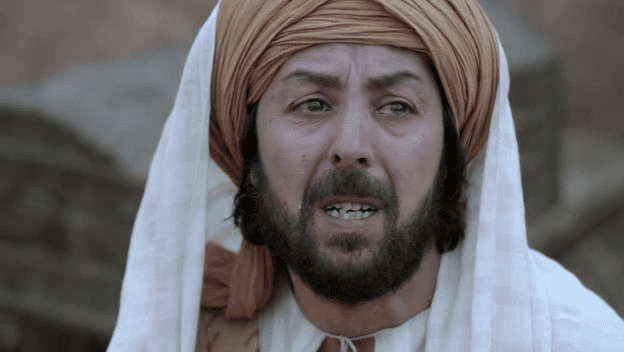 Then there is the scene where Jesus calls on Matthew, the tax collector, to join him and his disciples. When the scene begins, Jesus is surrounded by disciples who follow him and at least one Pharisee who criticizes him — but the one thing disciples and Pharisee can agree on is that tax collectors are “vermin”. Jesus responds by telling the parable of the publican and the Pharisee — and as he reaches the words that the publican spoke in humble prayer, Matthew recites them in sync with Jesus and starts to cry.
It’s an especially powerful moment, and it may catch the viewer by surprise, inasmuch as it suggests that Jesus is not only telling a story here but exercising his divine or prophetic knowledge of something that Matthew had done more-or-less in private. And of course, by exercising his knowledge like this, Jesus lets Matthew know that his prayers have been heard, which gives Matthew an emotionally compelling reason to drop his work and join the Jesus movement right then and there. (Honestly, I get a little verklempt just thinking about that scene as I write these words, three days after seeing it.)
The Matthew scene is also intriguing to me because, in at least some versions of the Eastern Orthodox sacrament of confession, the priest asks God to forgive the person who has just given his confession by appealing to the way God forgave various other people in the Bible — including the publican! But the publican was fictitious, part of a story within the story, even on the Bible’s terms, right? This is one of the points that has come up when my fellow Orthodox and I discuss the sometimes murky relationship between history and fiction in our tradition — but for what it’s worth, I have never had a problem with this particular prayer, because clearly the parable presents the publican as a “type” of sinner that God does, in fact, forgive.
So, on the whole, I think it’s actually quite brilliant that the mini-series goes one step further and ties this parable to an actual person.
That being said, I cannot help but also contrast the Matthew-and-parable scene here with a very different Matthew-and-parable scene in another movie. In Franco Zeffirelli’s Jesus of Nazareth (1977), Matthew is Peter’s neighbourhood tax collector, and Peter hates him for obvious reasons — so when Jesus goes to Matthew’s house, he bridges the gap between these two men by telling the parable of the prodigal son. When Peter hears the words of the father to the jealous elder brother, Peter realizes that he is committing the same sin as the elder brother, and this realization leads to a reconciliation with Matthew which is quite powerful in its own way.
In The Bible, on the other hand, Jesus tells the parable of the publican and the Pharisee in the presence of an actual Pharisee who is already very critical of Jesus’ movement. And as Matthew goes on to join Jesus’ movement, the Pharisee proclaims that if Jesus is accepting sinners like Matthew, then who knows what other kinds of sinners there might be in Jesus’ entourage. So where, in Zeffirelli’s film, the parable served to bring together two former enemies, the current mini-series is, perhaps, more divisive, more conducive to us-vs.-them ways of thinking.
 Nationalism, inverted. I mentioned two weeks ago that the mini-series seemed to be pandering to a certain kind of nationalism, in scenes like the one where Israelites under Joshua chant “Israel! Israel! Israel!” after conquering Jericho. But this Jesus-themed episode flips that motif on its head.
First, after Jesus miraculously feeds the multitude — which is the only miracle that appears in all four gospels, incidentally (and in two of them, it even happens twice) — the crowd of five thousand expresses a desire to make Jesus their king, and they all start chanting “Israel! Israel! Israel!” This bothers Jesus, who says, “No, this is not the way! Not by force!”
Later, when Jesus is asked if the Jews should pay taxes to Caesar, the crowd immediately chants “No!” and, again, “Israel! Israel! Israel!” And Jesus, of course, gives the same brilliant answer to this question that he gives in the gospels, and goes even further by tossing the coin to a nearby Roman soldier.
So there’s a very explicit link between the Joshua and Jesus episodes, thanks to the chanting — and the link is made even more interesting when you realize that Joshua and Jesus are basically the same name. (Joshua = Yehoshua = Yeshua = Jesus.)
But does the mini-series encourage us to think about the connection? Does it have anything to say about Joshua’s explicitly violent campaign of conquest and Jesus’ equally explicit rejection of violence? Does it offer any explanation for the apparent change in divine tactics between these two episodes? If so, I can’t figure out what it is.
Still, it’s interesting that the filmmakers put the chant in both episodes. It’s only natural to assume they meant something by it.
The violence, redux. It wouldn’t be a Bible episode without a little gratuitous violence, so this one gives us at least two, courtesy of Pilate.
In one, he’s practising sword-fighting at his residence — and, after he has clearly defeated his fighting partner, he gashes the man’s chest for no good reason.
And in the other, Pilate unleashes his soldiers on a crowd of Jews who have gathered to protest the use of Temple funds for building an aqueduct.
Neither of these episodes are biblical, per se; the aqueduct episode, in fact, comes from Josephus. But Luke 13 does tell us about some Galileans who were slaughtered by Pilate — which, I believe, is the only reference in the New Testament to any of Pilate’s actions outside of Holy Week — so there is, admittedly, some basis in the Bible for depicting Pilate’s cruelty outside of his interactions with Jesus.
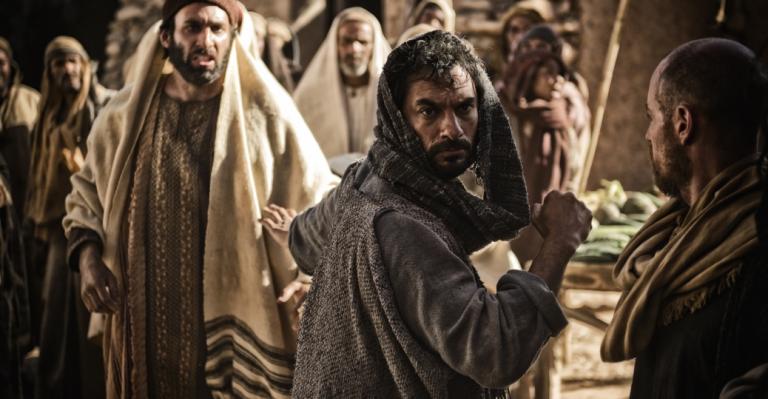 Turning the other cheek. “Show, don’t tell,” the saying goes, and a number of Jesus films, instead of simply letting Jesus recite the command to turn the other cheek, have tried to actually show people doing this in response to Jesus’ command.
The CBS mini-series Jesus (1999), for example, had Jesus himself turn the other cheek after the Jewish zealot Barabbas strikes him, and the musical Godspell (1973), set in the modern era, had Jesus himself slap one of his followers’ cheeks, as punishment for blasphemy, after which the follower in question reins in his own impulse to strike back.
The Bible puts a slightly different spin on this by having Jesus give the instruction to Peter after some of their Jewish opponents start throwing stones at them.
It was all a big misunderstanding! As New Testament scholar Mark Goodacre, one of this series’ consultants, notes, one of the biggest challenges facing anyone who would dramatize the death of Jesus is how to portray his Jewish opponents, chief of whom was the high priest Caiaphas.
The Bible does a decent job of making Caiaphas a recognizably human person, with justifiable concerns about the future of his people and an alarming willingness to sacrifice “one peasant” for the sake of the nation. But the mini-series also suggests that Caiaphas prosecuted Jesus on the basis of a rumour that got out of control — and its portrayal of the incident that sparked this rumour is just kind of goofy, if you ask me.
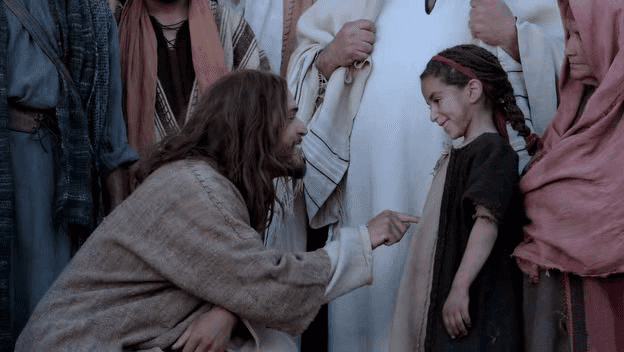 Specifically, as Jesus leaves the Temple, he smiles at a little girl and pokes her and tells her that “not one stone of this place — not one stone! — will be left standing.” This is quickly interpreted by Jesus’ enemies, including Caiaphas, as an indication that Jesus plans to destroy the Temple himself — and thus, the mini-series seems to be suggesting that the death of Jesus was just the result of a big misunderstanding. A big, big, big misunderstanding.
But what is the proper understanding of what Jesus said? Why, in fact, did Jesus say it? In the mini-series, it kind of comes out of nowhere. But in the gospels, Jesus says it in response to disciples of his who had started to praise the building they were standing in. When Jesus said “not one stone” would be left standing, he was predicting the building’s ultimate destruction at the hand of the Romans — which hardly seems like a fit subject for playful banter with a young child.
Indeed, according to Luke 23, when Jesus was being led to his death, he told the women of Jerusalem not to weep for him but to “weep for yourselves and for your children. For the time will come when you will say, ‘Blessed are the childless women, the wombs that never bore and the breasts that never nursed!'” That is the one time in the Bible that Jesus referred to children when predicting the fall of Jerusalem, and he was anything but smiley about it.
What is Jesus thinking, redux. Last week, I noted how the mini-series used flash-forwards and at least one point-of-view shot to allow us to identify, however partially, with Jesus’ subjectivity and thus with his humanity.
This episode continues the pattern. When Jesus hears of the death of John the Baptist, he is clearly bothered, and as he mulls it over, we get a flashback to that same point-of-view shot, of John’s face hovering over Jesus during the latter’s baptism. And we get some more flash-forwards to Jesus’ death, particularly at the Last Supper.
 It’s noteworthy, too, how Jesus hugs Peter rather tightly — it’s a loving hug — when Peter says he will never desert Jesus. And it is while Jesus is hugging Peter that Jesus predicts Peter will deny him three times. It is as though Jesus wanted to reassure Peter of his love for him even as he made a prediction that, in some ways, could have come across as a rebuke.
Finally, I like the way Jesus and Malchus look at each other after Jesus heals Malchus’s ear. That brief moment of eye contact between Jesus and Malchus — before the bag goes over Jesus’ head and Malchus’s fellow temple guards take him away — almost feels like a set-up for some continued character development on Malchus’s part in the next episode, but, at the pace this series goes, I wouldn’t count on it. Ah well.
Re-assigned dialogue. I have already noted how the mini-series gives Nicodemus, at least, a sort of character arc, inasmuch as he starts out as one of the Jewish leaders who is deeply skeptical of Jesus, and then gradually comes around to believing in him, or at least to giving him the benefit of the doubt.
Thus, it is Nicodemus, and not some anonymous nobody, who confronts Jesus with the question re: paying taxes to Caesar. And it is Nicodemus who Jesus addresses as “hypocrite” in one of the earlier scenes, when Jesus turns over the moneychangers’ tables.
Other bits of dialogue are re-assigned in interesting ways, too. It is one of the disciples, not Jesus, who tells the other disciples that Jesus came to save sinners, not the righteous. And it is Peter who, cautiously, first warns Jesus that claiming the power to forgive sins is a form of “blasphemy”; Peter makes this remark in the presence of a Pharisee who is in the middle of confronting Jesus, and the Pharisee basically picks up on this and says, “See? He knows.”
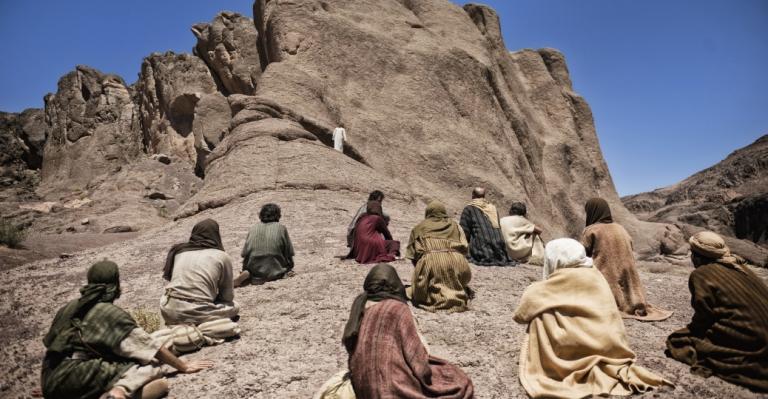 Finally, I liked the way the Sermon on the Mount — and the Lord’s Prayer in particular — is spread out over a montage in which we see Jesus teach his followers in multiple locations. Most scholars agree that the Sermon on the Mount, as recorded in the Bible, is a literary device that gathers many of Jesus’ sayings, rather than a historical record of an actual sermon in which Jesus stood in one place and recited a bunch of things all at once. Pier Paolo Pasolini captured this aspect of the Sermon quite brilliantly in The Gospel according to St. Matthew (1964) by filming each of the sayings separately and editing them together in a montage; here, the mini-series does something similar, though a little different, by having a single teaching spread out over multiple clips. It still conveys the basic idea, though, that Jesus’ sayings would have been spoken multiple times, in multiple ways, before they sank into everyone’s minds.
Watered down? Some of Jesus’ key sayings are trimmed a little much for my liking. For example, the mini-series shows him saying, “I am the way, the truth and the life,” but not, “No one comes to the Father except through me.” Or it shows him at the Last Supper saying, “This is my body,” and, “This is my blood,” but not the verses that follow, about his body being broken for us or his blood being shed for the remission of our sins.
But that might just be quibbling on my part. The mini-series does have Jesus saying things like, “You only have one Father, and he is in Heaven; you only have one teacher, and he is the Christ,” so it’s not like the film downplays the Christology, per se. Chalk this up, perhaps, to the many cuts, big and small, that had to be made to fit the mini-series’ running time.
 Odds and ends. Satan makes another brief appearance in this episode, as Judas leaves the Last Supper and coughs up the bread that Jesus gave him. This is an interesting way of communicating, visually, that God has left Judas (inasmuch as the bread can be understood on a sacramental level) while Satan, to quote Luke 22, “entered Judas”.
Question: How did Jesus go from having just one follower — Peter — at the end of the last episode to having a big crowd follow him at the beginning of this one?
This is at least the third film — following Martin Scorsese’s The Last Temptation of Christ (1988) and the Visual Bible’s The Gospel of John (2003) — to place at least one female disciple (Mary Magdalene, natch) at the Last Supper and/or Gethsemane.
It’s also striking how Jesus’ prayer in Gethsemane is cross-cut with the prayers of the Jewish leaders and the prayers of Pilate and his wife to their ancestors. Could this be setting up something for the next episode, too? We shall see.
gospel according to st matthew
Previous Post

March 27, 2013
Flashback: Over one hundred years of Moses movies!
Browse Our Archives
Select a Category Anglican Planet Articles BC Christian News BC Report Bible Movies Bible Review Blog Books & Culture Campus Times CBC Radio Christianity Today ChristianWeek Essays Faith Today Festival Cinemas Guide Film Journals Georgia Straight Interviews MB Herald National Catholic Register Salvationist Today's Christian Two Chairs Ubyssey Uncategorized Vancouver Courier Vancouver Sun
Select a Month August 2025 April 2025 January 2025 December 2024 November 2024 May 2024 February 2024 December 2023 May 2023 March 2023 November 2022 July 2022 June 2022 May 2022 April 2022 February 2022 January 2022 December 2021 November 2021 October 2021 September 2021 August 2021 July 2021 June 2021 April 2021 March 2021 February 2021 January 2021 December 2020 November 2020 October 2020 August 2020 July 2020 June 2020 May 2020 March 2020 February 2020 January 2020 December 2019 November 2019 September 2019 July 2019 May 2019 April 2019 March 2019 February 2019 January 2019 December 2018 November 2018 October 2018 September 2018 July 2018 June 2018 May 2018 April 2018 March 2018 February 2018 January 2018 December 2017 November 2017 October 2017 September 2017 August 2017 July 2017 June 2017 May 2017 April 2017 March 2017 February 2017 January 2017 December 2016 November 2016 October 2016 September 2016 August 2016 July 2016 June 2016 May 2016 April 2016 March 2016 February 2016 January 2016 December 2015 November 2015 October 2015 September 2015 August 2015 July 2015 June 2015 May 2015 April 2015 March 2015 February 2015 January 2015 December 2014 November 2014 October 2014 September 2014 August 2014 July 2014 June 2014 May 2014 April 2014 March 2014 February 2014 January 2014 December 2013 November 2013 October 2013 September 2013 August 2013 July 2013 June 2013 May 2013 April 2013 March 2013 February 2013 January 2013 December 2012 November 2012 October 2012 September 2012 August 2012 July 2012 June 2012 April 2012 January 2012 January 2011 December 2010 November 2010 October 2010 September 2010 August 2010 July 2010 June 2010 May 2010 April 2010 March 2010 February 2010 January 2010 December 2009 November 2009 October 2009 September 2009 August 2009 July 2009 June 2009 May 2009 April 2009 March 2009 February 2009 January 2009 December 2008 November 2008 October 2008 September 2008 August 2008 July 2008 June 2008 May 2008 April 2008 March 2008 February 2008 January 2008 December 2007 November 2007 October 2007 September 2007 August 2007 July 2007 June 2007 May 2007 April 2007 March 2007 February 2007 January 2007 December 2006 November 2006 October 2006 September 2006 August 2006 July 2006 June 2006 May 2006 April 2006 March 2006 February 2006 January 2006 December 2005 November 2005 October 2005 September 2005 August 2005 July 2005 June 2005 May 2005 April 2005 March 2005 January 2005 December 2004 November 2004 October 2004 September 2004 August 2004 July 2004 June 2004 May 2004 April 2004 March 2004 February 2004 January 2004 November 2003 October 2003 August 2003 July 2003 June 2003 May 2003 January 2003 December 2002 November 2002 August 2002 July 2002 June 2002 May 2002 March 2002 January 2002 December 2001 November 2001 September 2001 August 2001 July 2001 June 2001 April 2001 March 2001 February 2001 December 2000 November 2000 October 2000 September 2000 August 2000 July 2000 June 2000 May 2000 April 2000 March 2000 January 2000 October 1999 August 1999 May 1999 April 1999 February 1999 January 1999 December 1998 November 1998 October 1998 August 1998 July 1998 June 1998 April 1998 March 1998 January 1998 November 1997 September 1997 July 1997 June 1997 April 1997 March 1997 February 1997 January 1997 December 1996 October 1996 September 1996 June 1996 March 1996 February 1996 January 1996 April 1995 November 1994 September 1994 September 1991
Follow Us!
TAKE THE
Religious Wisdom Quiz
Who prayed for rain after a long drought and sent his servant to look seven times?
Select your answer to see how you score.
Samuel Hosea Isaiah Elijah
Related posts from FilmChat

Joseph of Egypt – the Chosen spin-off announces...

Exclusive: A clip from Angel Studios' The King...

Exclusive: Watch a clip from Angel Studios' Brave...

Exclusive: Watch a clip from Angel Studios' Homestead
TRENDING AT PATHEOS Religious Music & Entertainment

"Les Diabolique" and Transgression
Alongside something like Arrival, Vertigo, or Charade, Les Diaboliques is a...

"The Plague Dogs" and Mortality
So, flashback to the late 70s, early 80s. Walt Disney Studios is...

With the recent and highly successful release of Christopher Nolan’s epic film,...

"L'avventura" and Human Weakness
Today's piece is going to be a little different for a few...

I first want to apologize for not posting or writing anything. I'm...

I've engaged in the multi-year project of reading through the Church Fathers,...
view all Religious Music & Entertainment blogs
Ad-Free & Subscriber Log-In Subscription Support
- About Us
- 2026 Calendar
- Videos
- Podcasts
- Library of World Religions
- Faith In Media Tracker
- Advertise With Us
- Write for Us
- Privacy Policy
- Terms of Service
- Do Not Sell My Data
- Contact Us
- Radiant Digital
- Manage Newsletter Subscriptions
- Unsubscribe From Notifications
- Sitemap
Copyright 2008-2026, Patheos. All rights reserved.
Subscription Support Ad-Free & Subscriber Log-In
Follow Patheos