
BuddhistCatholicContemplativeEvangelicalGeneral ChristianHinduJewishLatter-day SaintMuslimNew VisionsProgressive Christian
Beliefs
- Buddhist
- Catholic
- Contemplative
- Evangelical
- General Christian
- Hindu
- Jewish
- Latter-day Saint
- More Voices
- Muslim
- New Visions
- Pagan
- Progressive Christian
Topics
- Religion News
- Food and Religion
- Sports and Religion
- Religious Art
- Religious Music and Entertainment
- Religious Events
- History and Religion
- Style and Religion
- Politics and Religion
- Women in Religion
- Recreation Outdoors and Religion
- Business Finance and Religion
- Careers Workplace and Religion
- Education and Religion
- Family Parenting and Religion
- Health Fitness and Religion
- Home and Religion
- Relationships and Religion
- Technology and Religion
- Travel and Religion
Columnists
- Buddhist Columnists
- Business Finance and Religion Columnists
- Careers Workplace and Religion Columnists
- Catholic Columnists
- Contemplative Columnists
- Education and Religion Columnists
- Evangelists Columnists
- Family Parenting and Religion Columnists
- General Christian Columnists
- Health Fitness and Religion Columnists
- Hindu Columnists
- History and Religion Columnists
- Home and Religion Columnists
- Jewish Columnists
- More Voices Columnists
- Latter Day Columnists
- Muslim Columnists
- New Visions Columnists
- Nonreligious Columnists
- Pagan Columnists
- Politics and Religion Columnists
- Progressive Columnists
- Recreation Outdoors and Religion Columnists
- Relationships and Religion Columnists
- Religion News Columnists
- Religious Art Columnists
- Religious Events Columnists
- Religious Music and Entertainment Columnists
- Sports and Religion Columnists
- Style and Religion Columnists
- Technology and Religion Columnists
- Travel and Religion Columnists
- Women in Religion Columnists
Resource Library
- 2026 Calendar
- Library of World Religions
- The 100 Most Holy Places on Earth
- Patheos Answers
- Podcasts
- Videos
- Faith Leaders Database
- Anglican Episcopalian
- Bahai
- Baptist
- Buddhism
- Christianity
- Confucianism
- Eastern Orthodoxy
- Hinduism
- Holiness and Pentecostal
- ISKCON
- Islam
- Judaism
- Lutheran
- Methodist
- The Church of Jesus Christ of Latter-day Saints
- New Age
- Paganism
- Presbytarian and Reformed
- Protestantism
- Religion Behind the Scenes
- Roman Catholic
- Scientology
- Shia Islam
- Sikhism
- Sufism
- Sunni Islam
- Taoism
- Zen
- See all religions
Research Tools
 Ad-Free & Subscriber Log-In Subscription Support
Ad-Free & Subscriber Log-In Subscription Support
Follow Patheos 

- Trending:
- Forgiveness
- |
- Marriage
- |
- Consciousness
- |
- Death Penalty
- |
- Election
- |
- Halloween

-
Articles
- Home
- Religious Music & Entertainment
- Review: Harry Potter more “Christian” than other current children’s best-sellers
Review: Harry Potter more “Christian” than other current children’s best-sellers
Last updated on: November 3, 2015 at 1:40 pm by Peter T. Chattaway
Review: Harry Potter more “Christian” than other current children’s best-sellers 2015-11-03T13:40:38-08:00 Peter T. Chattaway
Patheos Explore the world's faith through different perspectives on religion and spirituality! Patheos has the views of the prevalent religions and spiritualities of the world.
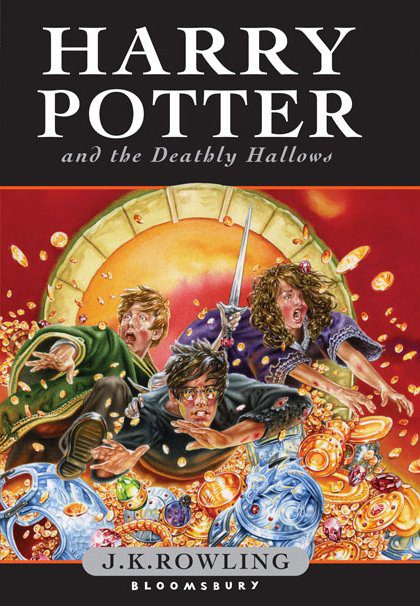 YOU EXPECT many things when you read a new Harry Potter novel: magic, humour, a set of mysteries, a looming battle between good and evil, even some clunky exposition. But you don’t necessarily expect to see quotes from Christian scripture.
And yet, there they are, on pages 266 and 268 of Harry Potter and the Deathly Hallows — the seventh and final installment of J.K. Rowling’s phenomenally popular series about a boy who goes to a school for people born with magical powers.
The book, which runs to 607 pages, is not quite half finished when Harry and his friend Hermione Granger visit a cemetery and see a pair of tombstones. One marks the grave of two relatives of Albus Dumbledore, the wise Hogwarts School of Witchcraft and Wizardry headmaster who died at the end of the previous book. The other marks the final resting place of Harry’s parents, James and Lily Potter.
The quote over the Dumbledore grave says, simply: “Where your treasure is, there will your heart be also.” Treasure is a recurring theme in this book — at one point, Harry and his friends Ron and Hermione have to break into a bank run by goblins — but those who recognize this passage will also remember that Jesus speaks this line after telling his followers to store up treasure in Heaven rather than on Earth.
And that takes us to the quote on the Potter grave, which states: “The last enemy that shall be destroyed is death.” Harry is puzzled, indeed horrified, by this quote at first. Hasn’t Dumbledore told him that the well-organized mind has nothing to fear from death? Isn’t the evil of the Dark Lord Voldemort rooted partly in his own fear of death, and in the obsessive way he and his followers cling to this life at all costs?
Hermione sets Harry right and tells him this quote must refer to something different. “It means . . . you know . . . living beyond death,” she says. “Living after death.”
Incidentally, Harry and Hermione happen to be having this conversation on Christmas Eve. Behind a church. Which, until a page or two before, was filled with people singing Christmas carols.
Over the years, the Harry Potter books have been attacked from various angles. To some, the books promote forms of sorcery that are clearly forbidden in the Bible — though I don’t think either the biblical authors or modern-day practitioners of Wicca have time travel and broomstick rides in mind when they discuss “witchcraft”.
To others, the books are too secular. Unlike the fantasies of C.S. Lewis and J.R.R. Tolkien, the writings of J.K. Rowling make no direct reference to God figures; no one seems to be “in charge”, as it were. And while the wizards speak of holidays and godfathers and so on, they do not seem to have any religion of their own.
Yet, as even conservative Christians like John Granger have noted, the books have always had at least an implicit or residual Christian sensibility. Rowling’s imagination has always been deeply informed by medieval symbolism, and to the extent that those symbols carry images of Christ within them, so too do her books.
Harry Potter and the Deathly Hallows does not completely resolve the confusion over what is literal and what is allegorical in Rowling’s world, and it suffers from other flaws too, but it does suggest more powerfully than any of the previous books that Rowling has a belief — or at least a hope — in the reality of the life to come.
Without giving too much away, suffice it to say that the most crucial moment in this book — and thus the entire series — involves a character obediently going to his death, surrounded by a “cloud of witnesses” (my term, not Rowling’s) from beyond the grave who seem “more real” (Rowling’s term, not mine) than the living.
It is a powerful, powerful portrayal of what is, in essence, an act of martyrdom. And it is quotes from scripture that help to prepare the reader for this moment.
This stands in stark contrast to the sorts of things we see in other best-selling books for children these days. Lemony Snicket’s A Series of Unfortunate Events, for example, takes occasional jabs at religion — the “Cathedral of the Alleged Virgin”, anyone? — and a climactic moment in the final novel involves a friendly snake emerging from a tree to give some people an apple that will heal them.
And then, of course, there is Philip Pullman’s His Dark Materials trilogy, in which God dies the most pathetic death imaginable while an ex-nun explains to a couple of children that Christianity is just “a very powerful and convincing mistake”. A major subplot also celebrates the annihilation of the soul. (The first part of the trilogy, The Golden Compass, makes the jump to the big screen in just a few months.)
In a market where popular and well-written children’s books turn scripture on its head, it is, if anything, refreshing to see scripture invoked in support of the key themes in the Harry Potter books. For this, we should celebrate the books, not condemn them — even as we encourage our children and each other to be more discerning readers.
Related stories:
This is how it will go down
Here’s how it should go down: Harry both dies and lives. It can be done. Rowling once said that she keeps her belief in God private “because if I talk too freely about that, I think the intelligent reader, whether 10 or 60, will be able to guess what’s coming.” Hmm. Guided by this comment, I think Harry could invert the Christian myth, and sacrifice his “godly” wizard identity — death of a sort — and be “reborn” a humble Muggle. I’m not sure of the mechanics of it all, but in the end he would accept this (prophecy-fulfilling) martyrdom as the price for vanquishing Voldemort in some apocalyptic confrontation.
Barbara Kay, National Post, July 18
Churches co-opt Potter’s magic
Poor Harry Potter. As if battling Voldemort, Death Eaters and Dementors wasn’t enough, the boy wizard has also endured the wrath of religious conservatives in the decade since J.K. Rowling’s books first found their way into the hearts of young Muggles the world over. There have been book burnings, book bans and even a declaration by one Catholic Church official last year that Harry Potter is “the devil.” But with Potter fans already lining up ahead of the final book release this Saturday, some Christian denominations are now eschewing condemnation for praise, embracing Ms. Rowling’s tales as powerful religious fables for our time.
Globe and Mail, July 19
Harry Potter, Good or Evil?
globeandmail.com has invited an inter-faith panel to debate these issues online and to take questions about Harry Potter and religion from our readers. The first two mini-essays are printed below. We asked the panelists to answer two questions: What does your religion/faith/creed say about magic, witchcraft and wizardry? How does your faith deal with the phenomenal interest among children — and adults — in Harry Potter’s fictional world?
Globe and Mail, July 19
— A version of this article was first published in BC Christian News*.*
harry potter and the deathly hallows
lemony snicket's a series of unfortunate events
Previous Post

August 15, 2007
Newsbites: Morris! Maher! Voyage! Escape!
Next Post
August 16, 2007 Deathly Hallows -- the article's up!
Browse Our Archives
Select a Category Anglican Planet Articles BC Christian News BC Report Bible Movies Bible Review Blog Books & Culture Campus Times CBC Radio Christianity Today ChristianWeek Essays Faith Today Festival Cinemas Guide Film Journals Georgia Straight Interviews MB Herald National Catholic Register Salvationist Today's Christian Two Chairs Ubyssey Uncategorized Vancouver Courier Vancouver Sun
Select a Month August 2025 April 2025 January 2025 December 2024 November 2024 May 2024 February 2024 December 2023 May 2023 March 2023 November 2022 July 2022 June 2022 May 2022 April 2022 February 2022 January 2022 December 2021 November 2021 October 2021 September 2021 August 2021 July 2021 June 2021 April 2021 March 2021 February 2021 January 2021 December 2020 November 2020 October 2020 August 2020 July 2020 June 2020 May 2020 March 2020 February 2020 January 2020 December 2019 November 2019 September 2019 July 2019 May 2019 April 2019 March 2019 February 2019 January 2019 December 2018 November 2018 October 2018 September 2018 July 2018 June 2018 May 2018 April 2018 March 2018 February 2018 January 2018 December 2017 November 2017 October 2017 September 2017 August 2017 July 2017 June 2017 May 2017 April 2017 March 2017 February 2017 January 2017 December 2016 November 2016 October 2016 September 2016 August 2016 July 2016 June 2016 May 2016 April 2016 March 2016 February 2016 January 2016 December 2015 November 2015 October 2015 September 2015 August 2015 July 2015 June 2015 May 2015 April 2015 March 2015 February 2015 January 2015 December 2014 November 2014 October 2014 September 2014 August 2014 July 2014 June 2014 May 2014 April 2014 March 2014 February 2014 January 2014 December 2013 November 2013 October 2013 September 2013 August 2013 July 2013 June 2013 May 2013 April 2013 March 2013 February 2013 January 2013 December 2012 November 2012 October 2012 September 2012 August 2012 July 2012 June 2012 April 2012 January 2012 January 2011 December 2010 November 2010 October 2010 September 2010 August 2010 July 2010 June 2010 May 2010 April 2010 March 2010 February 2010 January 2010 December 2009 November 2009 October 2009 September 2009 August 2009 July 2009 June 2009 May 2009 April 2009 March 2009 February 2009 January 2009 December 2008 November 2008 October 2008 September 2008 August 2008 July 2008 June 2008 May 2008 April 2008 March 2008 February 2008 January 2008 December 2007 November 2007 October 2007 September 2007 August 2007 July 2007 June 2007 May 2007 April 2007 March 2007 February 2007 January 2007 December 2006 November 2006 October 2006 September 2006 August 2006 July 2006 June 2006 May 2006 April 2006 March 2006 February 2006 January 2006 December 2005 November 2005 October 2005 September 2005 August 2005 July 2005 June 2005 May 2005 April 2005 March 2005 January 2005 December 2004 November 2004 October 2004 September 2004 August 2004 July 2004 June 2004 May 2004 April 2004 March 2004 February 2004 January 2004 November 2003 October 2003 August 2003 July 2003 June 2003 May 2003 January 2003 December 2002 November 2002 August 2002 July 2002 June 2002 May 2002 March 2002 January 2002 December 2001 November 2001 September 2001 August 2001 July 2001 June 2001 April 2001 March 2001 February 2001 December 2000 November 2000 October 2000 September 2000 August 2000 July 2000 June 2000 May 2000 April 2000 March 2000 January 2000 October 1999 August 1999 May 1999 April 1999 February 1999 January 1999 December 1998 November 1998 October 1998 August 1998 July 1998 June 1998 April 1998 March 1998 January 1998 November 1997 September 1997 July 1997 June 1997 April 1997 March 1997 February 1997 January 1997 December 1996 October 1996 September 1996 June 1996 March 1996 February 1996 January 1996 April 1995 November 1994 September 1994 September 1991
Follow Us!
TAKE THE
Religious Wisdom Quiz
What does "Gideon" mean in Hebrew?
Select your answer to see how you score.
God is my Strength Warrior Hewer Redeemer
Related posts from FilmChat
Review: Fantastic Beasts: The Secrets of Dumbledore (dir....
Box office: Fantastic Beasts underperforms Harry Potter in...

The New World a feast for the senses...
Jack Thorne to write His Dark Materials reboot...
TRENDING AT PATHEOS Religious Music & Entertainment

"Les Diabolique" and Transgression
Alongside something like Arrival, Vertigo, or Charade, Les Diaboliques is a...

"The Plague Dogs" and Mortality
So, flashback to the late 70s, early 80s. Walt Disney Studios is...

With the recent and highly successful release of Christopher Nolan’s epic film,...

"L'avventura" and Human Weakness
Today's piece is going to be a little different for a few...

I first want to apologize for not posting or writing anything. I'm...

I've engaged in the multi-year project of reading through the Church Fathers,...
view all Religious Music & Entertainment blogs
Ad-Free & Subscriber Log-In Subscription Support
- About Us
- 2026 Calendar
- Videos
- Podcasts
- Library of World Religions
- Faith In Media Tracker
- Advertise With Us
- Write for Us
- Privacy Policy
- Terms of Service
- Do Not Sell My Data
- Contact Us
- Radiant Digital
- Manage Newsletter Subscriptions
- Unsubscribe From Notifications
- Sitemap
Copyright 2008-2026, Patheos. All rights reserved.
Subscription Support Ad-Free & Subscriber Log-In
Follow Patheos