
BuddhistCatholicContemplativeEvangelicalGeneral ChristianHinduJewishLatter-day SaintMuslimNew VisionsProgressive Christian
Beliefs
- Buddhist
- Catholic
- Contemplative
- Evangelical
- General Christian
- Hindu
- Jewish
- Latter-day Saint
- More Voices
- Muslim
- New Visions
- Pagan
- Progressive Christian
Topics
- Religion News
- Food and Religion
- Sports and Religion
- Religious Art
- Religious Music and Entertainment
- Religious Events
- History and Religion
- Style and Religion
- Politics and Religion
- Women in Religion
- Recreation Outdoors and Religion
- Business Finance and Religion
- Careers Workplace and Religion
- Education and Religion
- Family Parenting and Religion
- Health Fitness and Religion
- Home and Religion
- Relationships and Religion
- Technology and Religion
- Travel and Religion
Columnists
- Buddhist Columnists
- Business Finance and Religion Columnists
- Careers Workplace and Religion Columnists
- Catholic Columnists
- Contemplative Columnists
- Education and Religion Columnists
- Evangelists Columnists
- Family Parenting and Religion Columnists
- General Christian Columnists
- Health Fitness and Religion Columnists
- Hindu Columnists
- History and Religion Columnists
- Home and Religion Columnists
- Jewish Columnists
- More Voices Columnists
- Latter Day Columnists
- Muslim Columnists
- New Visions Columnists
- Nonreligious Columnists
- Pagan Columnists
- Politics and Religion Columnists
- Progressive Columnists
- Recreation Outdoors and Religion Columnists
- Relationships and Religion Columnists
- Religion News Columnists
- Religious Art Columnists
- Religious Events Columnists
- Religious Music and Entertainment Columnists
- Sports and Religion Columnists
- Style and Religion Columnists
- Technology and Religion Columnists
- Travel and Religion Columnists
- Women in Religion Columnists
Resource Library
- 2026 Calendar
- Library of World Religions
- The 100 Most Holy Places on Earth
- Patheos Answers
- Podcasts
- Videos
- Faith Leaders Database
- Anglican Episcopalian
- Bahai
- Baptist
- Buddhism
- Christianity
- Confucianism
- Eastern Orthodoxy
- Hinduism
- Holiness and Pentecostal
- ISKCON
- Islam
- Judaism
- Lutheran
- Methodist
- The Church of Jesus Christ of Latter-day Saints
- New Age
- Paganism
- Presbytarian and Reformed
- Protestantism
- Religion Behind the Scenes
- Roman Catholic
- Scientology
- Shia Islam
- Sikhism
- Sufism
- Sunni Islam
- Taoism
- Zen
- See all religions
Research Tools
 Ad-Free & Subscriber Log-In Subscription Support
Ad-Free & Subscriber Log-In Subscription Support
Follow Patheos 

- Trending:
- Forgiveness
- |
- Marriage
- |
- Consciousness
- |
- Death Penalty
- |
- Election
- |
- Halloween

-
Articles
- Home
- Religious Music & Entertainment
- Review: Next (dir. Lee Tamahori, 2007)
Review: Next (dir. Lee Tamahori, 2007)
Last updated on: June 4, 2014 at 11:57 pm by Peter T. Chattaway
Review: Next (dir. Lee Tamahori, 2007) 2014-06-04T23:57:57-07:00 Peter T. Chattaway
Patheos Explore the world's faith through different perspectives on religion and spirituality! Patheos has the views of the prevalent religions and spiritualities of the world.
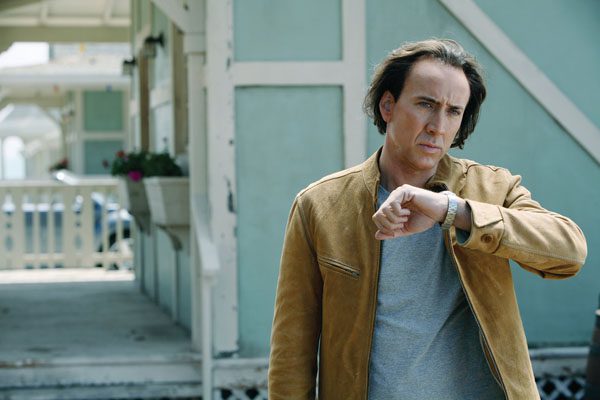 You know how movies sometimes make you think certain things are happening, and then one of the characters wakes up and realizes it was all a dream? Used once or twice, this device can be pretty effective, but used too often — or too excessively, like the time the writers on Dallas decided that an entire season’s worth of episodes never took place — it can be the most groan-inducing of gimmicks.
That isn’t exactly what happens in Next, the latest film to be based on one of Philip K. Dick’s trippy, mind-bending stories (in this case, The Golden Man), but it’s pretty close. The film stars Nicolas Cage as Cris Johnson, a man who can see up to two minutes into his own future — and if he doesn’t like what he sees, then he can change his course of action and bring about a different future. But Cris does not merely see his future, as though he were observing it from a distance; he seems to actually experience his future, and it is only after he reaches a bad end that he mentally hits the “reset” button and decides to do things differently.
The result is that we in the audience experience these various alternate timelines with Cris, but whereas he knows that they lie in the future, we assume — at least the first few times — that we are experiencing the present. So when Cris hits his personal “reset” button, the rug is pulled out from under us. And throughout the earlier parts of this film, at least, it gets pulled again, and again, and again.
To be fair, the film has some fun with this conceit. When Cris wants to introduce himself to a girl — more on her in a moment — he visualizes multiple ways of walking up to her and getting her attention, most of which end in failure. We assume his first effort to meet her is the real thing, and then maybe his second effort, but by the sixth or eighth attempt or whatever, we’re in on the joke. It’s a little like watching Bill Murray’s various attempts to seduce Andie MacDowell in Groundhog Day, except we know that Cris must work more quickly, due to his two-minute time limit.
Sometimes, however, the film just lets us sit and watch Cris use those reflexes, and when it isn’t trying too hard to impress us, the results can be quite clever.
To hide the fact that he really can see the future, Cris works in Las Vegas as a stage magician named Frank Cadillac — so if anybody ever thinks his behavior is a little odd or uncanny, they’ll just chalk it up to tricks of the trade. To kill time between acts, he sometimes sits down for a card game or two at one of the other casinos — and when the security guards get suspicious, he escapes by knowing exactly where to stand, where to walk, and where to hide his face at any given moment.
Cris’s escape from the casino is smooth, calm, and basically believable. But in later scenes, his feats turn downright superhuman. Dodging a bullet seems plausible enough — if you can see a wee bit into the future and step to the side, that is — but what kind of mind could process all the information it would take to dodge an entire avalanche full of crashing logs, vehicles, and various other kinds of debris? The question is even more daunting when you consider that, in all the other timelines Cris sees during that avalanche, he probably dies or is seriously wounded.
There are moments when Cris hints at what it must be like to live with the memory of those experiences, but only moments. Most of the time he’s too busy dodging other people’s attempts to get him — and this is where some of the film’s cheesier elements come into play. The FBI, led in part by Callie Ferris (Julianne Moore), wants Cris to help them find a missing nuclear bomb before it goes off, and they are prepared to trample all over his rights in order to force him to do their bidding. Meanwhile, the bad guys — a mix of German, French, British and other Europeans — get wind of the FBI’s plan, so they try to kill Cris before the FBI can get him.
And then there is the girl. Normally, Cris can see only two minutes into the future, and normally, he can see only his own future; but for some reason he has seen a girl named Liz (Jessica Biel) sitting in a diner at a certain time of day, so he makes a point of going to that diner every day and waiting for her there. And once he meets her, romance ensues, though you have to wonder how fulfilling a relationship can be when the other person’s actions are never a surprise, or when the other person’s actions can be manipulated in some way. In fact, one of the unstated assumptions behind this movie seems to be that it is only Cris who has free will. (Or does he? Maybe seeing the future compels him to make certain choices in the present.)
At any rate, everything in the story from this point on hinges on the relationship between Cris and Liz, and while some of their initial scenes together are cute enough, some of the dialogue between them is quite laughable, and never more so than when they are supposed to be getting serious about each other.
Film buffs might appreciate some of the allusions to other, better movies. There are at least two strong Stanley Kubrick references — one of which, involving a device that props a man’s eyes open, ends on yet another ludicrous note. And when Peter Falk shows up, for no particular reason, as one of Cris’s friends, you may find yourself recalling that Falk starred in Wim Wenders’ Wings of Desire while Cage starred in its Hollywood remake, City of Angels. (And between this film and The Illusionist, it would seem that Jessica Biel has a thing for magicians.)
The screenplay — credited to Gary Goldman (Total Recall), Jonathan Hensleigh (The Punisher) and Paul Bernbaum (Hollywoodland) — has some themes in common with other recent adaptations of Philip K. Dick’s work. The early scenes bring to mind Minority Report, which also explored the idea that seeing the future could allow us to prevent it. But the later scenes — in which the fates of all the characters come together in a flurry of guns and explosions — bring to mind Paycheck, because they share with that film a certain lack of suspense. If the hero has already seen the future and taken it into account, then what difference does it make how many people chase him or how many bullets fly? We know that he’s prepared for all that.
The script has even bigger problems, though, some of which I can’t get into here for spoiler reasons. But suffice it to say that there are a few major plot holes, and while some moviegoers will want to come out of the theatre talking about some of the really cool concepts the film explores — like the relationship between memory and experience and objective reality — others will come out of the theater wanting to rip the movie apart. And the film will have given them ample opportunity to do so.
2.5 stars (out of 4)
–
Talk About It
Discussion starters
1. Cris says that when you see the future, you change it. Do you agree? What role do things like prophecy and free will play in this? (See 1 Samuel 23:7-13 or debates between “open theists” and “classical theists.”)
3. If you “experience” something in a movie, does it really happen? What if the movie tells you afterwards that the experience wasn’t real? If it felt “real” while you were watching the movie, does that feeling still count for something? How does your experience of these alternate futures parallel Cris’s experience? How is it different?
The Family Corner
For parents to consider
Next is rated PG-13 for intense sequences of violent action (including lots of gunplay and a few very significant explosions), and some language (about half-a-dozen four-letter words). Two characters sleep together after knowing each other for only a day or so, and are shown in bed together afterwards.
— A version of this review was first published at Christianity Today Movies.
Previous Post

April 25, 2007
Mike White on enthusiasm and repression
Next Post
April 27, 2007 Next -- the review's up!
Browse Our Archives
Select a Category Anglican Planet Articles BC Christian News BC Report Bible Movies Bible Review Blog Books & Culture Campus Times CBC Radio Christianity Today ChristianWeek Essays Faith Today Festival Cinemas Guide Film Journals Georgia Straight Interviews MB Herald National Catholic Register Salvationist Today's Christian Two Chairs Ubyssey Uncategorized Vancouver Courier Vancouver Sun
Select a Month August 2025 April 2025 January 2025 December 2024 November 2024 May 2024 February 2024 December 2023 May 2023 March 2023 November 2022 July 2022 June 2022 May 2022 April 2022 February 2022 January 2022 December 2021 November 2021 October 2021 September 2021 August 2021 July 2021 June 2021 April 2021 March 2021 February 2021 January 2021 December 2020 November 2020 October 2020 August 2020 July 2020 June 2020 May 2020 March 2020 February 2020 January 2020 December 2019 November 2019 September 2019 July 2019 May 2019 April 2019 March 2019 February 2019 January 2019 December 2018 November 2018 October 2018 September 2018 July 2018 June 2018 May 2018 April 2018 March 2018 February 2018 January 2018 December 2017 November 2017 October 2017 September 2017 August 2017 July 2017 June 2017 May 2017 April 2017 March 2017 February 2017 January 2017 December 2016 November 2016 October 2016 September 2016 August 2016 July 2016 June 2016 May 2016 April 2016 March 2016 February 2016 January 2016 December 2015 November 2015 October 2015 September 2015 August 2015 July 2015 June 2015 May 2015 April 2015 March 2015 February 2015 January 2015 December 2014 November 2014 October 2014 September 2014 August 2014 July 2014 June 2014 May 2014 April 2014 March 2014 February 2014 January 2014 December 2013 November 2013 October 2013 September 2013 August 2013 July 2013 June 2013 May 2013 April 2013 March 2013 February 2013 January 2013 December 2012 November 2012 October 2012 September 2012 August 2012 July 2012 June 2012 April 2012 January 2012 January 2011 December 2010 November 2010 October 2010 September 2010 August 2010 July 2010 June 2010 May 2010 April 2010 March 2010 February 2010 January 2010 December 2009 November 2009 October 2009 September 2009 August 2009 July 2009 June 2009 May 2009 April 2009 March 2009 February 2009 January 2009 December 2008 November 2008 October 2008 September 2008 August 2008 July 2008 June 2008 May 2008 April 2008 March 2008 February 2008 January 2008 December 2007 November 2007 October 2007 September 2007 August 2007 July 2007 June 2007 May 2007 April 2007 March 2007 February 2007 January 2007 December 2006 November 2006 October 2006 September 2006 August 2006 July 2006 June 2006 May 2006 April 2006 March 2006 February 2006 January 2006 December 2005 November 2005 October 2005 September 2005 August 2005 July 2005 June 2005 May 2005 April 2005 March 2005 January 2005 December 2004 November 2004 October 2004 September 2004 August 2004 July 2004 June 2004 May 2004 April 2004 March 2004 February 2004 January 2004 November 2003 October 2003 August 2003 July 2003 June 2003 May 2003 January 2003 December 2002 November 2002 August 2002 July 2002 June 2002 May 2002 March 2002 January 2002 December 2001 November 2001 September 2001 August 2001 July 2001 June 2001 April 2001 March 2001 February 2001 December 2000 November 2000 October 2000 September 2000 August 2000 July 2000 June 2000 May 2000 April 2000 March 2000 January 2000 October 1999 August 1999 May 1999 April 1999 February 1999 January 1999 December 1998 November 1998 October 1998 August 1998 July 1998 June 1998 April 1998 March 1998 January 1998 November 1997 September 1997 July 1997 June 1997 April 1997 March 1997 February 1997 January 1997 December 1996 October 1996 September 1996 June 1996 March 1996 February 1996 January 1996 April 1995 November 1994 September 1994 September 1991
Follow Us!
TAKE THE
Religious Wisdom Quiz
Who was made mute and only spoke God's word until Jerusalem fell?
Select your answer to see how you score.
Jonah Ezekiel Daniel Amos
Related posts from FilmChat
Sidney Poitier marathon: A Raisin in the Sun...

Review: Stay (dir. Marc Forster, 2005)

Moses at the Movies / When we trace...

Review: Wanted (dir. Timur Bekmambetov, 2008)
TRENDING AT PATHEOS Religious Music & Entertainment

"Les Diabolique" and Transgression
Alongside something like Arrival, Vertigo, or Charade, Les Diaboliques is a...

"The Plague Dogs" and Mortality
So, flashback to the late 70s, early 80s. Walt Disney Studios is...

With the recent and highly successful release of Christopher Nolan’s epic film,...

"L'avventura" and Human Weakness
Today's piece is going to be a little different for a few...

I first want to apologize for not posting or writing anything. I'm...

I've engaged in the multi-year project of reading through the Church Fathers,...
view all Religious Music & Entertainment blogs
Ad-Free & Subscriber Log-In Subscription Support
- About Us
- 2026 Calendar
- Videos
- Podcasts
- Library of World Religions
- Faith In Media Tracker
- Advertise With Us
- Write for Us
- Privacy Policy
- Terms of Service
- Do Not Sell My Data
- Contact Us
- Radiant Digital
- Manage Newsletter Subscriptions
- Unsubscribe From Notifications
- Sitemap
Copyright 2008-2026, Patheos. All rights reserved.
Subscription Support Ad-Free & Subscriber Log-In
Follow Patheos