
BuddhistCatholicContemplativeEvangelicalGeneral ChristianHinduJewishLatter-day SaintMuslimNew VisionsProgressive Christian
Beliefs
- Buddhist
- Catholic
- Contemplative
- Evangelical
- General Christian
- Hindu
- Jewish
- Latter-day Saint
- More Voices
- Muslim
- New Visions
- Pagan
- Progressive Christian
Topics
- Religion News
- Food and Religion
- Sports and Religion
- Religious Art
- Religious Music and Entertainment
- Religious Events
- History and Religion
- Style and Religion
- Politics and Religion
- Women in Religion
- Recreation Outdoors and Religion
- Business Finance and Religion
- Careers Workplace and Religion
- Education and Religion
- Family Parenting and Religion
- Health Fitness and Religion
- Home and Religion
- Relationships and Religion
- Technology and Religion
- Travel and Religion
Columnists
- Buddhist Columnists
- Business Finance and Religion Columnists
- Careers Workplace and Religion Columnists
- Catholic Columnists
- Contemplative Columnists
- Education and Religion Columnists
- Evangelists Columnists
- Family Parenting and Religion Columnists
- General Christian Columnists
- Health Fitness and Religion Columnists
- Hindu Columnists
- History and Religion Columnists
- Home and Religion Columnists
- Jewish Columnists
- More Voices Columnists
- Latter Day Columnists
- Muslim Columnists
- New Visions Columnists
- Nonreligious Columnists
- Pagan Columnists
- Politics and Religion Columnists
- Progressive Columnists
- Recreation Outdoors and Religion Columnists
- Relationships and Religion Columnists
- Religion News Columnists
- Religious Art Columnists
- Religious Events Columnists
- Religious Music and Entertainment Columnists
- Sports and Religion Columnists
- Style and Religion Columnists
- Technology and Religion Columnists
- Travel and Religion Columnists
- Women in Religion Columnists
Resource Library
- 2026 Calendar
- Library of World Religions
- The 100 Most Holy Places on Earth
- Patheos Answers
- Podcasts
- Videos
- Faith Leaders Database
- Anglican Episcopalian
- Bahai
- Baptist
- Buddhism
- Christianity
- Confucianism
- Eastern Orthodoxy
- Hinduism
- Holiness and Pentecostal
- ISKCON
- Islam
- Judaism
- Lutheran
- Methodist
- The Church of Jesus Christ of Latter-day Saints
- New Age
- Paganism
- Presbytarian and Reformed
- Protestantism
- Religion Behind the Scenes
- Roman Catholic
- Scientology
- Shia Islam
- Sikhism
- Sufism
- Sunni Islam
- Taoism
- Zen
- See all religions
Research Tools
 Ad-Free & Subscriber Log-In Subscription Support
Ad-Free & Subscriber Log-In Subscription Support
Follow Patheos 

- Trending:
- Forgiveness
- |
- Marriage
- |
- Consciousness
- |
- Death Penalty
- |
- Election
- |
- Halloween

-
Articles
- Home
- Religious Music & Entertainment
- Interview: David Belton (Beyond the Gates, 2005)
Interview: David Belton (Beyond the Gates, 2005)
Last updated on: April 8, 2016 at 10:42 am by Peter T. Chattaway
Interview: David Belton (Beyond the Gates, 2005) 2016-04-08T10:42:27-07:00 Peter T. Chattaway
Patheos Explore the world's faith through different perspectives on religion and spirituality! Patheos has the views of the prevalent religions and spiritualities of the world.
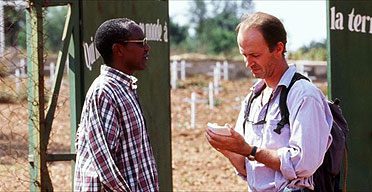 It has been over a dozen years since the Rwandan genocide — an atrocity in which as many as 800,000 Tutsis and Hutu sympathizers were killed by Hutu extremists in just a few months, while the outside world turned a blind eye or, worse, withdrew what little help it had offered in the first place.
David Belton covered the genocide as a reporter for the BBC. He went on to become a producer of documentaries like War Spin and Soldiers to Be, and he returned to Rwanda for his first dramatic film, Beyond the Gates, now showing in limited theaters. (Look for our review on Friday.)
Beyond the Gates, co-written and produced by Belton, is one of a recent spate of films about the genocide that began with the Oscar-nominated Hotel Rwanda and also includes Sometimes in April, A Sunday in Kigali and the upcoming Shake Hands with the Devil. One thing that sets this film apart, though, is the fact that its protagonist is a Catholic priest whose response to the atrocity is rooted in his own religious convictions.
Belton spoke about the film in a phone interview from his office in Great Britain.
Why did you pick this topic for your first non-documentary?
Belton: I had been a journalist for the BBC in Rwanda in 1994, and had covered the genocide, and had spent quite a lot of time out there during the events that the film depicts. So it was a story that was very close to my heart. When you move from the world of documentary to the world of drama, you’ve got to be really sure of yourself and the messages you want to convey, because it’s a much more powerful medium. And so I wanted to be sure that I was going to tell a story that was close to my heart, something that I felt very strongly about.
Were you aware when you chose this project that there were other Rwanda films in development at the time?
Belton: Yes. I knew Terry George was making Hotel Rwanda, and for a time we were kind of running along in parallel with them. But we fell behind them because we were very keen to make the film in Rwanda. [Hotel Rwanda was shot mostly in South Africa.] I knew the people there, and I knew that they would have wanted this film to be made in Rwanda. And it became very clear to me that we should be making it in the place where the actual story happened.
I think we’ve got a film that is very authentic and something that anyone who was involved in making the film found to be an extraordinary experience, and one they will carry for the rest of their lives. And of course it was wonderful to be in Rwanda and to help the Rwandans tell their own story.
Did going back to Rwanda and having to relive this bring back bad memories?
Belton: Yeah. The memories never go away, but certainly, going back brings the memories to the forefront. But to be honest, as bad as the memories are, they kind of disappear into the background when you start to form friendships with the Rwandans themselves, and everything they went through. My experience was very traumatic at times, but it was a thousandth of what was going on for Rwandans. I found certain scenes difficult to watch; there were times when I would just walk away, and that was fine for me to do that.
I think Rwanda was really pleased that we came there to make this film, and part of that reason, I think, is that the process of reconciliation for these two ethnic groups — Hutus and Tutsis — to come together and live together as one, as they did before 1994, requires a huge amount of reconciliation. And reconciliation involves going through the history of what happened, and talking about it. And I think our film, for all those who participated in it, and indeed for all those Rwandans who have now watched it, I think they found it a cathartic experience.
I think it was helpful, in terms of the reconciliation; it was almost as though they were being allowed to own their own trauma. This wasn’t a bunch of westerners in white coats coming in with stethoscopes and telling them how they were feeling. This is about Rwandans actually taking part in the process of making this film, being very collaborative in it, and in that process, owning their own history for a change, rather than being told what to feel and what not to feel. So it was a very rewarding and emotional experience, to be there with Rwandans who wanted to be part of this.
And of course, there were Rwandans who didn’t, who said we understand why you’re doing this, we’re glad you’re here, but this is not something we want to go back and re-enact ourselves. And for those people of course, I have a huge amount of respect. They didn’t take part in the film, but they certainly supported it.
Why does the story focus on the priest, or bring the religious element so into the foreground as it does?
Belton: The part of Father Christopher, played by John Hurt, is very much inspired by a man that I knew in Rwanda during the genocide, a European priest. He was only one of two European priests who stayed in Rwanda throughout the genocide, and in the course of his time there, he saved the lives of thousands of Rwandans, and he almost certainly saved the lives of myself and my television crew at the time as well. So I was profoundly moved by this man and his sense of spirit, his resolve, and his bravery in what he was doing and the way he was defying the extremist militias and refusing to leave. I felt that that was a role that deserved to be honored.
But I think it went deeper, because when we started to write the story, we didn’t start from the point of, “Let’s write about a Catholic priest and kind of see what happens.” The start point was, “What does it take to do the right thing? Do people have the depth of faith, the conviction, the courage to stand up and do what is right in their hearts?” And only by asking that question first did we feel comfortable about having a priest as the main character in the film. Because of course, through the journey that he takes in this film, he goes from a very spiritually depleted place to somewhere where his soul is very much revived, and it’s in that moment of change that the question is answered, about whether it is possible to do the right thing. And in Father Christopher’s world, to do the right thing is to re-assert his own Christian values.
But it would have been just as likely, or just as possible, to make the main character a doctor, for example. I knew a doctor in Rwanda, and there were times that he was very, very low, very despairing of what he was seeing, and he just didn’t see the point in what he was doing. But he goes back into the operating theater the next day, saving people’s lives, and he has his own spiritual resurgence. So it does have a religious theme, but it’s about spirituality, I think, as much as anything else.
I was struck by how the film not only makes the main character a priest, but also shows people discussing the nature of the mass, or reciting the creed, things like that.
Belton: I think sometimes people pay lip service to a person’s job in a film, but if the person’s job is instrumental in the decisions they make about whether to stay or leave — and in the end, Father Christopher’s decision to stay or leave is based entirely on his faith — then we need to see that faith. We need to see where it is being practiced with vigor, and we need to see where it is being practiced with a rather faint heart. John delivers a fantastic performance in that.
Being in Africa a lot in the last 20 years, I’ve seen priests who are at a low ebb — you can see they’re just going through the motions — and you can see them a month later feeling really revived, because Africa is that sort of place. It isn’t a place where you just bumble along in your own little world. You have big highs and big lows, it’s that kind of continent. So we felt very strongly that if you’re going to tell the story of a priest, then tell it correctly and embrace what he did, so that when people see what he finally decides to do, they kind of understand the journey that he’s come from.
The film’s original title was Shooting Dogs when it played in other parts of the world, but now that it’s coming to the U.S., the title has been changed to Beyond the Gates. One report said the original title was perceived to be too “cynical” and would appeal to the urban arthouse market, but not to the spiritual heartland. Do you agree?
Belton: I don’t have a problem with the new title. I don’t think “Shooting Dogs” was cynical; I think it’s a very tough title, and I think what we want to be able to do is reach out with this film; I don’t want to alienate people. I think all things need to be adapted sometimes to bring in as many people as possible so they can share this experience. And everyone has different tastes, and certainly the European taste is slightly different from the American one. So the decision was made to change it.
If we can reach out into more than just the liberal arts community, and if we can get people into the cinemas that otherwise would not go, that’s a good thing. Because when it comes to questions about who we are and what sort of world we want to live in, this film is posing those questions.
Were you surprised to hear that they were going to give it this special push to the religious market?
Belton: No, I wasn’t surprised. I was really keen for it to happen. I went down to Louisiana last April to see some friends who had taken part in the film. They were really keen to show the film to an audience, and we got a packed audience — 500 people crammed into the theater. And they all just came out absolutely blown away, and they all took something very strong and spiritual from it, in a way that I hadn’t witnessed before in the U.K. or in Europe. Everyone took their own kind of spiritual feelings away from it. This film does do that; it does really get people in that way. And why not put a push in that direction, to get audiences that wouldn’t otherwise see a film about an African genocide, and get them to feel that this is a really worthwhile experience and they’re really glad they saw it?
Go to the official website to learn more about the film and to see the trailer.
— A version of this interview was first published at Christianity Today Movies.
Previous Post

March 13, 2007
Newsbites: Plissken! Becket! Commandments!
Next Post
March 13, 2007 Beyond the Gates -- the interview's up!
Browse Our Archives
Select a Category Anglican Planet Articles BC Christian News BC Report Bible Movies Bible Review Blog Books & Culture Campus Times CBC Radio Christianity Today ChristianWeek Essays Faith Today Festival Cinemas Guide Film Journals Georgia Straight Interviews MB Herald National Catholic Register Salvationist Today's Christian Two Chairs Ubyssey Uncategorized Vancouver Courier Vancouver Sun
Select a Month August 2025 April 2025 January 2025 December 2024 November 2024 May 2024 February 2024 December 2023 May 2023 March 2023 November 2022 July 2022 June 2022 May 2022 April 2022 February 2022 January 2022 December 2021 November 2021 October 2021 September 2021 August 2021 July 2021 June 2021 April 2021 March 2021 February 2021 January 2021 December 2020 November 2020 October 2020 August 2020 July 2020 June 2020 May 2020 March 2020 February 2020 January 2020 December 2019 November 2019 September 2019 July 2019 May 2019 April 2019 March 2019 February 2019 January 2019 December 2018 November 2018 October 2018 September 2018 July 2018 June 2018 May 2018 April 2018 March 2018 February 2018 January 2018 December 2017 November 2017 October 2017 September 2017 August 2017 July 2017 June 2017 May 2017 April 2017 March 2017 February 2017 January 2017 December 2016 November 2016 October 2016 September 2016 August 2016 July 2016 June 2016 May 2016 April 2016 March 2016 February 2016 January 2016 December 2015 November 2015 October 2015 September 2015 August 2015 July 2015 June 2015 May 2015 April 2015 March 2015 February 2015 January 2015 December 2014 November 2014 October 2014 September 2014 August 2014 July 2014 June 2014 May 2014 April 2014 March 2014 February 2014 January 2014 December 2013 November 2013 October 2013 September 2013 August 2013 July 2013 June 2013 May 2013 April 2013 March 2013 February 2013 January 2013 December 2012 November 2012 October 2012 September 2012 August 2012 July 2012 June 2012 April 2012 January 2012 January 2011 December 2010 November 2010 October 2010 September 2010 August 2010 July 2010 June 2010 May 2010 April 2010 March 2010 February 2010 January 2010 December 2009 November 2009 October 2009 September 2009 August 2009 July 2009 June 2009 May 2009 April 2009 March 2009 February 2009 January 2009 December 2008 November 2008 October 2008 September 2008 August 2008 July 2008 June 2008 May 2008 April 2008 March 2008 February 2008 January 2008 December 2007 November 2007 October 2007 September 2007 August 2007 July 2007 June 2007 May 2007 April 2007 March 2007 February 2007 January 2007 December 2006 November 2006 October 2006 September 2006 August 2006 July 2006 June 2006 May 2006 April 2006 March 2006 February 2006 January 2006 December 2005 November 2005 October 2005 September 2005 August 2005 July 2005 June 2005 May 2005 April 2005 March 2005 January 2005 December 2004 November 2004 October 2004 September 2004 August 2004 July 2004 June 2004 May 2004 April 2004 March 2004 February 2004 January 2004 November 2003 October 2003 August 2003 July 2003 June 2003 May 2003 January 2003 December 2002 November 2002 August 2002 July 2002 June 2002 May 2002 March 2002 January 2002 December 2001 November 2001 September 2001 August 2001 July 2001 June 2001 April 2001 March 2001 February 2001 December 2000 November 2000 October 2000 September 2000 August 2000 July 2000 June 2000 May 2000 April 2000 March 2000 January 2000 October 1999 August 1999 May 1999 April 1999 February 1999 January 1999 December 1998 November 1998 October 1998 August 1998 July 1998 June 1998 April 1998 March 1998 January 1998 November 1997 September 1997 July 1997 June 1997 April 1997 March 1997 February 1997 January 1997 December 1996 October 1996 September 1996 June 1996 March 1996 February 1996 January 1996 April 1995 November 1994 September 1994 September 1991
Follow Us!
TAKE THE
Religious Wisdom Quiz
What is the shortest chapter in the Bible?
Select your answer to see how you score.
Psalm 117 Psalm 119 John 3 Proverbs 31
Related posts from FilmChat

Watch: The Chosen's creators on Season 4's big...
Interview: Emilio Estevez on immersive travel, the road...
Interview: David Helling on directing His Only Son
Interview: Vanessa Benavente on playing Jesus' mother in...
TRENDING AT PATHEOS Religious Music & Entertainment

"Les Diabolique" and Transgression
Alongside something like Arrival, Vertigo, or Charade, Les Diaboliques is a...

"The Plague Dogs" and Mortality
So, flashback to the late 70s, early 80s. Walt Disney Studios is...

With the recent and highly successful release of Christopher Nolan’s epic film,...

"L'avventura" and Human Weakness
Today's piece is going to be a little different for a few...

I first want to apologize for not posting or writing anything. I'm...

I've engaged in the multi-year project of reading through the Church Fathers,...
view all Religious Music & Entertainment blogs
Ad-Free & Subscriber Log-In Subscription Support
- About Us
- 2026 Calendar
- Videos
- Podcasts
- Library of World Religions
- Faith In Media Tracker
- Advertise With Us
- Write for Us
- Privacy Policy
- Terms of Service
- Do Not Sell My Data
- Contact Us
- Radiant Digital
- Manage Newsletter Subscriptions
- Unsubscribe From Notifications
- Sitemap
Copyright 2008-2026, Patheos. All rights reserved.
Subscription Support Ad-Free & Subscriber Log-In
Follow Patheos