
BuddhistCatholicContemplativeEvangelicalGeneral ChristianHinduJewishLatter-day SaintMuslimNew VisionsProgressive Christian
Beliefs
- Buddhist
- Catholic
- Contemplative
- Evangelical
- General Christian
- Hindu
- Jewish
- Latter-day Saint
- More Voices
- Muslim
- New Visions
- Pagan
- Progressive Christian
Topics
- Religion News
- Food and Religion
- Sports and Religion
- Religious Art
- Religious Music and Entertainment
- Religious Events
- History and Religion
- Style and Religion
- Politics and Religion
- Women in Religion
- Recreation Outdoors and Religion
- Business Finance and Religion
- Careers Workplace and Religion
- Education and Religion
- Family Parenting and Religion
- Health Fitness and Religion
- Home and Religion
- Relationships and Religion
- Technology and Religion
- Travel and Religion
Columnists
- Buddhist Columnists
- Business Finance and Religion Columnists
- Careers Workplace and Religion Columnists
- Catholic Columnists
- Contemplative Columnists
- Education and Religion Columnists
- Evangelists Columnists
- Family Parenting and Religion Columnists
- General Christian Columnists
- Health Fitness and Religion Columnists
- Hindu Columnists
- History and Religion Columnists
- Home and Religion Columnists
- Jewish Columnists
- More Voices Columnists
- Latter Day Columnists
- Muslim Columnists
- New Visions Columnists
- Nonreligious Columnists
- Pagan Columnists
- Politics and Religion Columnists
- Progressive Columnists
- Recreation Outdoors and Religion Columnists
- Relationships and Religion Columnists
- Religion News Columnists
- Religious Art Columnists
- Religious Events Columnists
- Religious Music and Entertainment Columnists
- Sports and Religion Columnists
- Style and Religion Columnists
- Technology and Religion Columnists
- Travel and Religion Columnists
- Women in Religion Columnists
Resource Library
- 2026 Calendar
- Library of World Religions
- The 100 Most Holy Places on Earth
- Patheos Answers
- Podcasts
- Videos
- Faith Leaders Database
- Anglican Episcopalian
- Bahai
- Baptist
- Buddhism
- Christianity
- Confucianism
- Eastern Orthodoxy
- Hinduism
- Holiness and Pentecostal
- ISKCON
- Islam
- Judaism
- Lutheran
- Methodist
- The Church of Jesus Christ of Latter-day Saints
- New Age
- Paganism
- Presbytarian and Reformed
- Protestantism
- Religion Behind the Scenes
- Roman Catholic
- Scientology
- Shia Islam
- Sikhism
- Sufism
- Sunni Islam
- Taoism
- Zen
- See all religions
Research Tools
 Ad-Free & Subscriber Log-In Subscription Support
Ad-Free & Subscriber Log-In Subscription Support
Follow Patheos 

- Trending:
- Forgiveness
- |
- Marriage
- |
- Consciousness
- |
- Death Penalty
- |
- Election
- |
- Halloween

-
Articles
- Home
- Religious Music & Entertainment
- Review: The Last King of Scotland (dir. Kevin Macdonald, 2006)
Review: The Last King of Scotland (dir. Kevin Macdonald, 2006)
Last updated on: January 15, 2013 at 10:35 am by Peter T. Chattaway
Review: The Last King of Scotland (dir. Kevin Macdonald, 2006) 2013-01-15T10:35:48-08:00 Peter T. Chattaway
Patheos Explore the world's faith through different perspectives on religion and spirituality! Patheos has the views of the prevalent religions and spiritualities of the world.
 Don’t let the title fool you. The Last King of Scotland takes place not in the Highlands but in Uganda, and the title refers not to some European monarch but to one of the most notorious African dictators, Idi Amin. So why do this film — and the Giles Foden novel on which it is based—bear this title? Partly because “King of Scotland” was one of the many titles Amin gave himself during his brutal eight-year reign; another was “Conqueror of the British Empire.” Amin, who rose through the ranks of the British colonial army under the patronage of Scottish officers before Uganda became independent, was a fan of all things Scottish, and sometimes wore kilts in public.
The film is also told from the point of view of Nicholas Garrigan (James McAvoy, last seen as Mister Tumnus in The Lion, the Witch and the Wardrobe), a Scotsman who has just earned his medical degree, and who goes to Africa to get away from his stern father and to have some “fun” — having sex with total strangers, treating the odd patient, and soaking in the anti-English, anti-colonial atmosphere. When Nicholas first arrives in Uganda, he hears that Amin has just taken over the country in a coup, but the locals tell him not to worry; and the first time he sees Idi Amin (Forest Whitaker) himself, at a political rally surrounded by supporters and tribal dancers, he is impressed by the leader’s charisma.
At this point, Garrigan is working at a mission with a pair of doctors whose marriage seems to be a little strained, and for a while, Garrigan befriends and even tries to seduce the female half of this couple (The X-Files‘ Gillian Anderson). But an unexpected roadside encounter with Amin, his bodyguards, and a wounded cow quickly sends Garrigan’s life spinning in another direction. Amin, impressed by the foreigner’s willfulness — and by his Scottishness! — makes Garrigan his personal physician, and treats him to all the pleasures that come with high office.
Ironically, because he is so close to Amin, it takes Garrigan a while to realize the extent to which Amin is, in fact, a murderous tyrant. The dictator, as played by Whitaker, is so disarmingly amusing at first — swapping shirts with Garrigan, teasing him about his hair, even asking him to ensure that no one else will hear about an embarrassing minor ailment or two — that it takes some time to notice the menace lurking beneath the smile. There are moments of violence, both distant and up close, but Garrigan accepts the explanation that the blame for this lies with the previous ruler, who he never knew. A British diplomat (Simon McBurney) warns Garrigan that Amin is worse than he seems, but Garrigan dismisses the information, convinced that the English are just making it up because they resent losing their Empire.
But then Amin crosses that line that separates the amusing from the truly insane. His declaration that he cannot be killed because God revealed to him the day that he would die is one thing — a harmless show of confidence, perhaps — but then he declares that God has told him to expel all Asians (mostly Indians) from Uganda, a racist act that devastates the country’s economy. Eventually, even Garrigan can no longer avoid the fact that Amin is responsible for a series of utterly barbaric atrocities — and by then, Garrigan is basically trapped and afraid for his own life.
The Last King of Scotland is reminiscent of All the King’s Men, at least insofar as both films concern a son of privilege who forsakes his upbringing and hooks up with a charismatic leader from the lower classes — only to find that the new boss is at least as bad as the old bosses. The difference is, Garrigan is a much shallower figure; instead of an idealist who witnesses the corruption of everything he held dear, he is a hedonist who is confronted by the depths of his own self-centered naiveté.
This film marks the first dramatic feature from director Kevin Macdonald, whose work so far has been in the field of documentaries; he won wide acclaim for Touching the Void, a film about a hiking accident that could have turned out much, much worse than it did, as well as an Oscar for One Day in September, a riveting account of the Munich Olympics hostage crisis. (Incidentally, one narrative element that is common to Scotland and September is Palestinian terrorists who sought refuge in Africa.)
Macdonald brings a documentary sensibility to The Last King of Scotland, shooting almost the entire film in Uganda; at the Vancouver International Film Festival, he said it was the first film to be shot in that country in years, maybe ever, and it even makes use of the actual limousine and swimming pool that Amin himself once used. Cinematographer Anthony Dod Mantle, who has worked on recent films by Danny Boyle (Millions) and Lars von Trier (Dogville), employs a sometimes jerky hand-held style that accentuates the realism and creates a sense of foreboding instability.
The performances are universally strong, as well — though the film’s documentary-like realism is arguably hampered by the fact that the story revolves around a fictitious character like Garrigan, who not only witnesses Amin’s historical deeds, but becomes actively, if unintentionally, involved in making them happen.
Yes, one of Amin’s wives met the gruesome fate depicted here, but her reputed lover at the time was a doctor named Mbalu Mukasa. And yes, Amin’s reputation (glossed over by foreign journalists who enjoyed his press-conference shtick) took a serious blow in the late 1970s, when an insider wrote a book about him — but that insider was Henry Kyemba, a former health minister. In this film, on the other hand, a black colleague tells Garrigan he wants to help him escape the country so that he can tell the world what Amin is really like: “They will believe you, you are a white man.” So for all the film’s post-colonial subtext, it does little to challenge the idea that the stories that matter are the ones in which the white man takes centre stage.
3 stars (out of 4)
–
Talk About It
Discussion starters
1. Do you think Garrigan learns anything over the course of this story? About Uganda? About himself? What does he learn? Do you think he becomes a better person? What responsibility does he bear, if any, for the atrocities he witnesses
2. Do you think the film explores the politics of that time deeply enough? Why do you think the film makes so much of the main character’s Scottishness? How are the British portrayed? Good, evil, or a mixture? What kind of mixture
3. Why do you think Idi Amin is so fascinated with Scottish culture, even as he celebrates the rise of African culture?
The Family Corner
For parents to consider
The Last King of Scotland is rated R for some strong violence and gruesome images (including scenes of execution, ambush attacks, dismembered human bodies, and an animal being put out of its misery), sexual content (including male and female nudity) and language (about a dozen f-words, and a few instances of swearing.) Two characters also talk about getting an abortion.
A version of this review was first published at Christianity Today Movies.
Previous Post

September 26, 2006
Now everybody gets to be a censor -- er, editor!
Next Post
September 27, 2006 VIFF 2006 -- movie-going schedule
Browse Our Archives
Select a Category Anglican Planet Articles BC Christian News BC Report Bible Movies Bible Review Blog Books & Culture Campus Times CBC Radio Christianity Today ChristianWeek Essays Faith Today Festival Cinemas Guide Film Journals Georgia Straight Interviews MB Herald National Catholic Register Salvationist Today's Christian Two Chairs Ubyssey Uncategorized Vancouver Courier Vancouver Sun
Select a Month August 2025 April 2025 January 2025 December 2024 November 2024 May 2024 February 2024 December 2023 May 2023 March 2023 November 2022 July 2022 June 2022 May 2022 April 2022 February 2022 January 2022 December 2021 November 2021 October 2021 September 2021 August 2021 July 2021 June 2021 April 2021 March 2021 February 2021 January 2021 December 2020 November 2020 October 2020 August 2020 July 2020 June 2020 May 2020 March 2020 February 2020 January 2020 December 2019 November 2019 September 2019 July 2019 May 2019 April 2019 March 2019 February 2019 January 2019 December 2018 November 2018 October 2018 September 2018 July 2018 June 2018 May 2018 April 2018 March 2018 February 2018 January 2018 December 2017 November 2017 October 2017 September 2017 August 2017 July 2017 June 2017 May 2017 April 2017 March 2017 February 2017 January 2017 December 2016 November 2016 October 2016 September 2016 August 2016 July 2016 June 2016 May 2016 April 2016 March 2016 February 2016 January 2016 December 2015 November 2015 October 2015 September 2015 August 2015 July 2015 June 2015 May 2015 April 2015 March 2015 February 2015 January 2015 December 2014 November 2014 October 2014 September 2014 August 2014 July 2014 June 2014 May 2014 April 2014 March 2014 February 2014 January 2014 December 2013 November 2013 October 2013 September 2013 August 2013 July 2013 June 2013 May 2013 April 2013 March 2013 February 2013 January 2013 December 2012 November 2012 October 2012 September 2012 August 2012 July 2012 June 2012 April 2012 January 2012 January 2011 December 2010 November 2010 October 2010 September 2010 August 2010 July 2010 June 2010 May 2010 April 2010 March 2010 February 2010 January 2010 December 2009 November 2009 October 2009 September 2009 August 2009 July 2009 June 2009 May 2009 April 2009 March 2009 February 2009 January 2009 December 2008 November 2008 October 2008 September 2008 August 2008 July 2008 June 2008 May 2008 April 2008 March 2008 February 2008 January 2008 December 2007 November 2007 October 2007 September 2007 August 2007 July 2007 June 2007 May 2007 April 2007 March 2007 February 2007 January 2007 December 2006 November 2006 October 2006 September 2006 August 2006 July 2006 June 2006 May 2006 April 2006 March 2006 February 2006 January 2006 December 2005 November 2005 October 2005 September 2005 August 2005 July 2005 June 2005 May 2005 April 2005 March 2005 January 2005 December 2004 November 2004 October 2004 September 2004 August 2004 July 2004 June 2004 May 2004 April 2004 March 2004 February 2004 January 2004 November 2003 October 2003 August 2003 July 2003 June 2003 May 2003 January 2003 December 2002 November 2002 August 2002 July 2002 June 2002 May 2002 March 2002 January 2002 December 2001 November 2001 September 2001 August 2001 July 2001 June 2001 April 2001 March 2001 February 2001 December 2000 November 2000 October 2000 September 2000 August 2000 July 2000 June 2000 May 2000 April 2000 March 2000 January 2000 October 1999 August 1999 May 1999 April 1999 February 1999 January 1999 December 1998 November 1998 October 1998 August 1998 July 1998 June 1998 April 1998 March 1998 January 1998 November 1997 September 1997 July 1997 June 1997 April 1997 March 1997 February 1997 January 1997 December 1996 October 1996 September 1996 June 1996 March 1996 February 1996 January 1996 April 1995 November 1994 September 1994 September 1991
Follow Us!
TAKE THE
Religious Wisdom Quiz
Who was Rahab's husband?
Select your answer to see how you score.
Jesse Boaz Salmon Obed
Related posts from FilmChat
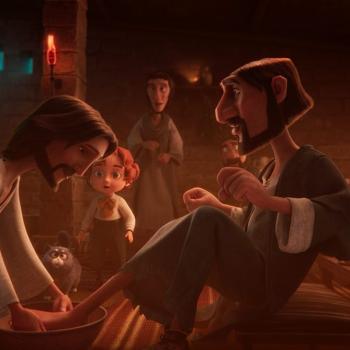
Oscar Isaac, Forest Whitaker join animated Jesus movie

Box office: Rogue One hits while Collateral Beauty...

Review: Stay (dir. Marc Forster, 2005)

Moses at the Movies / When we trace...
TRENDING AT PATHEOS Religious Music & Entertainment

"Les Diabolique" and Transgression
Alongside something like Arrival, Vertigo, or Charade, Les Diaboliques is a...

"The Plague Dogs" and Mortality
So, flashback to the late 70s, early 80s. Walt Disney Studios is...

With the recent and highly successful release of Christopher Nolan’s epic film,...

"L'avventura" and Human Weakness
Today's piece is going to be a little different for a few...

I first want to apologize for not posting or writing anything. I'm...

I've engaged in the multi-year project of reading through the Church Fathers,...
view all Religious Music & Entertainment blogs
Ad-Free & Subscriber Log-In Subscription Support
- About Us
- 2026 Calendar
- Videos
- Podcasts
- Library of World Religions
- Faith In Media Tracker
- Advertise With Us
- Write for Us
- Privacy Policy
- Terms of Service
- Do Not Sell My Data
- Contact Us
- Radiant Digital
- Manage Newsletter Subscriptions
- Unsubscribe From Notifications
- Sitemap
Copyright 2008-2026, Patheos. All rights reserved.
Subscription Support Ad-Free & Subscriber Log-In
Follow Patheos