
BuddhistCatholicContemplativeEvangelicalGeneral ChristianHinduJewishLatter-day SaintMuslimNew VisionsProgressive Christian
Beliefs
- Buddhist
- Catholic
- Contemplative
- Evangelical
- General Christian
- Hindu
- Jewish
- Latter-day Saint
- More Voices
- Muslim
- New Visions
- Pagan
- Progressive Christian
Topics
- Religion News
- Food and Religion
- Sports and Religion
- Religious Art
- Religious Music and Entertainment
- Religious Events
- History and Religion
- Style and Religion
- Politics and Religion
- Women in Religion
- Recreation Outdoors and Religion
- Business Finance and Religion
- Careers Workplace and Religion
- Education and Religion
- Family Parenting and Religion
- Health Fitness and Religion
- Home and Religion
- Relationships and Religion
- Technology and Religion
- Travel and Religion
Columnists
- Buddhist Columnists
- Business Finance and Religion Columnists
- Careers Workplace and Religion Columnists
- Catholic Columnists
- Contemplative Columnists
- Education and Religion Columnists
- Evangelists Columnists
- Family Parenting and Religion Columnists
- General Christian Columnists
- Health Fitness and Religion Columnists
- Hindu Columnists
- History and Religion Columnists
- Home and Religion Columnists
- Jewish Columnists
- More Voices Columnists
- Latter Day Columnists
- Muslim Columnists
- New Visions Columnists
- Nonreligious Columnists
- Pagan Columnists
- Politics and Religion Columnists
- Progressive Columnists
- Recreation Outdoors and Religion Columnists
- Relationships and Religion Columnists
- Religion News Columnists
- Religious Art Columnists
- Religious Events Columnists
- Religious Music and Entertainment Columnists
- Sports and Religion Columnists
- Style and Religion Columnists
- Technology and Religion Columnists
- Travel and Religion Columnists
- Women in Religion Columnists
Resource Library
- 2026 Calendar
- Library of World Religions
- The 100 Most Holy Places on Earth
- Patheos Answers
- Podcasts
- Videos
- Faith Leaders Database
- Anglican Episcopalian
- Bahai
- Baptist
- Buddhism
- Christianity
- Confucianism
- Eastern Orthodoxy
- Hinduism
- Holiness and Pentecostal
- ISKCON
- Islam
- Judaism
- Lutheran
- Methodist
- The Church of Jesus Christ of Latter-day Saints
- New Age
- Paganism
- Presbytarian and Reformed
- Protestantism
- Religion Behind the Scenes
- Roman Catholic
- Scientology
- Shia Islam
- Sikhism
- Sufism
- Sunni Islam
- Taoism
- Zen
- See all religions
Research Tools
 Ad-Free & Subscriber Log-In Subscription Support
Ad-Free & Subscriber Log-In Subscription Support
Follow Patheos 

- Trending:
- Forgiveness
- |
- Marriage
- |
- Consciousness
- |
- Death Penalty
- |
- Election
- |
- Halloween

-
Articles
- Home
- Religious Music & Entertainment
- Review: The Da Vinci Code (dir. Ron Howard, 2006)
Review: The Da Vinci Code (dir. Ron Howard, 2006)
Last updated on: April 19, 2014 at 1:53 pm by Peter T. Chattaway
Review: The Da Vinci Code (dir. Ron Howard, 2006) 2014-04-19T13:53:55-07:00 Peter T. Chattaway
Patheos Explore the world's faith through different perspectives on religion and spirituality! Patheos has the views of the prevalent religions and spiritualities of the world.
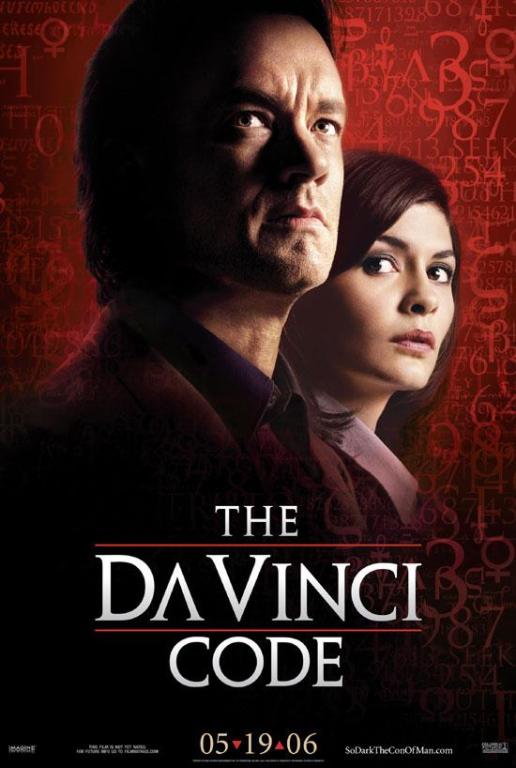 The makers of The Da Vinci Code have been saying for some time now that their film is not supposed to be taken all that seriously. It’s not history, and it’s not theology, director Ron Howard has said; instead, it’s just a rollicking good bit of entertainment. And leading man Tom Hanks has said it’s loaded “with all sorts of hooey and fun kind of scavenger-hunt-type nonsense,” calling the story “a lot of fun.”
If only they had taken their own advice. Dan Brown’s novel may be the product of extremely sloppy historical study, but even many of the book’s critics have admitted that it is a “page-turner,” an exciting yarn that carries the reader off on a semi-clever, fast-paced ride. The film, on the other hand, is a dull and plodding bore, and it takes itself far, far too seriously.
For those who have not yet read the book or any summaries thereof, the story begins with an albino monk named Silas (Paul Bettany) shooting Jacques Sauniere (Jean-Pierre Marielle), the curator of the Louvre museum in Paris. In his dying moments, Sauniere strips off his clothes, cuts a symbol into his own flesh, and scrawls some cryptic messages in invisible ink in various places around the museum. Police chief Bezu Fache (Jean Reno) summons Robert Langdon (Tom Hanks), an expert on symbols, to the Louvre and comes to believe that Langdon might be the killer — but while he is plotting to arrest Langdon, Sauniere’s granddaughter Sophie Neveu (Audrey Tautou), herself a police officer, helps Langdon to escape. Langdon and Sophie then run all over France and, eventually, England, dodging the police while solving the coded puzzles that Sauniere left behind — puzzles which lead to a secret society that claims everything Christians believe is a lie.
The thing to remember about Dan Brown’s novels, and now the adaptations thereof, is that they are fundamentally silly. Few books have made me laugh out loud as heartily as Angels & Demons, the first novel to feature the character of Robert Langdon, in which Langdon makes the ludicrous claim that Christians “borrowed” the practice of Holy Communion from the Aztecs — a North American culture that didn’t encounter Christianity until nearly 1,500 years after the life of Jesus. And I have always gotten a giggle from the Da Vinci Code trailer, in which Langdon’s eccentric friend Sir Leigh Teabing (Ian McKellen) gravely intones that he knows a secret which, if revealed, would “devastate the very foundations of mankind.” Ah, so grandiose!
In the movie, however, Teabing says that the secret he knows would “devastate the very foundations of Christianity,” a much more specific, and offensive, sort of claim. And the movie, written by Akiva Goldsman (A Beautiful Mind), seems to go out of its way to give the story even more historical credibility than the novel does. One of the amusing things about the book is how Brown slaps together as many cultural reference points as possible — from high-brow Renaissance art to popular Disney cartoons — in a sort of post-modern pastiche to create the impression that the conspiracies and secret societies he describes are everywhere around us. But in the film, everything is played with a very straight face, the pop-culture allusions are eliminated altogether (as are some of the book’s loopier claims), and our focus stays on the classic and medieval paintings, sculptures and architecture.
In addition, Robert Langdon has been made into more of a skeptic, so that when he talks about the Priory of Sion (the secret society that is supposedly protecting the descendants of Jesus and Mary Magdalene), he refers to them, at first, as a “myth.” He even says the group was exposed as a “hoax” in 1967 — a claim which prompts Teabing to say, “That’s what they want you to believe.” Also, in the book, Teabing says that Mary Magdalene was labeled a “prostitute” by “the early church” as part of a “smear campaign,” and leaves it at that; but in the film, Langdon specifies A.D. 591 as the date when Mary Magdalene was formally identified as a prostitute. (That was the year when Pope Gregory gave a sermon claiming that Mary Magdalene, Mary of Bethany, and the “sinful woman” who washed Jesus’ feet were all the same woman.)
What’s more, Langdon and Teabing now play a sort of good-cop-bad-cop routine. The book flat-out states that “five million” (emphasis in the original) women were killed by the Catholic church over 300 years, and it states this in a passage that seems to be reflecting Langdon’s own thoughts as he thinks back on the history of the church. But in the film, Langdon says the number was 50,000, and then Teabing interjects that some would say the victims actually numbered in the “millions.” Also, when Teabing says that the emperor Constantine had to intervene in religious matters in the early 4th century because Christians were rioting against pagans in the streets (a claim that is brought to visual life in a brief, violent flashback), Langdon interjects and says that the pagans might have started the atrocities first — a claim that is never backed up by anything on the screen. And the film’s version of Langdon explicitly says that Constantine did not invent the divinity of Jesus — which is almost the exact opposite of what the book’s version of Langdon says.
The changes the film makes to Langdon have a subtle, even sinister, effect. The book tends to emphasize his superior knowledge, which could have the effect of distancing him from the average moviegoer. But the film casts Everyman actor Tom Hanks in the role, and then makes Langdon a moderate Everyman who initially finds Teabing’s claims too crazy. The thing is, as far as this story is concerned, Langdon comes to discover that Teabing, for all his anti-ecclesiastical kookiness, is actually right. In short, the film is the story of how Langdon comes to believe in Teabing’s theories; and because Langdon has been made more accessible, he takes the audience along with him on his journey to this new belief. And while all this is going on, the film’s explicitly Christian characters — Silas, Fache, and the manipulative Bishop Aringarosa (Alfred Molina), who takes his own cues from a mysterious unseen “Teacher” — are all portrayed as pathetic dupes, let down by their own beliefs.
In one of the final scenes, Langdon tries to spell out the film’s main theme. Referring to the nature of Jesus, Langdon asks, “Why does it have to be human or divine?” At this point, I half-expected Tom Hanks to go into Forrest Gump mode and say, “Maybe it’s both” — which would, of course, be the orthodox position (even if we might quibble with what the film says about the way Jesus expressed his humanity during his earthly ministry). But no, instead, Langdon’s next words are, “Maybe human is divine.” Which may be very soothing to the post-modern ear, but it just begs the questions: What is divinity? What is humanity?
Given this kind of dialogue, it’s impossible to take the filmmakers seriously when they say that their movie makes no historical or theological claims. Why did they feel the need to add details missing from Brown’s book, or to correct some of its errors, if the historical claims didn’t really matter? And would they have been just as pleased with a closing scene in which Langdon said Jesus is the divine Son of God who became man to show us how to become the fully human beings we were originally meant to be? Somehow, I doubt it.
And what of the entertainment, the rollicking good thrill ride that the filmmakers say they are trying to give us? Truth be told, whether it’s Silas popping out of nowhere with a weapon in his hand, or Langdon accidentally disarming an ally who turns out to be a gun-packing enemy, or Sophie driving a car backwards through busy traffic, these are among the movie’s weakest and most generic elements. The performances are all pretty grim, too; only McKellen, as Teabing, seems to be having any fun. And Howard’s direction emphasizes all the wrong things; the quasi-academic exposition, which is what has intrigued most fans of the book, is tossed off so rapidly in places that you almost miss it, whereas the camera dwells at some length on scenes of the albino monk’s self-flagellation, among other things. Hans Zimmer’s musical score is effective in places, at least, but it would have been even better if it didn’t sound like a carbon copy of the themes he wrote for Batman Begins.
Bottom line: If you want an entertaining yarn about the Knights Templar, historical secrets, and cryptic codes hidden in famous documents and artifacts, go rent National Treasure. Now there’s a movie that knows how to have fun with an absurd premise — and it doesn’t spread falsehoods about the Church that have already undermined the faith of many Christians. The best thing that can be said about The Da Vinci Code is that it is such a dud, it just might help to bring this phenomenon to an end. And the sooner, the better.
1.5 stars (out of 4)
–
Talk About It
Discussion starters
1. Can a movie like this can be “only entertainment”? How do you respond to its images of the Nicene Council, or of early Christians rioting in the streets? How do the movie’s visuals tilt your sympathies? Are you more inclined to believe one character than another?
2. A nun tells Silas, “Jesus had but one true message.” Does this movie say what that message is? If so, what is it? How does the nun’s statement square with the scene in which Langdon tells Sophie that what matters is what she believes? What does the movie suggest about the possibility of an exclusive truth claim, vs. the idea of many valid beliefs?
3. Do you think the bones of Mary Magdalene pose any threat to Christianity? What do you make of the churches which claim to have her relics? Would there be a way to say if those relics were the true ones? Does it matter? Why do you think no one in the film ever shows any interest in the bones of Jesus?
4. Sophie tells Silas, “Your God doesn’t forgive murderers. He burns them!” How would you answer this? Do you think Sophie believes in God? Do you think Silas can be forgiven for what he has done?
5. Can anything be “proved” historically? To what degree is history an act of faith? How do movies, including earlier Ron Howard or Tom Hanks movies like Saving Private Ryan or Apollo 13, shape our view of history? How do they shape our faith?
The Family Corner
For parents to consider
The Da Vinci Code is rated PG-13 for disturbing images, violence (including shootings, kickings, impalings, poisonings, and the breaking of necks), some nudity (of a monk’s naked behind, before he whips himself), thematic material (including the depiction of Mary Magdalene bearing the child of Jesus, Christians killing pagans in the streets in the days before Constantine legalized Christianity, the Crusaders conquering Jerusalem, and Teabing’s claim that Constantine “presided over” the creation of the Bible), brief drug references (when Teabing asks the police if they’ve discovered any cannabis) and sexual content (in a very brief flashback where the young Sophie witnesses her grandfather having sex as part of a secret religious ritual; but their bodies are covered by a blanket).
— A version of this review was first published at Christianity Today Movies.
Previous Post

May 18, 2006
Da Vinci Code press kit contradicts the novel!
Next Post
May 18, 2006 The Da Vinci Code -- another article's up!
Browse Our Archives
Select a Category Anglican Planet Articles BC Christian News BC Report Bible Movies Bible Review Blog Books & Culture Campus Times CBC Radio Christianity Today ChristianWeek Essays Faith Today Festival Cinemas Guide Film Journals Georgia Straight Interviews MB Herald National Catholic Register Salvationist Today's Christian Two Chairs Ubyssey Uncategorized Vancouver Courier Vancouver Sun
Select a Month August 2025 April 2025 January 2025 December 2024 November 2024 May 2024 February 2024 December 2023 May 2023 March 2023 November 2022 July 2022 June 2022 May 2022 April 2022 February 2022 January 2022 December 2021 November 2021 October 2021 September 2021 August 2021 July 2021 June 2021 April 2021 March 2021 February 2021 January 2021 December 2020 November 2020 October 2020 August 2020 July 2020 June 2020 May 2020 March 2020 February 2020 January 2020 December 2019 November 2019 September 2019 July 2019 May 2019 April 2019 March 2019 February 2019 January 2019 December 2018 November 2018 October 2018 September 2018 July 2018 June 2018 May 2018 April 2018 March 2018 February 2018 January 2018 December 2017 November 2017 October 2017 September 2017 August 2017 July 2017 June 2017 May 2017 April 2017 March 2017 February 2017 January 2017 December 2016 November 2016 October 2016 September 2016 August 2016 July 2016 June 2016 May 2016 April 2016 March 2016 February 2016 January 2016 December 2015 November 2015 October 2015 September 2015 August 2015 July 2015 June 2015 May 2015 April 2015 March 2015 February 2015 January 2015 December 2014 November 2014 October 2014 September 2014 August 2014 July 2014 June 2014 May 2014 April 2014 March 2014 February 2014 January 2014 December 2013 November 2013 October 2013 September 2013 August 2013 July 2013 June 2013 May 2013 April 2013 March 2013 February 2013 January 2013 December 2012 November 2012 October 2012 September 2012 August 2012 July 2012 June 2012 April 2012 January 2012 January 2011 December 2010 November 2010 October 2010 September 2010 August 2010 July 2010 June 2010 May 2010 April 2010 March 2010 February 2010 January 2010 December 2009 November 2009 October 2009 September 2009 August 2009 July 2009 June 2009 May 2009 April 2009 March 2009 February 2009 January 2009 December 2008 November 2008 October 2008 September 2008 August 2008 July 2008 June 2008 May 2008 April 2008 March 2008 February 2008 January 2008 December 2007 November 2007 October 2007 September 2007 August 2007 July 2007 June 2007 May 2007 April 2007 March 2007 February 2007 January 2007 December 2006 November 2006 October 2006 September 2006 August 2006 July 2006 June 2006 May 2006 April 2006 March 2006 February 2006 January 2006 December 2005 November 2005 October 2005 September 2005 August 2005 July 2005 June 2005 May 2005 April 2005 March 2005 January 2005 December 2004 November 2004 October 2004 September 2004 August 2004 July 2004 June 2004 May 2004 April 2004 March 2004 February 2004 January 2004 November 2003 October 2003 August 2003 July 2003 June 2003 May 2003 January 2003 December 2002 November 2002 August 2002 July 2002 June 2002 May 2002 March 2002 January 2002 December 2001 November 2001 September 2001 August 2001 July 2001 June 2001 April 2001 March 2001 February 2001 December 2000 November 2000 October 2000 September 2000 August 2000 July 2000 June 2000 May 2000 April 2000 March 2000 January 2000 October 1999 August 1999 May 1999 April 1999 February 1999 January 1999 December 1998 November 1998 October 1998 August 1998 July 1998 June 1998 April 1998 March 1998 January 1998 November 1997 September 1997 July 1997 June 1997 April 1997 March 1997 February 1997 January 1997 December 1996 October 1996 September 1996 June 1996 March 1996 February 1996 January 1996 April 1995 November 1994 September 1994 September 1991
Follow Us!
TAKE THE
Religious Wisdom Quiz
I married an unfaithful wife to illustrate God's relationship with Israel. What was my wife's name?
Select your answer to see how you score.
Gomer Jezebel Bathsheba Delilah
Related posts from FilmChat
Jeymes Samuel and LaKeith Stanfield are going to...
Magdala round-up: clips, photos, and reviews from Cannes
Mary Magdalene movie to get its world premiere...
The Chosen -- season two, Christmas special
TRENDING AT PATHEOS Religious Music & Entertainment

"Les Diabolique" and Transgression
Alongside something like Arrival, Vertigo, or Charade, Les Diaboliques is a...

"The Plague Dogs" and Mortality
So, flashback to the late 70s, early 80s. Walt Disney Studios is...

With the recent and highly successful release of Christopher Nolan’s epic film,...

"L'avventura" and Human Weakness
Today's piece is going to be a little different for a few...

I first want to apologize for not posting or writing anything. I'm...

I've engaged in the multi-year project of reading through the Church Fathers,...
view all Religious Music & Entertainment blogs
Ad-Free & Subscriber Log-In Subscription Support
- About Us
- 2026 Calendar
- Videos
- Podcasts
- Library of World Religions
- Faith In Media Tracker
- Advertise With Us
- Write for Us
- Privacy Policy
- Terms of Service
- Do Not Sell My Data
- Contact Us
- Radiant Digital
- Manage Newsletter Subscriptions
- Unsubscribe From Notifications
- Sitemap
Copyright 2008-2026, Patheos. All rights reserved.
Subscription Support Ad-Free & Subscriber Log-In
Follow Patheos