
BuddhistCatholicContemplativeEvangelicalGeneral ChristianHinduJewishLatter-day SaintMuslimNew VisionsProgressive Christian
Beliefs
- Buddhist
- Catholic
- Contemplative
- Evangelical
- General Christian
- Hindu
- Jewish
- Latter-day Saint
- More Voices
- Muslim
- New Visions
- Pagan
- Progressive Christian
Topics
- Religion News
- Food and Religion
- Sports and Religion
- Religious Art
- Religious Music and Entertainment
- Religious Events
- History and Religion
- Style and Religion
- Politics and Religion
- Women in Religion
- Recreation Outdoors and Religion
- Business Finance and Religion
- Careers Workplace and Religion
- Education and Religion
- Family Parenting and Religion
- Health Fitness and Religion
- Home and Religion
- Relationships and Religion
- Technology and Religion
- Travel and Religion
Columnists
- Buddhist Columnists
- Business Finance and Religion Columnists
- Careers Workplace and Religion Columnists
- Catholic Columnists
- Contemplative Columnists
- Education and Religion Columnists
- Evangelists Columnists
- Family Parenting and Religion Columnists
- General Christian Columnists
- Health Fitness and Religion Columnists
- Hindu Columnists
- History and Religion Columnists
- Home and Religion Columnists
- Jewish Columnists
- More Voices Columnists
- Latter Day Columnists
- Muslim Columnists
- New Visions Columnists
- Nonreligious Columnists
- Pagan Columnists
- Politics and Religion Columnists
- Progressive Columnists
- Recreation Outdoors and Religion Columnists
- Relationships and Religion Columnists
- Religion News Columnists
- Religious Art Columnists
- Religious Events Columnists
- Religious Music and Entertainment Columnists
- Sports and Religion Columnists
- Style and Religion Columnists
- Technology and Religion Columnists
- Travel and Religion Columnists
- Women in Religion Columnists
Resource Library
- 2026 Calendar
- Library of World Religions
- The 100 Most Holy Places on Earth
- Patheos Answers
- Podcasts
- Videos
- Faith Leaders Database
- Anglican Episcopalian
- Bahai
- Baptist
- Buddhism
- Christianity
- Confucianism
- Eastern Orthodoxy
- Hinduism
- Holiness and Pentecostal
- ISKCON
- Islam
- Judaism
- Lutheran
- Methodist
- The Church of Jesus Christ of Latter-day Saints
- New Age
- Paganism
- Presbytarian and Reformed
- Protestantism
- Religion Behind the Scenes
- Roman Catholic
- Scientology
- Shia Islam
- Sikhism
- Sufism
- Sunni Islam
- Taoism
- Zen
- See all religions
Research Tools
 Ad-Free & Subscriber Log-In Subscription Support
Ad-Free & Subscriber Log-In Subscription Support
Follow Patheos 

- Trending:
- Forgiveness
- |
- Marriage
- |
- Consciousness
- |
- Death Penalty
- |
- Election
- |
- Halloween

-
Articles
- Home
- Religious Music & Entertainment
- Review: Munich (dir. Steven Spielberg, 2005)
Review: Munich (dir. Steven Spielberg, 2005)
Last updated on: April 13, 2016 at 11:11 am by Peter T. Chattaway
Review: Munich (dir. Steven Spielberg, 2005) 2016-04-13T11:11:15-07:00 Peter T. Chattaway
Patheos Explore the world's faith through different perspectives on religion and spirituality! Patheos has the views of the prevalent religions and spiritualities of the world.
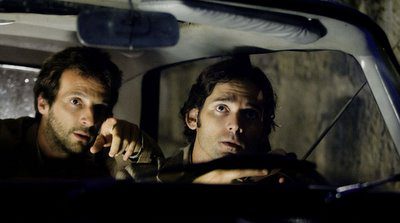 Munich takes place about 30 years ago, but it may be the most urgent film Steven Spielberg has ever made. While Spielberg has made a few historical movies before, so far they have all concerned events that took place well before he was born, and it doesn’t exactly require a whole lot of courage these days to say that slavery and the Holocaust were wrong. Munich, on the other hand, is the first to depict an event that occurred during Spielberg’s own lifetime, the ramifications of which are still being felt, and debated, today.
The film begins in September 1972, when Palestinian terrorists captured and murdered eleven Israeli athletes at the Summer Olympics in Munich, Germany. The initial violence as the terrorists break into the athletes’ suites is blunt, and brutal. And when the authorities respond, they screw up royally; among other things, they have to call off a rescue mission when it turns out the movements of their snipers have been broadcast on TV, where the terrorists can see everything. In one scene, Spielberg puts his camera inside the room as a terrorist steps out onto a balcony, his image transmitted to a TV nearby the door — and there is a palpable tension between the archival video footage and the actor re-enacting it off to the side, just as there is a tension between our knowledge of what will happen and our hope that things might turn out differently (between fate and free will, as it were).
The bulk of the film, however, takes place after the Olympics, when the Israeli government responds to the incident by sending a counter-terrorist team to Europe and other points around the Mediterranean to find and execute 11 Palestinian leaders. The film is based on George Jonas’s book Vengeance — previously filmed in 1986 as the TV-movie Sword of Gideon — and it follows a Mossad agent known only as Avner (Eric Bana) as he leads four fellow agents on a mission that, ironically, requires them to think and act a little like terrorists themselves. Jonas’s book, which relies heavily on Avner’s memories of events that took place a decade or more before, has been the focus of much controversy itself, and it is beyond the scope of this review to say how accurate it is. For now, suffice to say that the screenplay, by playwright Tony Kushner (Angels in America), follows it fairly closely.
The mission begins when Avner, an agent with a pregnant wife, is summoned to the home of Israeli Prime Minister Golda Meir (Lynn Cohen) and introduced to Ephraim (Geoffrey Rush), the Mossad chief who trains him and puts his team together. (Interestingly, Jonas’s book claims that the current prime minister, Ariel Sharon, was also present at this meeting and a “hero” to Avner, but unless my ears blinked, the film leaves him out of this scene.) Avner is told he will have to resign from the agency, to become “officially unofficial,” and he will have to leave Israel and his nascent family for months at a time, maybe even years. Despite being off the books, though, Avner will still have to produce receipts.
There is humour in details like this, and Spielberg finds other moments of tense amusement in what is otherwise a deadly serious story. In one scene, Avner and his teammates — bombs expert Robert (Amelie’s Mathieu Kassovitz), cars expert Steve (future James Bond Daniel Craig), documents expert Hans (Hanns Zischler), and clean-up man Carl (Ciarán Hinds) — find themselves sharing a safe house with some Arab terrorists, and after they get over the initial surprise, they have a small contest of wills over radio station preferences. Spielberg also deftly cranks up the tension in other scenes, like the one where a girl unexpectedly returns home to her father, just as Avner’s team is about to blow him up.
In some ways, Spielberg is less emotionally manipulative in this film than he has been in his other movies; when Avner tells his wife, “You’re the only home I’ve ever had,” Spielberg treats the moment matter-of-factly and even allows Avner’s wife to burst out laughing and call his sentiments “so corny.” But the way Spielberg systematically tweaks the events recounted in Jonas’s book does add up to a political statement of sorts. For one thing, he accentuates the collateral damage pretty much all the way through, though at least some of the earlier victims were killed rather discretely; according to Jonas, at least, the first explosion was inaudible and did not shatter any windows, contrary to what we see here. The film also downplays, perhaps even eliminates, Ephraim’s insistence that absolutely no innocent bystanders are to be injured. While Avner’s team does run into problems later on, it might have been better if Spielberg had allowed us to experience the early “successes” of the mission as successes, before moving on to the hits that went a little wrong.
The film also has a strange habit of linking sex and violence and dwelling on that link. While this element simmers in some of the early scenes, like the one where the girlfriend of one of Avner’s terrorist contacts comes on to him, it becomes more explicit later on. One subplot concerns the team’s fatal encounter with a perfumed woman (The Barbarian Invasions’ Marie-Josée Croze), and Spielberg makes a point of displaying the naked bodies of the dead (although, as per the usual double standard, the woman’s body is more clearly exposed than the man’s). Then there is the daring, climactic sequence in which Avner has sex with his wife even as he is tormented by thoughts of the Munich massacre. (Just as Private Ryan was haunted by memories of things that had actually happened to someone else, so too Avner experiences the events of Munich in flashback as though he had been there.)
This last scene reflects the way that, for some Jews at least, procreation itself has become a political act; this apparently includes Avner’s mother (Gila Almagor), who appears to have had her son not so much for his own sake but to ensure the continuation of Israel. (For Palestinians, too, birth rates can be a big deal; in Paradise Now, a taxi driver boasts about the quality of his sperm and the size of his family.) The relationship between family and politics also comes up when Avner meets Papa (Michael Lonsdale), the head of a mysterious French family that sells information to terrorists of all persuasions. Papa seems to like Avner more than his own son Louis (Mathieu Amalric), who is Avner’s main contact with the family; but, notes Papa ruefully, Avner himself is not family.
Some of the film’s critics have accused Spielberg of breaking faith, as it were, with his own people, because his film is critical of Israeli tactics. Not only does Munich question the practical use of assassination squads — Avner’s team, by bribing various terrorist contacts, actually pumps Israeli money into the terrorist network, and some of Avner’s “successes” create power vacuums that are filled by even worse villains like Carlos the Jackal — it also questions the moral justification for such squads. Carl suggests that the tactics used by the Israelis and the Palestinians may not be all that different in the end, and Robert protests that Jews are supposed to be “righteous,” instead of sinking to their enemies’ level.
These are troubling claims, since, as Jonas puts it, when counter-terrorists such as Avner and his team make a point of not targeting innocent civilians, there is as great a difference between terrorism and what they do as there is between war crimes and acts of war. But it would be wrong to say, as some have done, that the film, by raising these questions, is anti-Semitic. While the film is ambivalent on the question of whether Israel ought to exist, its critique of counter-terrorism is expressed in very Jewish terms, and the fact that it is the Jews who wrestle with their consciences actually reflects rather well on them. In contrast, the few Arab terrorists we meet never question their methods — methods which are, of course, much worse, even if the film isn’t as clear on that point as it should be.
Interestingly, Jonas, now a columnist with the National Post, is a Canadian conservative, and Spielberg is an American liberal, so the tension between these two perspectives makes Munich a good place to enter the debate over appropriate responses to terrorism. As the final scene makes very clear, the issues America is dealing with now are issues that Israel and other nations have dealt with for a long, long time; and while we may or may not agree with Spielberg’s take on the matter, it is to his credit that he has asked us to address our current concerns by taking a step back and looking at the bigger historical picture.
3 stars (out of 4)
–
Talk About It
Discussion starters
1. In a foreword to a new edition of George Jonas’s Vengeance, “Avner” writes that “An eye for an eye and a tooth for a tooth” (Exodus 21:24, Leviticus 24:20, Deuteronomy 19:21) is the exact opposite of the Golden Rule: “Do unto others what you would have them do unto you” (Matthew 7:12). Jesus also says that, instead of paying back “an eye for an eye,” we should “turn the other cheek” (Matthew 5:38-42). Why do you think both sets of commands are in the Bible? Does one trump the other? Are there ever times when we should follow Moses’ command instead of Jesus’ command? Is the “eye for an eye” principle an incitement to get revenge, or is it a limitation on the kind of justice that people sometimes seek?
2. Is vengeance ever justified? How is it similar to, or different from, justice? Is it okay to commit acts of justice even if you derive a personal feeling of vengeance from them? Do you think the counter-terrorist team is justified in what it does? What about the scene where they get revenge against the hit-woman, despite having no authorization from the Israeli authorities? Was that action justified, either tactically or morally?
3. Golda Meir says, “Every civilization finds it necessary to negotiate compromise with its own values.” Do you agree? Is compromise ever necessary? Are some values absolute? What is the relationship between faith and culture, or faith and “civilization”?
4. Compare Robert’s insistence that Jews should be “righteous” with the scene in which a German terrorist says right and wrong are merely concepts. Is Avner’s team operating out of a belief in righteousness? Or are they flirting with the German’s nihilism by compromising their belief in right and wrong? Where do the Arab terrorists belong on this spectrum?
5. Papa quotes the line in Ecclesiastes 9:11 about “time and chance” happening to us all. The author of Ecclesiastes notes that everyone dies, and because of this, he says, “Everything is meaningless.” Do you agree or disagree? Are the actions of terrorists and counter-terrorists morally equivalent, or is any form of struggle meaningless, because everyone will end up dead anyway? Why do you think Ecclesiastes is in the Bible?
6. Carl says, “I was born reluctant. If I can’t kvetch, I can’t do my job.” What sort of role does “kvetching” play in Jewish faith and culture? What sort of role, if any, should it play in Christian life? How do we balance obedience and criticism of the authorities we are under?
The Family Corner
For parents to consider
Munich is rated R for strong graphic violence, some sexual content, nudity and language. The violence is pretty graphic, including a man stabbed in the head, many shootings, and several scenes of exploding helicopters, apartments and hotel rooms. The only onscreen sexual activity is between a husband and wife, though there is also some nudity when a man and a woman are killed and their naked bodies exposed.
— A version of this review was first published at Christianity Today Movies.
Previous Post

December 23, 2005
Review: Casanova (dir. Lasse Hallström, 2005)
Next Post
December 23, 2005 Casanova in Munich -- the reviews are up!
Browse Our Archives
Select a Category Anglican Planet Articles BC Christian News BC Report Bible Movies Bible Review Blog Books & Culture Campus Times CBC Radio Christianity Today ChristianWeek Essays Faith Today Festival Cinemas Guide Film Journals Georgia Straight Interviews MB Herald National Catholic Register Salvationist Today's Christian Two Chairs Ubyssey Uncategorized Vancouver Courier Vancouver Sun
Select a Month August 2025 April 2025 January 2025 December 2024 November 2024 May 2024 February 2024 December 2023 May 2023 March 2023 November 2022 July 2022 June 2022 May 2022 April 2022 February 2022 January 2022 December 2021 November 2021 October 2021 September 2021 August 2021 July 2021 June 2021 April 2021 March 2021 February 2021 January 2021 December 2020 November 2020 October 2020 August 2020 July 2020 June 2020 May 2020 March 2020 February 2020 January 2020 December 2019 November 2019 September 2019 July 2019 May 2019 April 2019 March 2019 February 2019 January 2019 December 2018 November 2018 October 2018 September 2018 July 2018 June 2018 May 2018 April 2018 March 2018 February 2018 January 2018 December 2017 November 2017 October 2017 September 2017 August 2017 July 2017 June 2017 May 2017 April 2017 March 2017 February 2017 January 2017 December 2016 November 2016 October 2016 September 2016 August 2016 July 2016 June 2016 May 2016 April 2016 March 2016 February 2016 January 2016 December 2015 November 2015 October 2015 September 2015 August 2015 July 2015 June 2015 May 2015 April 2015 March 2015 February 2015 January 2015 December 2014 November 2014 October 2014 September 2014 August 2014 July 2014 June 2014 May 2014 April 2014 March 2014 February 2014 January 2014 December 2013 November 2013 October 2013 September 2013 August 2013 July 2013 June 2013 May 2013 April 2013 March 2013 February 2013 January 2013 December 2012 November 2012 October 2012 September 2012 August 2012 July 2012 June 2012 April 2012 January 2012 January 2011 December 2010 November 2010 October 2010 September 2010 August 2010 July 2010 June 2010 May 2010 April 2010 March 2010 February 2010 January 2010 December 2009 November 2009 October 2009 September 2009 August 2009 July 2009 June 2009 May 2009 April 2009 March 2009 February 2009 January 2009 December 2008 November 2008 October 2008 September 2008 August 2008 July 2008 June 2008 May 2008 April 2008 March 2008 February 2008 January 2008 December 2007 November 2007 October 2007 September 2007 August 2007 July 2007 June 2007 May 2007 April 2007 March 2007 February 2007 January 2007 December 2006 November 2006 October 2006 September 2006 August 2006 July 2006 June 2006 May 2006 April 2006 March 2006 February 2006 January 2006 December 2005 November 2005 October 2005 September 2005 August 2005 July 2005 June 2005 May 2005 April 2005 March 2005 January 2005 December 2004 November 2004 October 2004 September 2004 August 2004 July 2004 June 2004 May 2004 April 2004 March 2004 February 2004 January 2004 November 2003 October 2003 August 2003 July 2003 June 2003 May 2003 January 2003 December 2002 November 2002 August 2002 July 2002 June 2002 May 2002 March 2002 January 2002 December 2001 November 2001 September 2001 August 2001 July 2001 June 2001 April 2001 March 2001 February 2001 December 2000 November 2000 October 2000 September 2000 August 2000 July 2000 June 2000 May 2000 April 2000 March 2000 January 2000 October 1999 August 1999 May 1999 April 1999 February 1999 January 1999 December 1998 November 1998 October 1998 August 1998 July 1998 June 1998 April 1998 March 1998 January 1998 November 1997 September 1997 July 1997 June 1997 April 1997 March 1997 February 1997 January 1997 December 1996 October 1996 September 1996 June 1996 March 1996 February 1996 January 1996 April 1995 November 1994 September 1994 September 1991
Follow Us!
TAKE THE
Religious Wisdom Quiz
Who taught Apollos about the gospel of Jesus Christ.
Select your answer to see how you score.
Timothy Aquila and Priscilla Barnabas Paul
Related posts from FilmChat

20 things about The Prince of Egypt, which...

Review: Stay (dir. Marc Forster, 2005)

Moses at the Movies / When we trace...
Box office: Tarzan leads a pack of also-rans...
TRENDING AT PATHEOS Religious Music & Entertainment

"Les Diabolique" and Transgression
Alongside something like Arrival, Vertigo, or Charade, Les Diaboliques is a...

"The Plague Dogs" and Mortality
So, flashback to the late 70s, early 80s. Walt Disney Studios is...

With the recent and highly successful release of Christopher Nolan’s epic film,...

"L'avventura" and Human Weakness
Today's piece is going to be a little different for a few...

I first want to apologize for not posting or writing anything. I'm...

I've engaged in the multi-year project of reading through the Church Fathers,...
view all Religious Music & Entertainment blogs
Ad-Free & Subscriber Log-In Subscription Support
- About Us
- 2026 Calendar
- Videos
- Podcasts
- Library of World Religions
- Faith In Media Tracker
- Advertise With Us
- Write for Us
- Privacy Policy
- Terms of Service
- Do Not Sell My Data
- Contact Us
- Radiant Digital
- Manage Newsletter Subscriptions
- Unsubscribe From Notifications
- Sitemap
Copyright 2008-2026, Patheos. All rights reserved.
Subscription Support Ad-Free & Subscriber Log-In
Follow Patheos