
BuddhistCatholicContemplativeEvangelicalGeneral ChristianHinduJewishLatter-day SaintMuslimNew VisionsProgressive Christian
Beliefs
- Buddhist
- Catholic
- Contemplative
- Evangelical
- General Christian
- Hindu
- Jewish
- Latter-day Saint
- More Voices
- Muslim
- New Visions
- Pagan
- Progressive Christian
Topics
- Religion News
- Food and Religion
- Sports and Religion
- Religious Art
- Religious Music and Entertainment
- Religious Events
- History and Religion
- Style and Religion
- Politics and Religion
- Women in Religion
- Recreation Outdoors and Religion
- Business Finance and Religion
- Careers Workplace and Religion
- Education and Religion
- Family Parenting and Religion
- Health Fitness and Religion
- Home and Religion
- Relationships and Religion
- Technology and Religion
- Travel and Religion
Columnists
- Buddhist Columnists
- Business Finance and Religion Columnists
- Careers Workplace and Religion Columnists
- Catholic Columnists
- Contemplative Columnists
- Education and Religion Columnists
- Evangelists Columnists
- Family Parenting and Religion Columnists
- General Christian Columnists
- Health Fitness and Religion Columnists
- Hindu Columnists
- History and Religion Columnists
- Home and Religion Columnists
- Jewish Columnists
- More Voices Columnists
- Latter Day Columnists
- Muslim Columnists
- New Visions Columnists
- Nonreligious Columnists
- Pagan Columnists
- Politics and Religion Columnists
- Progressive Columnists
- Recreation Outdoors and Religion Columnists
- Relationships and Religion Columnists
- Religion News Columnists
- Religious Art Columnists
- Religious Events Columnists
- Religious Music and Entertainment Columnists
- Sports and Religion Columnists
- Style and Religion Columnists
- Technology and Religion Columnists
- Travel and Religion Columnists
- Women in Religion Columnists
Resource Library
- 2026 Calendar
- Library of World Religions
- The 100 Most Holy Places on Earth
- Patheos Answers
- Podcasts
- Videos
- Faith Leaders Database
- Anglican Episcopalian
- Bahai
- Baptist
- Buddhism
- Christianity
- Confucianism
- Eastern Orthodoxy
- Hinduism
- Holiness and Pentecostal
- ISKCON
- Islam
- Judaism
- Lutheran
- Methodist
- The Church of Jesus Christ of Latter-day Saints
- New Age
- Paganism
- Presbytarian and Reformed
- Protestantism
- Religion Behind the Scenes
- Roman Catholic
- Scientology
- Shia Islam
- Sikhism
- Sufism
- Sunni Islam
- Taoism
- Zen
- See all religions
Research Tools
 Ad-Free & Subscriber Log-In Subscription Support
Ad-Free & Subscriber Log-In Subscription Support
Follow Patheos 

- Trending:
- Forgiveness
- |
- Marriage
- |
- Consciousness
- |
- Death Penalty
- |
- Election
- |
- Halloween

-
Articles
- Home
- Religious Music & Entertainment
- Review: Ben-Hur: A Tale of the Christ (dir. Fred Niblo, 1925); Ben-Hur (dir. William Wyler, 1959)
Review: Ben-Hur: A Tale of the Christ (dir. Fred Niblo, 1925); Ben-Hur (dir. William Wyler, 1959)
Last updated on: June 18, 2014 at 5:05 pm by Peter T. Chattaway
Review: Ben-Hur: A Tale of the Christ (dir. Fred Niblo, 1925); Ben-Hur (dir. William Wyler, 1959) 2014-06-18T17:05:04-07:00 Peter T. Chattaway
Patheos Explore the world's faith through different perspectives on religion and spirituality! Patheos has the views of the prevalent religions and spiritualities of the world.
 General Lew Wallace had lived a colorful life of his own before his novel Ben-Hur: A Tale of the Christ was published in 1880. By then, he had defended Washington, D.C. from Confederates during the Civil War, served on the court-martial that tried Lincoln’s assassins, and, as Governor of New Mexico Territory, dealt with outlaws like Billy the Kid.
But what he really wanted to do was write — and so he wrote his novel about a Jewish prince who is betrayed by a Roman tribune during the time when Jesus lived. Ben-Hur was spurred by Wallace’s love of stories like The Count of Monte Cristo, but it was also motivated by an encounter with Robert Ingersoll, a famous agnostic who was passionately opposed to Christianity. Until that meeting, Wallace had been indifferent towards religion, but afterwards, he felt he needed to research Christianity for himself — and thus he became a believer.
Wallace died exactly one century ago, but he lived long enough to see his story (which was as famous for its sea battle and chariot race as it was for its religious content) become a popular stage production in 1899. For the chariot-race sequence, real live horses ran on treadmills pointed at the audience.
Films were just getting started around that time. In 1907, two years after Wallace’s death, the Kalem company produced the first film to bear his novel’s name; it lasted only 15 minutes, and was little more than a glorified race sequence. But it was made without the permission of Wallace’s estate, which sued for copyright infringement in a precedent-setting case.
Two more films followed — one produced in 1925, near the end of the silent era, plus the famous Charlton Heston-starring remake produced in 1959. The Bible-epic genre was at the peak of its popularity, and the film won an unprecedented 11 Academy Awards (a feat matched only by 1997’s Titanic and 2003’s The Lord of the Rings: The Return of the King).
Both films are now available in a four-disc DVD set, which also comes with several hours of bonus features, including two documentaries on the film and its legacy, an audio commentary, and various newsreels, screen tests and other bits of archival footage.
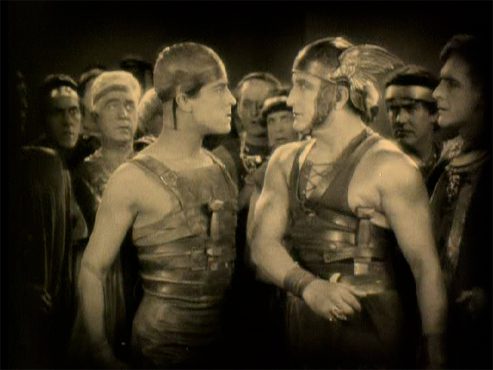 Ben-Hur: A Tale of the Christ (1925)
directed by Fred Niblo
In some ways, the silent version is the more Christian film, but it is also the more risqué. The film clocks in at 2 hours and 23 minutes, and devotes the first 15 minutes alone to the Nativity; later scenes incorporate the teachings of Christ, including the Sermon on the Mount and his defense of the woman caught in adultery, as well as Palm Sunday, the Last Supper, and the Crucifixion. Jesus himself is never glimpsed directly; all we see is his hand, gesturing from the edge of the frame. And while the film was mostly shot in black-and-white, many of these scenes are shot in two-strip Technicolor, to underscore their sacred nature.
But Technicolor is also used for one of the not-so-sacred sequences. Judah Ben-Hur (played by Ramon Novarro), the Jewish prince who was unjustly accused of trying to kill a Roman governor, and who was then sentenced to row the oars as a galley slave for the rest of his life, sees his fortunes reverse again when he saves a Roman consul (Frank Currier) during a sea battle, and is then adopted by that consul. The scenes in Rome that follow are partly shot in Technicolor — and they start with a victory parade led by topless women scattering flowers!
Thus this film toes the line between piety and exhibitionism that was common to other Bible epics produced during the 1920s. There are one or two other moments of partial nudity in this film, but nothing serious. More significant is the way the film brings its two parallel storylines together — the one about Christ, and the one about Judah Ben-Hur — by portraying Judah as a man who eagerly awaits the Messiah, and who is prepared to use his wealth and social status to raise entire legions to help the Messiah fight against the Romans.
Judah’s expectations are thwarted, of course, when Jesus willingly goes to the cross. And the film’s other characters, including Judah’s mother and sister, as well as the Egyptian magus Balthazar, talk of the need to have faith in Christ, and to pray. The film ends with Judah declaring faithfully, “He is not dead. He will live forever in the hearts of men.”
Directed by Fred Niblo (whose other films include the Douglas Fairbanks classic The Mark of Zorro) and a handful of other, uncredited directors, this version of Ben-Hur stands up very well next to its remake. The film has some artful visuals, such as the silhouettes that skulk across the foreground when Judah looks for his mother and sister in the Valley of Lepers. The treacherous Roman tribune Messala (Francis X. Bushman) is a bit of a one-dimensional bad guy, but within the conventions of the silent era, this take on the character doesn’t seem so odd.
The set pieces are also fantastic, even by today’s standards. The 1925 film’s chariot race holds its own against the one in the remake, but its sea battle is arguably even better than the one that came later, partly because it seems to rely less on miniatures and more on the life-size galleys that were easier to build back when Hollywood worked with non-union crews. And the earthquake that marks the death of Christ leads to a disaster-movie moment that would be eclipsed just a couple years later by the storm in Cecil B. DeMille’s The King of Kings.
 Ben-Hur (1959)
directed by William Wyler
The 1959 version — which clocks in at over 3-and-a-half hours, not including the overture and entr’acte music that plays at the beginning of each disc — is better remembered, and very popular with Christian audiences. But this version actually takes a step back from the overtly Christian tone of the earlier film, in favor of a message that is more subtly humanistic.
Directed by William Wyler, who won Oscars for Mrs. Miniver and The Best Years of Our Lives before Ben-Hur earned him a third statuette, the film still features some religious concepts and images. It begins with a Nativity sequence, now only about five minutes long, and climaxes with the Crucifixion; but there are very few episodes from Jesus’ life between those points. And just as we never see Jesus’ face, we also never hear his voice; so the teachings of Christ, which appeared on title cards in 1925, are now transmitted by other characters, who sometimes phrase them in ways that underscore the film’s more secular inclinations.
Produced after the Holocaust and the creation of the state of Israel in 1948, the film was motivated partly by a desire to bring the world’s major religions together. Judah Ben-Hur (Charlton Heston) proudly identifies himself as a Jew, but never professes belief in a Messiah of any sort; his opposition to Rome is fuelled more by personal feelings of vengeance than by any sense that he could help to fulfill prophecy, so he never quite becomes a Christian.
Early on, a Roman officer sums up Jesus’ message by saying that “God is near, in every man.” Esther (Haya Harareet), the freed slave girl who falls in love with Judah, tells him that Jesus preaches about love and forgiveness, and Judah’s last words in the film — “I felt his voice take the sword out of my hand” — are less a profession of faith than a profession of pacifism. In his commentary, film historian T. Gene Hatcher also notes that Judah’s mother and sister are healed of leprosy more because they pitied Christ than because they followed him.
Judah also befriends a scene-stealing Arab sheik (Hugh Griffith) who supplies the horses that pull Judah’s chariot; and before the race, the sheik gives him a Star of David to wear, and says it will shine that day for Jews and Arabs alike. When Wyler accepted Griffith’s Oscar for this role, he praised the actor for his portrayal of a humorous and sympathetic Arab chieftain, and lamented that the film had been banned in some Arab countries.
The film still has many strengths. Produced just three years after Cecil B. DeMille’s remake of The Ten Commandments, which also starred Heston, Ben-Hur is a much more intimate film, and makes greater use of shadows than DeMille’s film, which tended more towards stagey theatrics and bright displays of color. The sea battle and chariot races are technical marvels, both for their depiction of savage violence and, in the race’s case, for its masterful use of sound effects. Wyler gets full-blooded performances from all of his actors, and Miklos Rozsa’s music — by turns romantic, exciting, and occasionally transcendent — is also superb.
The DVD’s bonus features are a mixed bag. One documentary highlights Wallace’s faith but also gives ample time to Gore Vidal, who worked on the film’s script very reluctantly, and who repeats his assertion, disputed by Wyler and Heston, that Boyd was instructed to play Messala as though he had a homosexual attraction to Judah. Another documentary looks at the influence of Ben-Hur on more recent epics, such as Gladiator and, uh, Star Wars: Episode I — The Phantom Menace. (No less than three clips are shown from this latter film.) Most alarming of all, perhaps, is some screen-test footage that features Leslie Nielsen as Messala!
Wyler happened to be an assistant director on the 1925 film, and according to Heston, Wyler used to look around the set of the 1959 film and wonder which of his own assistants would make the next version. That hasn’t happened yet, but thanks to this new DVD set, audiences can experience and appreciate both of the epics based on Wallace’s novel anew.
— A version of this review first appeared on the Christianity Today website.
star wars episode i the phantom menace
Previous Post

September 19, 2005
Quasi-newsbites: Serenity! Exorcism of Reese!
Next Post
September 21, 2005 Mark Steyn on The Umbrellas of Cherbourg
Browse Our Archives
Select a Category Anglican Planet Articles BC Christian News BC Report Bible Movies Bible Review Blog Books & Culture Campus Times CBC Radio Christianity Today ChristianWeek Essays Faith Today Festival Cinemas Guide Film Journals Georgia Straight Interviews MB Herald National Catholic Register Salvationist Today's Christian Two Chairs Ubyssey Uncategorized Vancouver Courier Vancouver Sun
Select a Month August 2025 April 2025 January 2025 December 2024 November 2024 May 2024 February 2024 December 2023 May 2023 March 2023 November 2022 July 2022 June 2022 May 2022 April 2022 February 2022 January 2022 December 2021 November 2021 October 2021 September 2021 August 2021 July 2021 June 2021 April 2021 March 2021 February 2021 January 2021 December 2020 November 2020 October 2020 August 2020 July 2020 June 2020 May 2020 March 2020 February 2020 January 2020 December 2019 November 2019 September 2019 July 2019 May 2019 April 2019 March 2019 February 2019 January 2019 December 2018 November 2018 October 2018 September 2018 July 2018 June 2018 May 2018 April 2018 March 2018 February 2018 January 2018 December 2017 November 2017 October 2017 September 2017 August 2017 July 2017 June 2017 May 2017 April 2017 March 2017 February 2017 January 2017 December 2016 November 2016 October 2016 September 2016 August 2016 July 2016 June 2016 May 2016 April 2016 March 2016 February 2016 January 2016 December 2015 November 2015 October 2015 September 2015 August 2015 July 2015 June 2015 May 2015 April 2015 March 2015 February 2015 January 2015 December 2014 November 2014 October 2014 September 2014 August 2014 July 2014 June 2014 May 2014 April 2014 March 2014 February 2014 January 2014 December 2013 November 2013 October 2013 September 2013 August 2013 July 2013 June 2013 May 2013 April 2013 March 2013 February 2013 January 2013 December 2012 November 2012 October 2012 September 2012 August 2012 July 2012 June 2012 April 2012 January 2012 January 2011 December 2010 November 2010 October 2010 September 2010 August 2010 July 2010 June 2010 May 2010 April 2010 March 2010 February 2010 January 2010 December 2009 November 2009 October 2009 September 2009 August 2009 July 2009 June 2009 May 2009 April 2009 March 2009 February 2009 January 2009 December 2008 November 2008 October 2008 September 2008 August 2008 July 2008 June 2008 May 2008 April 2008 March 2008 February 2008 January 2008 December 2007 November 2007 October 2007 September 2007 August 2007 July 2007 June 2007 May 2007 April 2007 March 2007 February 2007 January 2007 December 2006 November 2006 October 2006 September 2006 August 2006 July 2006 June 2006 May 2006 April 2006 March 2006 February 2006 January 2006 December 2005 November 2005 October 2005 September 2005 August 2005 July 2005 June 2005 May 2005 April 2005 March 2005 January 2005 December 2004 November 2004 October 2004 September 2004 August 2004 July 2004 June 2004 May 2004 April 2004 March 2004 February 2004 January 2004 November 2003 October 2003 August 2003 July 2003 June 2003 May 2003 January 2003 December 2002 November 2002 August 2002 July 2002 June 2002 May 2002 March 2002 January 2002 December 2001 November 2001 September 2001 August 2001 July 2001 June 2001 April 2001 March 2001 February 2001 December 2000 November 2000 October 2000 September 2000 August 2000 July 2000 June 2000 May 2000 April 2000 March 2000 January 2000 October 1999 August 1999 May 1999 April 1999 February 1999 January 1999 December 1998 November 1998 October 1998 August 1998 July 1998 June 1998 April 1998 March 1998 January 1998 November 1997 September 1997 July 1997 June 1997 April 1997 March 1997 February 1997 January 1997 December 1996 October 1996 September 1996 June 1996 March 1996 February 1996 January 1996 April 1995 November 1994 September 1994 September 1991
Follow Us!
TAKE THE
Religious Wisdom Quiz
In Revelation, what is the correct sequence of events in the End Times?
Select your answer to see how you score.
Beast rises from sea, dragon cast to earth, mark of the beast given, false prophet rises Dragon cast to earth, beast rises from sea, false prophet rises from earth, mark of the beast given Mark of the beast given, dragon cast to earth, beast rises, false prophet rises False prophet rises, dragon cast to earth, beast rises from sea, mark of the beast given
Related posts from FilmChat

Exclusive: A clip from Angel Studios' The King...
Oscar Isaac, Forest Whitaker join animated Jesus movie

Watch: The Chosen's creators on Season 4's big...

Which Bible movies are getting the most views...
TRENDING AT PATHEOS Religious Music & Entertainment

"Les Diabolique" and Transgression
Alongside something like Arrival, Vertigo, or Charade, Les Diaboliques is a...

"The Plague Dogs" and Mortality
So, flashback to the late 70s, early 80s. Walt Disney Studios is...

With the recent and highly successful release of Christopher Nolan’s epic film,...

"L'avventura" and Human Weakness
Today's piece is going to be a little different for a few...

I first want to apologize for not posting or writing anything. I'm...

I've engaged in the multi-year project of reading through the Church Fathers,...
view all Religious Music & Entertainment blogs
Ad-Free & Subscriber Log-In Subscription Support
- About Us
- 2026 Calendar
- Videos
- Podcasts
- Library of World Religions
- Faith In Media Tracker
- Advertise With Us
- Write for Us
- Privacy Policy
- Terms of Service
- Do Not Sell My Data
- Contact Us
- Radiant Digital
- Manage Newsletter Subscriptions
- Unsubscribe From Notifications
- Sitemap
Copyright 2008-2026, Patheos. All rights reserved.
Subscription Support Ad-Free & Subscriber Log-In
Follow Patheos