
BuddhistCatholicContemplativeEvangelicalGeneral ChristianHinduJewishLatter-day SaintMuslimNew VisionsProgressive Christian
Beliefs
- Buddhist
- Catholic
- Contemplative
- Evangelical
- General Christian
- Hindu
- Jewish
- Latter-day Saint
- More Voices
- Muslim
- New Visions
- Pagan
- Progressive Christian
Topics
- Religion News
- Food and Religion
- Sports and Religion
- Religious Art
- Religious Music and Entertainment
- Religious Events
- History and Religion
- Style and Religion
- Politics and Religion
- Women in Religion
- Recreation Outdoors and Religion
- Business Finance and Religion
- Careers Workplace and Religion
- Education and Religion
- Family Parenting and Religion
- Health Fitness and Religion
- Home and Religion
- Relationships and Religion
- Technology and Religion
- Travel and Religion
Columnists
- Buddhist Columnists
- Business Finance and Religion Columnists
- Careers Workplace and Religion Columnists
- Catholic Columnists
- Contemplative Columnists
- Education and Religion Columnists
- Evangelists Columnists
- Family Parenting and Religion Columnists
- General Christian Columnists
- Health Fitness and Religion Columnists
- Hindu Columnists
- History and Religion Columnists
- Home and Religion Columnists
- Jewish Columnists
- More Voices Columnists
- Latter Day Columnists
- Muslim Columnists
- New Visions Columnists
- Nonreligious Columnists
- Pagan Columnists
- Politics and Religion Columnists
- Progressive Columnists
- Recreation Outdoors and Religion Columnists
- Relationships and Religion Columnists
- Religion News Columnists
- Religious Art Columnists
- Religious Events Columnists
- Religious Music and Entertainment Columnists
- Sports and Religion Columnists
- Style and Religion Columnists
- Technology and Religion Columnists
- Travel and Religion Columnists
- Women in Religion Columnists
Resource Library
- 2026 Calendar
- Library of World Religions
- The 100 Most Holy Places on Earth
- Patheos Answers
- Podcasts
- Videos
- Faith Leaders Database
- Anglican Episcopalian
- Bahai
- Baptist
- Buddhism
- Christianity
- Confucianism
- Eastern Orthodoxy
- Hinduism
- Holiness and Pentecostal
- ISKCON
- Islam
- Judaism
- Lutheran
- Methodist
- The Church of Jesus Christ of Latter-day Saints
- New Age
- Paganism
- Presbytarian and Reformed
- Protestantism
- Religion Behind the Scenes
- Roman Catholic
- Scientology
- Shia Islam
- Sikhism
- Sufism
- Sunni Islam
- Taoism
- Zen
- See all religions
Research Tools
 Ad-Free & Subscriber Log-In Subscription Support
Ad-Free & Subscriber Log-In Subscription Support
Follow Patheos 

- Trending:
- Forgiveness
- |
- Marriage
- |
- Consciousness
- |
- Death Penalty
- |
- Election
- |
- Halloween

-
Articles
- Home
- Religious Music & Entertainment
- Review: War of the Worlds (dir. Steven Spielberg, 2005)
Review: War of the Worlds (dir. Steven Spielberg, 2005)
Last updated on: June 6, 2014 at 8:04 am by Peter T. Chattaway
Review: War of the Worlds (dir. Steven Spielberg, 2005) 2014-06-06T08:04:59-07:00 Peter T. Chattaway
Patheos Explore the world's faith through different perspectives on religion and spirituality! Patheos has the views of the prevalent religions and spiritualities of the world.
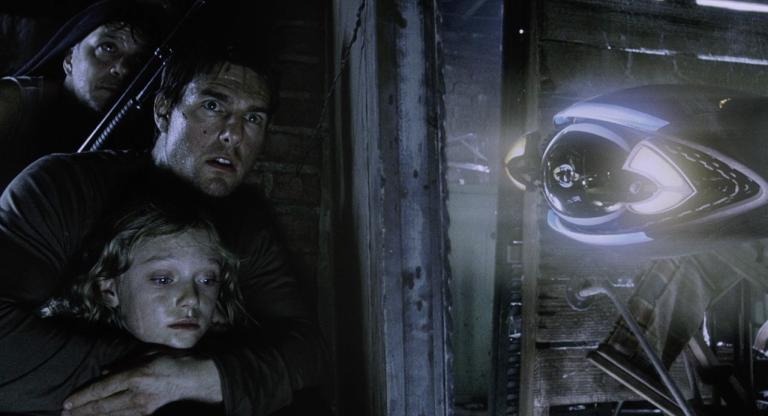 Has it really been two centuries since H.G. Wells wrote The War of the Worlds? Well, no, not quite, but he did write it in the late 19th century, and in it, he criticized the European and especially British imperialism of his time; just as the world’s colonial superpowers had wiped out the dodo, the bison, the aboriginal tribes of Tasmania, and others, so too they would now feel what it was like to live under the brutal domination of an advanced civilization, albeit one from Mars.
But if the novel encouraged self-reflection and invited its readers to consider how they had mistreated the world, the story’s film and radio dramatizations have tended to confirm their audiences’ fear and suspicion of the other. Orson Welles’s 1938 radio play, which caused panic when some listeners mistook it for a genuine news broadcast, was produced less than a year before the Nazis launched the Second World War; George Pal’s 1953 film came out during the Cold War, and presented Americans as the heroic, God-fearing victims of an unwarranted and presumably Soviet-style attack; and now, in the first decade of the 21st century, Steven Spielberg’s film presents the alien invaders as stand-ins for the terrorists who attacked on September 11, 2001.
This time, the aliens do not come from Mars but from some other, unspecified world; and it turns out their fighting machines have been buried under the surface of the Earth, waiting for pilots to come and use them, for possibly millions of years — the alien equivalent of sleeper cells, perhaps. The pilots come down in lightning storms that send out an electromagnetic pulse that knocks out all the local machines; and when their machines rise up from the ground, they proceed to shatter the buildings and evaporate the people. The survivors are coated in the dust of their fellow citizens, an image that recalls photos of the people who emerged from the cloud of debris after the World Trade Center towers fell.

One of these survivors, a dockworker named Ray Ferrier (Tom Cruise), is a divorced father of two who happens to be looking after the kids for the weekend when the aliens hit. (One of his children is supposed to be working on a school paper on the French occupation of Algeria; this is the film’s only explicit nod to the novel’s anti-colonialist subtext, and, tellingly, it directs the criticism somewhere else.) Like many other Tom Cruise characters, Ray is glib and irresponsible when we first meet him — he jokes about his troubles with women, his vintage Mustang skids loudly as it turns through the intersection near his house, and he shows up half-an-hour late for a meeting with his ex-wife (Miranda Otto), who is dropping off their teenaged son Robbie (Justin Chatwin) and ten-year-old daughter Rachel (Dakota Fanning) so that she and her new husband can visit her parents on their own — but circumstances force him to become more focused and purposeful by the story’s end.
Ray’s first instinct is to steal a mini-van that a local mechanic fixed with his help, and to take the children back to their home. But the house is deserted, and — shades of the plane that fell in the Rockaway neighborhood of Queens, two months after the terrorist attacks — it is soon destroyed by a falling airplane. He then heads for his ex-wife’s parents’ home in Boston, but he encounters a series of obstacles along the way. And to make matters worse, the children don’t respond very well to his feeble assertions of authority over them.
Those expecting a conventional war movie, whether of the fantasy Star Wars variety or the realistic Saving Private Ryan variety, may be in for a shock. Spielberg shows little interest in the military, except to show how even it is powerless against the alien attack; and as the panicked humans begin to fight amongst themselves, while the aliens start harvesting humans for their blood, the film takes on the bleaker and more apocalyptic tones of A.I. Artificial Intelligence and even Schindler’s List. As Ogilvy (Tim Robbins), a delusional survivalist with whom Ray and his daughter hide for a spell, puts it, “This is not a war, any more than there’s a war between men and maggots. This is an extermination.”
From a technical standpoint, Spielberg is one of the slickest filmmakers around, and he has a knack for making special effects look easy and natural; he also has a healthier appreciation for the human and the absurd than many other directors in this genre. (Take George Lucas — please!) In one scene in War of the Worlds, the camera starts outside Ray’s van as it speeds down the highway, and then it passes through the inside, before coming back outside and lifting up into the sky as the van heads off into the distance. The shot must have been a doozy to plan and execute, but the camera moves with ease, and throughout it, Spielberg keeps his focus on the relationship between Ray and his children. He also leavens the sheer grimness of the story with small, believable doses of humor; when Robbie asks if the attack came from terrorists, Ray says, “It came from somewhere else,” and Robbie replies, to his father’s exasperation, “You mean, like, Europe?”
Still, however warm Spielberg may feel toward individual persons, War of the Worlds just may represent the bleakest view of humanity as a whole that has ever come through in one of his films. In one of the more disturbing scenes, a mob surrounds Ray’s mini-van as individuals try to get inside; windows are smashed, guns are drawn, and lives are taken. Ray also comes to the point where he feels he must murder an insane man in order to shut him up before he draws unwanted attention. In Wells’s book, this homicide is almost accidental, a crime of passion that our protagonist tries not to feel too guilty about because he did not plan it beforehand; but Ray’s action is premeditated, and you wonder if it would seem as justified if he were protecting only himself and not his little girl as well.
As with so many other Spielberg films, it is impossible to watch War of the Worlds without thinking of other movies. It plays like a fusion of 1990s disaster flicks — the alien invasions of Independence Day, the dark clouds and ominous winds of Twister, the sinking vessel and panicked passengers of Titanic — and those foreboding nuclear-war films that were all the rage in the 1980s. A scene in which an alien probe searches a basement for human prey perfectly mirrors a scene in Spielberg and Cruise’s earlier collaboration, Minority Report. The cages in which the humans are stored as food under the heads of the “tripods” recall similar devices in A.I. Artificial Intelligence. And the giant sphincter that sucks human victims out of those cages brings to mind, uh, Ivan Reitman’s Evolution.
Disaster movies and apocalyptic movies usually invite some sort of religious reflection, and Spielberg has not been shy about exploring faith issues in his films; Minority Report even cast Colin Farrell as an alumnus of Fuller Theological Seminary! But War of the Worlds is a more solidly secular affair. In Wells’s novel, religion is depicted mainly as a force that drives people insane — the man that the protagonist kills is, in fact, a clergyman — while Pal’s 1953 film reflected the heightened religiosity of its time. Spielberg, working from a script by Josh Friedman (Chain Reaction) and David Koepp (Jurassic Park, Spider-Man), avoids both the negative and positive extremes — the man Ray considers killing is no man of the cloth this time — but in doing so, he leaves an unfilled void at the heart of his movie.
A church is one of the first buildings to be destroyed, and, given the chaos that follows, this may signify how society is lost without faith; then again, given how none of the characters ever consider the possible religious dimensions of their plight, it may also signify that religion is a luxury that society cannot afford when it must struggle simply to survive. Like disasters in real life, the film hits you in the gut with a vision of catastrophe, and leaves you to sort out what it all means. It’s a daring approach for a would-be summer blockbuster — so daring it’s almost admirable — but some viewers might want a little more guidance.
3 stars (out of 4)
Talk About It
Discussion starters
1. How does this film depict technology and nature? When Rachel has a splinter, she says her body will push it out “when it’s ready.” How does this relate to the alien invasion? What does this say about how we should deal with suffering?
2. Do you think this film has any resonance to current world events? If so, in what way?
3. What do you think of the film’s depiction of religion? What would you have done differently? What do you make of the link between God and the evolutionary process of natural selection (“by the toll of a billion deaths”) in the film’s closing line?
4. What does the film say about authority? How does it portray soldiers, police officers, the media, and parents? What about the film’s portrayal of everyday people? Do they need authority? Can they get by on their own? How often do good intentions lead to bad results?
5. What do you make of the film’s depiction of violence? Is Ray justified in trying to kill someone to save his family, or even just to save himself? What would you do in his place?
The Family Corner
For parents to consider
War of the Worlds is rated PG-13 for frightening sequences of sci-fi violence and disturbing images. There is also some profanity, including several uses of God’s name in vain. There are lots of deaths and dead bodies, and there is lots of wreckage. It’s too scary for young children — probably darker and more intense than Star Wars: Episode III: Revenge of the Sith.
— A version of this review was first published at Christianity Today Movies. I posted some extra thoughts here.
Previous Post

June 28, 2005
Newsbites: Composers and comedians!
Next Post
June 29, 2005 War of the Worlds -- the review is up!
Browse Our Archives
Select a Category Anglican Planet Articles BC Christian News BC Report Bible Movies Bible Review Blog Books & Culture Campus Times CBC Radio Christianity Today ChristianWeek Essays Faith Today Festival Cinemas Guide Film Journals Georgia Straight Interviews MB Herald National Catholic Register Salvationist Today's Christian Two Chairs Ubyssey Uncategorized Vancouver Courier Vancouver Sun
Select a Month August 2025 April 2025 January 2025 December 2024 November 2024 May 2024 February 2024 December 2023 May 2023 March 2023 November 2022 July 2022 June 2022 May 2022 April 2022 February 2022 January 2022 December 2021 November 2021 October 2021 September 2021 August 2021 July 2021 June 2021 April 2021 March 2021 February 2021 January 2021 December 2020 November 2020 October 2020 August 2020 July 2020 June 2020 May 2020 March 2020 February 2020 January 2020 December 2019 November 2019 September 2019 July 2019 May 2019 April 2019 March 2019 February 2019 January 2019 December 2018 November 2018 October 2018 September 2018 July 2018 June 2018 May 2018 April 2018 March 2018 February 2018 January 2018 December 2017 November 2017 October 2017 September 2017 August 2017 July 2017 June 2017 May 2017 April 2017 March 2017 February 2017 January 2017 December 2016 November 2016 October 2016 September 2016 August 2016 July 2016 June 2016 May 2016 April 2016 March 2016 February 2016 January 2016 December 2015 November 2015 October 2015 September 2015 August 2015 July 2015 June 2015 May 2015 April 2015 March 2015 February 2015 January 2015 December 2014 November 2014 October 2014 September 2014 August 2014 July 2014 June 2014 May 2014 April 2014 March 2014 February 2014 January 2014 December 2013 November 2013 October 2013 September 2013 August 2013 July 2013 June 2013 May 2013 April 2013 March 2013 February 2013 January 2013 December 2012 November 2012 October 2012 September 2012 August 2012 July 2012 June 2012 April 2012 January 2012 January 2011 December 2010 November 2010 October 2010 September 2010 August 2010 July 2010 June 2010 May 2010 April 2010 March 2010 February 2010 January 2010 December 2009 November 2009 October 2009 September 2009 August 2009 July 2009 June 2009 May 2009 April 2009 March 2009 February 2009 January 2009 December 2008 November 2008 October 2008 September 2008 August 2008 July 2008 June 2008 May 2008 April 2008 March 2008 February 2008 January 2008 December 2007 November 2007 October 2007 September 2007 August 2007 July 2007 June 2007 May 2007 April 2007 March 2007 February 2007 January 2007 December 2006 November 2006 October 2006 September 2006 August 2006 July 2006 June 2006 May 2006 April 2006 March 2006 February 2006 January 2006 December 2005 November 2005 October 2005 September 2005 August 2005 July 2005 June 2005 May 2005 April 2005 March 2005 January 2005 December 2004 November 2004 October 2004 September 2004 August 2004 July 2004 June 2004 May 2004 April 2004 March 2004 February 2004 January 2004 November 2003 October 2003 August 2003 July 2003 June 2003 May 2003 January 2003 December 2002 November 2002 August 2002 July 2002 June 2002 May 2002 March 2002 January 2002 December 2001 November 2001 September 2001 August 2001 July 2001 June 2001 April 2001 March 2001 February 2001 December 2000 November 2000 October 2000 September 2000 August 2000 July 2000 June 2000 May 2000 April 2000 March 2000 January 2000 October 1999 August 1999 May 1999 April 1999 February 1999 January 1999 December 1998 November 1998 October 1998 August 1998 July 1998 June 1998 April 1998 March 1998 January 1998 November 1997 September 1997 July 1997 June 1997 April 1997 March 1997 February 1997 January 1997 December 1996 October 1996 September 1996 June 1996 March 1996 February 1996 January 1996 April 1995 November 1994 September 1994 September 1991
Follow Us!
TAKE THE
Religious Wisdom Quiz
What food was eaten during the first Passover?
Select your answer to see how you score.
Roasted quail and dates Barley and honey Unleavened bread, bitter herbs, and lamb Fish and figs
Related posts from FilmChat
20 things about The Prince of Egypt, which...

Review: Stay (dir. Marc Forster, 2005)

Newsbites: Methuselah! Samson and Delilah!

Box office: Tyler Perry beats a Tom Cruise...
TRENDING AT PATHEOS Religious Music & Entertainment

"Les Diabolique" and Transgression
Alongside something like Arrival, Vertigo, or Charade, Les Diaboliques is a...

"The Plague Dogs" and Mortality
So, flashback to the late 70s, early 80s. Walt Disney Studios is...

With the recent and highly successful release of Christopher Nolan’s epic film,...

"L'avventura" and Human Weakness
Today's piece is going to be a little different for a few...

I first want to apologize for not posting or writing anything. I'm...

I've engaged in the multi-year project of reading through the Church Fathers,...
view all Religious Music & Entertainment blogs
Ad-Free & Subscriber Log-In Subscription Support
- About Us
- 2026 Calendar
- Videos
- Podcasts
- Library of World Religions
- Faith In Media Tracker
- Advertise With Us
- Write for Us
- Privacy Policy
- Terms of Service
- Do Not Sell My Data
- Contact Us
- Radiant Digital
- Manage Newsletter Subscriptions
- Unsubscribe From Notifications
- Sitemap
Copyright 2008-2026, Patheos. All rights reserved.
Subscription Support Ad-Free & Subscriber Log-In
Follow Patheos