
BuddhistCatholicContemplativeEvangelicalGeneral ChristianHinduJewishLatter-day SaintMuslimNew VisionsProgressive Christian
Beliefs
- Buddhist
- Catholic
- Contemplative
- Evangelical
- General Christian
- Hindu
- Jewish
- Latter-day Saint
- More Voices
- Muslim
- New Visions
- Pagan
- Progressive Christian
Topics
- Religion News
- Food and Religion
- Sports and Religion
- Religious Art
- Religious Music and Entertainment
- Religious Events
- History and Religion
- Style and Religion
- Politics and Religion
- Women in Religion
- Recreation Outdoors and Religion
- Business Finance and Religion
- Careers Workplace and Religion
- Education and Religion
- Family Parenting and Religion
- Health Fitness and Religion
- Home and Religion
- Relationships and Religion
- Technology and Religion
- Travel and Religion
Columnists
- Buddhist Columnists
- Business Finance and Religion Columnists
- Careers Workplace and Religion Columnists
- Catholic Columnists
- Contemplative Columnists
- Education and Religion Columnists
- Evangelists Columnists
- Family Parenting and Religion Columnists
- General Christian Columnists
- Health Fitness and Religion Columnists
- Hindu Columnists
- History and Religion Columnists
- Home and Religion Columnists
- Jewish Columnists
- More Voices Columnists
- Latter Day Columnists
- Muslim Columnists
- New Visions Columnists
- Nonreligious Columnists
- Pagan Columnists
- Politics and Religion Columnists
- Progressive Columnists
- Recreation Outdoors and Religion Columnists
- Relationships and Religion Columnists
- Religion News Columnists
- Religious Art Columnists
- Religious Events Columnists
- Religious Music and Entertainment Columnists
- Sports and Religion Columnists
- Style and Religion Columnists
- Technology and Religion Columnists
- Travel and Religion Columnists
- Women in Religion Columnists
Resource Library
- 2026 Calendar
- Library of World Religions
- The 100 Most Holy Places on Earth
- Patheos Answers
- Podcasts
- Videos
- Faith Leaders Database
- Anglican Episcopalian
- Bahai
- Baptist
- Buddhism
- Christianity
- Confucianism
- Eastern Orthodoxy
- Hinduism
- Holiness and Pentecostal
- ISKCON
- Islam
- Judaism
- Lutheran
- Methodist
- The Church of Jesus Christ of Latter-day Saints
- New Age
- Paganism
- Presbytarian and Reformed
- Protestantism
- Religion Behind the Scenes
- Roman Catholic
- Scientology
- Shia Islam
- Sikhism
- Sufism
- Sunni Islam
- Taoism
- Zen
- See all religions
Research Tools
 Ad-Free & Subscriber Log-In Subscription Support
Follow Patheos 

- Trending:
- Advent
- |
- Forgiveness
- |
- Thanksgiving
- |
- Election
- |
- Seasonal Holidays
- |
- Marriage

-
Articles
- Home
- Religious Music & Entertainment
- Billy Graham movies — the ’50s and ’60s
Billy Graham movies — the ’50s and ’60s
Last updated on: June 25, 2005 at 3:53 pm by Peter T. Chattaway
Billy Graham movies — the ’50s and ’60s 2005-06-25T15:53:00-07:00 Peter T. Chattaway
Patheos Explore the world's faith through different perspectives on religion and spirituality! Patheos has the views of the prevalent religions and spiritualities of the world.
Last month, I mentioned I was working on an article about Billy Graham movies, and I said my editors weren’t paying me enough to watch all of them. Well, it looks like I’m doing my obsessive, completist best to watch as many of them as possible anyway! Almost all of the feature films produced during World Wide Pictures’ first quarter-century can be watched online, and I’ve spent the past week watching them and making notes. Here are some brief, brief comments on what I’ve seen so far.
First, a confession of bias on my part. I saw all three of the WWP films released in the 1980s — The Prodigal (1983), Cry from the Mountain (1985) and Caught (1987) — when they were brand new, and even as a student attending a Christian high school, I grew disenchanted with the formula behind these films pretty quickly. Apart from noting their sheer predictability, I likened them to fairy tales, which always end with a wedding but never show what it’s like to make a marriage work after the honeymoon is over; and I remember saying at the time that I found the Indian missionary’s story in Caught more interesting than that of the character who ends up converting at the end, for precisely this reason.
So I find myself revisiting these thoughts, as I watch the earlier films. But I also recognize that the whole point in making these films was to extend the Billy Graham ministry into a filmic medium, so I try to remind myself that the trick to watching these films is not to see whether they follow a formula, but rather, to see how creative or interesting they can be within their formula.
Second, it is interesting to see how the emphases shift over the years, and how you can almost categorize these films thematically by decade. (I say “almost” because, in order for my scheme to work, I have to consider 1972’s Time to Run a 1960s film. Plus, 1960’s Shadow of the Boomerang and 1970’s His Land are not available online, so I cannot take them into account.)
The 1950s films (Souls in Conflict, Oiltown U.S.A., Wiretapper, The Heart Is a Rebel) are mainly concerned with middle-class adults, usually couples, concerned about their economic success. The 1960s films (The Restless Ones, Two a Penny, For Pete’s Sake, Time to Run) are mainly about young-rebel types who are cynical about the system and often get involved with drugs and/or premarital sex. And the 1970s films (The Hiding Place, Shiokari Pass, No Longer Alone, Joni) are all true stories.
Among other things, it is interesting to see how the 1960s films must negotiate the fact that the critique of adult middle-class materialism, which was once the exclusive prophetic domain of Billy Graham himself or the characters who conveyed his ideals, is now shared by the rebellious youngsters, who need to be convinced of the insuffiency of their godless ways on some other basis; and while all this is going on, of course, the films must also now find some way to reconcile these youth to their elders.
It is also interesting to see how the 1970s films, by virtue of being true stories, tend to be period pieces in which there is little or no place for the Billy Graham crusade to play the deus ex machina. What’s more, they tend to be about people who are already Christian and therefore trying to apply the gospel to their lives; or, to use the terms I came up with in high school, they are about the marriage and not the wedding. (FWIW, the IMDB indicates that Graham does appear in 1978’s No Longer Alone, which tells the story of how Joan Winmill Brown became a Christian, but he is apparently not in the others; and while 1979’s Joni might not be a “period piece”, per se, it does begin with a diving accident that took place about a dozen years before the film came out.)
Third, it is remarkable how consistent the Billy Graham message and preaching style are across the decades. But I also note that most of the 1960s films, which all came out after the death of C.S. Lewis, all contain some variation on the “liar, lunatic, or lord” argument that Lewis coined in his 1940s book Mere Christianity and which Josh McDowell later developed in his 1972 book Evidence Which Demands a Verdict; this message is sometimes articulated by one of the characters, and sometimes by Graham himself in one of his sermons. This line of argument seems to be missing from the films of the 1950s, which is interesting; this may reflect the fact that the 1960s films are more interested in the younger folk, many of whom were going to college and wrestling with more intellectual issues than the adults that we saw in those earlier films, who had more domestic issues to deal with.
I have to admit I don’t care for most of the early films that much, partly because the Billy-Graham-movie formula was still very much in development at this time, but also because almost all of these films star an actress named Georgia Lee, whose perfect 1950s-style prettiness and sudden, manipulative mood changes really get on my nerves; she’s in all of them from 1954’s Oiltown U.S.A. to 1965’s The Restless Ones, the latter of which was the first Billy Graham movie to be released in theatres. (The IMDB says she appeared in only two other movies, namely the mid-’70s cult flicks Big Bad Mama and Switchblade Sisters, both of which starred her daughter Robbie. I kind of want to see those, now.)
However, once Georgia Lee and her director Dick Ross (who went on to produce 1970’s The Cross and the Switchblade) leave the picture, and once The Restless Ones screenwriter James F. Collier starts directing these films, things get more interesting. The standouts so far (and since the WWP website and the IMDB often disagree on the dates for these films, I’m providing both):
 Two a Penny (1966/1967), because it stars Cliff Richard, who I do admire, as well as a number of actors I fondly recognize from other British films (including To Sir with Love and The Family Way); because it is the only film so far in which dramatic action takes place on the actual platform from which Billy Graham speaks at his crusade (in contrast to all the other films, where footage of Graham’s sermons is spliced into an otherwise unrelated dramatic story, and the closest the characters ever get to the stage is milling about with the other converts after they come forward); because it is the first film in which the title song represents a character’s troubled inner thoughts and not the message of the film; because it ends on an ambiguous note in which the protagonist’s salvation is still kind of up in the air; and for other, smaller reasons besides. Alas, the version on the WWP website is only 65 minutes or so, but I understand a 97-minute version is available on DVD in Britain, and since the reviews I have read (e.g. here) refer to a Cliff Richard performance of ‘Twist & Shout’ that I don’t remember hearing when I watched the film, I can only assume that that was one of the scenes deleted from the American and/or Christian version of the film. Still, even in its bowdlerized form, the film’s merits do come through.
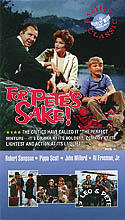 For Pete’s Sake (1966/1968), because the crusade takes place at the beginning of the story and not the end; this is that rare film which even tries to look at the aftermath of an altar call. This is also the film in which a rainshower interrupts one of Graham’s sermons — the very sermon to which the newly-saved protagonists have invited their skeptical friend! It’s just one of a number of difficulties that these characters face when trying to spread the Word, and it’s kind of funny and self-deprecating and nicely worked into the fabric of the story. Oh, plus, this is the film with Teri Garr in a small role as a biker chick. (This is the most suburban and parent-oriented of the “1960s films”, but the dad works at a garage and one of the main subplots involves his witnessing to some younger folks.)
 The Hiding Place (1975/1975), because it’s probably the closest WWP ever came to producing an epic; because it’s the first of their films that takes place outside the Anglosphere; because it may be the first that does not concern either troubled marriages or troubled youth; because it’s one of the better-acted films (FWIW, Yes Minister‘s Nigel Hawthorne has a small role as a local pastor); and because it pushes artistic boundaries that many Christian filmmakers still go nowhere near (such as depicting, however discretely, the nudity imposed on the prisoners at Ravensbruck; while it’s not as explicit as Steven Spielberg’s Schindler’s List, which came out 18 years later, the film does at least recognize that the horror and degradation of the concentration camps would be incomplete without this element). This was not the first WWP film to tell a true story — I believe 1955’s Wiretapper has that honour — but it kicked off a trend that lasted through a few more films, which I have yet to see.
After those, and based on what I remember of the 1980s films, it appears the WWP franchise went back to the formula of the 1960s, with troubled families and individuals being saved at the last minute by the deus ex machina of a Billy Graham crusade; although, FWIW, I think The Prodigal (1983/1983) may have been the first one to feature Graham as an actual actor in one of these films, since, if memory serves, I believe there was a scene in that film of Graham visiting a college and having an exchange with the students. True, his preaching in a TV studio in Oiltown U.S.A. (1954/—-) was staged just for the film, and he even looks straight at the camera, but he was still basically just preaching like he always does; and true, we do see him take a seat on the platform some time before he starts preaching in Two a Penny, but he is still seen from afar — the film crew never invades his personal space — and he never interacts with the characters.
I have not yet seen any of the 1990s or 2000s films, but I hope to sample some of them in the very near future. And since (1) it appears WWP really stepped up the pace at which these films were produced, and (2) none of them are available online, I definitely won’t be as completist with the last quarter-century’s worth of films as I was with the first; I am relying now on the videotapes and DVDs that I have been able to borrow or acquire.
Previous Post

June 24, 2005
Pasolini's Oedipus Rex
Next Post
June 26, 2005 Courts, compulsory acquisition, and The Castle
Browse Our Archives
Select a Category Anglican Planet Articles BC Christian News BC Report Bible Movies Bible Review Blog Books & Culture Campus Times CBC Radio Christianity Today ChristianWeek Essays Faith Today Festival Cinemas Guide Film Journals Georgia Straight Interviews MB Herald National Catholic Register Salvationist Today's Christian Two Chairs Ubyssey Uncategorized Vancouver Courier Vancouver Sun
Select a Month August 2025 April 2025 January 2025 December 2024 November 2024 May 2024 February 2024 December 2023 May 2023 March 2023 November 2022 July 2022 June 2022 May 2022 April 2022 February 2022 January 2022 December 2021 November 2021 October 2021 September 2021 August 2021 July 2021 June 2021 April 2021 March 2021 February 2021 January 2021 December 2020 November 2020 October 2020 August 2020 July 2020 June 2020 May 2020 March 2020 February 2020 January 2020 December 2019 November 2019 September 2019 July 2019 May 2019 April 2019 March 2019 February 2019 January 2019 December 2018 November 2018 October 2018 September 2018 July 2018 June 2018 May 2018 April 2018 March 2018 February 2018 January 2018 December 2017 November 2017 October 2017 September 2017 August 2017 July 2017 June 2017 May 2017 April 2017 March 2017 February 2017 January 2017 December 2016 November 2016 October 2016 September 2016 August 2016 July 2016 June 2016 May 2016 April 2016 March 2016 February 2016 January 2016 December 2015 November 2015 October 2015 September 2015 August 2015 July 2015 June 2015 May 2015 April 2015 March 2015 February 2015 January 2015 December 2014 November 2014 October 2014 September 2014 August 2014 July 2014 June 2014 May 2014 April 2014 March 2014 February 2014 January 2014 December 2013 November 2013 October 2013 September 2013 August 2013 July 2013 June 2013 May 2013 April 2013 March 2013 February 2013 January 2013 December 2012 November 2012 October 2012 September 2012 August 2012 July 2012 June 2012 April 2012 January 2012 January 2011 December 2010 November 2010 October 2010 September 2010 August 2010 July 2010 June 2010 May 2010 April 2010 March 2010 February 2010 January 2010 December 2009 November 2009 October 2009 September 2009 August 2009 July 2009 June 2009 May 2009 April 2009 March 2009 February 2009 January 2009 December 2008 November 2008 October 2008 September 2008 August 2008 July 2008 June 2008 May 2008 April 2008 March 2008 February 2008 January 2008 December 2007 November 2007 October 2007 September 2007 August 2007 July 2007 June 2007 May 2007 April 2007 March 2007 February 2007 January 2007 December 2006 November 2006 October 2006 September 2006 August 2006 July 2006 June 2006 May 2006 April 2006 March 2006 February 2006 January 2006 December 2005 November 2005 October 2005 September 2005 August 2005 July 2005 June 2005 May 2005 April 2005 March 2005 January 2005 December 2004 November 2004 October 2004 September 2004 August 2004 July 2004 June 2004 May 2004 April 2004 March 2004 February 2004 January 2004 November 2003 October 2003 August 2003 July 2003 June 2003 May 2003 January 2003 December 2002 November 2002 August 2002 July 2002 June 2002 May 2002 March 2002 January 2002 December 2001 November 2001 September 2001 August 2001 July 2001 June 2001 April 2001 March 2001 February 2001 December 2000 November 2000 October 2000 September 2000 August 2000 July 2000 June 2000 May 2000 April 2000 March 2000 January 2000 October 1999 August 1999 May 1999 April 1999 February 1999 January 1999 December 1998 November 1998 October 1998 August 1998 July 1998 June 1998 April 1998 March 1998 January 1998 November 1997 September 1997 July 1997 June 1997 April 1997 March 1997 February 1997 January 1997 December 1996 October 1996 September 1996 June 1996 March 1996 February 1996 January 1996 April 1995 November 1994 September 1994 September 1991
Follow Us!
TAKE THE
Religious Wisdom Quiz
Which New Testament book has the most Old Testament quotes?
Select your answer to see how you score.
Hebrews Romans Revelation Matthew
Related posts from FilmChat

Joseph of Egypt – the Chosen spin-off announces...

Exclusive: A clip from Angel Studios' The King...

Exclusive: Watch a clip from Angel Studios' Brave...

Exclusive: Watch a clip from Angel Studios' Homestead
TRENDING AT PATHEOS Religious Music & Entertainment

A Christian, a Narnia Fan, and a Filmmaker...
Watching The Narnia Trailer As A Fan And A Filmmaker Ever since...

Great Spiritual Horror Films of the 20th Century...
For the Christian, horror movies are often troubling—and many would say that...

"Les Diabolique" and Transgression
Alongside something like Arrival, Vertigo, or Charade, Les Diaboliques is a...

"The Plague Dogs" and Mortality
So, flashback to the late 70s, early 80s. Walt Disney Studios is...

With the recent and highly successful release of Christopher Nolan’s epic film,...

"L'avventura" and Human Weakness
Today's piece is going to be a little different for a few...
view all Religious Music & Entertainment blogs
Ad-Free & Subscriber Log-In Subscription Support
- About Us
- 2026 Calendar
- Videos
- Podcasts
- Library of World Religions
- Faith In Media Tracker
- Advertise With Us
- Write for Us
- Privacy Policy
- Terms of Service
- Do Not Sell My Data
- Contact Us
- Radiant Digital
- Manage Newsletter Subscriptions
- Unsubscribe From Notifications
- Sitemap
Copyright 2008-2026, Patheos. All rights reserved.
Subscription Support Ad-Free & Subscriber Log-In
Follow Patheos