
BuddhistCatholicContemplativeEvangelicalGeneral ChristianHinduJewishLatter-day SaintMuslimNew VisionsProgressive Christian
Beliefs
- Buddhist
- Catholic
- Contemplative
- Evangelical
- General Christian
- Hindu
- Jewish
- Latter-day Saint
- More Voices
- Muslim
- New Visions
- Pagan
- Progressive Christian
Topics
- Religion News
- Food and Religion
- Sports and Religion
- Religious Art
- Religious Music and Entertainment
- Religious Events
- History and Religion
- Style and Religion
- Politics and Religion
- Women in Religion
- Recreation Outdoors and Religion
- Business Finance and Religion
- Careers Workplace and Religion
- Education and Religion
- Family Parenting and Religion
- Health Fitness and Religion
- Home and Religion
- Relationships and Religion
- Technology and Religion
- Travel and Religion
Columnists
- Buddhist Columnists
- Business Finance and Religion Columnists
- Careers Workplace and Religion Columnists
- Catholic Columnists
- Contemplative Columnists
- Education and Religion Columnists
- Evangelists Columnists
- Family Parenting and Religion Columnists
- General Christian Columnists
- Health Fitness and Religion Columnists
- Hindu Columnists
- History and Religion Columnists
- Home and Religion Columnists
- Jewish Columnists
- More Voices Columnists
- Latter Day Columnists
- Muslim Columnists
- New Visions Columnists
- Nonreligious Columnists
- Pagan Columnists
- Politics and Religion Columnists
- Progressive Columnists
- Recreation Outdoors and Religion Columnists
- Relationships and Religion Columnists
- Religion News Columnists
- Religious Art Columnists
- Religious Events Columnists
- Religious Music and Entertainment Columnists
- Sports and Religion Columnists
- Style and Religion Columnists
- Technology and Religion Columnists
- Travel and Religion Columnists
- Women in Religion Columnists
Resource Library
- 2026 Calendar
- Library of World Religions
- The 100 Most Holy Places on Earth
- Patheos Answers
- Podcasts
- Videos
- Faith Leaders Database
- Anglican Episcopalian
- Bahai
- Baptist
- Buddhism
- Christianity
- Confucianism
- Eastern Orthodoxy
- Hinduism
- Holiness and Pentecostal
- ISKCON
- Islam
- Judaism
- Lutheran
- Methodist
- The Church of Jesus Christ of Latter-day Saints
- New Age
- Paganism
- Presbytarian and Reformed
- Protestantism
- Religion Behind the Scenes
- Roman Catholic
- Scientology
- Shia Islam
- Sikhism
- Sufism
- Sunni Islam
- Taoism
- Zen
- See all religions
Research Tools
 Ad-Free & Subscriber Log-In Subscription Support
Ad-Free & Subscriber Log-In Subscription Support
Follow Patheos 

- Trending:
- Forgiveness
- |
- Marriage
- |
- Consciousness
- |
- Death Penalty
- |
- Election
- |
- Halloween

-
Articles
- Home
- Religious Music & Entertainment
- Star Trek: First Contact
Star Trek: First Contact
Last updated on: May 15, 2013 at 11:10 am by Peter T. Chattaway
Star Trek: First Contact 2013-05-15T11:10:20-07:00 Peter T. Chattaway
Patheos Explore the world's faith through different perspectives on religion and spirituality! Patheos has the views of the prevalent religions and spiritualities of the world.
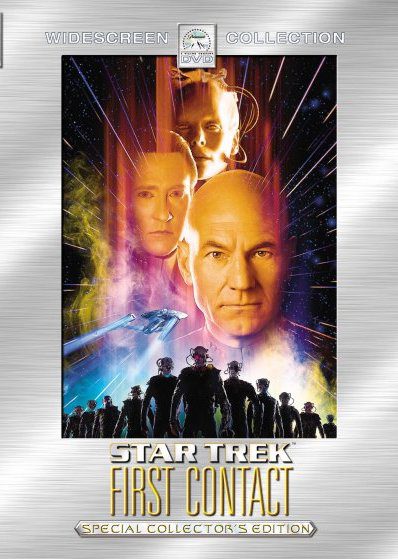 I know it came out several weeks ago, but it was only in the last couple days that I finally caught up and saw the new two-disc edition of Star Trek: First Contact (1996).
This film is noteworthy for a number of reasons, both for its own sake and also as a matter of personal significance. First of all, it was the last of the really good Star Trek films; and thus, it was the last of the films that I saw three times in the theatre, which I had done for every single film going back to The Search for Spock (1984), which came out when I was 13 years old. (I knew Star Trek had lost its appeal for me when I saw 1998’s Insurrection only twice, and 2002’s Nemesis only once, and had no urge to see them again.)
Second, of the five films that were scored by Jerry Goldsmith, this is the only one that was actually a good film in its own right; you might say it was the only film that deserved him. Goldsmith’s scores were always excellent — his soundtrack to Star Trek: The Motion Picture (1979) is a superb, lush, mysterious, romantic CD, and one I listen to often — but the films themselves typically were not. (His other scores were for ST:I, ST:N and 1989’s The Final Frontier — the first film to come out after the creation of Star Trek: The Next Generation, which used his ST:TMP theme in its title sequence.) It is fitting, therefore, that the DVD for this film — the only film that deserved his skills, and the only film on which Goldsmith collaborated with his son Joel — includes a special tribute to Goldsmith, who passed away recently.
(Footnote: One of several Goldsmith themes that is especially popular is the “Klingon” theme he wrote for ST:TMP in 1979; he used it again, in a more pumped-up action-movie mode, in ST5:TFF in 1989. In both of those films, the Klingons basically represented “the enemy” — but in ST:FC, he uses the theme again when the film introduces Worf, in the middle of a battle against the Borg. There has been some discussion among soundtrack buffs over the appropriateness of this choice. Does the theme represent “bad guys”? Or is it representative of Klingon culture, which is inherently neither good nor bad? Personally, I think it works just as well for Worf as it did for his villainous forebears.)
Third, this was the second Trek film to come out after I became an editor at a student newspaper, and I wrote an essay for the paper analyzing this film’s approach to gender in light of a book I had just finished reading on the sci-fi and horror films of the 1950s; a slightly revised version of that essay is posted here. I sent a copy of this article to the editor of Books & Culture when I first proposed writing an article for them; that was the beginning of a long and fruitful relationship with that magazine.
Fourth, this film came out right around the time Star Trek was celebrating the 30th anniversary of the premiere of the original series — and one factoid I had not known, until I watched this DVD, is that the “uncredited saloon keeper” who appears at the 1:14 mark is played by an actor who appeared in that first episode and who was, in fact, the first of many Enterprise crew members to die. It seems the Trek movies tended to turn out better if they came out in anniversary years: The Voyage Home, which remains the top-grossing film of the series even despite inflation, coincided with the show’s 20th anniversary in 1986; and The Undiscovered Country, which did an okay job of tying the old series to the new ones, coincided with the show’s 25th anniversary in 1991.
Fifth, as writers Brannon Braga and Ronald D. Moore note in their commentary, this was the first Star Trek film that did not feature any members of the original crew, and what’s more, they were not obliged to go through the “laundry list” of things that they had to incorporate into 1994’s Generations. So there was a definite freedom to this film — a freedom enhanced by the fact that it almost entirely takes place in the 21st century, and thus outside of whatever week-to-week continuity was being established in the TV shows back then — and you can sense it. (Granted, Worf had joined Deep Space Nine by this time, so his appearance needs to be fitted into that show’s continuity, but it ain’t that big a deal.)
And yet, despite this freedom, the show still revolves around a character from the original series! James Cromwell, who had just become quasi-famous for his role in Babe (1995), plays Zefram Cochrane, the inventor of the warp drive, who was a guest character in an episode of the original series, albeit one who was played by an actor who looked totally different. Ah well, Cromwell’s so good in the role, I don’t care.
Sixth, one thing I have always loved about this film is the way it goes for the scary, horror-movie stuff yet also manages to bring in the optimism of Gene Roddenberry’s original concept — there is a remarkable balancing act in this film between the light and the dark, and it plays out beautifully.
Amazingly, Braga and Moore say they originally conceived the film as a time-travel story set in the medieval era — but then Patrick Stewart said he refused to wear any more tights! And then they imagined going back to Zefram Cochrane’s era, except it was going to be Riker fighting the Borg on the ship and Picard helping Cochrane on the ground. Well that doesn’t make any sense — and Stewart rightly pointed out that Picard ought to be the one defending his ship (and besides, doesn’t Picard have a little bit of personal history with the Borg that might need to be dealt with?).
I learned some fascinating things from this DVD. For example, all the missile silo scenes were actually shot in a real missile silo, with a real Titan missile! So when Picard and Data have what one filmmaker calls their “sensual” scene with the missile, in which Picard explains to Data how physically touching an object from the past can make it seem more real, the actors are actually touching a real part of Cold War history!
FWIW, I know exactly what Picard means. When I was strolling through the British Museum in the summer of ’94, I was stunned to come across the Black Obelisk of Shalmaneser III (which happens to contain the only contemporary portrait of a biblical character), and to see that it was just standing there in the open, albeit behind a rope; so while no one was looking, I touched it. Touching history is a big deal, to me — and it’s one reason why I don’t have any objection at all to the Orthodox practice of venerating relics.
Braga and Moore say they debated whether or not Picard should quote Moby Dick, since Khan had already done that years earlier in 1982’s The Wrath of Khan; perhaps it would seem like too many trips to the well. I’m glad they decided to keep that line, though, because, as the authors of Deep Space and Sacred Time point out, the two uses of Moby Dick in the Star Trek films allow us to see how stories can either confirm us in our lack of self-awareness (as was the case with Khan) or force us to step outside ourselves and reflect on our actions (as is the case with Picard).
Braga and Moore also say they specifically wanted three Vulcans to come out of the ship at the end of the film as an homage to the “three wise men” of Nativity stories — but then one of them jokes that “the corruption of the Vulcans begins on day one,” as Cochrane plays some rockabilly tunes for them. This is very interesting, as Mike Hertenstein, in The Double Vision of Star Trek (my review), had a problem with this aspect of the film:
Technically, First Contact doesn’t suggest that the aliens save humanity, but that, just by learning about the aliens’ existence, humans were finally able to get it together and save themselves.
But that’s not how the scene plays. As the mother ship descends, the people on the ground squint, shielding their eyes. The dust kicks up and becomes a low-hanging fog that swallows the glowing sphere. The crowd of people watch in breathless awe as the door of the ship smoothly — but relentlessly — folds open and becomes a long ramp thrust down into their midst. Bright light beams through the fog from within the vessel. Now a dark figure appears at the top of the ramp, backlit in the doorway, an imposing silhouette. After a brief hesitation, the figure descends — a robed figure, whose face is shadowed in a hood: which he now reaches up to lower! A light dawns in the faces of those watching as the figure is revealed to be — Gene Roddenberry!
Oops. Actually, First Contact‘s literal god-in-the-machine answer to the central problems of human existence would have made Roddenberry apoplectic. A deus ex machina anywhere but here. Think of all the other films where we’ve watched this scene before, in general spirit if not all the details: E.T., Close Encounters of the Third Kind, and others. There’s a name for this subgenre of sci-fi movies — the alien-messiah film.
Alien-messiah films combine religious emotions with the trappings of science fiction. There’s no question its [sic] easy to mix the two up; scientists looking for life Out There do it all the time. Depending on which sort of messiah one looks for, the alien messiah can arrive in triumph, full of power and glory, or be vulnerable, an innocent, morally superior but misunderstood, usually killed by earth men and then resurrected. Perhaps it is the quintessential human act: killing the messiah. Here is one more reason First Contact rings false. The arrival of an alien messiah demands that the story move on to the next step: crucifixion.
Personally, I have always thought that Hertenstein makes a little much of the messiah parallels here — especially given that the Vulcans are so familiar to us already, and are immediately subverted or humanized when Cochrane subjects them to the rockabilly jukebox. And indeed, Braga’s reference to the “wise men” suggests not that these characters have come to effect a miracle, but to bear witness to a miracle already effected.
In any case, however, you spin this scene, it was interesting to hear the writers describe it in religiously evocative terms.
On a side note, Hertenstein also makes the point that discovering “we’re not alone in the universe” isn’t necessarily a positive thing — what if it had been the Borg, and not the Vulcans, with which Earth first came into contact? To this, I think it is worth noting that one of the theories bandied about in William Shatner’s Star Trek novels is the idea that the time-travel escapades of ST:FC may have created a parallel timeline . . . a parallel universe . . . perhaps even a Mirror Universe . . . in which the militaristic Federation may have been the consequence of a more pronounced awareness of the Borg threat looming in humanity’s future.
One last point. Braga and Moore also discuss how this film came out at the “high point” for all things Trek — there were two fairly new shows on TV, First Contact was keeping the earlier show’s momentum going, and things were ticking along quite nicely. But all this eventually began to dry up, and indeed, the current series Enterprise, which takes place between the events of ST:FC and the original series, was recently cancelled (probably after the commentary tracks were recorded for this DVD).
I never watched more than the first two episodes of that show, but I heard lots of gripes from fans who objected to the continuity problems on that show, and what’s interesting is how the writers discuss the way continuity has become something of a trap for the writers of Trek. Moore alludes to DC Comics’ 1985 mini-series Crisis on Infinite Earths (or, as he dimly recalls the title, “Worlds of Infinity”), and says Star Trek may have to do something similar — jettison all previous continuity, and start afresh. To this, Braga replies that, yes, Star Trek is “going to need a jolt.”
Whatever, dudes. Personally, I’d be quite happy if they just stopped making new stories altogether. It seems to me they’ve made enough good ones already, and their hit-to-miss ratio hasn’t exactly been promising of late. If the future isn’t what it used to be, there’s no need to go ditching the past!
Previous Post

May 5, 2005
I have seen Revenge of the Sith ...
Next Post
May 5, 2005 Kingdom of loopy errors
Browse Our Archives
Select a Category Anglican Planet Articles BC Christian News BC Report Bible Movies Bible Review Blog Books & Culture Campus Times CBC Radio Christianity Today ChristianWeek Essays Faith Today Festival Cinemas Guide Film Journals Georgia Straight Interviews MB Herald National Catholic Register Salvationist Today's Christian Two Chairs Ubyssey Uncategorized Vancouver Courier Vancouver Sun
Select a Month August 2025 April 2025 January 2025 December 2024 November 2024 May 2024 February 2024 December 2023 May 2023 March 2023 November 2022 July 2022 June 2022 May 2022 April 2022 February 2022 January 2022 December 2021 November 2021 October 2021 September 2021 August 2021 July 2021 June 2021 April 2021 March 2021 February 2021 January 2021 December 2020 November 2020 October 2020 August 2020 July 2020 June 2020 May 2020 March 2020 February 2020 January 2020 December 2019 November 2019 September 2019 July 2019 May 2019 April 2019 March 2019 February 2019 January 2019 December 2018 November 2018 October 2018 September 2018 July 2018 June 2018 May 2018 April 2018 March 2018 February 2018 January 2018 December 2017 November 2017 October 2017 September 2017 August 2017 July 2017 June 2017 May 2017 April 2017 March 2017 February 2017 January 2017 December 2016 November 2016 October 2016 September 2016 August 2016 July 2016 June 2016 May 2016 April 2016 March 2016 February 2016 January 2016 December 2015 November 2015 October 2015 September 2015 August 2015 July 2015 June 2015 May 2015 April 2015 March 2015 February 2015 January 2015 December 2014 November 2014 October 2014 September 2014 August 2014 July 2014 June 2014 May 2014 April 2014 March 2014 February 2014 January 2014 December 2013 November 2013 October 2013 September 2013 August 2013 July 2013 June 2013 May 2013 April 2013 March 2013 February 2013 January 2013 December 2012 November 2012 October 2012 September 2012 August 2012 July 2012 June 2012 April 2012 January 2012 January 2011 December 2010 November 2010 October 2010 September 2010 August 2010 July 2010 June 2010 May 2010 April 2010 March 2010 February 2010 January 2010 December 2009 November 2009 October 2009 September 2009 August 2009 July 2009 June 2009 May 2009 April 2009 March 2009 February 2009 January 2009 December 2008 November 2008 October 2008 September 2008 August 2008 July 2008 June 2008 May 2008 April 2008 March 2008 February 2008 January 2008 December 2007 November 2007 October 2007 September 2007 August 2007 July 2007 June 2007 May 2007 April 2007 March 2007 February 2007 January 2007 December 2006 November 2006 October 2006 September 2006 August 2006 July 2006 June 2006 May 2006 April 2006 March 2006 February 2006 January 2006 December 2005 November 2005 October 2005 September 2005 August 2005 July 2005 June 2005 May 2005 April 2005 March 2005 January 2005 December 2004 November 2004 October 2004 September 2004 August 2004 July 2004 June 2004 May 2004 April 2004 March 2004 February 2004 January 2004 November 2003 October 2003 August 2003 July 2003 June 2003 May 2003 January 2003 December 2002 November 2002 August 2002 July 2002 June 2002 May 2002 March 2002 January 2002 December 2001 November 2001 September 2001 August 2001 July 2001 June 2001 April 2001 March 2001 February 2001 December 2000 November 2000 October 2000 September 2000 August 2000 July 2000 June 2000 May 2000 April 2000 March 2000 January 2000 October 1999 August 1999 May 1999 April 1999 February 1999 January 1999 December 1998 November 1998 October 1998 August 1998 July 1998 June 1998 April 1998 March 1998 January 1998 November 1997 September 1997 July 1997 June 1997 April 1997 March 1997 February 1997 January 1997 December 1996 October 1996 September 1996 June 1996 March 1996 February 1996 January 1996 April 1995 November 1994 September 1994 September 1991
Follow Us!
TAKE THE
Religious Wisdom Quiz
Which Christian denomination is most common in Russia?
Select your answer to see how you score.
Catholic Eastern Orthodox Methodist Baptist
Related posts from FilmChat

Joseph of Egypt – the Chosen spin-off announces...

Exclusive: A clip from Angel Studios' The King...

Exclusive: Watch a clip from Angel Studios' Brave...

Exclusive: Watch a clip from Angel Studios' Homestead
TRENDING AT PATHEOS Religious Music & Entertainment

"Les Diabolique" and Transgression
Alongside something like Arrival, Vertigo, or Charade, Les Diaboliques is a...

"The Plague Dogs" and Mortality
So, flashback to the late 70s, early 80s. Walt Disney Studios is...

With the recent and highly successful release of Christopher Nolan’s epic film,...

"L'avventura" and Human Weakness
Today's piece is going to be a little different for a few...

I first want to apologize for not posting or writing anything. I'm...

I've engaged in the multi-year project of reading through the Church Fathers,...
view all Religious Music & Entertainment blogs
Ad-Free & Subscriber Log-In Subscription Support
- About Us
- 2026 Calendar
- Videos
- Podcasts
- Library of World Religions
- Faith In Media Tracker
- Advertise With Us
- Write for Us
- Privacy Policy
- Terms of Service
- Do Not Sell My Data
- Contact Us
- Radiant Digital
- Manage Newsletter Subscriptions
- Unsubscribe From Notifications
- Sitemap
Copyright 2008-2026, Patheos. All rights reserved.
Subscription Support Ad-Free & Subscriber Log-In
Follow Patheos