
BuddhistCatholicContemplativeEvangelicalGeneral ChristianHinduJewishLatter-day SaintMuslimNew VisionsProgressive Christian
Beliefs
- Buddhist
- Catholic
- Contemplative
- Evangelical
- General Christian
- Hindu
- Jewish
- Latter-day Saint
- More Voices
- Muslim
- New Visions
- Pagan
- Progressive Christian
Topics
- Religion News
- Food and Religion
- Sports and Religion
- Religious Art
- Religious Music and Entertainment
- Religious Events
- History and Religion
- Style and Religion
- Politics and Religion
- Women in Religion
- Recreation Outdoors and Religion
- Business Finance and Religion
- Careers Workplace and Religion
- Education and Religion
- Family Parenting and Religion
- Health Fitness and Religion
- Home and Religion
- Relationships and Religion
- Technology and Religion
- Travel and Religion
Columnists
- Buddhist Columnists
- Business Finance and Religion Columnists
- Careers Workplace and Religion Columnists
- Catholic Columnists
- Contemplative Columnists
- Education and Religion Columnists
- Evangelists Columnists
- Family Parenting and Religion Columnists
- General Christian Columnists
- Health Fitness and Religion Columnists
- Hindu Columnists
- History and Religion Columnists
- Home and Religion Columnists
- Jewish Columnists
- More Voices Columnists
- Latter Day Columnists
- Muslim Columnists
- New Visions Columnists
- Nonreligious Columnists
- Pagan Columnists
- Politics and Religion Columnists
- Progressive Columnists
- Recreation Outdoors and Religion Columnists
- Relationships and Religion Columnists
- Religion News Columnists
- Religious Art Columnists
- Religious Events Columnists
- Religious Music and Entertainment Columnists
- Sports and Religion Columnists
- Style and Religion Columnists
- Technology and Religion Columnists
- Travel and Religion Columnists
- Women in Religion Columnists
Resource Library
- 2026 Calendar
- Library of World Religions
- The 100 Most Holy Places on Earth
- Patheos Answers
- Podcasts
- Videos
- Faith Leaders Database
- Anglican Episcopalian
- Bahai
- Baptist
- Buddhism
- Christianity
- Confucianism
- Eastern Orthodoxy
- Hinduism
- Holiness and Pentecostal
- ISKCON
- Islam
- Judaism
- Lutheran
- Methodist
- The Church of Jesus Christ of Latter-day Saints
- New Age
- Paganism
- Presbytarian and Reformed
- Protestantism
- Religion Behind the Scenes
- Roman Catholic
- Scientology
- Shia Islam
- Sikhism
- Sufism
- Sunni Islam
- Taoism
- Zen
- See all religions
Research Tools
 Ad-Free & Subscriber Log-In Subscription Support
Ad-Free & Subscriber Log-In Subscription Support
Follow Patheos 

- Trending:
- Forgiveness
- |
- Marriage
- |
- Consciousness
- |
- Death Penalty
- |
- Election
- |
- Halloween

-
Articles
- Home
- Religious Music & Entertainment
- Review: The Amityville Horror (dir. Andrew Douglas, 2005)
Review: The Amityville Horror (dir. Andrew Douglas, 2005)
Last updated on: December 3, 2013 at 9:29 pm by Peter T. Chattaway
Review: The Amityville Horror (dir. Andrew Douglas, 2005) 2013-12-03T21:29:53-08:00 Peter T. Chattaway
Patheos Explore the world's faith through different perspectives on religion and spirituality! Patheos has the views of the prevalent religions and spiritualities of the world.
 For a Christian film critic like me, one of the more interesting things about the recent glut of horror sequels and remakes is the opportunity it has given me to go back and look at the classic thrillers that I avoided at all costs in my younger days. When I was a child, I was reluctant to expose myself to any supernatural story that didn’t have the clear imprimatur of some evangelical author or other, and by the time I became a man and put away childish things, many of the films made during my youth had faded into video-store oblivion. So the best thing I can say about Andrew Douglas’s remake of The Amityville Horror is that it gave me a reason to track down the original film, which I remember hearing about when I was still in grade school, and which, to my surprise, has a fair bit of Christian content.
In that 1979 original, based on a book by Jay Anson and directed by Stuart Rosenberg (Cool Hand Luke), it is made very clear that George and Kathy Lutz are a Catholic couple, who count a nun among their relatives and ask a priest to bless their home as a matter of course. When the priest is driven out of the house by some sort of evil presence, he begs his ecclesiastical superiors to let him seek help for the family, but the church bureaucracy is skeptical of his claims and turns him down. In some ways, the film harks back to The Exorcist, but where that slightly earlier movie was content to express the conflict between skeptical modernity and spiritual pre-modernity suggestively, through its use of sounds and images and character arcs, The Amityville Horror spells things out more bluntly, as the characters use words like “modernist” and “rationalist” in their conversations.
Still, even a blatantly obvious discussion of the relationship between faith and doubt can be better than no discussion at all, and alas, the faith elements are all but missing from the Amityville remake. Written by Scott Kosar, whose earlier credits include the remake of The Texas Chainsaw Massacre, and directed by Andrew Douglas, whose only previous film is the alt-country documentary Searching for the Wrong-Eyed Jesus, the new movie is completely uninterested in offering or exploring any sort of subtext to the events that transpire at the Amityville house. Instead, it offers little more than a stylish exercise in cinematic shock and awe, full of lightning storms and ghosts popping up in mirrors and windows, and lacking anything that might stick with you once the ride is over.
The film insists it is based on a true story, and the opening scenes use just enough real-life news and crime-scene footage to make that claim stick. In 1974, Ronald DeFeo Jr. murdered the other six members of his family, most of whom were in their sleep, and the opening re-enactment of this crime is followed by actual clips of the detectives who investigated the case. The film then picks up one year later, when George Lutz (Ryan Reynolds) and his wife Kathy (Melissa George) buy the former DeFeo house; while other buyers have steered clear of the building, the Lutzes figure they should take advantage of its low, low price. After all, houses don’t kill people, people kill people, right?
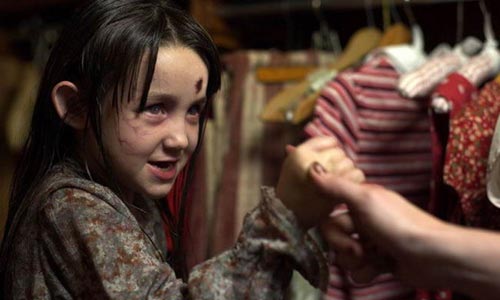
However, spooky things begin to happen almost as soon as the family moves in. George finds the temperature too cold, and spends hours chopping firewood, his behavior becoming more and more obsessive with every swing of his axe. The first time George and Kathy have sex in their new bedroom, George suddenly sees a girl hanging from a noose at the foot of the bed — which is odd, since the DeFeos were shot, not hanged. Shadowy figures zip through rooms when people aren’t looking. Fridge-magnet letters spell scary messages all by themselves. And sweet young Chelsea (Chloe Moretz) begins to pass on messages from her new “imaginary friend” Jodie (Isabel Conner) — and it doesn’t seem to faze her at all that Jodie has deathly-pale skin and a bullet hole through her head.
The film’s co-stars are a pretty sexy couple, and comedian Reynolds in particular seems to have no trouble flaunting the muscles he built up for his vampire-hunting role in Blade: Trinity. Perhaps no episode captures the new film’s emphasis on cheesy humor, perfectly toned bodies and grotesque special effects like the one involving the babysitter Lisa (Rachel Nichols). When she shows up, she’s dressed in clothes so tight and skimpy you’d think she was going out on the hottest of dates, instead of looking after the kids so that Mr. and Mrs. Lutz can spend an evening together. George takes this in his stride and asks his step-son Billy (Jesse James), who has been protesting that he’s too old for a babysitter, if he really doesn’t want to be alone with this bombshell after all. And when Lisa is trapped inside Chelsea’s closet, Jodie shows up and sticks Lisa’s finger right inside the hole in her forehead.
Nearly an hour of this sort of thing goes by before Kathy finally turns to a priest for help, and when Father Callaway (Philip Baker Hall) does show up at the Lutz residence — not to perform a routine blessing, this time, but to perform an exorcism — he is scared away pretty quickly and more or less abandons the family without trying to contact them or to solicit the help of his fellow clergy. And so they are forced to struggle with ever more brutal events — the death of a dog, the discovery of centuries-old torture chambers under the building, and so on — and we are compelled to endure these trials with them. Those who want nothing more than a thrill ride might get a kick or two out of this film, but the rest of us might prefer to hold out for something a little more thoughtful and interesting.
1.5 stars (out of 4)
–
Talk About It
Discussion starters
1. When Ronald DeFeo Jr. is about to kill his family, we see a book titled, Evil Is Proof of God. Do you agree? Why or why not? Is it possible for goodness to exist without God? Is it possible for evil to exist without goodness? Why does God allow evil to exist?
2. Billy says prayer does no good, because he asked God to keep his father alive and his father died anyway. How would you respond to Billy? How do you think this film shows prayer? What about the priest’s efforts to bless or exorcise the house?
3. If a child said her “imaginary friend” was real because she had seen her, how would you respond? How does Chelsea’s insistence that “I’ve seen her” compare to, say, Lucy’s insistence in The Lion, the Witch and the Wardrobe that she has been to a fantastic country? How do you think the Professor in that story would apply his “logic” to Chelsea?
4. What is the relationship between faith and skepticism? How readily should we agree to anyone’s assertion that events like the ones behind this film really happened? Are we more inclined to believe positive stories than negative ones? Should we be?
5. What would you do if you lived in a house where strange things like these seemed to happen? Do you believe the house could be “cured”? Do you think you would have to abandon it? What other sorts of situations should we be prepared to flee from, and why?
The Family Corner
For parents to consider
The Amityville Horror is rated R for violence, disturbing images, language, brief sexuality and drug use. The film is full of gruesome and shocking images, including bodies hung from hooks, showers of blood, and the ghosts of various corpses. The film’s one sex scene involves a married couple, and in one scene, a babysitter asks a boy if he knows how to French kiss.
— A version of this review was first published on the Christianity Today Movies website.
Previous Post

April 14, 2005
Dante's Inferno -- trailer online!
Next Post
April 15, 2005 Amityville remake -- the review is up
Browse Our Archives
Select a Category Anglican Planet Articles BC Christian News BC Report Bible Movies Bible Review Blog Books & Culture Campus Times CBC Radio Christianity Today ChristianWeek Essays Faith Today Festival Cinemas Guide Film Journals Georgia Straight Interviews MB Herald National Catholic Register Salvationist Today's Christian Two Chairs Ubyssey Uncategorized Vancouver Courier Vancouver Sun
Select a Month August 2025 April 2025 January 2025 December 2024 November 2024 May 2024 February 2024 December 2023 May 2023 March 2023 November 2022 July 2022 June 2022 May 2022 April 2022 February 2022 January 2022 December 2021 November 2021 October 2021 September 2021 August 2021 July 2021 June 2021 April 2021 March 2021 February 2021 January 2021 December 2020 November 2020 October 2020 August 2020 July 2020 June 2020 May 2020 March 2020 February 2020 January 2020 December 2019 November 2019 September 2019 July 2019 May 2019 April 2019 March 2019 February 2019 January 2019 December 2018 November 2018 October 2018 September 2018 July 2018 June 2018 May 2018 April 2018 March 2018 February 2018 January 2018 December 2017 November 2017 October 2017 September 2017 August 2017 July 2017 June 2017 May 2017 April 2017 March 2017 February 2017 January 2017 December 2016 November 2016 October 2016 September 2016 August 2016 July 2016 June 2016 May 2016 April 2016 March 2016 February 2016 January 2016 December 2015 November 2015 October 2015 September 2015 August 2015 July 2015 June 2015 May 2015 April 2015 March 2015 February 2015 January 2015 December 2014 November 2014 October 2014 September 2014 August 2014 July 2014 June 2014 May 2014 April 2014 March 2014 February 2014 January 2014 December 2013 November 2013 October 2013 September 2013 August 2013 July 2013 June 2013 May 2013 April 2013 March 2013 February 2013 January 2013 December 2012 November 2012 October 2012 September 2012 August 2012 July 2012 June 2012 April 2012 January 2012 January 2011 December 2010 November 2010 October 2010 September 2010 August 2010 July 2010 June 2010 May 2010 April 2010 March 2010 February 2010 January 2010 December 2009 November 2009 October 2009 September 2009 August 2009 July 2009 June 2009 May 2009 April 2009 March 2009 February 2009 January 2009 December 2008 November 2008 October 2008 September 2008 August 2008 July 2008 June 2008 May 2008 April 2008 March 2008 February 2008 January 2008 December 2007 November 2007 October 2007 September 2007 August 2007 July 2007 June 2007 May 2007 April 2007 March 2007 February 2007 January 2007 December 2006 November 2006 October 2006 September 2006 August 2006 July 2006 June 2006 May 2006 April 2006 March 2006 February 2006 January 2006 December 2005 November 2005 October 2005 September 2005 August 2005 July 2005 June 2005 May 2005 April 2005 March 2005 January 2005 December 2004 November 2004 October 2004 September 2004 August 2004 July 2004 June 2004 May 2004 April 2004 March 2004 February 2004 January 2004 November 2003 October 2003 August 2003 July 2003 June 2003 May 2003 January 2003 December 2002 November 2002 August 2002 July 2002 June 2002 May 2002 March 2002 January 2002 December 2001 November 2001 September 2001 August 2001 July 2001 June 2001 April 2001 March 2001 February 2001 December 2000 November 2000 October 2000 September 2000 August 2000 July 2000 June 2000 May 2000 April 2000 March 2000 January 2000 October 1999 August 1999 May 1999 April 1999 February 1999 January 1999 December 1998 November 1998 October 1998 August 1998 July 1998 June 1998 April 1998 March 1998 January 1998 November 1997 September 1997 July 1997 June 1997 April 1997 March 1997 February 1997 January 1997 December 1996 October 1996 September 1996 June 1996 March 1996 February 1996 January 1996 April 1995 November 1994 September 1994 September 1991
Follow Us!
TAKE THE
Religious Wisdom Quiz
Which letter is addressed "to the twelve tribes in the Dispersion"?
Select your answer to see how you score.
Galatians 2 John Jude James
Related posts from FilmChat

Review: Stay (dir. Marc Forster, 2005)

Moses at the Movies / When we trace...

Exclusive: James Wan on his return to horror,...

Box office: The Angry Birds rule the weekend,...
TRENDING AT PATHEOS Religious Music & Entertainment

"Les Diabolique" and Transgression
Alongside something like Arrival, Vertigo, or Charade, Les Diaboliques is a...

"The Plague Dogs" and Mortality
So, flashback to the late 70s, early 80s. Walt Disney Studios is...

With the recent and highly successful release of Christopher Nolan’s epic film,...

"L'avventura" and Human Weakness
Today's piece is going to be a little different for a few...

I first want to apologize for not posting or writing anything. I'm...

I've engaged in the multi-year project of reading through the Church Fathers,...
view all Religious Music & Entertainment blogs
Ad-Free & Subscriber Log-In Subscription Support
- About Us
- 2026 Calendar
- Videos
- Podcasts
- Library of World Religions
- Faith In Media Tracker
- Advertise With Us
- Write for Us
- Privacy Policy
- Terms of Service
- Do Not Sell My Data
- Contact Us
- Radiant Digital
- Manage Newsletter Subscriptions
- Unsubscribe From Notifications
- Sitemap
Copyright 2008-2026, Patheos. All rights reserved.
Subscription Support Ad-Free & Subscriber Log-In
Follow Patheos