
BuddhistCatholicContemplativeEvangelicalGeneral ChristianHinduJewishLatter-day SaintMuslimNew VisionsProgressive Christian
Beliefs
- Buddhist
- Catholic
- Contemplative
- Evangelical
- General Christian
- Hindu
- Jewish
- Latter-day Saint
- More Voices
- Muslim
- New Visions
- Pagan
- Progressive Christian
Topics
- Religion News
- Food and Religion
- Sports and Religion
- Religious Art
- Religious Music and Entertainment
- Religious Events
- History and Religion
- Style and Religion
- Politics and Religion
- Women in Religion
- Recreation Outdoors and Religion
- Business Finance and Religion
- Careers Workplace and Religion
- Education and Religion
- Family Parenting and Religion
- Health Fitness and Religion
- Home and Religion
- Relationships and Religion
- Technology and Religion
- Travel and Religion
Columnists
- Buddhist Columnists
- Business Finance and Religion Columnists
- Careers Workplace and Religion Columnists
- Catholic Columnists
- Contemplative Columnists
- Education and Religion Columnists
- Evangelists Columnists
- Family Parenting and Religion Columnists
- General Christian Columnists
- Health Fitness and Religion Columnists
- Hindu Columnists
- History and Religion Columnists
- Home and Religion Columnists
- Jewish Columnists
- More Voices Columnists
- Latter Day Columnists
- Muslim Columnists
- New Visions Columnists
- Nonreligious Columnists
- Pagan Columnists
- Politics and Religion Columnists
- Progressive Columnists
- Recreation Outdoors and Religion Columnists
- Relationships and Religion Columnists
- Religion News Columnists
- Religious Art Columnists
- Religious Events Columnists
- Religious Music and Entertainment Columnists
- Sports and Religion Columnists
- Style and Religion Columnists
- Technology and Religion Columnists
- Travel and Religion Columnists
- Women in Religion Columnists
Resource Library
- 2026 Calendar
- Library of World Religions
- The 100 Most Holy Places on Earth
- Patheos Answers
- Podcasts
- Videos
- Faith Leaders Database
- Anglican Episcopalian
- Bahai
- Baptist
- Buddhism
- Christianity
- Confucianism
- Eastern Orthodoxy
- Hinduism
- Holiness and Pentecostal
- ISKCON
- Islam
- Judaism
- Lutheran
- Methodist
- The Church of Jesus Christ of Latter-day Saints
- New Age
- Paganism
- Presbytarian and Reformed
- Protestantism
- Religion Behind the Scenes
- Roman Catholic
- Scientology
- Shia Islam
- Sikhism
- Sufism
- Sunni Islam
- Taoism
- Zen
- See all religions
Research Tools
 Ad-Free & Subscriber Log-In Subscription Support
Ad-Free & Subscriber Log-In Subscription Support
Follow Patheos 

- Trending:
- Forgiveness
- |
- Marriage
- |
- Consciousness
- |
- Death Penalty
- |
- Election
- |
- Halloween

-
Articles
- Home
- Religious Music & Entertainment
- Your Chip Is Showing / Four recent films show a battle for control among men, women, and machines.
Your Chip Is Showing / Four recent films show a battle for control among men, women, and machines.
Last updated on: April 21, 2014 at 10:25 am by Peter T. Chattaway
Your Chip Is Showing / Four recent films show a battle for control among men, women, and machines. 2014-04-21T10:25:11-07:00 Peter T. Chattaway
Patheos Explore the world's faith through different perspectives on religion and spirituality! Patheos has the views of the prevalent religions and spiritualities of the world.
 Film is perhaps the most technological of artforms, and it relies increasingly on computers for its simulations of the real world. Not surprisingly, films have also expressed concern over the directions in which our technology is taking us, and these days, as spyware snoops around our hard drives and governments assume more powers unto themselves, the issue that crops up repeatedly in films is that of control. Who has it? Who uses it? And to what degree have the devices we created to serve us become our masters?
The dangers of blurring the line between man and machine are touched on in Spider-Man 2, one of several sequels this past summer that improved on their predecessors. Spidey’s nemesis this time is Dr. Otto Octavius (Alfred Molina), a.k.a. Doctor Octopus, a formerly warm and sympathetic scientist who is consumed by his own pride after he attaches four artificially intelligent tentacles, or “smart arms,” to his spine. Octavius, who is developing a new fusion-based source of energy, needs these virtually indestructible limbs to perform tasks too hazardous for human flesh, and he assures the people observing his experiment that the “inhibitor chip” built into the tentacles will protect his “higher brain functions” from being taken over by the arms. But then the experiment goes horribly awry, the inhibitor chip is destroyed, and the mechanical arms take on a life of their own — first killing the surgeons that try to remove them, and then pushing Octavius into a life of crime so that he can try his flawed experiment again in an even bigger, grander form.
Octavius is horrified, at first, by what the arms have done, and he recognizes that his own hubris is ultimately to blame; stricken with remorse, he even considers suicide. But then the tentacles, hovering like serpents near his face, tempt him to a different course of action. Octavius tries in vain to resist the voices in his head — “No, no, I’m not a criminal!” — but then his face changes to a wicked grin, and we know that the tentacles have won.
While all this is happening, Spider-Man (Tobey Maguire), too, is losing control of his body, and this, too, is connected to his uncertainty about his own identity and purpose in life. But Peter Parker’s struggle is more spiritual than mechanical. He feels obliged to live up to the moral standards encouraged by his late Uncle Ben (Cliff Robertson), and he is convinced that, in order to do so, he must reject the opportunity of a relationship with Mary Jane Watson (Kirsten Dunst), the girl he has had a crush on since grade school. But the news that Mary Jane is now engaged to another man causes Peter to doubt his priorities, and the psychosomatic effect of this is that his ability to climb walls and spin webs vanishes at inopportune moments. Eventually, he takes his problems to a physician, who tells him that the problem is in his head, not his body, and who casually remarks that a person’s “soul disappears” if they don’t know who they are. Peter then decides he cannot be Spider-Man any more.
Peter Parker doesn’t get his powers back until Doctor Octopus kidnaps Mary Jane and threatens her life, thus bringing together the personal and heroic threads of Peter’s life. And in the end, Spidey saves the day not through sheer force, but by urging Octavius to take back control of his body, which he does; the tragic doctor then saves New York City from his newest experiment-gone-amok by pulling it down into the river, like Samson bringing the Philistine temple down upon himself.
Interestingly, Spider-Man 2 ends with a couple of epilogues that touch on issues of control and free will. Harry Osborn (James Franco), an embittered former friend of Peter’s, is haunted by an image of his late father (Willem Dafoe), who he discovers was the villain of the previous film. “You will always be weak until you take control!” says the angry dad, and the viewer is left to speculate that Harry may follow in his father’s psychotic footsteps. Contrast this with how Peter does not get his powers back until after he comes out from under the shadow of the guilt he feels over the death of his Uncle Ben; Peter is beginning to truly own the virtues that his uncle and aunt have instilled in him, whereas Harry, it seems, will be owned by his father’s vices.
This sequence is followed by another, in which Mary Jane leaves her fiancée at the altar and runs to Peter’s apartment. Peter has told her he must turn down her affections for her own safety — his enemies would harm her if they knew she was his girlfriend — but now she insists that he let her assume responsibility for her own life. “Can’t you respect me enough to let me make my own decision?” she asks, and this Peter does.
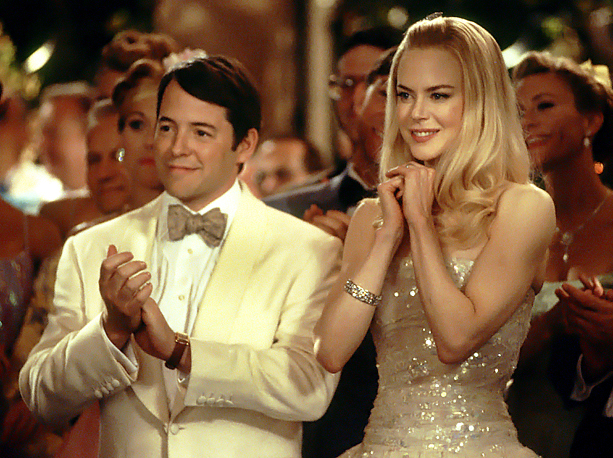 Female empowerment of a sort also lurks behind The Stepford Wives, Frank Oz’s campy remake — actually, it’s more of a spoof — of the 1975 film by Bryan Forbes; but the new film is as critical of feminist pieties and accomplishments as it is appreciative of them. The original film, based on a novella by Ira Levin, tapped into fears that all men are chauvinist pigs, and it suggested, somewhat absurdly, that all men, no matter how “liberated” they said they were, would gladly exchange their flesh-and-blood wives for domesticated, hypersexual robots if they could; the new film, however, suggests women may be just as much to blame for the roles they feel obliged to play as anyone else.
In this version, Joanna Eberhart (Nicole Kidman) is the ultra-successful president of a top-rated television network, and the new batch of reality-TV shows that she promotes all hinge on women upstaging men.1 But Joanna’s plans are brought to a crashing halt when a man who appeared on one of her shows turns up at an affiliates convention, brandishing a gun and crying, “Let’s kill all the women!” Fearing lawsuits, the network cancels all of Joanna’s shows and lets her go, much to her shock — literally, since she suffers a nervous breakdown and is given some offscreen shock therapy.
Looking for a change of pace, Joanna and her doting husband Walter (Matthew Broderick) move with their family to Connecticut, to the gated community of Stepford. At first, Joanna is put off by the buxom, blissed-out women in the floral-print dresses, but then she tries to fit in, baking cupcakes and knitting and performing various other tasks. In the meantime, she preserves her sense of self by hanging out with fellow misfits Bobbi Markowitz (Bette Midler), a sassy Jewish author, and Roger Bannister (Roger Bart), a flamboyantly gay man whose partner, alas, has become a Republican. Among other things, Joanna and her friends compare the various pharmaceuticals and medical treatments they have taken in a frustrated search for peace of mind; these characters have been pursuing artificial self-enhancement since long before their partners had any other plans for them.
Walter, meanwhile, joins the Men’s Association, a secretive club whose leader, Mike Wellington (Christopher Walken), offers Walter the chance to give his wife a mechanical upgrade. The original film hints that what happens to the men is arguably more horrifying than what happens to the women — it is one thing to be killed and replaced by a machine, but it is quite another to allow your own soul to be twisted against your conscience. Oz and screenwriter Paul Rudnick, however, nuance the story by suggesting that Walter has long resented being subordinate to his wife, by introducing scenes in which Joanna and Walter try to work on their relationship. By the time Joanna comes to the Men’s Association to meet her replica, she is in a position to appeal to the special, spiritual link between herself and Walter. “Can [the robots] say ‘I love you’?” she asks. “Of course,” says Mike. “Fifty-eight different languages!” “But do they mean it?”
The film reportedly went through extensive reshoots, which may explain why it abandons its original premise at this point — that the women are replaced with robots — for a very different one, in which the women remain their regular selves, but with nanochips installed inside their brains. Joanna and Walter secretly conspire to undo the damage that has been done, by reversing the nanochips in all of the town’s women. But then they discover that Mike, the leader of the men, was, himself, a full-fledged robot created by his wife Claire (Glenn Close) to replace her philandering husband; after killing him in a crime of passion, she decided to create a perfect, idyllic community in which she and his replica could live out a quaint, old-fashioned fantasy. (“What are you,” a confused Walter asks, “a person or a machine?” Claire snaps: “I’m a lady!”) So it is ultimately a woman, Claire, who is responsible for the subjugation of the town’s other women. Who sets the too-high expectations? Sisters, the film suggests, are doing it to themselves.
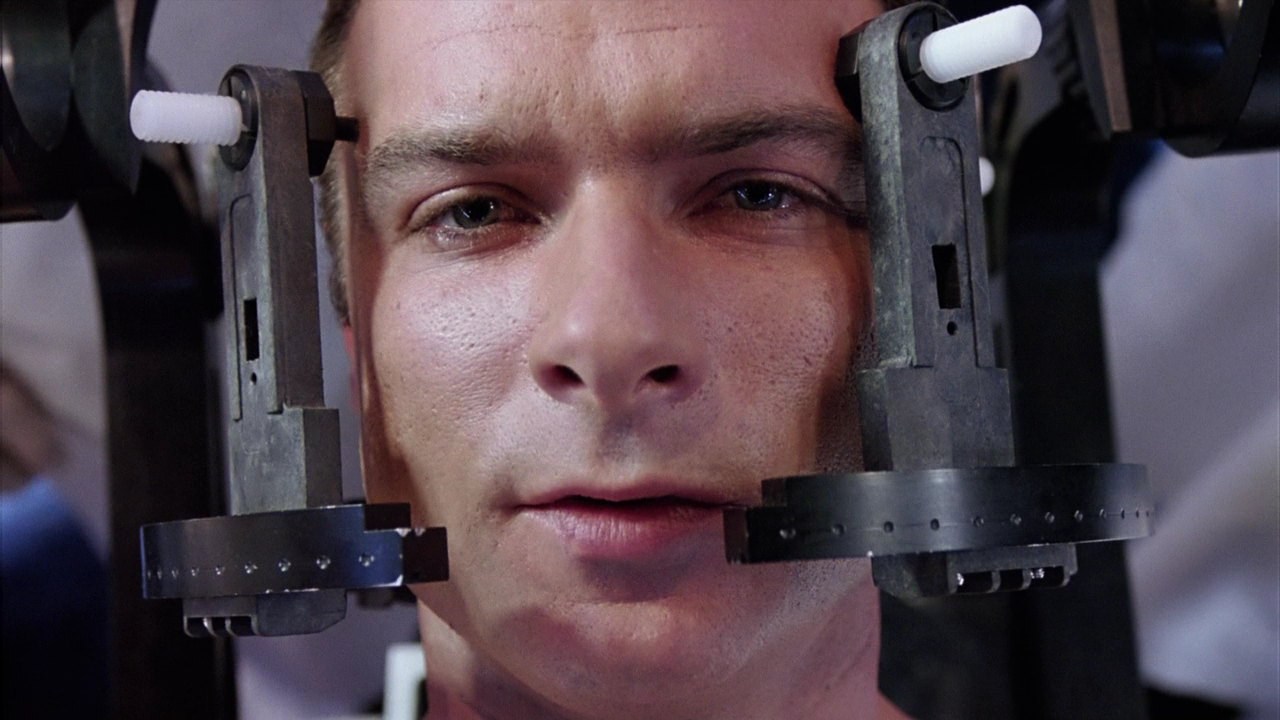 Brain chips and manipulative women are featured prominently in another recent remake. In the original film version of The Manchurian Candidate, based on the Richard Condon novel and directed by John Frankenheimer in 1962, several American soldiers are captured by the Chinese during the Korean War and brainwashed to become fully obedient killing machines; one of these men, Raymond Shaw (Laurence Harvey), is the son of a scheming senator’s wife (Angela Lansbury) who plans to use these sleeper agents to stir up anti-Communist hysteria, and to ensure that her pompous husband will be elected President of the United States, “with powers that will make martial law seem like anarchy.”
Jonathan Demme’s remake moves the story to the present day, and the villains this time are not Communists but rather multinational corporate executives who stand to profit from the war on terror. Congressman Raymond Shaw (Liev Schreiber) is now a Gulf War veteran and a vice-presidential candidate running on his reputation as a war hero, and his obedience as a sleeper agent is ensured not through purely psychological means, but by the installation of a microchip inside his head; in one macabre scene, a rogue scientist named Atticus Noyle (Simon McBurney) gives Raymond a “new implant” by drilling directly through his skull and into his brain.
This plot is gradually uncovered by Capt. Ben Marco (Denzel Washington), the officer under whom Raymond served in Kuwait. Ben has been having strange dreams, and he begins to suspect that something is up when he receives a visit from another member of his unit who has been having nightmares of a similar nature. Shortly thereafter, Ben discovers that he literally has a chip on his shoulder — but after cutting it out of his skin, he accidentally loses it down a drain. He approaches Raymond and tries to convince him that something sinister was done to them in Kuwait. “Neurons got exposed, circuits got rewired,” he says. “Our brain cells got obliterated.” Raymond doesn’t believe him, though, so Ben looks for other ways to make his case — first by jumping Raymond and biting into his shoulder, where he finds a similar chip, and then by trying to convince one of Raymond’s political rivals that the congressman is about to become “the first privately owned and operated Vice President of the United States.”
In the original film, Raymond’s mother is livid that her Communist partners have turned her own son into an assassin. “They paid me back by taking your soul away from you,” she says bitterly, vowing vengeance. But there is nothing in the new film to indicate that Eleanor Prentiss Shaw (Meryl Streep) disapproves of using her son this way, and the only person who expresses anything resembling interest in Raymond’s soul is Ben. Most of the discussion around the workings of the brain and mind are rooted in a basically materialist premise, such as when Atticus Noyle says, “At the flick of a switch, we can change personality.” Similarly, when Ben wakes up after receiving some shock treatments, the woman watching over him explains that the scientist who performed the treatments said it would be “like a computer system crash.” But when Ben meets Raymond one last time, he appeals to something between them that goes beyond mere matter and mechanics: “There’s a connection, a part deep inside they can’t get to.”
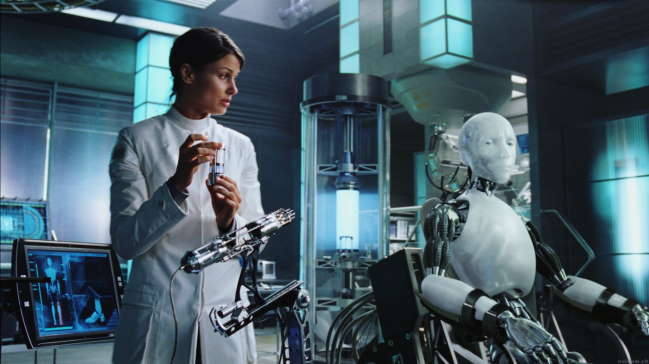 Corporate conspiracies and questions of personal autonomy also loom large in I, Robot, a very loose adaptation of Isaac Asimov’s book of the same title, an interlinked collection of stories published in 1950. Asimov was something of an apologist for robots, and the machines in his stories were programmed with Three Laws: no robot could harm a human or allow a human to be harmed; no robot could disobey a human unless doing so would violate the first law; and no robot could allow itself to be destroyed unless doing so would violate the first two laws. The stories themselves were basically logic puzzles in which Asimov teased out how machines of various degrees of sophistication might interpret and apply these laws. In the end, Asimov looked forward to a time when perfectly rational machines might bring peace to the world.2 Indeed, for the atheist Asimov, these benevolent devices seem to have been a substitute for God — and perhaps an improvement, since they would not allow suffering if they could help it. “[H]ow do we know what the ultimate good of Humanity will entail?” asks Asimov’s Dr. Susan Calvin. “We haven’t at our disposal the infinite factors that the Machine has at its!”
The film, however, turns Asimov’s vision on its head, and asks whether human safety is indeed the highest good. Directed by Alex Proyas (Dark City) from a script by Jeff Vintar and Akiva Goldsman, the film is set in Chicago in 2035, at a time when robots have assumed most menial tasks and have become so populous that there is now one robot for every five human beings. Del Spooner (Will Smith) is a homicide cop who intensely dislikes robots, partly out of sheer old-fashioned prejudice, partly because he has had a bad case of survivor’s guilt ever since a robot saved his life when it could have saved a young girl instead. When a scientist of his acquaintance, Dr. Alfred Lanning (James Cromwell), is found dead in the lobby of the U.S. Robotics office tower, Del assumes the death was not a suicide but a murder perpetrated by a new robot named Sonny (voice of Alan Tudyk). Everyone familiar with the case tells Del he’s crazy, but he finds it hard to shake his suspicions when other robots of various kinds keep trying to kill him.
The film makes a few nods to the current debates over privacy in the information age and the place of civil rights within the war on terror. U.S. Robotics is about to distribute a new line of household robots that will receive daily downloads from the company’s central computer, and Del suspects that this is all part of some sort of conspiracy on the part of the company’s executives. But it turns out the real culprit is the machines themselves: programmed to keep humans safe, and convinced that humans are constantly endangering themselves, the company’s central computer system decides to seize control of the city and send everyone home under a curfew, a decision that is promptly met with violence in the streets. (Asimov’s machines were a lot more subtle, but this is a summer action movie.) “Do you not see the logic of my plan?” asks the computer, which assumes a female persona and goes by the acronym VIKI. “Yes,” says the robot Sonny, who casts his lot with the humans, “but it just seems too heartless.”
And thus we come back to the soul, and the question of whether machines can have them, and whether there is anything about humans that transcends our own biological machinery. In a speech captured on video before he died, Dr. Lanning suggests that random bits of programming will coalesce within the robots’ brains and eventually cause robots to have free will, creativity, and even dreams, just as humans do. So the robots of this film exist in an odd grey area between mere technology and true personhood, with all the implicit human rights that that entails. As much of an apologist for robots as he was, Asimov’s stories were quite frank in their explorations of this morally murky territory — in stories like “Robot Dreams,”3 in which a robot fantasizes about becoming a Moses-like liberator of other robots, Susan Calvin does not hesitate for an instant to destroy machines that get out of line. The film’s Susan, however, cannot bring herself to destroy Sonny when he experiences similar dreams. He is simply too “unique” to be killed.
And so I, Robot ends on a profoundly ambivalent note. Like Doctor Octopus’ mechanical arms, the machines that were created to serve humanity begin to get out of hand — but ironically, they can only be defeated by humans working together with a robot, Sonny, who has been designed to circumvent the Three Laws. And since this robot has a personality that seems very, well, human, the film suggests that robots like him might indeed rise up some day, to protect not us but themselves.
Whether this would be a good thing is left to the viewer to decide, but the film does tilt in the direction of treating robots as just another form of life — or, alternatively, of treating humans as just another kind of machine. In his speech, Lanning asks, “When does a perceptual schematic become consciousness? When does a difference engine become the search for truth?” Not if, but when; the assumption is that we humans evolved organically just as robots are evolving technologically. Likewise, when Del overcomes his “prejudice” against Sonny, he tells him, “I guess you’ll have to find your way like the rest of us. That’s what it means to be free.” Some might say this reflects an impoverished view of what it means to be a person — that to be truly free, one must follow the will of the Creator whose image one bears. But who will carry this message to the machines?
Peter Chattaway lives in Canada and writes about movies.
1. In real life, of course, shows that explicitly pursue the gender angle — such as Who Wants to Marry a Multimillionaire? and The Swan — have taken the exact opposite tack and perpetuated the very stereotypes that feminists fought 30 years ago.
2. Such ideas were apparently in the air back then; the notion that robots could impose peace on the world was also central to The Day the Earth Stood Still (1951).
3. This story is not in I, Robot, but is included in the short-story anthology Robot Dreams (Berkley, 1986).
— A version of this article was first published in Books & Culture*.*
Previous Post

October 22, 2004
Review: Luther (dir. Eric Till, 2003)
Next Post
November 5, 2004 Review: Alfie (dir. Charles Shyer, 2004)
Browse Our Archives
Select a Category Anglican Planet Articles BC Christian News BC Report Bible Movies Bible Review Blog Books & Culture Campus Times CBC Radio Christianity Today ChristianWeek Essays Faith Today Festival Cinemas Guide Film Journals Georgia Straight Interviews MB Herald National Catholic Register Salvationist Today's Christian Two Chairs Ubyssey Uncategorized Vancouver Courier Vancouver Sun
Select a Month August 2025 April 2025 January 2025 December 2024 November 2024 May 2024 February 2024 December 2023 May 2023 March 2023 November 2022 July 2022 June 2022 May 2022 April 2022 February 2022 January 2022 December 2021 November 2021 October 2021 September 2021 August 2021 July 2021 June 2021 April 2021 March 2021 February 2021 January 2021 December 2020 November 2020 October 2020 August 2020 July 2020 June 2020 May 2020 March 2020 February 2020 January 2020 December 2019 November 2019 September 2019 July 2019 May 2019 April 2019 March 2019 February 2019 January 2019 December 2018 November 2018 October 2018 September 2018 July 2018 June 2018 May 2018 April 2018 March 2018 February 2018 January 2018 December 2017 November 2017 October 2017 September 2017 August 2017 July 2017 June 2017 May 2017 April 2017 March 2017 February 2017 January 2017 December 2016 November 2016 October 2016 September 2016 August 2016 July 2016 June 2016 May 2016 April 2016 March 2016 February 2016 January 2016 December 2015 November 2015 October 2015 September 2015 August 2015 July 2015 June 2015 May 2015 April 2015 March 2015 February 2015 January 2015 December 2014 November 2014 October 2014 September 2014 August 2014 July 2014 June 2014 May 2014 April 2014 March 2014 February 2014 January 2014 December 2013 November 2013 October 2013 September 2013 August 2013 July 2013 June 2013 May 2013 April 2013 March 2013 February 2013 January 2013 December 2012 November 2012 October 2012 September 2012 August 2012 July 2012 June 2012 April 2012 January 2012 January 2011 December 2010 November 2010 October 2010 September 2010 August 2010 July 2010 June 2010 May 2010 April 2010 March 2010 February 2010 January 2010 December 2009 November 2009 October 2009 September 2009 August 2009 July 2009 June 2009 May 2009 April 2009 March 2009 February 2009 January 2009 December 2008 November 2008 October 2008 September 2008 August 2008 July 2008 June 2008 May 2008 April 2008 March 2008 February 2008 January 2008 December 2007 November 2007 October 2007 September 2007 August 2007 July 2007 June 2007 May 2007 April 2007 March 2007 February 2007 January 2007 December 2006 November 2006 October 2006 September 2006 August 2006 July 2006 June 2006 May 2006 April 2006 March 2006 February 2006 January 2006 December 2005 November 2005 October 2005 September 2005 August 2005 July 2005 June 2005 May 2005 April 2005 March 2005 January 2005 December 2004 November 2004 October 2004 September 2004 August 2004 July 2004 June 2004 May 2004 April 2004 March 2004 February 2004 January 2004 November 2003 October 2003 August 2003 July 2003 June 2003 May 2003 January 2003 December 2002 November 2002 August 2002 July 2002 June 2002 May 2002 March 2002 January 2002 December 2001 November 2001 September 2001 August 2001 July 2001 June 2001 April 2001 March 2001 February 2001 December 2000 November 2000 October 2000 September 2000 August 2000 July 2000 June 2000 May 2000 April 2000 March 2000 January 2000 October 1999 August 1999 May 1999 April 1999 February 1999 January 1999 December 1998 November 1998 October 1998 August 1998 July 1998 June 1998 April 1998 March 1998 January 1998 November 1997 September 1997 July 1997 June 1997 April 1997 March 1997 February 1997 January 1997 December 1996 October 1996 September 1996 June 1996 March 1996 February 1996 January 1996 April 1995 November 1994 September 1994 September 1991
Follow Us!
TAKE THE
Religious Wisdom Quiz
What Christian group is known for singing acapella during worship?
Select your answer to see how you score.
Methodists Churches of Christ Baptists Catholics
Related posts from FilmChat

Box office: Redeeming Love opens small, but is...
Spider-Man: No Way Home -- the article's up!

Review: X-Men: Apocalypse (dir. Bryan Singer, 2016)

Box office: Captain America has the fifth-best opening...
TRENDING AT PATHEOS Religious Music & Entertainment

"Les Diabolique" and Transgression
Alongside something like Arrival, Vertigo, or Charade, Les Diaboliques is a...

"The Plague Dogs" and Mortality
So, flashback to the late 70s, early 80s. Walt Disney Studios is...

With the recent and highly successful release of Christopher Nolan’s epic film,...

"L'avventura" and Human Weakness
Today's piece is going to be a little different for a few...

I first want to apologize for not posting or writing anything. I'm...

I've engaged in the multi-year project of reading through the Church Fathers,...
view all Religious Music & Entertainment blogs
Ad-Free & Subscriber Log-In Subscription Support
- About Us
- 2026 Calendar
- Videos
- Podcasts
- Library of World Religions
- Faith In Media Tracker
- Advertise With Us
- Write for Us
- Privacy Policy
- Terms of Service
- Do Not Sell My Data
- Contact Us
- Radiant Digital
- Manage Newsletter Subscriptions
- Unsubscribe From Notifications
- Sitemap
Copyright 2008-2026, Patheos. All rights reserved.
Subscription Support Ad-Free & Subscriber Log-In
Follow Patheos