
BuddhistCatholicContemplativeEvangelicalGeneral ChristianHinduJewishLatter-day SaintMuslimNew VisionsProgressive Christian
Beliefs
- Buddhist
- Catholic
- Contemplative
- Evangelical
- General Christian
- Hindu
- Jewish
- Latter-day Saint
- More Voices
- Muslim
- New Visions
- Pagan
- Progressive Christian
Topics
- Religion News
- Food and Religion
- Sports and Religion
- Religious Art
- Religious Music and Entertainment
- Religious Events
- History and Religion
- Style and Religion
- Politics and Religion
- Women in Religion
- Recreation Outdoors and Religion
- Business Finance and Religion
- Careers Workplace and Religion
- Education and Religion
- Family Parenting and Religion
- Health Fitness and Religion
- Home and Religion
- Relationships and Religion
- Technology and Religion
- Travel and Religion
Columnists
- Buddhist Columnists
- Business Finance and Religion Columnists
- Careers Workplace and Religion Columnists
- Catholic Columnists
- Contemplative Columnists
- Education and Religion Columnists
- Evangelists Columnists
- Family Parenting and Religion Columnists
- General Christian Columnists
- Health Fitness and Religion Columnists
- Hindu Columnists
- History and Religion Columnists
- Home and Religion Columnists
- Jewish Columnists
- More Voices Columnists
- Latter Day Columnists
- Muslim Columnists
- New Visions Columnists
- Nonreligious Columnists
- Pagan Columnists
- Politics and Religion Columnists
- Progressive Columnists
- Recreation Outdoors and Religion Columnists
- Relationships and Religion Columnists
- Religion News Columnists
- Religious Art Columnists
- Religious Events Columnists
- Religious Music and Entertainment Columnists
- Sports and Religion Columnists
- Style and Religion Columnists
- Technology and Religion Columnists
- Travel and Religion Columnists
- Women in Religion Columnists
Resource Library
- 2026 Calendar
- Library of World Religions
- The 100 Most Holy Places on Earth
- Patheos Answers
- Podcasts
- Videos
- Faith Leaders Database
- Anglican Episcopalian
- Bahai
- Baptist
- Buddhism
- Christianity
- Confucianism
- Eastern Orthodoxy
- Hinduism
- Holiness and Pentecostal
- ISKCON
- Islam
- Judaism
- Lutheran
- Methodist
- The Church of Jesus Christ of Latter-day Saints
- New Age
- Paganism
- Presbytarian and Reformed
- Protestantism
- Religion Behind the Scenes
- Roman Catholic
- Scientology
- Shia Islam
- Sikhism
- Sufism
- Sunni Islam
- Taoism
- Zen
- See all religions
Research Tools
 Ad-Free & Subscriber Log-In Subscription Support
Ad-Free & Subscriber Log-In Subscription Support
Follow Patheos 

- Trending:
- Forgiveness
- |
- Marriage
- |
- Consciousness
- |
- Death Penalty
- |
- Election
- |
- Halloween

-
Articles
- Home
- Religious Music & Entertainment
- Review: National Treasure (dir. Jon Turteltaub, 2004)
Review: National Treasure (dir. Jon Turteltaub, 2004)
Last updated on: April 19, 2014 at 4:21 pm by Peter T. Chattaway
Review: National Treasure (dir. Jon Turteltaub, 2004) 2014-04-19T16:21:00-07:00 Peter T. Chattaway
Patheos Explore the world's faith through different perspectives on religion and spirituality! Patheos has the views of the prevalent religions and spiritualities of the world.
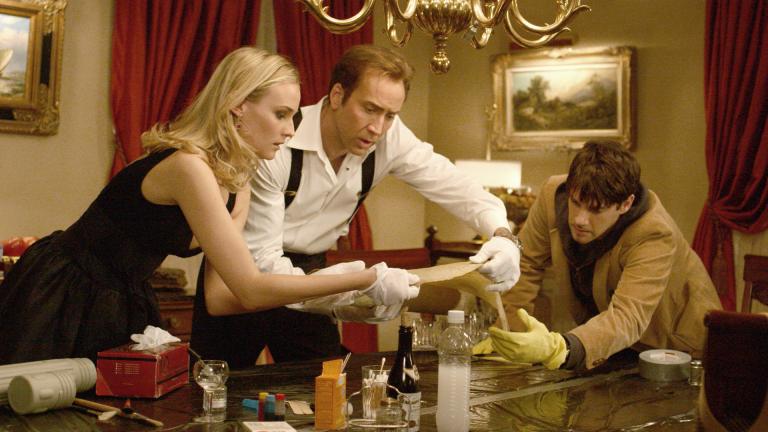 About eight years ago, something happened to Nicolas Cage. Known until then as an offbeat but fascinating charactor actor, Cage won an Oscar for playing an alcoholic who literally drinks himself to death in Leaving Las Vegas — and then he suddenly turned into an action hero. Many, but not all, of Cage’s onscreen adventures since then have been produced by Jerry Bruckheimer, including the R-rated action movies The Rock and Con Air and the PG-13 heist flick Gone in 60 Seconds. But now, with National Treasure — a PG-rated romp through the relics, myths and legends surrounding America’s founding fathers — Cage and Bruckheimer have set their sights on a younger, and perhaps less critical, audience. This film is being released as a full-fledged Walt Disney picture, and unlike some of Cage’s more intense flicks, this one has the benign villains and occasionally silly sensibility of those films Disney used to churn out back in the ’70s and show as two-parters on their Sunday-night “Wonderful World of Disney.” The main difference is, this new film has bigger stars and a bigger budget.
Seen in that light, National Treasure can be enjoyed as preposterous fun, even when you sense that the cast and crew are just going through the motions. Cage plays Benjamin Franklin Gates, the latest in a long line of men who have shared an incredible secret going back centuries and transmitted from one generation to the next. The first time we see Benjamin, he is a preteen boy rummaging through his grandfather’s attic — and when his grandfather (Christopher Plummer) finds him there, he sits the lad down, tells him he’s probably old enough now to hear the family story, and proceeds to tell him the tall, tall tale of a vast, unimaginable treasure that was amassed by the ancient Egyptian and Roman empires, and which the Knights Templar found in Jerusalem during the Crusades.
One might assume these soldiers would have been happy to keep the plunder for their own vain purposes, but no, these knights decided to protect the treasure; and so, between them and the Freemasons, the existence of the treasure was kept secret, while the treasure itself was smuggled to North America, and the United States’ national documents and monuments were peppered with clues to the treasure’s hiding place. That all-seeing eye hovering over the pyramid on the back of the dollar bill? That clock at Independence Hall on the back of the hundred-dollar bill? All these things contain secrets, planted there by the founding fathers. And as Benjamin grows up, he dedicates his life to following the clues — even though it means racing against dastardly rival treasure hunters and skeptical police officers and the like. It’s all rather like The Da Vinci Code, but without the sacrilege.
The first half of the film revolves mostly around the Declaration of Independence, the back of which, Benjamin discovers, has an invisible map. Ian Howe (Sean Bean), a former benefactor and current rival of Benjamin’s, plans to steal the Declaration for his own selfish gain, and since none of the authorities in Washington believe Benjamin when he tries to warn them, Benjamin decides he must steal it first in order to protect it. (The words “Declaration of Independence” are used so often in this film, you begin to suspect the screenwriters dedicated a special button on their keyboard to that phrase.)
Benjamin and his computer-whiz partner Riley Poole (Justin Bartha) carry out the heist with the help of high-tech equipment, the effect of which is enhanced by the film’s own reliance on that annoying modern stylistic tic of fast-forwarding through short bursts of film, instead of building a straightforward montage out of straightforward cuts. Their plan goes fairly smoothly, until a National Archives exec named Abigail Chase (Diane Kruger) is kidnapped by Ian and his men — and so, with the police on their tail, Benjamin and Riley have to save the girl and keep the Declaration of Independence out of Ian’s hands and track down the rest of the clues while staying “off the grid.” As a result, the rest of the film is less about fancy gizmos and more about deciphering riddles and following shadows at certain times of day and looking for tunnels behind centuries-old coffins.
There is a certain Indiana Jones quality to the proceedings, especially toward the end of the film, but without that brush of the transcendent or supernatural that made Indy’s adventures more than just jazzed-up Saturday-matinee fare. Parallels to The Da Vinci Code also fall short in this area; whereas Dan Brown’s book zips through the history of Christianity and mixes fact with fiction in order to undermine traditional understandings of the Church, this film actually leaves the surface meaning of the United States’ founding documents quite intact, even as it spins a lot of hooey for the sake of a fun ride. Benjamin says that one must sometimes do what seems wrong to others in order to do what one believes to be right, and, well, if that sounds like little more than an excuse to break the law, just what does one call the American revolution against the British, anyway?
The fun thing about conspiracy thrillers, especially when they reach back thousands of years, is that they appeal to that part of us that suspects there is more to the world than we can see; they goad us into looking at the world in new ways. But National Treasure offers nothing more shocking than an invisible treasure map, and eventually, we know that the fun of solving every puzzle only to find another puzzle behind it must come to an end. If, as Benjamin’s disillusioned father (Jon Voight) suggests, there is no truth to the legends, and the clues were created simply to keep the British distracted, then the mystery is hollow and serves no purpose; but if the legends are right, then the trail of clues will eventually come to an end, in a big pile of stuff, and no matter how appealing that stuff might be, it probably won’t produce that same thrilling sensation of moving “further up and further in.”
Still, hey, it’s a treasure hunt, and it’s fun to follow the clues, no matter how contrived some of them may be, or how incredibly coincidental certain plot turns might be (this is the kind of movie in which someone hoping to find a ship buried under the ice digs for just a few seconds and hits a metal plaque bearing the ship’s name), or how very unlikely some of the techniques supposedly developed by America’s founding fathers would seem to be.
Granted, the actors aren’t in especially top form. Nearly all of them, including Harvey Keitel as a federal agent, seem to regard this movie as basically just another paycheck, and while they’re all competent enough, they tend to underplay their roles, or to restrain themselves; the film’s humor is pretty dry, deadpan, almost aloof at times. (Plummer, at least, brings just the right touch of hamminess to his cameo.) And riddle-solving stories like this are probably more fun to read than to watch, because you can savor the mystery’s cleverness at your own pace, instead of trying to keep up with the actors.
But if you can see the film through the eyes of a relatively young boy or girlone who can separate fact from fiction, and one who thinks a cheesy thriller is the ideal way to pick up new facts about the history of his countrythen this isn’t that bad a yarn, really.
2 stars (out of 4)
–
Talk About It
Discussion starters
1. In one scene, Benjamin Gates drinks a toast to “high treason” and says the American founding fathers “did what was considered wrong in order to do what they knew was right.” Is this attitude consistent with Christian principles? How do we know what is right? How do we know when it is okay to break the law, or to commit “high treason”?
2. Why do you think the Knights and Freemasons left so many clues behind, if they wanted the treasure to remain hidden? Should the treasure still be kept hidden, if and when the characters find it? Of what value is a treasure that almost no one knows exists?
3. The young Benjamin Gates asks his grandfather if they come from a family of “knights.” Why do you think knighthood appeals to people, and especially to the young? Do you think the grown-up Benjamin Gates acts like a knight, or is influenced by knightly ideals?
4. Why do you think stories about ancient mysteries appeal to North American audiences? Doesn’t North America have enough history of its own? In what ways can we feel connected to history by being part of the Church?
The Family Corner
For parents to consider
National Treasure is rated PG for action violence and some scary images. The bad guys fire guns because that’s what bad guys do, but the film doesn’t emphasize the peril; someone lights a flare in a room filled with gunpowder, people swing from open doors in moving vans, one person falls into a dark abyss, and a man cuts his finger so that his blood can help solve a clue. A man and a woman also change clothes in separate but parallel changing rooms that have rather short doors. Parents might want to discuss with their children the idea that the American Revolution was both rebellious and committed to higher ideals.
— A version of this review was first published at Christianity Today Movies.
Previous Post

November 5, 2004
Review: Alfie (dir. Charles Shyer, 2004)
Next Post
November 24, 2004 Review: Alexander (dir. Oliver Stone, 2004)
Browse Our Archives
Select a Category Anglican Planet Articles BC Christian News BC Report Bible Movies Bible Review Blog Books & Culture Campus Times CBC Radio Christianity Today ChristianWeek Essays Faith Today Festival Cinemas Guide Film Journals Georgia Straight Interviews MB Herald National Catholic Register Salvationist Today's Christian Two Chairs Ubyssey Uncategorized Vancouver Courier Vancouver Sun
Select a Month August 2025 April 2025 January 2025 December 2024 November 2024 May 2024 February 2024 December 2023 May 2023 March 2023 November 2022 July 2022 June 2022 May 2022 April 2022 February 2022 January 2022 December 2021 November 2021 October 2021 September 2021 August 2021 July 2021 June 2021 April 2021 March 2021 February 2021 January 2021 December 2020 November 2020 October 2020 August 2020 July 2020 June 2020 May 2020 March 2020 February 2020 January 2020 December 2019 November 2019 September 2019 July 2019 May 2019 April 2019 March 2019 February 2019 January 2019 December 2018 November 2018 October 2018 September 2018 July 2018 June 2018 May 2018 April 2018 March 2018 February 2018 January 2018 December 2017 November 2017 October 2017 September 2017 August 2017 July 2017 June 2017 May 2017 April 2017 March 2017 February 2017 January 2017 December 2016 November 2016 October 2016 September 2016 August 2016 July 2016 June 2016 May 2016 April 2016 March 2016 February 2016 January 2016 December 2015 November 2015 October 2015 September 2015 August 2015 July 2015 June 2015 May 2015 April 2015 March 2015 February 2015 January 2015 December 2014 November 2014 October 2014 September 2014 August 2014 July 2014 June 2014 May 2014 April 2014 March 2014 February 2014 January 2014 December 2013 November 2013 October 2013 September 2013 August 2013 July 2013 June 2013 May 2013 April 2013 March 2013 February 2013 January 2013 December 2012 November 2012 October 2012 September 2012 August 2012 July 2012 June 2012 April 2012 January 2012 January 2011 December 2010 November 2010 October 2010 September 2010 August 2010 July 2010 June 2010 May 2010 April 2010 March 2010 February 2010 January 2010 December 2009 November 2009 October 2009 September 2009 August 2009 July 2009 June 2009 May 2009 April 2009 March 2009 February 2009 January 2009 December 2008 November 2008 October 2008 September 2008 August 2008 July 2008 June 2008 May 2008 April 2008 March 2008 February 2008 January 2008 December 2007 November 2007 October 2007 September 2007 August 2007 July 2007 June 2007 May 2007 April 2007 March 2007 February 2007 January 2007 December 2006 November 2006 October 2006 September 2006 August 2006 July 2006 June 2006 May 2006 April 2006 March 2006 February 2006 January 2006 December 2005 November 2005 October 2005 September 2005 August 2005 July 2005 June 2005 May 2005 April 2005 March 2005 January 2005 December 2004 November 2004 October 2004 September 2004 August 2004 July 2004 June 2004 May 2004 April 2004 March 2004 February 2004 January 2004 November 2003 October 2003 August 2003 July 2003 June 2003 May 2003 January 2003 December 2002 November 2002 August 2002 July 2002 June 2002 May 2002 March 2002 January 2002 December 2001 November 2001 September 2001 August 2001 July 2001 June 2001 April 2001 March 2001 February 2001 December 2000 November 2000 October 2000 September 2000 August 2000 July 2000 June 2000 May 2000 April 2000 March 2000 January 2000 October 1999 August 1999 May 1999 April 1999 February 1999 January 1999 December 1998 November 1998 October 1998 August 1998 July 1998 June 1998 April 1998 March 1998 January 1998 November 1997 September 1997 July 1997 June 1997 April 1997 March 1997 February 1997 January 1997 December 1996 October 1996 September 1996 June 1996 March 1996 February 1996 January 1996 April 1995 November 1994 September 1994 September 1991
Follow Us!
TAKE THE
Religious Wisdom Quiz
Who said, "Speak, Lord, for your servant is listening"?
Select your answer to see how you score.
David Eli Samuel Solomon
Related posts from FilmChat

Sony Animation reveals the cast for Nativity film...

Review: Stay (dir. Marc Forster, 2005)

Moses at the Movies / When we trace...

Review: Wanted (dir. Timur Bekmambetov, 2008)
TRENDING AT PATHEOS Religious Music & Entertainment

"Les Diabolique" and Transgression
Alongside something like Arrival, Vertigo, or Charade, Les Diaboliques is a...

"The Plague Dogs" and Mortality
So, flashback to the late 70s, early 80s. Walt Disney Studios is...

With the recent and highly successful release of Christopher Nolan’s epic film,...

"L'avventura" and Human Weakness
Today's piece is going to be a little different for a few...

I first want to apologize for not posting or writing anything. I'm...

I've engaged in the multi-year project of reading through the Church Fathers,...
view all Religious Music & Entertainment blogs
Ad-Free & Subscriber Log-In Subscription Support
- About Us
- 2026 Calendar
- Videos
- Podcasts
- Library of World Religions
- Faith In Media Tracker
- Advertise With Us
- Write for Us
- Privacy Policy
- Terms of Service
- Do Not Sell My Data
- Contact Us
- Radiant Digital
- Manage Newsletter Subscriptions
- Unsubscribe From Notifications
- Sitemap
Copyright 2008-2026, Patheos. All rights reserved.
Subscription Support Ad-Free & Subscriber Log-In
Follow Patheos