
BuddhistCatholicContemplativeEvangelicalGeneral ChristianHinduJewishLatter-day SaintMuslimNew VisionsProgressive Christian
Beliefs
- Buddhist
- Catholic
- Contemplative
- Evangelical
- General Christian
- Hindu
- Jewish
- Latter-day Saint
- More Voices
- Muslim
- New Visions
- Pagan
- Progressive Christian
Topics
- Religion News
- Food and Religion
- Sports and Religion
- Religious Art
- Religious Music and Entertainment
- Religious Events
- History and Religion
- Style and Religion
- Politics and Religion
- Women in Religion
- Recreation Outdoors and Religion
- Business Finance and Religion
- Careers Workplace and Religion
- Education and Religion
- Family Parenting and Religion
- Health Fitness and Religion
- Home and Religion
- Relationships and Religion
- Technology and Religion
- Travel and Religion
Columnists
- Buddhist Columnists
- Business Finance and Religion Columnists
- Careers Workplace and Religion Columnists
- Catholic Columnists
- Contemplative Columnists
- Education and Religion Columnists
- Evangelists Columnists
- Family Parenting and Religion Columnists
- General Christian Columnists
- Health Fitness and Religion Columnists
- Hindu Columnists
- History and Religion Columnists
- Home and Religion Columnists
- Jewish Columnists
- More Voices Columnists
- Latter Day Columnists
- Muslim Columnists
- New Visions Columnists
- Nonreligious Columnists
- Pagan Columnists
- Politics and Religion Columnists
- Progressive Columnists
- Recreation Outdoors and Religion Columnists
- Relationships and Religion Columnists
- Religion News Columnists
- Religious Art Columnists
- Religious Events Columnists
- Religious Music and Entertainment Columnists
- Sports and Religion Columnists
- Style and Religion Columnists
- Technology and Religion Columnists
- Travel and Religion Columnists
- Women in Religion Columnists
Resource Library
- 2026 Calendar
- Library of World Religions
- The 100 Most Holy Places on Earth
- Patheos Answers
- Podcasts
- Videos
- Faith Leaders Database
- Anglican Episcopalian
- Bahai
- Baptist
- Buddhism
- Christianity
- Confucianism
- Eastern Orthodoxy
- Hinduism
- Holiness and Pentecostal
- ISKCON
- Islam
- Judaism
- Lutheran
- Methodist
- The Church of Jesus Christ of Latter-day Saints
- New Age
- Paganism
- Presbytarian and Reformed
- Protestantism
- Religion Behind the Scenes
- Roman Catholic
- Scientology
- Shia Islam
- Sikhism
- Sufism
- Sunni Islam
- Taoism
- Zen
- See all religions
Research Tools
 Ad-Free & Subscriber Log-In Subscription Support
Ad-Free & Subscriber Log-In Subscription Support
Follow Patheos 

- Trending:
- Forgiveness
- |
- Marriage
- |
- Consciousness
- |
- Death Penalty
- |
- Election
- |
- Halloween

-
Articles
- Home
- Religious Music & Entertainment
- Review: Alexander (dir. Oliver Stone, 2004)
Review: Alexander (dir. Oliver Stone, 2004)
Last updated on: November 28, 2013 at 9:51 am by Peter T. Chattaway
Review: Alexander (dir. Oliver Stone, 2004) 2013-11-28T09:51:06-08:00 Peter T. Chattaway
Patheos Explore the world's faith through different perspectives on religion and spirituality! Patheos has the views of the prevalent religions and spiritualities of the world.
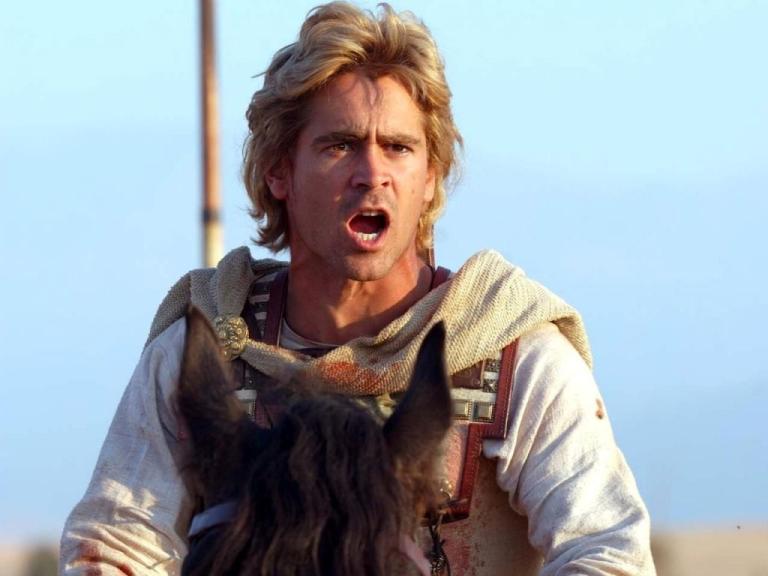 Years ago, when I was a teenager obsessed with history, I began to wonder why Christ had come to Earth at the particular time that he did. Why not a century or two earlier or later? I eventually settled on the idea that he had come at the time that would have been most opportune for spreading the gospel — a time after the Greeks had unified many of the world’s cultures and bestowed on them a common language, and a time after the Romans had unified many of the world’s governments. It seemed unfair, then, that the Bible had almost nothing to say about the Greek empire; the Assyrian, Babylonian, Persian and Roman empires all had major roles to play, but apart from an obscurely-written prophetic passage or two, the Greeks fell into that gap between the Testaments.
Likewise, there have been very few films about Alexander the Great and his conquests; the genre of the ancient epic is so dominated by biblical stories that, traditionally, even films that concern themselves with pagan history have been obliged to at least refer to the looming arrival of Christianity in their narration. The last major film about Alexander, which starred Richard Burton and came out in 1956, even tweaked the dialogue in places so that it sounded kind of biblical, and concluded with Alexander becoming a monotheist. But thanks to Gladiator, unapologetically pagan epics are now in vogue, and thus Oliver Stone has finally fulfilled his years-old ambition to commit the life of Alexander to celluloid.
It’s a good thing Troy, another thoroughly pagan Greek story, came out just a few months ago and revived the myth of Achilles for modern audiences, since the historical Alexander evidently fancied himself a descendant of Achilles, and he lived by the same basic principles: live fast, die young, and be famous forever for your glorious deeds in battle. Stone’s film is probably better than Troy, which suffered from pedestrian direction, stilted performances, and a hack musical score that sounded like it was written in a weekend; in place of those things, Stone gives us some truly stirring visuals, music that soars and charges more often than not, and, um, performances that… Well, um, okay, about those performances…
Framing devices aside, the film begins when Alexander is a boy, growing up within a highly dysfunctional royal family. His father, King Philip (Val Kilmer), is prone to drunken rages, and the sight of guests raping slaves of either gender is a not uncommon feature at official banquets. One night, Philip even storms into the bedroom of his wife, Queen Olympias (Angelina Jolie), and tries to force himself on her, oblivious to the fact that their son is right there in the room with them. Olympias, who claims to be descended from Achilles, drives a wedge between father and son by telling Alexander his real father is not Philip, but one of the gods themselves; and although he seems to believe it, the adult Alexander (Colin Farrell) still objects when his father takes another wife and the new in-laws insinuate that Alexander is illegitimate and therefore not fit to inherit his father’s throne.
Here the story lurches ahead rather awkwardly. The story of Alexander is told through the eyes of Ptolemy (Anthony Hopkins), a general of his who went on to become Pharaoh in Alexandria, and who is now dictating the story of their conquests some 40 years later to a scribe in that city’s famous library. This device allows Stone, who wrote the screenplay with Christopher Kyle (K-19: The Widowmaker) and Laeta Kalogridis (TV’s Birds of Prey), to stitch the dramatic episodes together with scenes of long exposition, but at times you scratch your head and wonder just how Stone selected which scenes to dramatize.
In a single speech, Ptolemy casually refers to Philip’s assassination, Alexander’s invasion of modern-day Turkey, his butchering and enslaving of select cities, and his visit to an Egyptian oracle who proclaimed him divine. How did Alexander and his mother react to Philip’s death? Indeed, what role might they have played in it? And what about Alexander’s fateful crossing of the river into Asia — the last time he ever saw European shores? Surely moments like these need a bit of fleshing out; and indeed, Stone does return to one of these events, but in a flashback that appears at an odd moment much later in the film.
The Ptolemy-as-narrator device also allows Stone to glide past the references to Alexander’s more massive acts of brutality, in order that the rest of his film can dwell on that side of Alexander which appreciated foreign cultures. And here his reasons for casting Colin Farrell become clear. Unlike Richard Burton, who, no surprise, had the belligerent drunken arrogance thing down pat, Farrell — who, despite his bad-boy persona, has never really made much of an impression onscreen — has relatively few moments of pointed anger. His Alexander is a much more sensitive character, who spends much of his time either making goo-goo eyes at his male lovers, or trembling and whining about his victimization at the hands of his abusive, negligent father and his domineering, manipulative mother. Even his two big battle scenes — one against Persia, the other against India — are portrayed as personal, emotional defeats, even though his army itself was never defeated.
Ah, but those battle scenes are something to behold. The battle against the Persians, full of chariots rushing by and units marching in formation through great clouds of dust, is one of the finer setpieces of its kind, and Stone wisely restrains himself from using the sort of swooping computer-animated aerial shots that have become a cliché since The Lord of the Rings. Rather than show off by bringing us down right into the hand-to-hand combat, Stone uses the technology to give us a sense of scale and a sense of where things are; he even makes significant symbolic use of an eagle that soars over the combat, so that we literally get a bird’s-eye-view of the terrain. Stone also undermines another cliché — the rousing speech delivered by a commander on horseback — by pointing his camera and microphone away from Alexander at times; whether this signifies Stone’s inspired refusal to rouse our bloodthirst the way Alexander rouses that of his troops, or whether it signifies a cynical belief that we don’t need to hear the rationalizations for the bloodshed, just so long as we get blood and guts and plenty of it, the viewer may decide for him or her self.
Alas, the women don’t come out of this film looking all that good. Jolie, faking a sort of east-European accent — which is kind of pointless, since Farrell doesn’t quite tame his Irish brogue, and at least one of Alexander’s generals sounds distinctly Scottish — is constantly seen playing with her snakes, and because it’s the certifiably freaky Jolie playing the role, you may wonder if this was written in the script or if the snakes are just pets that she brought to the set straight from her trailer. Then there is Rosario Dawson, who fakes a sort of South Asian accent as Alexander’s first wife, Roxanne; while Alexander seems to prefer the company of men, he does realize a woman might be useful for producing a son and heir. But despite Stone’s efforts to make Roxanne look “feisty,” and thus strong or powerful or whatever the times demand, Dawson has little to do but expose her body for the film’s wedding-night scene. The high dramatic point for both actresses comes when their characters grab some open doors, fall to their knees, and scream really loud.
The strangest thing about this film is its presumably unintended political overtones; Stone, a liberal who has spent the past few years making documentaries about Fidel Castro, has produced a story that reads like a defense of the Bush administration. Think about it: Alexander swiftly defeats a Middle Eastern army, takes Babylon (or, as we now call that region, Iraq) while the local leader is still in hiding (in a spiderhole, perhaps?), spreads civilization around the globe through force of arms, copes with squabbling generals, and claims to fight for the side of “freedom” while his underlings suggest he is becoming a “tyrant.” He is even motivated by a competitive desire to outdo his father’s rule.
The film tells us, repeatedly, that Alexander will suffer while pursuing his utopian goal of uniting the world, yet it seems to say, through Ptolemy, that Alexander’s loss was everyone else’s gain. Is Stone trying to make a similar point about today’s empires? Maybe, maybe not — and it’s difficult to tell, when the film itself is a bit of a mess. Near the end, Ptolemy says Alexander’s failures towered over other men’s successes, and it’s not too hard to imagine that Oliver Stone might hope that his films will find a similar mixed legacy.
2.5 stars (out of 4)
–
Talk About It
Discussion starters
1. Philip tells Alexander that people are slaves to Fate and that the gods laugh at us. What would it have been like to grow up with that belief system? How do these myths affect the decisions Alexander makes?
2. Aristotle tells his students that Greek culture is superior to that of the Persians because the East does everything “excessively,” whereas Greeks do things in “moderation.” Is moderation always a good thing? Do you think Alexander and his generals are moderate? What about their treatment of slaves and women?
3. What do you make of Alexander’s attempts to accommodate Eastern cultures? Is it possible to spread “freedom” and civilization through warfare and bloodshed?
4. Alexander says, “Conquer your fear, and I promise you, you will conquer death.” Do you agree or disagree? Why or why not? Is it possible to conquer fear, and if so, how? Do you think Alexander achieves this?
5. Is it possible to see God’s hand in historical events such as the spread of the Greek empire? Hebrew prophets such as Jeremiah and Habakkuk talk about God working through the pagan armies of their day. What do you think Christianity would be like if the Greeks had not filled the world with Greek philosophy and the Greek language?
The Family Corner
For parents to consider
Alexander is rated R for violence and some sexuality/nudity. The battle scenes are full of stabbings, impalings, spearings, severed limbs, people being shot with arrows and gored on elephants’ tusks and trampled under elephants’ feet, and so on. There are also scenes of people being executed and assassinated apart from battle scenes. Alexander’s bisexuality is frequently hinted at, going back to his teenage years as a student under Aristotle (who preaches the virtues of certain kinds of homosexual relationships), but apart from a kiss and some eye contact, his affairs with men are never really fleshed out; however, there is full female nudity in his wedding-night scene with Roxanne. There are also many references to the gods and myths of pagan Greek religion.
— A version of this review first appeared on the Christianity Today website.
Previous Post

November 19, 2004
Review: National Treasure (dir. Jon Turteltaub, 2004)
Browse Our Archives
Select a Category Anglican Planet Articles BC Christian News BC Report Bible Movies Bible Review Blog Books & Culture Campus Times CBC Radio Christianity Today ChristianWeek Essays Faith Today Festival Cinemas Guide Film Journals Georgia Straight Interviews MB Herald National Catholic Register Salvationist Today's Christian Two Chairs Ubyssey Uncategorized Vancouver Courier Vancouver Sun
Select a Month August 2025 April 2025 January 2025 December 2024 November 2024 May 2024 February 2024 December 2023 May 2023 March 2023 November 2022 July 2022 June 2022 May 2022 April 2022 February 2022 January 2022 December 2021 November 2021 October 2021 September 2021 August 2021 July 2021 June 2021 April 2021 March 2021 February 2021 January 2021 December 2020 November 2020 October 2020 August 2020 July 2020 June 2020 May 2020 March 2020 February 2020 January 2020 December 2019 November 2019 September 2019 July 2019 May 2019 April 2019 March 2019 February 2019 January 2019 December 2018 November 2018 October 2018 September 2018 July 2018 June 2018 May 2018 April 2018 March 2018 February 2018 January 2018 December 2017 November 2017 October 2017 September 2017 August 2017 July 2017 June 2017 May 2017 April 2017 March 2017 February 2017 January 2017 December 2016 November 2016 October 2016 September 2016 August 2016 July 2016 June 2016 May 2016 April 2016 March 2016 February 2016 January 2016 December 2015 November 2015 October 2015 September 2015 August 2015 July 2015 June 2015 May 2015 April 2015 March 2015 February 2015 January 2015 December 2014 November 2014 October 2014 September 2014 August 2014 July 2014 June 2014 May 2014 April 2014 March 2014 February 2014 January 2014 December 2013 November 2013 October 2013 September 2013 August 2013 July 2013 June 2013 May 2013 April 2013 March 2013 February 2013 January 2013 December 2012 November 2012 October 2012 September 2012 August 2012 July 2012 June 2012 April 2012 January 2012 January 2011 December 2010 November 2010 October 2010 September 2010 August 2010 July 2010 June 2010 May 2010 April 2010 March 2010 February 2010 January 2010 December 2009 November 2009 October 2009 September 2009 August 2009 July 2009 June 2009 May 2009 April 2009 March 2009 February 2009 January 2009 December 2008 November 2008 October 2008 September 2008 August 2008 July 2008 June 2008 May 2008 April 2008 March 2008 February 2008 January 2008 December 2007 November 2007 October 2007 September 2007 August 2007 July 2007 June 2007 May 2007 April 2007 March 2007 February 2007 January 2007 December 2006 November 2006 October 2006 September 2006 August 2006 July 2006 June 2006 May 2006 April 2006 March 2006 February 2006 January 2006 December 2005 November 2005 October 2005 September 2005 August 2005 July 2005 June 2005 May 2005 April 2005 March 2005 January 2005 December 2004 November 2004 October 2004 September 2004 August 2004 July 2004 June 2004 May 2004 April 2004 March 2004 February 2004 January 2004 November 2003 October 2003 August 2003 July 2003 June 2003 May 2003 January 2003 December 2002 November 2002 August 2002 July 2002 June 2002 May 2002 March 2002 January 2002 December 2001 November 2001 September 2001 August 2001 July 2001 June 2001 April 2001 March 2001 February 2001 December 2000 November 2000 October 2000 September 2000 August 2000 July 2000 June 2000 May 2000 April 2000 March 2000 January 2000 October 1999 August 1999 May 1999 April 1999 February 1999 January 1999 December 1998 November 1998 October 1998 August 1998 July 1998 June 1998 April 1998 March 1998 January 1998 November 1997 September 1997 July 1997 June 1997 April 1997 March 1997 February 1997 January 1997 December 1996 October 1996 September 1996 June 1996 March 1996 February 1996 January 1996 April 1995 November 1994 September 1994 September 1991
Follow Us!
TAKE THE
Religious Wisdom Quiz
How old was Joseph when he became a ruler in Egypt?
Select your answer to see how you score.
25 years old 30 years old 35 years old 40 years old
Related posts from FilmChat
Tanner '88 -- some notes on a political...

Box office: Fantastic Beasts underperforms Harry Potter in...

Review: Stay (dir. Marc Forster, 2005)

Moses at the Movies / When we trace...
TRENDING AT PATHEOS Religious Music & Entertainment

"Les Diabolique" and Transgression
Alongside something like Arrival, Vertigo, or Charade, Les Diaboliques is a...

"The Plague Dogs" and Mortality
So, flashback to the late 70s, early 80s. Walt Disney Studios is...

With the recent and highly successful release of Christopher Nolan’s epic film,...

"L'avventura" and Human Weakness
Today's piece is going to be a little different for a few...

I first want to apologize for not posting or writing anything. I'm...

I've engaged in the multi-year project of reading through the Church Fathers,...
view all Religious Music & Entertainment blogs
Ad-Free & Subscriber Log-In Subscription Support
- About Us
- 2026 Calendar
- Videos
- Podcasts
- Library of World Religions
- Faith In Media Tracker
- Advertise With Us
- Write for Us
- Privacy Policy
- Terms of Service
- Do Not Sell My Data
- Contact Us
- Radiant Digital
- Manage Newsletter Subscriptions
- Unsubscribe From Notifications
- Sitemap
Copyright 2008-2026, Patheos. All rights reserved.
Subscription Support Ad-Free & Subscriber Log-In
Follow Patheos