
BuddhistCatholicContemplativeEvangelicalGeneral ChristianHinduJewishLatter-day SaintMuslimNew VisionsProgressive Christian
Beliefs
- Buddhist
- Catholic
- Contemplative
- Evangelical
- General Christian
- Hindu
- Jewish
- Latter-day Saint
- More Voices
- Muslim
- New Visions
- Pagan
- Progressive Christian
Topics
- Religion News
- Food and Religion
- Sports and Religion
- Religious Art
- Religious Music and Entertainment
- Religious Events
- History and Religion
- Style and Religion
- Politics and Religion
- Women in Religion
- Recreation Outdoors and Religion
- Business Finance and Religion
- Careers Workplace and Religion
- Education and Religion
- Family Parenting and Religion
- Health Fitness and Religion
- Home and Religion
- Relationships and Religion
- Technology and Religion
- Travel and Religion
Columnists
- Buddhist Columnists
- Business Finance and Religion Columnists
- Careers Workplace and Religion Columnists
- Catholic Columnists
- Contemplative Columnists
- Education and Religion Columnists
- Evangelists Columnists
- Family Parenting and Religion Columnists
- General Christian Columnists
- Health Fitness and Religion Columnists
- Hindu Columnists
- History and Religion Columnists
- Home and Religion Columnists
- Jewish Columnists
- More Voices Columnists
- Latter Day Columnists
- Muslim Columnists
- New Visions Columnists
- Nonreligious Columnists
- Pagan Columnists
- Politics and Religion Columnists
- Progressive Columnists
- Recreation Outdoors and Religion Columnists
- Relationships and Religion Columnists
- Religion News Columnists
- Religious Art Columnists
- Religious Events Columnists
- Religious Music and Entertainment Columnists
- Sports and Religion Columnists
- Style and Religion Columnists
- Technology and Religion Columnists
- Travel and Religion Columnists
- Women in Religion Columnists
Resource Library
- 2026 Calendar
- Library of World Religions
- The 100 Most Holy Places on Earth
- Patheos Answers
- Podcasts
- Videos
- Faith Leaders Database
- Anglican Episcopalian
- Bahai
- Baptist
- Buddhism
- Christianity
- Confucianism
- Eastern Orthodoxy
- Hinduism
- Holiness and Pentecostal
- ISKCON
- Islam
- Judaism
- Lutheran
- Methodist
- The Church of Jesus Christ of Latter-day Saints
- New Age
- Paganism
- Presbytarian and Reformed
- Protestantism
- Religion Behind the Scenes
- Roman Catholic
- Scientology
- Shia Islam
- Sikhism
- Sufism
- Sunni Islam
- Taoism
- Zen
- See all religions
Research Tools
 Ad-Free & Subscriber Log-In Subscription Support
Ad-Free & Subscriber Log-In Subscription Support
Follow Patheos 

- Trending:
- Forgiveness
- |
- Marriage
- |
- Consciousness
- |
- Death Penalty
- |
- Election
- |
- Halloween

-
Articles
- Home
- Religious Music & Entertainment
- Review: The Motorcycle Diaries (dir. Walter Salles, 2004)
Review: The Motorcycle Diaries (dir. Walter Salles, 2004)
Last updated on: May 30, 2014 at 12:41 am by Peter T. Chattaway
Review: The Motorcycle Diaries (dir. Walter Salles, 2004) 2014-05-30T00:41:26-07:00 Peter T. Chattaway
Patheos Explore the world's faith through different perspectives on religion and spirituality! Patheos has the views of the prevalent religions and spiritualities of the world.
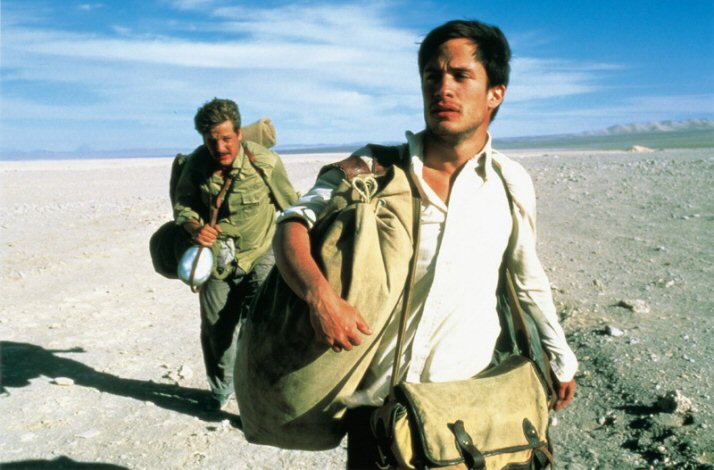 For years, Ernesto “Che” Guevara has been more of a symbol than a man — but a symbol of what, exactly, is hard to say. The Latin American revolutionary, who helped bring Fidel Castro to power in Cuba in 1959 and died at the hands of the Bolivian army in 1967, is still revered for his Marxist politics in some quarters, but for many people, he is little more than the model for that famous image which can now be seen on everything from T-shirts to pop bottles: Framed by a beard and a beret, Che’s face seems to stare, romantically but determinedly, into a future where things have been made better. Drained of any specific content, that image has come to represent a generic itch for change, and it has been co-opted by corporations and churches alike to show how hip and macho they can be.
The Motorcycle Diaries aims to subvert all this by showing us the man behind the myth, but in its own way, it too downplays the particulars of the man and his politics. This is partly because the film limits its focus to a life-changing road trip that Ernesto (Gael Garcia Bernal, who previously played Che in the TV mini-series Fidel) and his buddy, Alberto Granada (Rodrigo de la Serna), took across South America in 1952, when they were still university students whose political identities had not yet been fully formed. This is also because director Walter Salles — who scored a crossover hit a few years ago with Central Station, a redemptive road movie about an old woman and an orphaned boy who go deep into the heart of Brazil — tends to emphasize the humanity of the characters through smaller, more intimate moments, while keeping overtly political statements to a minimum.
As a result, The Motorcycle Diaries is a beautiful and even entertaining travelogue of a film that won’t ruffle too many feathers. It begins on a somewhat comical note, as Ernesto and Alberto wipe out on their beat-up 1939 Norton en route to the swanky Argentinean estate where Ernesto’s girlfriend lives with her family, and Alberto discovers that Ernesto has smuggled a puppy on the bike as a gift for his beloved. (Many more wipeouts are to come.) Alberto is also something of a ladies’ man, and always ready to be the life of the party, while Ernesto is somewhat awkward in social situations, and content to stick to the sidelines; when a woman does solicit his attention at a dance in Chile, she happens to be married, and her husband promptly runs Ernesto and his buddy out of town.
Some of their escapades, such as Alberto’s success at a gambling table on the night that he decides to hook up with a prostitute, unfold a little too smoothly, a little too much like the sort of thing you’d expect to see in a movie. But at least a few of these episodes do seem to be authentic, such as the one in which a newspaper prints a photo of the two men after Ernesto feeds them a bogus story about their travels; the original newspaper clipping is one of many archival images that appears in the background during the end credits.
That episode aside, The Motorcycle Diaries does indulge in a familiar form of political mythmaking by going out of its way to emphasize Ernesto’s honesty. Alberto is a fabulously charming liar who is always making up stories and flattering people — a fact that should, perhaps, be kept in mind, given that this film was based in part on the real Alberto’s memoirs as well as Ernesto’s — but Ernesto consistently tells people the truth even if it is not what they want to hear, whether he is dealing with a well-to-do German with a tumor on his neck or an associate whose storywriting skills aren’t the best. Such scenes are a tad reminiscent of the tales one hears about, say, George Washington and the cherry tree.
Things turn increasingly serious as the men encounter persecuted Communists, exploited miners and mistreated migrants, whose faces come back to haunt Ernesto as he reflects on his travels. The road trip ends at a leper colony in Peru, where Ernesto and Alberto volunteer their services. The facility, which puts the lepers on one side of the Amazon River and the medical staff on the other, is overseen by Catholic nuns who refuse to serve lunch to those who do not attend mass, and who insist that the medical staff wear gloves, even though there is no need for them. Not surprisingly, Ernesto starts to make waves, both figuratively and literally, first by removing his gloves and touching the patients directly — they respond to this by sneaking food to him when the nuns aren’t looking — and then by demonstrating his solidarity with them in a climactic, and highly symbolic, swim.
As the film ends, Ernesto tells Alberto he will have to do some serious thinking, because he has now seen so much injustice. The striking thing is that this film does not explicitly endorse the conclusions to which the future Che Guevera came, which arguably produced even more forms of injustice. And while co-star Bernal has said he finds the character inspiring, he also told a press conference at the Toronto Film Festival that Latin Americans of his generation are more ambivalent about the armed revolutions of so many years ago, which led to a great deal of bloodshed but little actual progress. Instead of presenting us with a political agenda, the film aims, instead, to prick our consciences.
If anything, the political injustices to which Ernesto bears witness are dwarfed in this film by what we might call “natural” injustices. As a young medical student, Ernesto comes across sick animals and people crippled by age and afflicted by various diseases; plus, Ernesto himself suffers, sometimes severely, from asthma. “Life is pain,” says one of the lepers he treats, and if it seems at times that Ernesto is brushing up against something of cosmic significance — the incredible beauty of the South American landscape when seen from afar, the many small tragedies that one sees up close — then it may be somewhat pathetic, almost a sign of resignation, that he settled for mere politics in his later life.
But that flaw belongs to the man, not the film. At its best, The Motorcycle Diaries is a thought-provoking film, grounded in breathtaking scenery and engaging performances, and if it is more interested in what it means to be human than in pushing any particular ideological agenda, then that is not necessarily a bad thing.
3.5 stars (out of 4)
–
Talk About It
Discussion starters
1. What is justice? How should we respond to the injustice in the world? What role, if any, did political justice play in Jesus’ ministry?
2. Is there anything Christ-like about Ernesto, perhaps in the way he deals with lepers? Is it possible to be Christ-like without being Christian? Can we learn anything about what it means to be Christ-like from people who do not believe in Christ?
3. What do you think about the relationship between the lives of real people, whether in politics or the church, and the stories that get told about them after they’re gone? How important is it to know the “man” behind the “myth”? Which is more important, the man or the myth? Does the myth have any value if it diverges from the man?
The Family Corner
For parents to consider
The Motorcycle Diaries is rated R for language; though the dialogue is in Spanish, the expletives show up in English subtitles. There is also some hanky-panky, but nothing explicit. Some characters express skepticism about the Church, at least as it is personified by the nuns at the leper colony; one character links the Church with capitalism by calling it “Jesus Christ Inc.”
— A version of this review was first published at Christianity Today Movies.
Previous Post

October 7, 2004
Come and See: How Movies Encourage Us to Look at (and with) Jesus
Next Post
October 20, 2004 Interview: An Orthodox professor ponders the scriptures
Browse Our Archives
Select a Category Anglican Planet Articles BC Christian News BC Report Bible Movies Bible Review Blog Books & Culture Campus Times CBC Radio Christianity Today ChristianWeek Essays Faith Today Festival Cinemas Guide Film Journals Georgia Straight Interviews MB Herald National Catholic Register Salvationist Today's Christian Two Chairs Ubyssey Uncategorized Vancouver Courier Vancouver Sun
Select a Month August 2025 April 2025 January 2025 December 2024 November 2024 May 2024 February 2024 December 2023 May 2023 March 2023 November 2022 July 2022 June 2022 May 2022 April 2022 February 2022 January 2022 December 2021 November 2021 October 2021 September 2021 August 2021 July 2021 June 2021 April 2021 March 2021 February 2021 January 2021 December 2020 November 2020 October 2020 August 2020 July 2020 June 2020 May 2020 March 2020 February 2020 January 2020 December 2019 November 2019 September 2019 July 2019 May 2019 April 2019 March 2019 February 2019 January 2019 December 2018 November 2018 October 2018 September 2018 July 2018 June 2018 May 2018 April 2018 March 2018 February 2018 January 2018 December 2017 November 2017 October 2017 September 2017 August 2017 July 2017 June 2017 May 2017 April 2017 March 2017 February 2017 January 2017 December 2016 November 2016 October 2016 September 2016 August 2016 July 2016 June 2016 May 2016 April 2016 March 2016 February 2016 January 2016 December 2015 November 2015 October 2015 September 2015 August 2015 July 2015 June 2015 May 2015 April 2015 March 2015 February 2015 January 2015 December 2014 November 2014 October 2014 September 2014 August 2014 July 2014 June 2014 May 2014 April 2014 March 2014 February 2014 January 2014 December 2013 November 2013 October 2013 September 2013 August 2013 July 2013 June 2013 May 2013 April 2013 March 2013 February 2013 January 2013 December 2012 November 2012 October 2012 September 2012 August 2012 July 2012 June 2012 April 2012 January 2012 January 2011 December 2010 November 2010 October 2010 September 2010 August 2010 July 2010 June 2010 May 2010 April 2010 March 2010 February 2010 January 2010 December 2009 November 2009 October 2009 September 2009 August 2009 July 2009 June 2009 May 2009 April 2009 March 2009 February 2009 January 2009 December 2008 November 2008 October 2008 September 2008 August 2008 July 2008 June 2008 May 2008 April 2008 March 2008 February 2008 January 2008 December 2007 November 2007 October 2007 September 2007 August 2007 July 2007 June 2007 May 2007 April 2007 March 2007 February 2007 January 2007 December 2006 November 2006 October 2006 September 2006 August 2006 July 2006 June 2006 May 2006 April 2006 March 2006 February 2006 January 2006 December 2005 November 2005 October 2005 September 2005 August 2005 July 2005 June 2005 May 2005 April 2005 March 2005 January 2005 December 2004 November 2004 October 2004 September 2004 August 2004 July 2004 June 2004 May 2004 April 2004 March 2004 February 2004 January 2004 November 2003 October 2003 August 2003 July 2003 June 2003 May 2003 January 2003 December 2002 November 2002 August 2002 July 2002 June 2002 May 2002 March 2002 January 2002 December 2001 November 2001 September 2001 August 2001 July 2001 June 2001 April 2001 March 2001 February 2001 December 2000 November 2000 October 2000 September 2000 August 2000 July 2000 June 2000 May 2000 April 2000 March 2000 January 2000 October 1999 August 1999 May 1999 April 1999 February 1999 January 1999 December 1998 November 1998 October 1998 August 1998 July 1998 June 1998 April 1998 March 1998 January 1998 November 1997 September 1997 July 1997 June 1997 April 1997 March 1997 February 1997 January 1997 December 1996 October 1996 September 1996 June 1996 March 1996 February 1996 January 1996 April 1995 November 1994 September 1994 September 1991
Follow Us!
TAKE THE
Religious Wisdom Quiz
What does Hebrews say we have as an anchor for the soul?
Select your answer to see how you score.
Love The word of God Hope Faith
Related posts from FilmChat
Noah's Ark: A Musical Adventure comes to Latin...

Review: Stay (dir. Marc Forster, 2005)

Miles Teller to lend his voice to a...

Moses at the Movies / When we trace...
TRENDING AT PATHEOS Religious Music & Entertainment

"Les Diabolique" and Transgression
Alongside something like Arrival, Vertigo, or Charade, Les Diaboliques is a...

"The Plague Dogs" and Mortality
So, flashback to the late 70s, early 80s. Walt Disney Studios is...

With the recent and highly successful release of Christopher Nolan’s epic film,...

"L'avventura" and Human Weakness
Today's piece is going to be a little different for a few...

I first want to apologize for not posting or writing anything. I'm...

I've engaged in the multi-year project of reading through the Church Fathers,...
view all Religious Music & Entertainment blogs
Ad-Free & Subscriber Log-In Subscription Support
- About Us
- 2026 Calendar
- Videos
- Podcasts
- Library of World Religions
- Faith In Media Tracker
- Advertise With Us
- Write for Us
- Privacy Policy
- Terms of Service
- Do Not Sell My Data
- Contact Us
- Radiant Digital
- Manage Newsletter Subscriptions
- Unsubscribe From Notifications
- Sitemap
Copyright 2008-2026, Patheos. All rights reserved.
Subscription Support Ad-Free & Subscriber Log-In
Follow Patheos