
BuddhistCatholicContemplativeEvangelicalGeneral ChristianHinduJewishLatter-day SaintMuslimNew VisionsProgressive Christian
Beliefs
- Buddhist
- Catholic
- Contemplative
- Evangelical
- General Christian
- Hindu
- Jewish
- Latter-day Saint
- More Voices
- Muslim
- New Visions
- Pagan
- Progressive Christian
Topics
- Religion News
- Food and Religion
- Sports and Religion
- Religious Art
- Religious Music and Entertainment
- Religious Events
- History and Religion
- Style and Religion
- Politics and Religion
- Women in Religion
- Recreation Outdoors and Religion
- Business Finance and Religion
- Careers Workplace and Religion
- Education and Religion
- Family Parenting and Religion
- Health Fitness and Religion
- Home and Religion
- Relationships and Religion
- Technology and Religion
- Travel and Religion
Columnists
- Buddhist Columnists
- Business Finance and Religion Columnists
- Careers Workplace and Religion Columnists
- Catholic Columnists
- Contemplative Columnists
- Education and Religion Columnists
- Evangelists Columnists
- Family Parenting and Religion Columnists
- General Christian Columnists
- Health Fitness and Religion Columnists
- Hindu Columnists
- History and Religion Columnists
- Home and Religion Columnists
- Jewish Columnists
- More Voices Columnists
- Latter Day Columnists
- Muslim Columnists
- New Visions Columnists
- Nonreligious Columnists
- Pagan Columnists
- Politics and Religion Columnists
- Progressive Columnists
- Recreation Outdoors and Religion Columnists
- Relationships and Religion Columnists
- Religion News Columnists
- Religious Art Columnists
- Religious Events Columnists
- Religious Music and Entertainment Columnists
- Sports and Religion Columnists
- Style and Religion Columnists
- Technology and Religion Columnists
- Travel and Religion Columnists
- Women in Religion Columnists
Resource Library
- 2026 Calendar
- Library of World Religions
- The 100 Most Holy Places on Earth
- Patheos Answers
- Podcasts
- Videos
- Faith Leaders Database
- Anglican Episcopalian
- Bahai
- Baptist
- Buddhism
- Christianity
- Confucianism
- Eastern Orthodoxy
- Hinduism
- Holiness and Pentecostal
- ISKCON
- Islam
- Judaism
- Lutheran
- Methodist
- The Church of Jesus Christ of Latter-day Saints
- New Age
- Paganism
- Presbytarian and Reformed
- Protestantism
- Religion Behind the Scenes
- Roman Catholic
- Scientology
- Shia Islam
- Sikhism
- Sufism
- Sunni Islam
- Taoism
- Zen
- See all religions
Research Tools
 Ad-Free & Subscriber Log-In Subscription Support
Ad-Free & Subscriber Log-In Subscription Support
Follow Patheos 

- Trending:
- Forgiveness
- |
- Marriage
- |
- Consciousness
- |
- Death Penalty
- |
- Election
- |
- Halloween

-
Articles
- Home
- Religious Music & Entertainment
- Interview: An Orthodox professor ponders the scriptures
Interview: An Orthodox professor ponders the scriptures
Last updated on: April 8, 2016 at 9:30 pm by Peter T. Chattaway
Interview: An Orthodox professor ponders the scriptures 2016-04-08T21:30:47-07:00 Peter T. Chattaway
Patheos Explore the world's faith through different perspectives on religion and spirituality! Patheos has the views of the prevalent religions and spiritualities of the world.
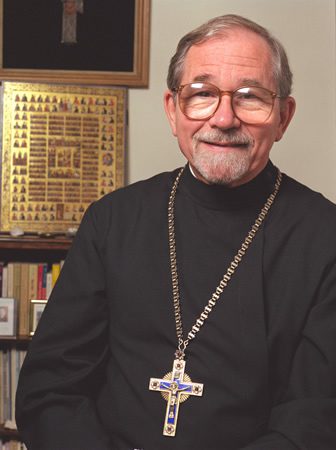 FR. THOMAS Hopko may have retired as Dean of St. Vladimir’s Seminary in New York two years ago, but he still keeps quite busy. Last month, the author of numerous books and articles on Eastern Orthodox Christianity spent nearly three weeks on the road, during which time he visited churches in Victoria and Vancouver and spoke at functions hosted by Regent College, Trinity Western University and InterVarsity Christian Fellowship.
The indefatigable Fr. Hopko sat down to talk about Orthodox-evangelical relations with CanadianChristianity.com at St. Herman of Alaska Orthodox Church in Langley, B.C., after a day spent teaching children’s Sunday school, preaching a sermon, and chatting with parishioners for hours during the fellowship afterwards about matters of the faith.
CC.com: A lot of people who are involved in evangelical-Orthodox dialogue — such as Fr. Peter Gillquist and Frederica Mathewes-Green — seem to be converts to Orthodoxy, but you are cradle Orthodox. What draws a cradle Orthodox to that sort of discussion?
TH: Well, I think if a person’s Orthodox, hopefully whether cradle or convert, you’re still very interested in Christian unity and you’re very interested in making your witness to what you believe Christianity is — which is, when all is said and done, exegesis of the Bible.
And then, of course, I love to go to those settings, because I know these people do respect the scriptures and usually know it, at least formally — and they usually think that we don’t! You know, they usually think, “Well, if you’re Orthodox, you have traditions and you follow monks and elders and stuff, but you don’t really know the scripture.” So I like to show them that we do.
There has been a tendency of Orthodox to get away from their biblical roots, but none of the great saints and teachers ever accepted that. The very first booklet that I ever published in my life, in 1963, in my parish, was called ‘Reading the Bible,’ where I tried to prove to Orthodox people that to read the Bible and know the Bible is not [exclusively] Protestant. And I quoted every saint that I could who spoke about the scriptures and reading the scriptures, how the Holy Fathers were doing nothing but interpreting the scriptures. All the great theological controversies were about what the Bible taught.
So it’s wrong to say, “Well, the Protestants have the Bible, but we have holy tradition” — that’s just ridiculous. Tradition is nothing other than the Bible properly exegeted and properly applied. That’s how we would understand it. So I like to go among evangelicals to make that point.
CC.com: I’ve heard some Orthodox say that the Bible is part of tradition. It could sound like you’re saying that tradition is in some way separate from the Bible, or comes after it.
TH: Well, I think what I would say, in three sentences, is that you first have a canon of faith that is orally delivered and preached. And that precedes whatever New Testament writings you have. But even that canon of faith is interpreting the Law, the Psalms and the Prophets, so it already has to be kata tas graphas [according to the scriptures].
I mean, St. Paul was converted by a vision, but he preached from the scripture, and he even chided people not to preach from visions and voices, in Colossians, and as soon as he had this conviction that Jesus was raised, he even says, I think in Galatians, that he went and studied the scripture and became convinced, and then he went around preaching from the scripture that Jesus was the Christ.
But then, the canon of faith, we would hold, was defended in apostolic scripture, and that would be the 27 writings of the New Testament. And there were lots of other scriptures at that point — Gnostic and so on — that our tradition would say were spurious, were just heretical, were wrong. So certain scriptures were canonized, but they were the scriptures that were in accordance with the canon of faith that was delivered orally. So you have in Thessalonians already, Paul speaking about “what I delivered to you both orally and in writing.” So there isn’t any competition between the two.
But you’ve got to go the next step and say, once the New Testament scriptures are canonized — which took a couple hundred years! — then they become the criterion by which tradition is judged. You can’t have anything in church tradition that is contrary to the scriptures. You might have other things that are not specifically written there — St. Basil speaks about oral traditions like, I don’t know, using the sign of the cross or facing the east — but they could not be contrary to what is in the scriptures.
CC.com: What do you think evangelicals see in Orthodoxy that would draw them to it?
TH: Two things. I think one is, evangelicals want a church that takes the Bible seriously as the Word of God, but they don’t want a church where everybody can interpret it the way they want to, because I think they were frustrated over how many churches there were claiming to really follow the Bible. So they said there has to be some other criterion of exegesis than just picking up the Bible and reading it, with your Scofield commentary or something.
And then they discovered that the early Church and the Fathers were interpreting the Bible. Then they discovered that there were consensuses of interpretation. Then they discovered that there were whole councils that had battled over exegesis and had come to a common mind, and that there was like a history of exegesis from the time of the apostles that those in a certain church agreed upon, namely the one holy Orthodox Church.
So I think that they wanted the Bible — they were convinced that the Bible was basic — but they had a problem of how do you interpret it, and how do you maintain the proper interpretation. And then they found that the patristic and Orthodox tradition was doing that, at least in their conviction.
The other big thing is worship. You accept Jesus as your saviour, you believe the Bible is the Word of God, but then what do you do? What church do you go to? And I think for fellows like Gillquist, that was their main problem — they said, “We all love Jesus, we all know this is the truth, but how do you worship? Where do you go? What church are you in?”
Then they came to the conclusion, if scripture is true, there’s got to be a church around somewhere that’s consonant with scripture, and then they became convinced it was the Orthodox.
So I think two things: biblical exegesis, a common biblical mind, and then the other was worship, a biblical worship that would be objective, Christian, communal, and that you wouldn’t have to make up yourself. I think those were the two things that convinced them. And I think those are the two main cards that Orthodox would have with evangelical people.
CC.com: Is there anything the Orthodox would find appealing about evangelicalism? Does the attraction go both ways, or is it more of a one-way thing?
TH: I think — I would hope — that it would go both ways. I don’t know if it often does. There was a joke that maybe contains kernels of truth, where it said, “Evangelicals come to Orthodoxy, and we teach them how to be orthodox, and they teach us how to be Christians.” (laughs)
I don’t know if you want to quote that. But in other words, their commitment to Christ, their zeal for Christ, their missionary enthusiasm, their enthusiasm for works of mercy — helping the poor, the needy, sacrificing their life to mission fields — well, Orthodoxy is definitely recharged by that, no doubt about it.
And that’s incredibly admirable, because except for the Russian church, all the other Orthodox were under Islam and they couldn’t do those things. The only philanthropy they could do was among their own people, and they couldn’t preach at all, and they had no schools, and they couldn’t even read, practically, so it’s very attractive to see a very committed, vibrant, informed, people-who-memorize-the-scriptures — I mean, that has to be inspiring.
And my own opinion is that the injection into American Orthodoxy from the evangelicals and other converts who join was a very, very critical element in the renewal of the entire Orthodoxy in America. Many, many cradle Orthodox were renewed in their faith by their contact with the evangelicals.
CC.com: Are there any concerns among Orthodox about evangelicals trying to “change” Orthodoxy?
TH: There are concerns. In fact, there were great fears in the beginning that these people just wanted to bring their evangelicalism into Orthodoxy and kind of teach the Orthodox how to be Christian and Orthodox and all that, and would never “get it”, and that’s a human concern. But I think that both faith and experience show that that was an ill-founded fear.
I was very much personally involved with Gillquist and that whole group in ’86, before they were Orthodox, and they definitely had that idea — “Oh, you know, we’ll show them” — but man, once they came in, and once they got into it, and once it went, it just worked itself out beautifully. It never was a problem. I think that everything that was of God and good, the treasures that they brought humanly speaking, were very important to Orthodox churches, but they also changed in remarkable ways themselves, probably in ways that they never would have imagined.
And I knew some people who joined the Orthodox church not liking it at all. I knew people who were at only two or three liturgies before they decided, “I have to join,” and they didn’t particularly like it, but they became convinced that it was the truth, and once they got in and began celebrating it organically, it kind of opened up for them. What they ultimately discovered after 10 years was far beyond what they expected that they were going to get when they first came.
There are Orientalisms in Orthodoxy that are hard on people, when they first come in, like doing prostrations in prayer, standing in prayer, using things like the sign of the cross or kissing the picture. People say, “Oh, what’s that?” But it’s more cultural than theological. But they get used to it after a while.
CC.com: Do you think things like that could ever be modified, in terms of church practise, when the church comes into cultures where people don’t, for example, kiss as frequently as people do in the Orient, for example?
TH: Yeah, it could, but I think what happens is you have a culture of the Church itself, that is not bound to any human culture. The Church itself is a cultural phenomenon — I mean, it’s basically christened Judaism.
I happened to be at McGill University once when they were having one of these discussions — they had an Orthodox priest, a Jew, an evangelical, a liberal Protestant, and a Roman Catholic, and they were talking and talking, and finally somebody in the audience raised a hand and said, “I’d like to ask that Orthodox priest a question. What religion are you closest to anyway?” And just, I guess, for the fun of it, the guy answered and said, “Judaism.”
And they said, “What do you mean, aren’t you Christian?” He said, “Yeah, but in our way of hearing the Bible, worshipping the way we do, you might say that we feel that sometimes we are closer to the Jews than we are to other Christians because of the way they approach the Bible, the way they approach authority, the way they approach worship,” and I think there is a certain truth there.
But the Church itself has a culture. It has songs and icons and hymns and sounds. I think there is a kind of ethos, a culture of the Church itself, that is not just reducible to Slavic or Hellenic or Semitic, that people can relate to. And so a thing like giving a kiss, or making a bow, or lighting a candle — that’s kind of Church culture, it’s not just human culture.
CC.com: Your remark about the Jewish parallels reminds me, a couple months ago I saw the Campus Crusade film for the first time in a long, long time, and when Jesus reads from the scriptures in the synagogue, at the end of that scene, he rolls up the scripture and kisses it — venerates it, you could say — and when I saw that, I wondered if the evangelicals who made this film, who wanted to be as authentic to the Jewish culture of that time as possible and showed Jesus himself doing that, ever asked themselves, “When did we stop doing that?”
TH: Yeah, right, right.
CC.com: These days people talk about post-modern culture and how thoughts and words are no longer enough — we need experience now — and the Orthodox worship has a sort of appeal there because it engages all five senses.
TH: Holistic, yeah.
CC.com: What would your response be to evangelicals who start using candles and incense and chants and possibly even icons — all the accoutrements — but without actually becoming Orthodox?
TH: It’s interesting you should ask that, because the Evangelical Orthodox [under Fr. Gillquist] were doing that before they joined up, and I was there when they were doing it, and if you went, the ethos and atmosphere was very Protestant, but they had the words of the liturgy, they had icons.
I think Fr. Nicholas in Santa Barbara stood up that week and said the word that kind of did the trick. He said, “You can’t imitate or mimic or mock the Church. You’re either in it, or you’re not.” And Orthodoxy isn’t a set of texts or a bunch of pictures — it’s a living, organic community that has texts and icons, and it’s that living community where the power is that you need, and if you’re not in that community, you can have the accoutrements, but you don’t have the power. That’s what he said.
And I think that made them realize they had to join up — for better or worse, put up with all Orthodox ethnicisms and everything. You couldn’t just imitate it, you had to be in it. Because it was a historical community, in history, that you had to enter into — just like the Gentiles had to be grafted to Israel.
CC.com: Otherwise it just becomes the latest fad, in other words.
TH: Yeah, and it isn’t any less individualistically self-willed than somebody who would get up in a polyester suit and necktie and bang the Bible and preach — it’s just, you happen to like these kinds of prayers and these kinds of pictures, but it’s still not the Church that is doing it, it’s you that’s doing it.
I wrote in that book, Speaking the Truth in Love, that that individualism and self-will thing can even be very conservative. It’s not always liberal to do what I feel I like to do, except my predilections happen to be for old things rather than new things, but it’s still me. And the Lord said, “out of his treasure, the man brings forth things new and old,” but it still has to be the Church, because it can’t be mine.
CC.com: Yesterday you said Orthodoxy was not just one denomination among many. What is the dialogue with evangelicals trying to accomplish, or how do you make that point to evangelicals who do see Orthodoxy as one of many denominations?
TH: I deal with that issue in Speaking the Truth in Love also, because dialogical is the way that it’s done. You encounter, you speak, you have to listen in order to relate, so there’s always a missionary dimension to dialogue. But it’s also a dimension of testimony, it’s also a willingness to have yourself tested. Okay, you think that we’re wrong — say why. Let’s talk about it.
If we’re all Christians, we all love Jesus, we all want the truth, and we don’t agree about what that is, we’d better talk about it, and try to have enough dialogue so that we know what we actually disagree about! John Courtney Murray once said, “We don’t know enough about each other even to disagree accurately.” We’ve been separated from the Latin West for 900 years!
However, there are all these dangers. The danger could be exactly toward denominationalism. Even at Trinity Western the other night, when an evangelical who doesn’t have a concept of the historical church and the sacramental church says, “I agree with everything you said,” sometimes I’m tempted to say, “No you don’t!” Because if you’re inventing worship every week, and you don’t believe that there’s a church in history or that it all started in reality in the 16th century, you don’t believe what we believe!
Now, the fact that we quote the Bible and talk about how Jesus saves us, you might relate to and believe in it, but the minute you come to how you access it, how it becomes yours, how you live it out — I still think that there are incredible differences between evangelicals and Eastern Orthodox. Because for us, the Church is part of the gospel. Let me put it this way: The gospel implies the Church.
Fr. Florovsky used to talk about ecumenism in time, as well as in space. Who are you with in the past? You name any century, and we’ll tell you who our guys were, and we’ll tell you where we think the Church was, and we’ll tell you where we think it wasn’t, at least not in its fullness, where it became defective. In the early Church, we’re with the so-called Catholics and not with the Gnostics and the Montanists. After the 4th century, we’re with Athanasius, Basil, Gregory and the Nicene communities. In the 5th century, we’re with the Chalcedonian communities, and in the later centuries, we’re with Photius as against the papacy.
We have a history that we deeply identify with. We speak about Gregory and Basil as if they were our contemporaries, because mystically they are — they are! And that’s one thing that I think evangelicals, at least in their organic traditions, don’t relate to.
In fact, a lot of times, as a matter of fact, they don’t even know about it. They don’t have the foggiest idea who these people even are. I’ve met United Church of Canada people who didn’t know what the Nicene Creed was, and they were at a [World Council of Churches] Faith and Order Commission meeting representing their church! Seriously.
Then they say, “Why do you need it, it’s Greek philosophy, it’s old-fashioned, no modern person can relate to it.” I remember in Russia once, I was there at a meeting exactly on the Nicene Creed, with Catholics and Protestants from all over the world — it was an international meeting, sponsored by the Faith and Order Commission — and the English-speaking Protestants were always on my case every day, because I could speak English, about, “Why do you do this, this is irrelevant, la la la.”
And then we went to St. Sergius monastery outside Moscow, and there were all these people — it was under Communism still — the blind, the lame, all these people were out there in the middle of the night singing and singing, and these Protestants were out there looking at them and they’re crying and saying, “I never saw such a piety,” and then they said, “By the way, what are they singing?” and I said, “Well, they’re just singing the outdated Nicene Creed that no one knows anything about.” (laughs)
They were singing the Nicene Creed! And these people were just arguing that it’s irrelevant, nobody cares about it, nobody knows what it is — well, the one thing you had to do if you were Orthodox was to memorize the Nicene Creed and to know how to sing it. So that’s the kind of thing that people find shocking.
I remember Desmond Tutu and his wife were at one service, and I heard her lean over to him and say, “I didn’t know white folks could sing like this.” So that’s what the meetings can hopefully overcome and produce, some kind of new understanding of things, not caricatures.
Previous Post

October 8, 2004
Review: The Motorcycle Diaries (dir. Walter Salles, 2004)
Next Post
October 22, 2004 Review: Luther (dir. Eric Till, 2003)
Browse Our Archives
Select a Category Anglican Planet Articles BC Christian News BC Report Bible Movies Bible Review Blog Books & Culture Campus Times CBC Radio Christianity Today ChristianWeek Essays Faith Today Festival Cinemas Guide Film Journals Georgia Straight Interviews MB Herald National Catholic Register Salvationist Today's Christian Two Chairs Ubyssey Uncategorized Vancouver Courier Vancouver Sun
Select a Month August 2025 April 2025 January 2025 December 2024 November 2024 May 2024 February 2024 December 2023 May 2023 March 2023 November 2022 July 2022 June 2022 May 2022 April 2022 February 2022 January 2022 December 2021 November 2021 October 2021 September 2021 August 2021 July 2021 June 2021 April 2021 March 2021 February 2021 January 2021 December 2020 November 2020 October 2020 August 2020 July 2020 June 2020 May 2020 March 2020 February 2020 January 2020 December 2019 November 2019 September 2019 July 2019 May 2019 April 2019 March 2019 February 2019 January 2019 December 2018 November 2018 October 2018 September 2018 July 2018 June 2018 May 2018 April 2018 March 2018 February 2018 January 2018 December 2017 November 2017 October 2017 September 2017 August 2017 July 2017 June 2017 May 2017 April 2017 March 2017 February 2017 January 2017 December 2016 November 2016 October 2016 September 2016 August 2016 July 2016 June 2016 May 2016 April 2016 March 2016 February 2016 January 2016 December 2015 November 2015 October 2015 September 2015 August 2015 July 2015 June 2015 May 2015 April 2015 March 2015 February 2015 January 2015 December 2014 November 2014 October 2014 September 2014 August 2014 July 2014 June 2014 May 2014 April 2014 March 2014 February 2014 January 2014 December 2013 November 2013 October 2013 September 2013 August 2013 July 2013 June 2013 May 2013 April 2013 March 2013 February 2013 January 2013 December 2012 November 2012 October 2012 September 2012 August 2012 July 2012 June 2012 April 2012 January 2012 January 2011 December 2010 November 2010 October 2010 September 2010 August 2010 July 2010 June 2010 May 2010 April 2010 March 2010 February 2010 January 2010 December 2009 November 2009 October 2009 September 2009 August 2009 July 2009 June 2009 May 2009 April 2009 March 2009 February 2009 January 2009 December 2008 November 2008 October 2008 September 2008 August 2008 July 2008 June 2008 May 2008 April 2008 March 2008 February 2008 January 2008 December 2007 November 2007 October 2007 September 2007 August 2007 July 2007 June 2007 May 2007 April 2007 March 2007 February 2007 January 2007 December 2006 November 2006 October 2006 September 2006 August 2006 July 2006 June 2006 May 2006 April 2006 March 2006 February 2006 January 2006 December 2005 November 2005 October 2005 September 2005 August 2005 July 2005 June 2005 May 2005 April 2005 March 2005 January 2005 December 2004 November 2004 October 2004 September 2004 August 2004 July 2004 June 2004 May 2004 April 2004 March 2004 February 2004 January 2004 November 2003 October 2003 August 2003 July 2003 June 2003 May 2003 January 2003 December 2002 November 2002 August 2002 July 2002 June 2002 May 2002 March 2002 January 2002 December 2001 November 2001 September 2001 August 2001 July 2001 June 2001 April 2001 March 2001 February 2001 December 2000 November 2000 October 2000 September 2000 August 2000 July 2000 June 2000 May 2000 April 2000 March 2000 January 2000 October 1999 August 1999 May 1999 April 1999 February 1999 January 1999 December 1998 November 1998 October 1998 August 1998 July 1998 June 1998 April 1998 March 1998 January 1998 November 1997 September 1997 July 1997 June 1997 April 1997 March 1997 February 1997 January 1997 December 1996 October 1996 September 1996 June 1996 March 1996 February 1996 January 1996 April 1995 November 1994 September 1994 September 1991
Follow Us!
TAKE THE
Religious Wisdom Quiz
What does "Pentateuch" mean in Greek?
Select your answer to see how you score.
Book of peace Five scrolls Stories of heroes First law
Related posts from FilmChat

Watch: The Chosen's creators on Season 4's big...
Interview: Emilio Estevez on immersive travel, the road...
Interview: David Helling on directing His Only Son
Interview: Vanessa Benavente on playing Jesus' mother in...
TRENDING AT PATHEOS Religious Music & Entertainment

"Les Diabolique" and Transgression
Alongside something like Arrival, Vertigo, or Charade, Les Diaboliques is a...

"The Plague Dogs" and Mortality
So, flashback to the late 70s, early 80s. Walt Disney Studios is...

With the recent and highly successful release of Christopher Nolan’s epic film,...

"L'avventura" and Human Weakness
Today's piece is going to be a little different for a few...

I first want to apologize for not posting or writing anything. I'm...

I've engaged in the multi-year project of reading through the Church Fathers,...
view all Religious Music & Entertainment blogs
Ad-Free & Subscriber Log-In Subscription Support
- About Us
- 2026 Calendar
- Videos
- Podcasts
- Library of World Religions
- Faith In Media Tracker
- Advertise With Us
- Write for Us
- Privacy Policy
- Terms of Service
- Do Not Sell My Data
- Contact Us
- Radiant Digital
- Manage Newsletter Subscriptions
- Unsubscribe From Notifications
- Sitemap
Copyright 2008-2026, Patheos. All rights reserved.
Subscription Support Ad-Free & Subscriber Log-In
Follow Patheos