
BuddhistCatholicContemplativeEvangelicalGeneral ChristianHinduJewishLatter-day SaintMuslimNew VisionsProgressive Christian
Beliefs
- Buddhist
- Catholic
- Contemplative
- Evangelical
- General Christian
- Hindu
- Jewish
- Latter-day Saint
- More Voices
- Muslim
- New Visions
- Pagan
- Progressive Christian
Topics
- Religion News
- Food and Religion
- Sports and Religion
- Religious Art
- Religious Music and Entertainment
- Religious Events
- History and Religion
- Style and Religion
- Politics and Religion
- Women in Religion
- Recreation Outdoors and Religion
- Business Finance and Religion
- Careers Workplace and Religion
- Education and Religion
- Family Parenting and Religion
- Health Fitness and Religion
- Home and Religion
- Relationships and Religion
- Technology and Religion
- Travel and Religion
Columnists
- Buddhist Columnists
- Business Finance and Religion Columnists
- Careers Workplace and Religion Columnists
- Catholic Columnists
- Contemplative Columnists
- Education and Religion Columnists
- Evangelists Columnists
- Family Parenting and Religion Columnists
- General Christian Columnists
- Health Fitness and Religion Columnists
- Hindu Columnists
- History and Religion Columnists
- Home and Religion Columnists
- Jewish Columnists
- More Voices Columnists
- Latter Day Columnists
- Muslim Columnists
- New Visions Columnists
- Nonreligious Columnists
- Pagan Columnists
- Politics and Religion Columnists
- Progressive Columnists
- Recreation Outdoors and Religion Columnists
- Relationships and Religion Columnists
- Religion News Columnists
- Religious Art Columnists
- Religious Events Columnists
- Religious Music and Entertainment Columnists
- Sports and Religion Columnists
- Style and Religion Columnists
- Technology and Religion Columnists
- Travel and Religion Columnists
- Women in Religion Columnists
Resource Library
- 2026 Calendar
- Library of World Religions
- The 100 Most Holy Places on Earth
- Patheos Answers
- Podcasts
- Videos
- Faith Leaders Database
- Anglican Episcopalian
- Bahai
- Baptist
- Buddhism
- Christianity
- Confucianism
- Eastern Orthodoxy
- Hinduism
- Holiness and Pentecostal
- ISKCON
- Islam
- Judaism
- Lutheran
- Methodist
- The Church of Jesus Christ of Latter-day Saints
- New Age
- Paganism
- Presbytarian and Reformed
- Protestantism
- Religion Behind the Scenes
- Roman Catholic
- Scientology
- Shia Islam
- Sikhism
- Sufism
- Sunni Islam
- Taoism
- Zen
- See all religions
Research Tools
 Ad-Free & Subscriber Log-In Subscription Support
Ad-Free & Subscriber Log-In Subscription Support
Follow Patheos 

- Trending:
- Forgiveness
- |
- Marriage
- |
- Consciousness
- |
- Death Penalty
- |
- Election
- |
- Halloween

-
Articles
- Home
- Religious Music & Entertainment
- Star Trek: Generations: the two-disc DVD
Star Trek: Generations: the two-disc DVD
Last updated on: May 15, 2013 at 11:02 am by Peter T. Chattaway
Star Trek: Generations: the two-disc DVD 2013-05-15T11:02:25-07:00 Peter T. Chattaway
Patheos Explore the world's faith through different perspectives on religion and spirituality! Patheos has the views of the prevalent religions and spiritualities of the world.
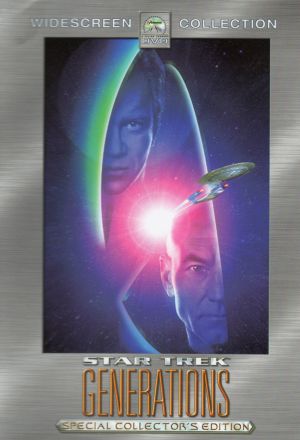 I said something earlier about ST5:TFF being a wasted opportunity. Star Trek: Generations (hereafter known as ST:G) was an even bigger opportunity, and thus, as it turned out, may have been an even bigger waste. It has been ten years — an entire decade — since Captain James T. Kirk bit the dust, and until I watched the “collector’s edition” DVD today, I don’t believe I had seen the film at all since the three times I caught it in the theatre back then; indeed, you could say I still haven’t seen it again, since I watched it with both the audio and text commentaries turned on, and thus wasn’t really paying attention to the dialogue, etc. But even with those bonus-feature distractions — and indeed, partly because of them, since the voices on the commentary express many gripes with the finished product! — it is still evident to me that ST:G was a clumsily made film, and a rather pathetic note on which to really, really, really end the original series.
ST6:TUC may have marked the last appearance of the full original-series cast, but ST:G is the film in which Kirk becomes the first member of the original Enterprise crew who dies and stays dead (unless you consider William Shatner’s Star Trek novels canonical!); it is also the last of the films to take place, even partially, in the 23rd century, and it brings back Scotty and Chekov, as well as introducing us to Sulu’s daughter. And as a fan of the original series, I have always rather liked the prologue, in which Kirk sits on a ship’s bridge for the last time in his life — but on the sidelines, not in the captain’s chair; indeed, the second or third time I saw this film, I was rather moved by Kirk’s refusal to sit in the Enterprise-B’s captain’s chair, knowing that his commitment to principle over personal satisfaction would soon spell his end. Moments like those ring very true to the character, and I’m grateful that the film gave us those last glimpses of Kirk in action.
But after that scene — oy vey! How lame that Kirk should “die” by being sucked into space during some random lame-o impromptu rescue mission gone wrong. Can it really be that that is how Kirk’s end was recorded in the history books, and that all those characters in the 24th century — including the much, much older McCoy and Sarek — have always believed Kirk had met his end this way? And how lame that Kirk should die a second time, and this time for real, by running around like some ill-fated red-shirt on an Enterprise-D mission. I know, I know, it would have been impossible to bring back the entire original-series cast and have a true meeting of the two shows … but still! Kirk was never all that interesting when he ran around punching people; his defining moments were always moments of decision and leadership, and that is sorely lacking in this film’s final act. This DVD also includes the original ending to the film, in which Soran (the Malcolm McDowell character) shoots Kirk in the back, and then Picard gets his revenge by shooting Soran more or less in cold blood (though I guess we could call it excessive force in the service of self-defense) — how could so many people have thought that an ending like that would have worked? Lame. Pathetic. And certainly neither of these endings gives Kirk a death anywhere near as meaningful as Spock’s in ST2:TWOK.
(Speaking of deleted scenes, the DVD includes another one that was going to start the film, in which Scotty and Chekov stand on the ground waiting for Kirk to finish a bout of orbital skydiving; it has that Starfleet-crew-on-vacation vibe that the opening scenes in ST5:TFF had, but if it was implausible then that, e.g., Sulu and Chekov should go on leave together, and not with their families, then it is even more implausible that Kirk should be hanging out with Scotty and Chekov, and not with, say, Spock and McCoy. Of course, the original script did call for Spock and McCoy to come back, but neither Leonard Nimoy nor DeForest Kelley was interested in reviving their roles, having said good-bye to them in the previous film. One thing that makes this deleted scene extra-strange is that it appears they were planning on intercutting between the Kirk-Scotty-Chekov scene and that special-effect sequence in which the champagne bottle is sent hurtling towards the Enterprise-B — I would have found the opening credits utterly incomprehensible if they had gone that route. Fortunately, they got the beginning of the film just about right, in the end, I think.)
Curiously, this is the only DVD so far in the Trek movie series in which none of the audio commentary is provided by the director; instead, it is provided by the two screenwriters. To judge from his IMDB page, director David Carson appears to be alive, still, so I can only speculate as to why he did not participate in this project; however, I note also that Carson has only directed one other feature film in his life — some obscure Wesley Snipes action movie — and that all of his other credits, which go back a few decades, are in TV. Unfortunately, ST:G does feel like a TV episode made by people who had a lot of money on their hands, rather than like a feature film (a fact exemplified, perhaps, by Dennis McCarthy’s score, which is easily one of the worst soundtracks in the Star Trek catalogue).
The film also feels terribly disjointed, partly because — as the writers themselves admit — they were trying to juggle too many formula elements and to please too many people at once. First you’ve got a sequence on the Enterprise-B. Then you’ve got an incredibly ginormous holodeck sequence. Then you’ve got a shoot-out on a space lab. Then you’ve got a rather convoluted hostage exchange (“If you give us back our crewmate, we’ll let you beam our captain down to the planet to talk to that other guy”). Then you’ve got a fantastic, extended Enterprise-D crash sequence. Then you’ve got this Victorian Christmas sequence in the Nexus. Then you’ve got Kirk scrambling eggs and riding horses. Then you’ve got a big mano a mano fight sequence on a rocky hill. Then, the end. It’s all rather disjointed; in fact, the awkward structure of it all kind of reminds me of The Last Temptation of Christ, which packs the life of Christ (a subject that ordinarily takes up an entire movie on its own) into its first two acts (if we can even think of Last Temptation in conventional three-act terms) and then spins off into some sort of alternate reality, before coming back in time and putting history back the way it was meant to be. (The parallels are actually rather eerie, the more I think about them — I’m surprised this had never occurred to me before.)
The writers are remarkably candid about how many things in the movie just don’t work the way they’d wanted them to: the sight of Picard wiggling through a hole in the rocks, the scene where Kirk and Picard scramble some eggs together (it was intended to be “charming and offbeat”, but now they find it “just painful” to watch), the “treacly” nature of the scene where Picard’s “children” thank him for their Christmas presents, the fact that Kirk’s line about “making a difference” doesn’t really “stick” with the other themes in the film (facing mortality, the effect that time has on us), etc. They also express qualms with aspects of the film that might not have been due to their script, e.g., they cannot recall whether it was in the script that Picard cries when he hears about his relatives’ deaths, or whether it was something Patrick Stewart decided to do; but either way, they don’t like the fact that Picard is seen crying in his first big movie. (Personally, I don’t mind the scene at all; I like the fact that Picard is human enough to show his vulnerability like that.) And they make some other interesting observations as well, e.g., they figure nothing will date ST:TNG more than the fact that a “therapist” like Counselor Troi was put not just on the ship, but on the bridge of the ship; they say it feels “very ’80s”. They also express some ambivalence about the fact that there were children on the Enterprise-D — a few good story ideas did come out of that situation, they admit, but, well, given how often the Enterprise-D was destroyed in parallel timelines (before finally being blown up in this film), it does seem odd.
The writers remark that this film, of all the ST:TNG films, is the most “true” to the show, and I think that’s true, but I think that may also have been one of the things that hindered it; certainly, the fact that ST5:TFF felt more like a regular episode of the original series than any of the other early films did not help that film in any way. It is also interesting to consider that this was the first of the films that depicted events which coincided with events on the other TV shows; ST:DS9 was just starting its third season when this film came out, and of course the future films will all have to find tricky ways to bring Worf back on the Enterprise despite the fact that he has been re-assigned to Deep Space 9. And yet the prologue, on the Enterprise-B, feels like it could have flowed naturally straight out of the previous six films. I get weird thoughts whenever I think of that prologue, actually, because it really does exist in some middle space between “an extension and continuation of the previous films, which all take place in the 23rd century” and “a trivial historical footnote, from the point of view of the 24th century”.
As you can see, I have difficulty leaving the original series behind. But hey, what can I say, it’s hard to forget the earlier films when ST:G recycles footage from the older movies. Now, there is a fair bit of recycling in the earlier films, too — the shots of the Enterprise leaving spacedock in ST:TMP were re-used in ST2:TWOK, and the ‘Genesis Planet’ footage in that film was re-used in ST3:TSFS and ST4:TVH, but I don’t object to this because none of these recycled shots was really “the point” of the story; those shots were all essentially in the background somewhere. But in ST:G, when the Enterprise-D blows up the Klingon sisters’ Bird of Prey, the film uses the exact same shot of General Chang’s Bird of Prey exploding from ST6:TUC — and I’m sorry, but you just can’t use one film’s climactic moment to depict another film’s climactic moment.
Let’s see, what else. Oh, yeah, when the scene of Data saying “Oh, shit” comes up, one of the writers remarks that this is the “first profanity” ever spoken on Star Trek — but that is not true. In ST4:TVH, Kirk had to assure Gillian, the whale expert, that there was “no dipshit” in what he was trying to tell her; one might also want to argue that expressions like “double dumb-ass on you” fall into the realm of profanity, depending on what kind of “ass” is under discussion there. What I would like to know is whether these expressions, which had apparently fallen out of fashion by the 23rd century, were somehow revived in the 24th — or is Data’s use of such an outdated expression an indication that he still hasn’t figured out how to use his emotion chip properly?
Speaking of Data, I did get a kick out of the writers’ claim that Brent Spiner hates cats, and thus hated having to do all those scenes with Spot — and they claim you can actually see just how much the cat can sense that Spiner hates it. And I also got a kick out of the fact that, not only did William Shatner know that the writers had thrown horses into the film in order to persuade him to appear in it, but Shatner also rented his horses to the production company, to make just a little more money!
Thankfully, the Star Trek franchise did have at least one more good movie left in it — but that was it. And while I’ve never been a big ST:TNG fan, I do think it’s kind of sad that only one of the four films produced by that generation turned out okay. Ah well.
— A version of this post was first posted to the OnFilm discussion group.
star trek v the final frontier
star trek vi the undiscovered country
Previous Post

August 20, 2004
Review: Exorcist: The Beginning (dir. Renny Harlin, 2004)
Next Post
October 7, 2004 Come and See: How Movies Encourage Us to Look at (and with) Jesus
Browse Our Archives
Select a Category Anglican Planet Articles BC Christian News BC Report Bible Movies Bible Review Blog Books & Culture Campus Times CBC Radio Christianity Today ChristianWeek Essays Faith Today Festival Cinemas Guide Film Journals Georgia Straight Interviews MB Herald National Catholic Register Salvationist Today's Christian Two Chairs Ubyssey Uncategorized Vancouver Courier Vancouver Sun
Select a Month August 2025 April 2025 January 2025 December 2024 November 2024 May 2024 February 2024 December 2023 May 2023 March 2023 November 2022 July 2022 June 2022 May 2022 April 2022 February 2022 January 2022 December 2021 November 2021 October 2021 September 2021 August 2021 July 2021 June 2021 April 2021 March 2021 February 2021 January 2021 December 2020 November 2020 October 2020 August 2020 July 2020 June 2020 May 2020 March 2020 February 2020 January 2020 December 2019 November 2019 September 2019 July 2019 May 2019 April 2019 March 2019 February 2019 January 2019 December 2018 November 2018 October 2018 September 2018 July 2018 June 2018 May 2018 April 2018 March 2018 February 2018 January 2018 December 2017 November 2017 October 2017 September 2017 August 2017 July 2017 June 2017 May 2017 April 2017 March 2017 February 2017 January 2017 December 2016 November 2016 October 2016 September 2016 August 2016 July 2016 June 2016 May 2016 April 2016 March 2016 February 2016 January 2016 December 2015 November 2015 October 2015 September 2015 August 2015 July 2015 June 2015 May 2015 April 2015 March 2015 February 2015 January 2015 December 2014 November 2014 October 2014 September 2014 August 2014 July 2014 June 2014 May 2014 April 2014 March 2014 February 2014 January 2014 December 2013 November 2013 October 2013 September 2013 August 2013 July 2013 June 2013 May 2013 April 2013 March 2013 February 2013 January 2013 December 2012 November 2012 October 2012 September 2012 August 2012 July 2012 June 2012 April 2012 January 2012 January 2011 December 2010 November 2010 October 2010 September 2010 August 2010 July 2010 June 2010 May 2010 April 2010 March 2010 February 2010 January 2010 December 2009 November 2009 October 2009 September 2009 August 2009 July 2009 June 2009 May 2009 April 2009 March 2009 February 2009 January 2009 December 2008 November 2008 October 2008 September 2008 August 2008 July 2008 June 2008 May 2008 April 2008 March 2008 February 2008 January 2008 December 2007 November 2007 October 2007 September 2007 August 2007 July 2007 June 2007 May 2007 April 2007 March 2007 February 2007 January 2007 December 2006 November 2006 October 2006 September 2006 August 2006 July 2006 June 2006 May 2006 April 2006 March 2006 February 2006 January 2006 December 2005 November 2005 October 2005 September 2005 August 2005 July 2005 June 2005 May 2005 April 2005 March 2005 January 2005 December 2004 November 2004 October 2004 September 2004 August 2004 July 2004 June 2004 May 2004 April 2004 March 2004 February 2004 January 2004 November 2003 October 2003 August 2003 July 2003 June 2003 May 2003 January 2003 December 2002 November 2002 August 2002 July 2002 June 2002 May 2002 March 2002 January 2002 December 2001 November 2001 September 2001 August 2001 July 2001 June 2001 April 2001 March 2001 February 2001 December 2000 November 2000 October 2000 September 2000 August 2000 July 2000 June 2000 May 2000 April 2000 March 2000 January 2000 October 1999 August 1999 May 1999 April 1999 February 1999 January 1999 December 1998 November 1998 October 1998 August 1998 July 1998 June 1998 April 1998 March 1998 January 1998 November 1997 September 1997 July 1997 June 1997 April 1997 March 1997 February 1997 January 1997 December 1996 October 1996 September 1996 June 1996 March 1996 February 1996 January 1996 April 1995 November 1994 September 1994 September 1991
Follow Us!
TAKE THE
Religious Wisdom Quiz
What did Jesus say about judging people?
Select your answer to see how you score.
Judge yourself only Judge fairly Judge not Judge justly
Related posts from FilmChat

Joseph of Egypt – the Chosen spin-off announces...

Exclusive: A clip from Angel Studios' The King...

Exclusive: Watch a clip from Angel Studios' Brave...

Exclusive: Watch a clip from Angel Studios' Homestead
TRENDING AT PATHEOS Religious Music & Entertainment

"Les Diabolique" and Transgression
Alongside something like Arrival, Vertigo, or Charade, Les Diaboliques is a...

"The Plague Dogs" and Mortality
So, flashback to the late 70s, early 80s. Walt Disney Studios is...

With the recent and highly successful release of Christopher Nolan’s epic film,...

"L'avventura" and Human Weakness
Today's piece is going to be a little different for a few...

I first want to apologize for not posting or writing anything. I'm...

I've engaged in the multi-year project of reading through the Church Fathers,...
view all Religious Music & Entertainment blogs
Ad-Free & Subscriber Log-In Subscription Support
- About Us
- 2026 Calendar
- Videos
- Podcasts
- Library of World Religions
- Faith In Media Tracker
- Advertise With Us
- Write for Us
- Privacy Policy
- Terms of Service
- Do Not Sell My Data
- Contact Us
- Radiant Digital
- Manage Newsletter Subscriptions
- Unsubscribe From Notifications
- Sitemap
Copyright 2008-2026, Patheos. All rights reserved.
Subscription Support Ad-Free & Subscriber Log-In
Follow Patheos