
BuddhistCatholicContemplativeEvangelicalGeneral ChristianHinduJewishLatter-day SaintMuslimNew VisionsProgressive Christian
Beliefs
- Buddhist
- Catholic
- Contemplative
- Evangelical
- General Christian
- Hindu
- Jewish
- Latter-day Saint
- More Voices
- Muslim
- New Visions
- Pagan
- Progressive Christian
Topics
- Religion News
- Food and Religion
- Sports and Religion
- Religious Art
- Religious Music and Entertainment
- Religious Events
- History and Religion
- Style and Religion
- Politics and Religion
- Women in Religion
- Recreation Outdoors and Religion
- Business Finance and Religion
- Careers Workplace and Religion
- Education and Religion
- Family Parenting and Religion
- Health Fitness and Religion
- Home and Religion
- Relationships and Religion
- Technology and Religion
- Travel and Religion
Columnists
- Buddhist Columnists
- Business Finance and Religion Columnists
- Careers Workplace and Religion Columnists
- Catholic Columnists
- Contemplative Columnists
- Education and Religion Columnists
- Evangelists Columnists
- Family Parenting and Religion Columnists
- General Christian Columnists
- Health Fitness and Religion Columnists
- Hindu Columnists
- History and Religion Columnists
- Home and Religion Columnists
- Jewish Columnists
- More Voices Columnists
- Latter Day Columnists
- Muslim Columnists
- New Visions Columnists
- Nonreligious Columnists
- Pagan Columnists
- Politics and Religion Columnists
- Progressive Columnists
- Recreation Outdoors and Religion Columnists
- Relationships and Religion Columnists
- Religion News Columnists
- Religious Art Columnists
- Religious Events Columnists
- Religious Music and Entertainment Columnists
- Sports and Religion Columnists
- Style and Religion Columnists
- Technology and Religion Columnists
- Travel and Religion Columnists
- Women in Religion Columnists
Resource Library
- 2026 Calendar
- Library of World Religions
- The 100 Most Holy Places on Earth
- Patheos Answers
- Podcasts
- Videos
- Faith Leaders Database
- Anglican Episcopalian
- Bahai
- Baptist
- Buddhism
- Christianity
- Confucianism
- Eastern Orthodoxy
- Hinduism
- Holiness and Pentecostal
- ISKCON
- Islam
- Judaism
- Lutheran
- Methodist
- The Church of Jesus Christ of Latter-day Saints
- New Age
- Paganism
- Presbytarian and Reformed
- Protestantism
- Religion Behind the Scenes
- Roman Catholic
- Scientology
- Shia Islam
- Sikhism
- Sufism
- Sunni Islam
- Taoism
- Zen
- See all religions
Research Tools
 Ad-Free & Subscriber Log-In Subscription Support
Ad-Free & Subscriber Log-In Subscription Support
Follow Patheos 

- Trending:
- Forgiveness
- |
- Marriage
- |
- Consciousness
- |
- Death Penalty
- |
- Election
- |
- Halloween

-
Articles
- Home
- Religious Music & Entertainment
- Review: Exorcist: The Beginning (dir. Renny Harlin, 2004)
Review: Exorcist: The Beginning (dir. Renny Harlin, 2004)
Last updated on: December 26, 2013 at 8:20 am by Peter T. Chattaway
Review: Exorcist: The Beginning (dir. Renny Harlin, 2004) 2013-12-26T08:20:40-08:00 Peter T. Chattaway
Patheos Explore the world's faith through different perspectives on religion and spirituality! Patheos has the views of the prevalent religions and spiritualities of the world.
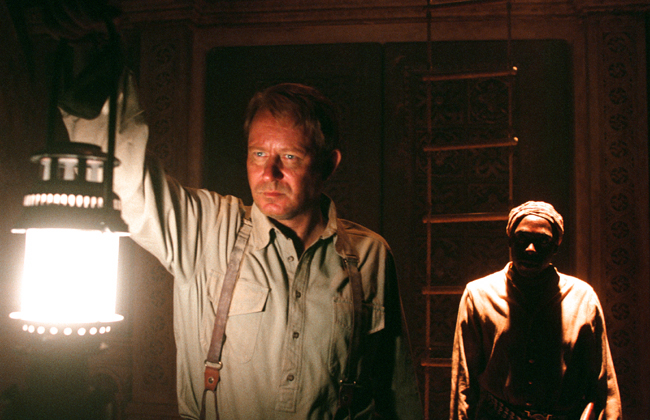 It is almost impossible to imagine that a worthy sequel to 1973’s The Exorcist could ever be made, but that hasn’t stopped several filmmakers from trying. The original film — directed by William Friedkin from a screenplay by William Peter Blatty, who also wrote the original novel — was more of a mood piece than a story. The demonic possession of a 12-year-old girl was less a conflict to be resolved than a hook on which to hang a thoughtful meditation on the tension between modern materialistic science and an ancient, even primitive, belief in a spiritual realm beyond this life. At a time when many were asking if God was dead, and if concepts such as goodness still had any meaning, Blatty and Friedkin hit audiences with a bold, shocking depiction of evil and dared them to say that this, too, was not meaningful. If there truly was such a thing as evil, then there truly must be such a thing as good, too; and if the Devil existed, then so did God.
Admittedly, The Exorcist had some elements which, if pressed too hard, would have taken the story in the direction of pure hokum. And press too hard is, alas, exactly what the sequels have done. John Boorman’s Exorcist II: The Heretic (1977), widely regarded as one of the dumbest movies ever made, tried to fill in all the gaps in the first film that were wisely left unfilled; among other things, it also abandoned the first film’s realistic depiction of modern mechanized medicine in favor of tacky sci-fi elements such as a mind-reading device that consisted of a couple headbands, a few wires, and a pulsing light bulb. The Exorcist III (1990), directed by Blatty and based on his 1983 novel Legion, spun a serial-killer murder mystery in which possession was little more than a plot device.
And now there is Exorcist: The Beginning, which could just as easily be called Exorcist: The Epic. This film was originally assigned to Paul Schrader, a graduate of Calvin College who has wrestled with his Christian upbringing in films as varied as The Last Temptation of Christ, which he wrote, and Hardcore, Light of Day and Touch, which he directed. Schrader has said that he wanted to make The Beginning a psychological, character-driven period drama, but the studio reportedly wanted more blood and gore, so it took the film out of Schrader’s hands after he had finished it and hired Renny Harlin (Die Hard 2, Cliffhanger) to remake it, almost from scratch. And Harlin gives the studio what it wants right from the opening frames, as a Byzantine priest wanders through a computer-generated sixth-century battlefield strewn with corpses, severed body parts, and upside-down crosses.
The film then jumps to the 1940s, where we meet Lankester Merrin (Stellan Skarsgård, as a younger version of the Max von Sydow character from the first two films). Merrin is a priest who has lost his faith because of the atrocities committed against members of his parish during the Nazi occupation of Holland, and he has fled his home in a vain attempt to get away from his memories. He is in Cairo when he is approached by Semelier (Chariots of Fire’s Ben Cross), a British collector of rare antiquities who knows of Merrin’s training in archaeology, and who asks Merrin to lend his expertise to an unusual excavation in Kenya.
It turns out the British have discovered a 1,500-year-old Byzantine church in a region where there shouldn’t be any; what’s more, the church seems to have been buried by natural forces as soon as it was completed, the head archaeologist has gone insane since climbing into the church through a hole in its dome, and the local village is rumored to have been struck by a plague just a few decades ago, the last time explorers came calling. And no sooner has Merrin arrived than hypnotized hyenas begin to attack the children and pregnant women begin to give birth to stillborn babies covered in maggots, while tensions between the British soldiers and African tribesmen also begin to boil over…
Yes, there’s an evil spirit out there somewhere. But whereas the first film concerned a very specific case of demonic possession, and whereas Blatty’s original story reflected his extensive research into such phenomena, this new film shows the same demon throwing its weight hither and yon as the film throws together a wide range of elements that feel like warmed-over horror-movie clichés, from insects crawling out of people’s mouths and sandstorms descending on entire villages to the spontaneous, and telekinetic, breaking of the bones of some African tribesmen who are trying to cast the demon out of their presence.
But until the film’s final half-hour, the demon’s presence itself barely registers. Whereas the symptoms of demonic possession kept escalating over the course of the original film, they are almost nowhere to be seen in the new film; an African boy’s bed shakes violently every now and them, but after a while you begin to wonder why he hasn’t started spitting or vomiting or barking obscenities. The reason becomes clear when a certain plot twist comes along near the end of the film, but while plot twists of this sort may be acceptable in, say, a Harry Potter movie, they are not what The Exorcist is, or should be, all about.
To be fair, Exorcist: The Beginning makes a few nice visual nods to the original film, and its references to World War II are actually very much in the spirit of the novel, which briefly cites the Holocaust, the Vietnam War, the persecution of Christians under the Communists and similar examples of real-world cruelty, as if to say, Why do we need a “sign” such as demonic possession in order to believe that evil is real? The new film’s exaltation of Christian ritual, belief, and submission to God over such occult practices as the reading of tarot cards is also quite commendable. But the new film misses the point, when it reduces Merrin’s confrontation with the demon to a set of comic-book heroics. In the first film, exorcism is presented as a stressful and prayerful activity requiring patience and diligence, and we are told that the exorcism Merrin performed in Africa some years ago took “months”; but in the new film, it’s all over in an evening of special effects.
Making a sequel to The Exorcist may ultimately be about as pointless as making a sequel to the Book of Job. While I certainly wouldn’t put Blatty’s novel or Friedkin’s film on the same level as Scripture, one thing these stories do have in common is that they deal with very challenging themes — the problem of suffering, the crisis of meaning in the modern world — and they invite deeper contemplation through re-reading, or re-viewing (at least for those who can stomach the more shocking elements in Friedkin’s film). It might very well be interesting to make a film about Father Merrin’s earlier experiences with demons, just as it might very well be interesting to dramatize the thoughts and feelings of, say, Job’s children, but neither of these exercises is likely to shed any light on what the original story was all about. Some things are better left mysterious, and some movies better left unmade.
1.5 stars (out of 4)
–
Talk About It
Discussion starters
1. C. S. Lewis said, in The Screwtape Letters, that demons want us to either not believe in them or to be inordinately fascinated with them. How do you think Christians should respond to movies about demons? How would a movie deal with the subject responsibly? Do our responses to these movies differ from our responses to biblical stories about exorcisms? If so, how?
2. Why do you think there is so much evil in the world? Is it all due to demonic activity? How much responsibility do you think we humans have for the evil we commit?
3. What does the Bible say about spiritual warfare? (See Ephesians 6:10-18).
The Family Corner
For parents to consider
This film is rated R for “strong violence and gore, disturbing images and rituals, and for language including some sexual dialogue.” There are many scenes of people being slashed, speared, shot, and so on, and some of these wounds are self-inflicted; also, some people’s bones are broken by invisible forces, and a woman gives birth to a stillborn baby covered in maggots. There is a brief hint of nudity when a woman takes a shower. Plus there is some rough language, especially where a lusty old man is concerned. Take the R rating seriously; this is not a movie for kids. Adults will want to be wary too, considering the content.
— A version of this review was first published at Christianity Today Movies.
Previous Post

August 16, 2004
Review: Alien vs. Predator (dir. Paul W.S. Anderson, 2004)
Next Post
September 30, 2004 Star Trek: Generations: the two-disc DVD
Browse Our Archives
Select a Category Anglican Planet Articles BC Christian News BC Report Bible Movies Bible Review Blog Books & Culture Campus Times CBC Radio Christianity Today ChristianWeek Essays Faith Today Festival Cinemas Guide Film Journals Georgia Straight Interviews MB Herald National Catholic Register Salvationist Today's Christian Two Chairs Ubyssey Uncategorized Vancouver Courier Vancouver Sun
Select a Month August 2025 April 2025 January 2025 December 2024 November 2024 May 2024 February 2024 December 2023 May 2023 March 2023 November 2022 July 2022 June 2022 May 2022 April 2022 February 2022 January 2022 December 2021 November 2021 October 2021 September 2021 August 2021 July 2021 June 2021 April 2021 March 2021 February 2021 January 2021 December 2020 November 2020 October 2020 August 2020 July 2020 June 2020 May 2020 March 2020 February 2020 January 2020 December 2019 November 2019 September 2019 July 2019 May 2019 April 2019 March 2019 February 2019 January 2019 December 2018 November 2018 October 2018 September 2018 July 2018 June 2018 May 2018 April 2018 March 2018 February 2018 January 2018 December 2017 November 2017 October 2017 September 2017 August 2017 July 2017 June 2017 May 2017 April 2017 March 2017 February 2017 January 2017 December 2016 November 2016 October 2016 September 2016 August 2016 July 2016 June 2016 May 2016 April 2016 March 2016 February 2016 January 2016 December 2015 November 2015 October 2015 September 2015 August 2015 July 2015 June 2015 May 2015 April 2015 March 2015 February 2015 January 2015 December 2014 November 2014 October 2014 September 2014 August 2014 July 2014 June 2014 May 2014 April 2014 March 2014 February 2014 January 2014 December 2013 November 2013 October 2013 September 2013 August 2013 July 2013 June 2013 May 2013 April 2013 March 2013 February 2013 January 2013 December 2012 November 2012 October 2012 September 2012 August 2012 July 2012 June 2012 April 2012 January 2012 January 2011 December 2010 November 2010 October 2010 September 2010 August 2010 July 2010 June 2010 May 2010 April 2010 March 2010 February 2010 January 2010 December 2009 November 2009 October 2009 September 2009 August 2009 July 2009 June 2009 May 2009 April 2009 March 2009 February 2009 January 2009 December 2008 November 2008 October 2008 September 2008 August 2008 July 2008 June 2008 May 2008 April 2008 March 2008 February 2008 January 2008 December 2007 November 2007 October 2007 September 2007 August 2007 July 2007 June 2007 May 2007 April 2007 March 2007 February 2007 January 2007 December 2006 November 2006 October 2006 September 2006 August 2006 July 2006 June 2006 May 2006 April 2006 March 2006 February 2006 January 2006 December 2005 November 2005 October 2005 September 2005 August 2005 July 2005 June 2005 May 2005 April 2005 March 2005 January 2005 December 2004 November 2004 October 2004 September 2004 August 2004 July 2004 June 2004 May 2004 April 2004 March 2004 February 2004 January 2004 November 2003 October 2003 August 2003 July 2003 June 2003 May 2003 January 2003 December 2002 November 2002 August 2002 July 2002 June 2002 May 2002 March 2002 January 2002 December 2001 November 2001 September 2001 August 2001 July 2001 June 2001 April 2001 March 2001 February 2001 December 2000 November 2000 October 2000 September 2000 August 2000 July 2000 June 2000 May 2000 April 2000 March 2000 January 2000 October 1999 August 1999 May 1999 April 1999 February 1999 January 1999 December 1998 November 1998 October 1998 August 1998 July 1998 June 1998 April 1998 March 1998 January 1998 November 1997 September 1997 July 1997 June 1997 April 1997 March 1997 February 1997 January 1997 December 1996 October 1996 September 1996 June 1996 March 1996 February 1996 January 1996 April 1995 November 1994 September 1994 September 1991
Follow Us!
TAKE THE
Religious Wisdom Quiz
Who was Jacob's firstborn son?
Select your answer to see how you score.
Joseph Reuben Levi Judah
Related posts from FilmChat
New apostle-themed projects coming from Scorsese & Schrader...
The Chosen -- season one, episode one
Mary Magdalene: a scene guide (with clips and...
Mary Magdalene: the Garth Davis interview round-up
TRENDING AT PATHEOS Religious Music & Entertainment

"Les Diabolique" and Transgression
Alongside something like Arrival, Vertigo, or Charade, Les Diaboliques is a...

"The Plague Dogs" and Mortality
So, flashback to the late 70s, early 80s. Walt Disney Studios is...

With the recent and highly successful release of Christopher Nolan’s epic film,...

"L'avventura" and Human Weakness
Today's piece is going to be a little different for a few...

I first want to apologize for not posting or writing anything. I'm...

I've engaged in the multi-year project of reading through the Church Fathers,...
view all Religious Music & Entertainment blogs
Ad-Free & Subscriber Log-In Subscription Support
- About Us
- 2026 Calendar
- Videos
- Podcasts
- Library of World Religions
- Faith In Media Tracker
- Advertise With Us
- Write for Us
- Privacy Policy
- Terms of Service
- Do Not Sell My Data
- Contact Us
- Radiant Digital
- Manage Newsletter Subscriptions
- Unsubscribe From Notifications
- Sitemap
Copyright 2008-2026, Patheos. All rights reserved.
Subscription Support Ad-Free & Subscriber Log-In
Follow Patheos