
BuddhistCatholicContemplativeEvangelicalGeneral ChristianHinduJewishLatter-day SaintMuslimNew VisionsProgressive Christian
Beliefs
- Buddhist
- Catholic
- Contemplative
- Evangelical
- General Christian
- Hindu
- Jewish
- Latter-day Saint
- More Voices
- Muslim
- New Visions
- Pagan
- Progressive Christian
Topics
- Religion News
- Food and Religion
- Sports and Religion
- Religious Art
- Religious Music and Entertainment
- Religious Events
- History and Religion
- Style and Religion
- Politics and Religion
- Women in Religion
- Recreation Outdoors and Religion
- Business Finance and Religion
- Careers Workplace and Religion
- Education and Religion
- Family Parenting and Religion
- Health Fitness and Religion
- Home and Religion
- Relationships and Religion
- Technology and Religion
- Travel and Religion
Columnists
- Buddhist Columnists
- Business Finance and Religion Columnists
- Careers Workplace and Religion Columnists
- Catholic Columnists
- Contemplative Columnists
- Education and Religion Columnists
- Evangelists Columnists
- Family Parenting and Religion Columnists
- General Christian Columnists
- Health Fitness and Religion Columnists
- Hindu Columnists
- History and Religion Columnists
- Home and Religion Columnists
- Jewish Columnists
- More Voices Columnists
- Latter Day Columnists
- Muslim Columnists
- New Visions Columnists
- Nonreligious Columnists
- Pagan Columnists
- Politics and Religion Columnists
- Progressive Columnists
- Recreation Outdoors and Religion Columnists
- Relationships and Religion Columnists
- Religion News Columnists
- Religious Art Columnists
- Religious Events Columnists
- Religious Music and Entertainment Columnists
- Sports and Religion Columnists
- Style and Religion Columnists
- Technology and Religion Columnists
- Travel and Religion Columnists
- Women in Religion Columnists
Resource Library
- 2026 Calendar
- Library of World Religions
- The 100 Most Holy Places on Earth
- Patheos Answers
- Podcasts
- Videos
- Faith Leaders Database
- Anglican Episcopalian
- Bahai
- Baptist
- Buddhism
- Christianity
- Confucianism
- Eastern Orthodoxy
- Hinduism
- Holiness and Pentecostal
- ISKCON
- Islam
- Judaism
- Lutheran
- Methodist
- The Church of Jesus Christ of Latter-day Saints
- New Age
- Paganism
- Presbytarian and Reformed
- Protestantism
- Religion Behind the Scenes
- Roman Catholic
- Scientology
- Shia Islam
- Sikhism
- Sufism
- Sunni Islam
- Taoism
- Zen
- See all religions
Research Tools
 Ad-Free & Subscriber Log-In Subscription Support
Ad-Free & Subscriber Log-In Subscription Support
Follow Patheos 

- Trending:
- Forgiveness
- |
- Marriage
- |
- Consciousness
- |
- Death Penalty
- |
- Election
- |
- Halloween

-
Articles
- Home
- Religious Music & Entertainment
- The Revenger’s Tragedy / Vengeance is ours, saith Hollywood.
The Revenger’s Tragedy / Vengeance is ours, saith Hollywood.
Last updated on: January 7, 2013 at 12:17 pm by Peter T. Chattaway
The Revenger’s Tragedy / Vengeance is ours, saith Hollywood. 2013-01-07T12:17:32-08:00 Peter T. Chattaway
Patheos Explore the world's faith through different perspectives on religion and spirituality! Patheos has the views of the prevalent religions and spiritualities of the world.
 Vengeance is ours, saith Hollywood. This message came through particularly loud and clear during a single week in April, in which the studios released three films about grim, determined vigilantes who seek brutal revenge against their enemies. While those who take the law into their own hands are usually anything but heroic in real life, the protagonists in Kill Bill, The Punisher, and Man on Fire are all presented in more or less sympathetic terms. All of their violent vendettas are portrayed as at least somewhat justified, and there even seems to be a hint of divine sanction hanging over their efforts. All three of them have lost a child, and sometimes other friends and family too, and all three of them have been shot and left for dead by the villains who deprived them of their loved ones. Thus, when all three of them recuperate and set out on their quests for vengeance, it is as though they have risen from the dead to set wrongs right.
The implicit divine approval is made explicit in Kill Bill, the two-part Quentin Tarantino movie which freely mixes the conventions of Eastern and Western revenge flicks. The story follows a female assassin, known at first only as The Bride (Uma Thurman), who is shot in the head by Bill (David Carradine), her former boss and lover, and then spends the next four years in a coma. In Vol. 1, released last year, she awakes, beats a hospital employee who has been raping her and pimping her body out to other men, then wills her paralyzed legs back to life. As The Bride sets off on a globe-trotting mission to kill the five former colleagues who killed her friends and caused her to lose the baby she was carrying, she marvels that she survived Bill’s attack; in a voice-over, she declares: “When fortune smiles on something as violent and ugly as revenge, it seems proof like no other that not only does God exist — you’re doing his will.”
As always with Tarantino, it is difficult to tell where hip posturing ends and sincerity begins. The one thing that does come through in his films is his unabashed love for both the artistic ambitions and the pulpy excesses of earlier films, and Kill Bill, divided neatly into ten chapters spread out over two films, is essentially a celebration of movie genres, from Westerns and gangster movies to kung fu flicks and Japanese animation. An opening title card even alludes to Star Trek, citing an “old Klingon proverb” to the effect that “Revenge is a dish best served cold.” But there is more to Kill Bill than a mere exercise in style. Tarantino is also concerned with the moral codes by which even criminals try to live, and with the possibility that even sinners as bad as these can find grace.
In a flashback in Vol. 2, we learn that The Bride tried to abandon her life of crime when she learned she was pregnant — and that her first act upon making this discovery was to spare the life of another female assassin who happened to invade her hotel room at that exact moment. The tense, amusing stand-off between these two hit-women recalls an episode in Tarantino’s earlier film, Pulp Fiction (1994), in which two hit-men are completely untouched by a virtually point-blank hail of bullets; one calls their survival a “miracle” and gives up his criminal ways, while the other sees nothing but a lucky accident and continues to work for their boss — and is killed on the job shortly thereafter. In that case, we may assume the hit-man who quit was allowed to go, but Bill is not so generous to The Bride; several months after she leaves him, he tracks her down, finds that she is about to marry another man, and kills the wedding party — and almost succeeds in killing her, too. So now, because The Bride’s efforts to embrace the good have been thwarted, she goes the other way, embracing evil in order to destroy it, using her lethal talents to kill her former colleagues.
Yet even amid all the cartoonish, blood-soaked mayhem, there remains the possibility that The Bride might find some sort of grace. When she finally faces Bill, she learns to her shock and amazement that their daughter is alive — and that Bill has been raising the child all this time. Suddenly The Bride’s mission is one of protection, of preserving whatever innocence her daughter has retained despite being left in the care of an active professional killer. When the moment to kill Bill finally arrives, it is played as tragedy more than triumph; grace was a possibility for Bill, too, but he turned it down. The film ends with The Bride curled on a motel bathroom floor, crying, smiling, and saying a prayer of thanks before she and her daughter hit the road, hopefully leaving the cycle of violence far, far behind them.
 There is nothing so hopeful in The Punisher, an adaptation of the Marvel comic, co-written and directed by Jonathan Hensleigh. The film hints strongly that there is no divine element in the world, just chance and our own conflicting efforts to impose order through sheer brute force. Frank Castle (Thomas Jane) is a retired cop whose last assignment ends in the unintended death of the son of an arch-criminal named Howard Saint (John Travolta). At his wife’s bidding, Saint sends a team of hit-men to wipe out Castle and all his relatives at their family reunion in the Caribbean.
Shortly before the hit-men show up, Castle’s wife tells him, “You and I, we’re not lucky — we are blessed.” But that blessing is soon undone, as she, their son, and the rest of their extended clan are killed in cold blood. Castle himself is shot in the chest by another of Saint’s sons, and he is left to die on a pier set to explode. But somehow, he survives, and is nursed back to health by a local healer who wears a cross around his neck. “Go with God,” the healer says when Castle is well enough to return home, but Castle grimly replies, “God’s gonna sit this one out.” Returning to America and finding that his former colleagues have done nothing to punish Saint, Castle sets a plan in motion to destroy Saint’s empire as well as his family. At times, Castle dispatches his victims with a barbaric vindictiveness that could have come straight out of pagan myth.1
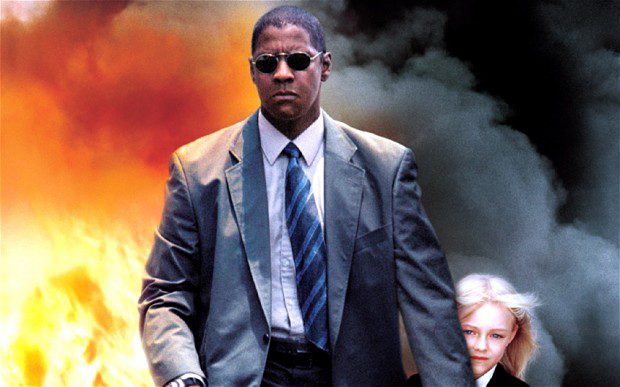 But the worst tendencies of the revenge genre truly reach their apotheosis in Man on Fire, directed with annoying hyperactivity by Tony Scott from a script by Brian Helgeland (whose last film, oddly enough, was the anti-revenge drama Mystic River). Man on Fire is the story of John Creasy (Denzel Washington), a suicidal, alcoholic former CIA assassin hired to be the bodyguard for a young girl named Pita (Dakota Fanning) in Mexico City, depicted here as the kidnapping capital of the world. In this film, life is a series of transactions: everything from money to sex is traded as a reward for favors rendered or as a bid for favors yet to come, and human life itself is the ultimate bargaining chip. In the midst of all this mutual exploitation, Pita sounds the one crystal-clear note of grace by offering Creasy her unconditional love — and although he resists her efforts to befriend him at first, he eventually gives in, and in doing so becomes a better father figure to her than her own dad. The fact that Creasy’s earlier attempt to kill himself failed in a seemingly miraculous fashion, when the bullet in his gun did not discharge as it should, also gives him a reason to live again. So he puts down his bottle and picks up his Bible.
But then Pita is kidnapped and, after a ransom deal goes bad, presumed dead. Creasy, wounded during the abduction, emerges from his hospitalization to declare war on the criminals and corrupt police officers responsible for Pita’s death. One by one, he works his way up the chain of command, slicing off a man’s fingers in order to make him talk, packing a handful of explosives up another man’s rectum, and burning down an entire nightclub, apparently to the amusement of its patrons. All the while, Creasy’s vendetta is given a religious tinge, through the film’s repeated references to the Scriptures and St. Jude, the patron saint of lost causes whose pendant Pita gave to Creasy. Standing before a statue of the Madonna, Creasy even encourages Pita’s father, who turns out to have been partly responsible for her abduction, to commit suicide with the “miracle bullet” that spared Creasy’s own life. When one person points out that the Church teaches us to forgive our enemies, Creasy replies, “Forgiveness is between them and God — it’s my job to arrange the meeting.”
Kill Bill, at least, lets us in on the fact that it’s only a movie — at one point, The Bride even winks at the camera — and its characters do recognize their common fallenness; at times, they even hope for, and point toward, a life beyond revenge. But the other films take themselves too seriously; at one point, Creasy quotes the same proverb that Tarantino attributes to the Klingons, but where Tarantino cites it with a nudge and a wink, Creasy is all business. More than ever, what we need right now are films that will encourage us to love, not hate, our enemies.
Peter Chattaway lives in Canada and writes about movies.
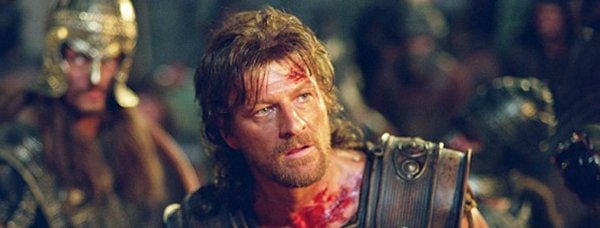
1. Compare the scene in The Punisher where Castle has Saint dragged to his death behind a car with the scene in Homer’s Iliad — also depicted in the recent blockbuster Troy — in which Achilles drags Hector’s body behind his chariot. But where Achilles’ action is seen as a sign of his inhuman arrogance, Castle’s action is the heroic climax to the film.
Previous Post

June 11, 2004
Review: The Stepford Wives (dir. Frank Oz, 2004)
Next Post
July 13, 2004 Review: Paul the Apostle (dir. Roger Young, 2000)
Browse Our Archives
Select a Category Anglican Planet Articles BC Christian News BC Report Bible Movies Bible Review Blog Books & Culture Campus Times CBC Radio Christianity Today ChristianWeek Essays Faith Today Festival Cinemas Guide Film Journals Georgia Straight Interviews MB Herald National Catholic Register Salvationist Today's Christian Two Chairs Ubyssey Uncategorized Vancouver Courier Vancouver Sun
Select a Month August 2025 April 2025 January 2025 December 2024 November 2024 May 2024 February 2024 December 2023 May 2023 March 2023 November 2022 July 2022 June 2022 May 2022 April 2022 February 2022 January 2022 December 2021 November 2021 October 2021 September 2021 August 2021 July 2021 June 2021 April 2021 March 2021 February 2021 January 2021 December 2020 November 2020 October 2020 August 2020 July 2020 June 2020 May 2020 March 2020 February 2020 January 2020 December 2019 November 2019 September 2019 July 2019 May 2019 April 2019 March 2019 February 2019 January 2019 December 2018 November 2018 October 2018 September 2018 July 2018 June 2018 May 2018 April 2018 March 2018 February 2018 January 2018 December 2017 November 2017 October 2017 September 2017 August 2017 July 2017 June 2017 May 2017 April 2017 March 2017 February 2017 January 2017 December 2016 November 2016 October 2016 September 2016 August 2016 July 2016 June 2016 May 2016 April 2016 March 2016 February 2016 January 2016 December 2015 November 2015 October 2015 September 2015 August 2015 July 2015 June 2015 May 2015 April 2015 March 2015 February 2015 January 2015 December 2014 November 2014 October 2014 September 2014 August 2014 July 2014 June 2014 May 2014 April 2014 March 2014 February 2014 January 2014 December 2013 November 2013 October 2013 September 2013 August 2013 July 2013 June 2013 May 2013 April 2013 March 2013 February 2013 January 2013 December 2012 November 2012 October 2012 September 2012 August 2012 July 2012 June 2012 April 2012 January 2012 January 2011 December 2010 November 2010 October 2010 September 2010 August 2010 July 2010 June 2010 May 2010 April 2010 March 2010 February 2010 January 2010 December 2009 November 2009 October 2009 September 2009 August 2009 July 2009 June 2009 May 2009 April 2009 March 2009 February 2009 January 2009 December 2008 November 2008 October 2008 September 2008 August 2008 July 2008 June 2008 May 2008 April 2008 March 2008 February 2008 January 2008 December 2007 November 2007 October 2007 September 2007 August 2007 July 2007 June 2007 May 2007 April 2007 March 2007 February 2007 January 2007 December 2006 November 2006 October 2006 September 2006 August 2006 July 2006 June 2006 May 2006 April 2006 March 2006 February 2006 January 2006 December 2005 November 2005 October 2005 September 2005 August 2005 July 2005 June 2005 May 2005 April 2005 March 2005 January 2005 December 2004 November 2004 October 2004 September 2004 August 2004 July 2004 June 2004 May 2004 April 2004 March 2004 February 2004 January 2004 November 2003 October 2003 August 2003 July 2003 June 2003 May 2003 January 2003 December 2002 November 2002 August 2002 July 2002 June 2002 May 2002 March 2002 January 2002 December 2001 November 2001 September 2001 August 2001 July 2001 June 2001 April 2001 March 2001 February 2001 December 2000 November 2000 October 2000 September 2000 August 2000 July 2000 June 2000 May 2000 April 2000 March 2000 January 2000 October 1999 August 1999 May 1999 April 1999 February 1999 January 1999 December 1998 November 1998 October 1998 August 1998 July 1998 June 1998 April 1998 March 1998 January 1998 November 1997 September 1997 July 1997 June 1997 April 1997 March 1997 February 1997 January 1997 December 1996 October 1996 September 1996 June 1996 March 1996 February 1996 January 1996 April 1995 November 1994 September 1994 September 1991
Follow Us!
TAKE THE
Religious Wisdom Quiz
Who lost his strength when his hair was cut?
Select your answer to see how you score.
Absalom Samson Elijah David
Related posts from FilmChat
Lionsgate sees "franchise" potential in Homer's epic poems

An African Jesus / Reimagined as a political...

TRENDING AT PATHEOS Religious Music & Entertainment

"Les Diabolique" and Transgression
Alongside something like Arrival, Vertigo, or Charade, Les Diaboliques is a...

"The Plague Dogs" and Mortality
So, flashback to the late 70s, early 80s. Walt Disney Studios is...

With the recent and highly successful release of Christopher Nolan’s epic film,...

"L'avventura" and Human Weakness
Today's piece is going to be a little different for a few...

I first want to apologize for not posting or writing anything. I'm...

I've engaged in the multi-year project of reading through the Church Fathers,...
view all Religious Music & Entertainment blogs
Ad-Free & Subscriber Log-In Subscription Support
- About Us
- 2026 Calendar
- Videos
- Podcasts
- Library of World Religions
- Faith In Media Tracker
- Advertise With Us
- Write for Us
- Privacy Policy
- Terms of Service
- Do Not Sell My Data
- Contact Us
- Radiant Digital
- Manage Newsletter Subscriptions
- Unsubscribe From Notifications
- Sitemap
Copyright 2008-2026, Patheos. All rights reserved.
Subscription Support Ad-Free & Subscriber Log-In
Follow Patheos