
BuddhistCatholicContemplativeEvangelicalGeneral ChristianHinduJewishLatter-day SaintMuslimNew VisionsProgressive Christian
Beliefs
- Buddhist
- Catholic
- Contemplative
- Evangelical
- General Christian
- Hindu
- Jewish
- Latter-day Saint
- More Voices
- Muslim
- New Visions
- Pagan
- Progressive Christian
Topics
- Religion News
- Food and Religion
- Sports and Religion
- Religious Art
- Religious Music and Entertainment
- Religious Events
- History and Religion
- Style and Religion
- Politics and Religion
- Women in Religion
- Recreation Outdoors and Religion
- Business Finance and Religion
- Careers Workplace and Religion
- Education and Religion
- Family Parenting and Religion
- Health Fitness and Religion
- Home and Religion
- Relationships and Religion
- Technology and Religion
- Travel and Religion
Columnists
- Buddhist Columnists
- Business Finance and Religion Columnists
- Careers Workplace and Religion Columnists
- Catholic Columnists
- Contemplative Columnists
- Education and Religion Columnists
- Evangelists Columnists
- Family Parenting and Religion Columnists
- General Christian Columnists
- Health Fitness and Religion Columnists
- Hindu Columnists
- History and Religion Columnists
- Home and Religion Columnists
- Jewish Columnists
- More Voices Columnists
- Latter Day Columnists
- Muslim Columnists
- New Visions Columnists
- Nonreligious Columnists
- Pagan Columnists
- Politics and Religion Columnists
- Progressive Columnists
- Recreation Outdoors and Religion Columnists
- Relationships and Religion Columnists
- Religion News Columnists
- Religious Art Columnists
- Religious Events Columnists
- Religious Music and Entertainment Columnists
- Sports and Religion Columnists
- Style and Religion Columnists
- Technology and Religion Columnists
- Travel and Religion Columnists
- Women in Religion Columnists
Resource Library
- 2026 Calendar
- Library of World Religions
- The 100 Most Holy Places on Earth
- Patheos Answers
- Podcasts
- Videos
- Faith Leaders Database
- Anglican Episcopalian
- Bahai
- Baptist
- Buddhism
- Christianity
- Confucianism
- Eastern Orthodoxy
- Hinduism
- Holiness and Pentecostal
- ISKCON
- Islam
- Judaism
- Lutheran
- Methodist
- The Church of Jesus Christ of Latter-day Saints
- New Age
- Paganism
- Presbytarian and Reformed
- Protestantism
- Religion Behind the Scenes
- Roman Catholic
- Scientology
- Shia Islam
- Sikhism
- Sufism
- Sunni Islam
- Taoism
- Zen
- See all religions
Research Tools
 Ad-Free & Subscriber Log-In Subscription Support
Ad-Free & Subscriber Log-In Subscription Support
Follow Patheos 

- Trending:
- Forgiveness
- |
- Marriage
- |
- Consciousness
- |
- Death Penalty
- |
- Election
- |
- Halloween

-
Articles
- Home
- Religious Music & Entertainment
- Review: I, Robot (dir. Alex Proyas, 2004)
Review: I, Robot (dir. Alex Proyas, 2004)
Last updated on: April 18, 2014 at 2:00 pm by Peter T. Chattaway
Review: I, Robot (dir. Alex Proyas, 2004) 2014-04-18T14:00:30-07:00 Peter T. Chattaway
Patheos Explore the world's faith through different perspectives on religion and spirituality! Patheos has the views of the prevalent religions and spiritualities of the world.
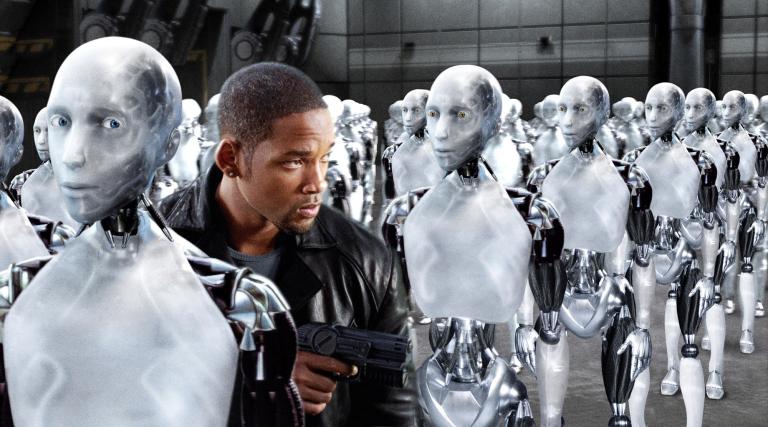 The movies have not been kind to Isaac Asimov. He may have been one of the most celebrated science fiction writers of the past half-century, but very few of his stories have attained that particular form of popular validation that comes from being adapted for the big screen — and this despite the fact that movie after movie has been based on the works of his contemporaries, including Ray Bradbury, Arthur C. Clarke and especially Philip K. Dick. On the rare occasion that a major studio has given one of Asimov’s stories the green light, the story in question has usually been massaged into something rather formulaic and at odds with his sensibilities. Five years ago, Bicentennial Man was turned into a regular Robin Williams schmaltzfest, albeit one with loads of visual effects. And now, I, Robot has been turned into a regular Will Smith action movie, also loaded with effects.
This, in and of itself, is not necessarily a bad thing. Asimov himself admitted he was a rather cerebral writer, and said his stories would need some heavy tweaking if they were ever to be translated into a visual medium like film. Most of the short stories in I, Robot, an anthology first published in 1950, were basically logic puzzles in which Asimov, having proposed that all robots would be programmed with three basic moral principles, teased out how machines of various degrees of sophistication might interpret and apply those principles. For those who like mental exercises, the stories are fun to read, but they are not all that dramatic, per se. In the 1970s, Harlan Ellison turned the book into a screenplay, which in turn was published some years later, with Asimov’s blessing, after the studio decided against producing it. Ellison threw in a few gratuitous action scenes, but the script, which Ellison modelled after Citizen Kane, was more of a character study that followed the life of robot psychologist Susan Calvin from youth to old age, much as the book did.
Back then, it was still possible to think that a studio might invest in a major science fiction film that was not all about gunplay and explosions. But these days, studio executives and audiences alike tend to assume that, with the effects, there must be a fair bit of fireworks, too — and so the current film, directed by former music-video auteur Alex Proyas (The Crow, Dark City), emphasizes shoot-outs and car chases.
The story, which the credits say was “suggested by” Asimov’s book and written by Jeff Vintar (Final Fantasy: The Spirits Within) and Akiva Goldsman (Batman & Robin, A Beautiful Mind), is set in Chicago in 2035, at a time when robots are so numerous there will soon be one of them for every five human beings. Will Smith — more serious than usual, but still strutting like he’s the hippest thing in the joint and cracking wise when the mood hits him — plays Del Spooner, a homicide detective who hates robots, though for no readily discernible reason. Perhaps it’s because they have taken menial jobs away from human beings, a possibility that echoes current concerns over immigrant and outsourced labor as much as it echoes concerns over the growth of technology. Perhaps it’s because he’s just an old-fashioned guy; he wears “vintage” shoes and his stereo is so retro it cannot be operated by voice, which is apparently the standard. Or perhaps it’s because he has had a bad case of survivor’s guilt ever since a robot saved his life when it could have saved a young girl instead.
Whatever the reason, Spooner doesn’t like robots very much, so when a scientist of his acquaintance named Alfred Lanning (James Cromwell) is found dead in the lobby of the U.S. Robotics office tower, he assumes the death was not a suicide but a murder perpetrated by a robot named Sonny (voice of Alan Tudyk). Everyone tells Spooner he’s crazy — especially Susan Calvin (Bridget Moynahan), a robot expert whose speech is so full of big words and whose mannerisms are so stiff and formal she seems almost mechanical herself. Every robot, she reminds Spooner, is programmed to protect humans at all costs, and to obey humans at all costs unless such obedience would harm human life. But it’s kind of hard for Spooner to shake his suspicions when various robots keep trying to kill him, from a home-demolition droid to a whole phalanx of metal men that ambush him while he drives through a conveniently empty tunnel.
This is where the action sequences come in, and while they look kind of snazzy, there is still something oddly lifeless about them. The car chase should be a kinetic thrill, but it’s basically just a cartoon, and it shows — with CGI robots leaping from CGI trucks onto a CGI car as it careens all over a CGI tunnel. When the sequence comes to an end and we see Spooner’s car grind to a halt, we are jolted by the fact that the car suddenly has a tangible, substantial physicality that it was notably lacking for the past several minutes. In this and other sequences, I, Robot has the cold, sleek, futuristic, blue-grey metallic sheen of Minority Report, but none of its grit. And when you consider how proud Will Smith was last year that the car chase in Bad Boys II did not make use of digital effects, the chase sequence here seems even more like a step backward for him.
Along the way, of course, there is much talk about the differences and similarities between humans and robots, particularly where that thing called “the soul” is concerned. In a speech captured on video before he died, Lanning suggests that random bits of programming will coalesce within the robots’ brains and eventually cause robots to have free will, creativity, and even dreams, just as humans do. And proof of this soul, the film suggests, will come when robots begin to follow their hearts and make illogical choices.
So the robots of this film exist in an odd grey area between mere technology — even if a robot did kill Lanning, says U.S. Robotics executive Lawrence Robertson (Bruce Greenwood), it would be nothing more than an industrial accident — and true personhood, with all the implicit human rights that that entails. Asimov’s stories explored this morally murky territory quite frankly — while some of the robots were written as sympathetic characters, his version of Susan Calvin did not hesitate for an instant to destroy machines that got out of line. The film’s Susan, however, is more protective of those robots who seem “unique.”
But the film defers those sorts of issues, for the most part. The key issue here is whether human safety is ultimately the highest good, and in this, the film completely turns Asimov’s vision on its head — and justifiably so, I think. Asimov’s book ends on an almost utopian note, as machines assume more and more control over the world and begin to manipulate things in a way that will prevent the human race from harming itself. For an atheist like Asimov, it seems benevolent machines were almost a substitute for God — potentially all-powerful beings who would not allow evil if they could help it, and who would use their supremely logical minds to save us from ourselves. (Such ideas were evidently in the air back then; compare this to the 1951 film The Day the Earth Stood Still, in which alien races achieve peace by handing control of their societies over to robots.)
I, Robot, however, suggests it would be a nightmare if humanity ever lost control of its fate like that — and along the way, the film makes a few nods to the current debates over privacy in the information age and civil rights within the so-called war on terror. But in order to make these points, the film has the machines abandon all sense of subtlety — even though you would think subtlety might be the more logical approach. And then there is Will Smith’s performance — his occasional sullenness suggests he is itching for another Ali-like chance to prove his acting chops even as he slums his way through another high-tech shoot-’em-up. The result is a film in which the story and the style seem to be at odds with one another — it’s not entirely sure what it wants to say, or what it wants to do. Like the robots in Asimov’s stories, it is caught between conflicting impulses, and it ends up paralyzed.
2 stars (out of 4)
–
Talk About It
Discussion starters
1. The robot Sonny tells Detective Spooner that we all have a purpose. What is purpose? Where does it come from? Is it something with which we are “programmed,” as it were? If so, who programs it? Is it possible to create purpose for ourselves? If so, how? What happens when different people’s understandings of purpose conflict with one another?
2. Detective Spooner tells Sonny, “You’ll have to find your way like the rest of us … that’s what it means to be free.” Do you agree? What does it mean to be free? What sorts of freedom do we have as “slaves” to God’s law? Are those who do not follow God “free,” and if so, in what sense? (Romans 7:25)
3. Detective Spooner asks Sonny if robots can write symphonies or paint masterpieces. What role does creativity play in our spiritual lives? Are people less soulful or spiritual if they are less creative? Is it possible for non-humans to be creative — for example, paintings by the gorilla Koko? What if machines can produce original art — is that creativity?
4. How important is it to be safe from harm? Is danger ever a good thing, and if so, how? Why do you think God allows us to live in a world that can harm us?
5. At one point, Sonny says you have to do what someone asks you to do, if you love them. Is this true? What if the person asks you to do something wrong? What if the person asks you to harm them? When should you disobey those who you love, and why?
The Family Corner
For parents to consider
I, Robot is rated PG-13 for “intense stylized action, and some brief partial nudity.” The film begins with a dead body, but most of the violence that follows affects robots, not humans; one person does get a gash in his arm, however, which reveals some robotic mechanisms beneath the skin. There are also two brief scenes in which individuals take showers — one person is obscured behind translucent glass, the other is seen only from behind, and at a distance. Also, Detective Spooner’s grandmother — the one person in his life with whom he has a normal relationship — is a churchgoer.
— A version of this review was first published at Christianity Today Movies.
Previous Post

July 13, 2004
Review: Paul the Apostle (dir. Roger Young, 2000)
Next Post
July 23, 2004 Review: The Bourne Supremacy (dir. Paul Greengrass, 2004)
Browse Our Archives
Select a Category Anglican Planet Articles BC Christian News BC Report Bible Movies Bible Review Blog Books & Culture Campus Times CBC Radio Christianity Today ChristianWeek Essays Faith Today Festival Cinemas Guide Film Journals Georgia Straight Interviews MB Herald National Catholic Register Salvationist Today's Christian Two Chairs Ubyssey Uncategorized Vancouver Courier Vancouver Sun
Select a Month August 2025 April 2025 January 2025 December 2024 November 2024 May 2024 February 2024 December 2023 May 2023 March 2023 November 2022 July 2022 June 2022 May 2022 April 2022 February 2022 January 2022 December 2021 November 2021 October 2021 September 2021 August 2021 July 2021 June 2021 April 2021 March 2021 February 2021 January 2021 December 2020 November 2020 October 2020 August 2020 July 2020 June 2020 May 2020 March 2020 February 2020 January 2020 December 2019 November 2019 September 2019 July 2019 May 2019 April 2019 March 2019 February 2019 January 2019 December 2018 November 2018 October 2018 September 2018 July 2018 June 2018 May 2018 April 2018 March 2018 February 2018 January 2018 December 2017 November 2017 October 2017 September 2017 August 2017 July 2017 June 2017 May 2017 April 2017 March 2017 February 2017 January 2017 December 2016 November 2016 October 2016 September 2016 August 2016 July 2016 June 2016 May 2016 April 2016 March 2016 February 2016 January 2016 December 2015 November 2015 October 2015 September 2015 August 2015 July 2015 June 2015 May 2015 April 2015 March 2015 February 2015 January 2015 December 2014 November 2014 October 2014 September 2014 August 2014 July 2014 June 2014 May 2014 April 2014 March 2014 February 2014 January 2014 December 2013 November 2013 October 2013 September 2013 August 2013 July 2013 June 2013 May 2013 April 2013 March 2013 February 2013 January 2013 December 2012 November 2012 October 2012 September 2012 August 2012 July 2012 June 2012 April 2012 January 2012 January 2011 December 2010 November 2010 October 2010 September 2010 August 2010 July 2010 June 2010 May 2010 April 2010 March 2010 February 2010 January 2010 December 2009 November 2009 October 2009 September 2009 August 2009 July 2009 June 2009 May 2009 April 2009 March 2009 February 2009 January 2009 December 2008 November 2008 October 2008 September 2008 August 2008 July 2008 June 2008 May 2008 April 2008 March 2008 February 2008 January 2008 December 2007 November 2007 October 2007 September 2007 August 2007 July 2007 June 2007 May 2007 April 2007 March 2007 February 2007 January 2007 December 2006 November 2006 October 2006 September 2006 August 2006 July 2006 June 2006 May 2006 April 2006 March 2006 February 2006 January 2006 December 2005 November 2005 October 2005 September 2005 August 2005 July 2005 June 2005 May 2005 April 2005 March 2005 January 2005 December 2004 November 2004 October 2004 September 2004 August 2004 July 2004 June 2004 May 2004 April 2004 March 2004 February 2004 January 2004 November 2003 October 2003 August 2003 July 2003 June 2003 May 2003 January 2003 December 2002 November 2002 August 2002 July 2002 June 2002 May 2002 March 2002 January 2002 December 2001 November 2001 September 2001 August 2001 July 2001 June 2001 April 2001 March 2001 February 2001 December 2000 November 2000 October 2000 September 2000 August 2000 July 2000 June 2000 May 2000 April 2000 March 2000 January 2000 October 1999 August 1999 May 1999 April 1999 February 1999 January 1999 December 1998 November 1998 October 1998 August 1998 July 1998 June 1998 April 1998 March 1998 January 1998 November 1997 September 1997 July 1997 June 1997 April 1997 March 1997 February 1997 January 1997 December 1996 October 1996 September 1996 June 1996 March 1996 February 1996 January 1996 April 1995 November 1994 September 1994 September 1991
Follow Us!
TAKE THE
Religious Wisdom Quiz
What is the main theme of the Parable of the Two Sons?
Select your answer to see how you score.
Obedience is proved by actions Honesty is best Repentance is easy Firstborns are favored
Related posts from FilmChat

Joseph of Egypt – the Chosen spin-off announces...

Exclusive: A clip from Angel Studios' The King...

Exclusive: Watch a clip from Angel Studios' Brave...

Exclusive: Watch a clip from Angel Studios' Homestead
TRENDING AT PATHEOS Religious Music & Entertainment

"Les Diabolique" and Transgression
Alongside something like Arrival, Vertigo, or Charade, Les Diaboliques is a...

"The Plague Dogs" and Mortality
So, flashback to the late 70s, early 80s. Walt Disney Studios is...

With the recent and highly successful release of Christopher Nolan’s epic film,...

"L'avventura" and Human Weakness
Today's piece is going to be a little different for a few...

I first want to apologize for not posting or writing anything. I'm...

I've engaged in the multi-year project of reading through the Church Fathers,...
view all Religious Music & Entertainment blogs
Ad-Free & Subscriber Log-In Subscription Support
- About Us
- 2026 Calendar
- Videos
- Podcasts
- Library of World Religions
- Faith In Media Tracker
- Advertise With Us
- Write for Us
- Privacy Policy
- Terms of Service
- Do Not Sell My Data
- Contact Us
- Radiant Digital
- Manage Newsletter Subscriptions
- Unsubscribe From Notifications
- Sitemap
Copyright 2008-2026, Patheos. All rights reserved.
Subscription Support Ad-Free & Subscriber Log-In
Follow Patheos