
BuddhistCatholicContemplativeEvangelicalGeneral ChristianHinduJewishLatter-day SaintMuslimNew VisionsProgressive Christian
Beliefs
- Buddhist
- Catholic
- Contemplative
- Evangelical
- General Christian
- Hindu
- Jewish
- Latter-day Saint
- More Voices
- Muslim
- New Visions
- Pagan
- Progressive Christian
Topics
- Religion News
- Food and Religion
- Sports and Religion
- Religious Art
- Religious Music and Entertainment
- Religious Events
- History and Religion
- Style and Religion
- Politics and Religion
- Women in Religion
- Recreation Outdoors and Religion
- Business Finance and Religion
- Careers Workplace and Religion
- Education and Religion
- Family Parenting and Religion
- Health Fitness and Religion
- Home and Religion
- Relationships and Religion
- Technology and Religion
- Travel and Religion
Columnists
- Buddhist Columnists
- Business Finance and Religion Columnists
- Careers Workplace and Religion Columnists
- Catholic Columnists
- Contemplative Columnists
- Education and Religion Columnists
- Evangelists Columnists
- Family Parenting and Religion Columnists
- General Christian Columnists
- Health Fitness and Religion Columnists
- Hindu Columnists
- History and Religion Columnists
- Home and Religion Columnists
- Jewish Columnists
- More Voices Columnists
- Latter Day Columnists
- Muslim Columnists
- New Visions Columnists
- Nonreligious Columnists
- Pagan Columnists
- Politics and Religion Columnists
- Progressive Columnists
- Recreation Outdoors and Religion Columnists
- Relationships and Religion Columnists
- Religion News Columnists
- Religious Art Columnists
- Religious Events Columnists
- Religious Music and Entertainment Columnists
- Sports and Religion Columnists
- Style and Religion Columnists
- Technology and Religion Columnists
- Travel and Religion Columnists
- Women in Religion Columnists
Resource Library
- 2026 Calendar
- Library of World Religions
- The 100 Most Holy Places on Earth
- Patheos Answers
- Podcasts
- Videos
- Faith Leaders Database
- Anglican Episcopalian
- Bahai
- Baptist
- Buddhism
- Christianity
- Confucianism
- Eastern Orthodoxy
- Hinduism
- Holiness and Pentecostal
- ISKCON
- Islam
- Judaism
- Lutheran
- Methodist
- The Church of Jesus Christ of Latter-day Saints
- New Age
- Paganism
- Presbytarian and Reformed
- Protestantism
- Religion Behind the Scenes
- Roman Catholic
- Scientology
- Shia Islam
- Sikhism
- Sufism
- Sunni Islam
- Taoism
- Zen
- See all religions
Research Tools
 Ad-Free & Subscriber Log-In Subscription Support
Ad-Free & Subscriber Log-In Subscription Support
Follow Patheos 

- Trending:
- Forgiveness
- |
- Marriage
- |
- Consciousness
- |
- Death Penalty
- |
- Election
- |
- Halloween

-
Articles
- Home
- Religious Music & Entertainment
- Review: The Stepford Wives (dir. Frank Oz, 2004)
Review: The Stepford Wives (dir. Frank Oz, 2004)
Last updated on: December 26, 2013 at 10:12 am by Peter T. Chattaway
Review: The Stepford Wives (dir. Frank Oz, 2004) 2013-12-26T10:12:02-08:00 Peter T. Chattaway
Patheos Explore the world's faith through different perspectives on religion and spirituality! Patheos has the views of the prevalent religions and spiritualities of the world.
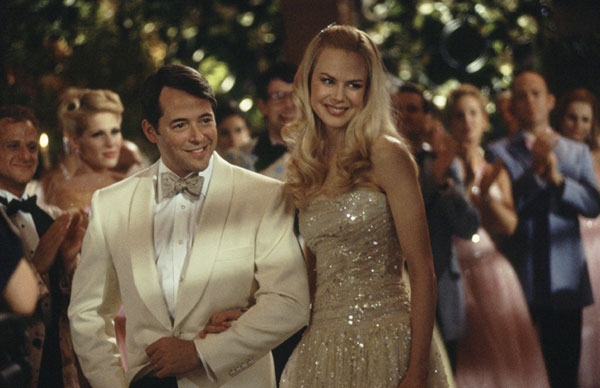 There has always been something a tad absurd about The Stepford Wives, even once you accept its science-fiction premise, but the new film pushes the concept way, way over the top. The original novella by thriller writer Ira Levin (Rosemary’s Baby, The Boys from Brazil) tapped into feminist fears that men would gladly exchange their flesh-and-blood wives for domesticated, hyper-sexual robots if they could, and the 1975 film directed by Bryan Forbes went on to emphasize the even deeper horror that takes place within the men themselves: it is one thing to be killed and replaced by a machine, but it is quite another to allow your own soul to be twisted against your conscience. These days, however, it seems the battle of the sexes is either so complicated or so passé — take your pick — that the only thing a mainstream film can do with the subject is to make fun of it all. So, in the hands of Frank Oz — the Muppeteer who gave life to Fozzie Bear, Miss Piggy and Yoda, and the director of the campy musical version of Little Shop of Horrors — The Stepford Wives has become an out-and-out comedy.
And as comedies go these days, it’s actually fairly funny, albeit in a light, superficial way which either hides or exposes the fact that the plot is a thick tangle of mutual contradictions and the social commentary is pretty much all over the place. No doubt the incoherence on display can be blamed on the reshoots that reportedly plagued this production, but one does have to wonder how much of the credit, if that’s the word, should go to screenwriter Paul Rudnick (In & Out), whose work in the past has shown a similar preference for zingers over narrative logic.
The first sign that the new film has pretty much nothing to do with the real world comes in the opening scene, in which Joanna Eberhart (Nicole Kidman), now no longer a freelance photographer but the ultra-successful president of a top-rated television network, promotes a new batch of reality-TV shows that all hinge on female empowerment. (In real life, of course, shows that explicitly pursue the gender angle — like Who Wants to Marry a Multimillionaire? and The Swan — have taken the exact opposite tack and perpetuated the very stereotypes that feminists fought thirty years ago.) Joanna’s plans are brought to a crashing halt when a man who appeared on one of her shows turns up, brandishing a gun and crying, “Let’s kill all the women!” Fearing lawsuits, the network cancels all of Joanna’s shows and lets her go — much to her shock.
Looking for a change of pace, Joanna and her doting husband Walter (Matthew Broderick) move with their family to Connecticut, and to the gated community of Stepford. At first, Joanna is weirded out by the buxom, blissed-out women in the floral-print dresses, but then she tries to fit in, baking cupcakes and knitting and performing various other tasks while Walter spends his time at the Men’s Association, a club whose leader, Mike Wellington (Christopher Walken), offers Walter the chance to give his wife a mechanical upgrade. Earlier versions of this story kept Walter’s activities at the club an ominous secret, and one that left him shaking; but in this film, he watches a man withdraw money from a woman’s mouth as though she were an ATM, and his eyes go wide with appreciative wonder. Later, when his son is playing and idly remarks that robots are cool, Walter grins with anticipation. Ha, ha, ha.
Joanna does not entirely conform to the Stepford way of life, thanks to two other relatively new arrivals in town — Bobbi Markowitz (Bette Midler), a sassy Jewish author, and Roger Bannister (Roger Bart), a flamboyantly gay man — who bring a bit of spice to her life and keep it unpredictable. But one by one, Joanna’s friends are Stepford-ized. Roger, who says there has been trouble in his relationship with his partner Jerry (David Marshall Grant) ever since the latter became a “gay Republican” (which Roger likens to being “gay with bad hair”), even becomes that rarest of specimens, a conservative politician who is both proudly gay and religious. And ultimately, Joanna too comes face-to-face with what her hubby has planned for her.
This is the point where earlier versions of the story pretty much came to their eerie end. But the new film gets to this point awfully quickly, and it keeps right on moving, into a new act that takes all the assumptions and premises of the earlier scenes and earlier versions of this story and blows them all right out of the water. You think the story is all about the subjugation of women by men? Think again. And as much as the new denouement may contradict the premises set down by the rest of the film, it does hark back, thematically, to those opening scenes at the network, where the only executives we see all happen to be female. The world of plastic smiles and simulated perfection, the film seems to be saying, may ultimately be something women impose on each other.
The film does touch on other current trends, such as the quest for spiritual stability through pharmaceuticals and medical treatments, all of which may tend to reduce human beings to the equivalent of machines that need fixing, as well as the growing interest in robotic pets and automated devices that talk back to us, which raises interesting questions about the kinds of attachments that are developing between humans and machines — and the effect these attachments may have on our human relationships. But it touches on these things very, very lightly. In the end, the film is much more interested in lampooning traditional gender roles, and the debates around them, than in worrying about such things.
2.5 stars (out of 4)
–
Talk About It
Discussion starters
1. Is there such a thing as “perfection”? If so, define it. If you could make yourself or anyone you know perfect, would you? Are all of our “flaws” really flaws, or do you think the real flaw is sometimes in our standards of “perfection”?
2. Joanna makes a distinction between saying you love someone (which the robots can do) and meaning it (which the robots presumably cannot do). How is this distinction important? Do you always mean it when you tell someone you love them? Should you ever tell someone you love them even if you don’t feel it? What is love? Is it a feeling, or something else? (See 1 Cor. 13, John 15:13, Romans 5:8.)
3. Do you think the film encourages stereotypes (of men, women, gays, Republicans, Jews, Christians, etc.), or does it challenge them? Both? What role do you think men and women have in society today? What role do you think they should have? How have things changed since the original film came out in 1975?
The Family Corner
For parents to consider
The Stepford Wives is rated PG-13 for “sexual content, thematic material and language.” The characters often talk about sex and on one occasion they overhear a couple having sex. Some of the humor also revolves around the physical endowment of the robot wives. One of the main characters is a gay man who keeps pictures of Lord of the Rings co-stars Orlando Bloom and Viggo Mortensen; he later runs for political office, touting the “power of prayer” and thanking his gay “partner in life, and partner in the Lord.” Except for the opening scene in which a man tries to assassinate Joanna, there is little violence, and most of it is directed against the robots, one of which loses its head, while another sticks its hand in a fire without noticing.
— A version of this review was first published at Christianity Today Movies.
Next Post

July 1, 2004 The Revenger's Tragedy / Vengeance is ours, saith Hollywood.
Browse Our Archives
Select a Category Anglican Planet Articles BC Christian News BC Report Bible Movies Bible Review Blog Books & Culture Campus Times CBC Radio Christianity Today ChristianWeek Essays Faith Today Festival Cinemas Guide Film Journals Georgia Straight Interviews MB Herald National Catholic Register Salvationist Today's Christian Two Chairs Ubyssey Uncategorized Vancouver Courier Vancouver Sun
Select a Month August 2025 April 2025 January 2025 December 2024 November 2024 May 2024 February 2024 December 2023 May 2023 March 2023 November 2022 July 2022 June 2022 May 2022 April 2022 February 2022 January 2022 December 2021 November 2021 October 2021 September 2021 August 2021 July 2021 June 2021 April 2021 March 2021 February 2021 January 2021 December 2020 November 2020 October 2020 August 2020 July 2020 June 2020 May 2020 March 2020 February 2020 January 2020 December 2019 November 2019 September 2019 July 2019 May 2019 April 2019 March 2019 February 2019 January 2019 December 2018 November 2018 October 2018 September 2018 July 2018 June 2018 May 2018 April 2018 March 2018 February 2018 January 2018 December 2017 November 2017 October 2017 September 2017 August 2017 July 2017 June 2017 May 2017 April 2017 March 2017 February 2017 January 2017 December 2016 November 2016 October 2016 September 2016 August 2016 July 2016 June 2016 May 2016 April 2016 March 2016 February 2016 January 2016 December 2015 November 2015 October 2015 September 2015 August 2015 July 2015 June 2015 May 2015 April 2015 March 2015 February 2015 January 2015 December 2014 November 2014 October 2014 September 2014 August 2014 July 2014 June 2014 May 2014 April 2014 March 2014 February 2014 January 2014 December 2013 November 2013 October 2013 September 2013 August 2013 July 2013 June 2013 May 2013 April 2013 March 2013 February 2013 January 2013 December 2012 November 2012 October 2012 September 2012 August 2012 July 2012 June 2012 April 2012 January 2012 January 2011 December 2010 November 2010 October 2010 September 2010 August 2010 July 2010 June 2010 May 2010 April 2010 March 2010 February 2010 January 2010 December 2009 November 2009 October 2009 September 2009 August 2009 July 2009 June 2009 May 2009 April 2009 March 2009 February 2009 January 2009 December 2008 November 2008 October 2008 September 2008 August 2008 July 2008 June 2008 May 2008 April 2008 March 2008 February 2008 January 2008 December 2007 November 2007 October 2007 September 2007 August 2007 July 2007 June 2007 May 2007 April 2007 March 2007 February 2007 January 2007 December 2006 November 2006 October 2006 September 2006 August 2006 July 2006 June 2006 May 2006 April 2006 March 2006 February 2006 January 2006 December 2005 November 2005 October 2005 September 2005 August 2005 July 2005 June 2005 May 2005 April 2005 March 2005 January 2005 December 2004 November 2004 October 2004 September 2004 August 2004 July 2004 June 2004 May 2004 April 2004 March 2004 February 2004 January 2004 November 2003 October 2003 August 2003 July 2003 June 2003 May 2003 January 2003 December 2002 November 2002 August 2002 July 2002 June 2002 May 2002 March 2002 January 2002 December 2001 November 2001 September 2001 August 2001 July 2001 June 2001 April 2001 March 2001 February 2001 December 2000 November 2000 October 2000 September 2000 August 2000 July 2000 June 2000 May 2000 April 2000 March 2000 January 2000 October 1999 August 1999 May 1999 April 1999 February 1999 January 1999 December 1998 November 1998 October 1998 August 1998 July 1998 June 1998 April 1998 March 1998 January 1998 November 1997 September 1997 July 1997 June 1997 April 1997 March 1997 February 1997 January 1997 December 1996 October 1996 September 1996 June 1996 March 1996 February 1996 January 1996 April 1995 November 1994 September 1994 September 1991
Follow Us!
TAKE THE
Religious Wisdom Quiz
What is the Christian teaching about truth-telling?
Select your answer to see how you score.
Say nothing Speak the truth Flatter often Lie if necessary
Related posts from FilmChat

Review: Stay (dir. Marc Forster, 2005)

Moses at the Movies / When we trace...

George Miller's version of Contact would have been...

Review: Wanted (dir. Timur Bekmambetov, 2008)
TRENDING AT PATHEOS Religious Music & Entertainment

"Les Diabolique" and Transgression
Alongside something like Arrival, Vertigo, or Charade, Les Diaboliques is a...

"The Plague Dogs" and Mortality
So, flashback to the late 70s, early 80s. Walt Disney Studios is...

With the recent and highly successful release of Christopher Nolan’s epic film,...

"L'avventura" and Human Weakness
Today's piece is going to be a little different for a few...

I first want to apologize for not posting or writing anything. I'm...

I've engaged in the multi-year project of reading through the Church Fathers,...
view all Religious Music & Entertainment blogs
Ad-Free & Subscriber Log-In Subscription Support
- About Us
- 2026 Calendar
- Videos
- Podcasts
- Library of World Religions
- Faith In Media Tracker
- Advertise With Us
- Write for Us
- Privacy Policy
- Terms of Service
- Do Not Sell My Data
- Contact Us
- Radiant Digital
- Manage Newsletter Subscriptions
- Unsubscribe From Notifications
- Sitemap
Copyright 2008-2026, Patheos. All rights reserved.
Subscription Support Ad-Free & Subscriber Log-In
Follow Patheos