
BuddhistCatholicContemplativeEvangelicalGeneral ChristianHinduJewishLatter-day SaintMuslimNew VisionsProgressive Christian
Beliefs
- Buddhist
- Catholic
- Contemplative
- Evangelical
- General Christian
- Hindu
- Jewish
- Latter-day Saint
- More Voices
- Muslim
- New Visions
- Pagan
- Progressive Christian
Topics
- Religion News
- Food and Religion
- Sports and Religion
- Religious Art
- Religious Music and Entertainment
- Religious Events
- History and Religion
- Style and Religion
- Politics and Religion
- Women in Religion
- Recreation Outdoors and Religion
- Business Finance and Religion
- Careers Workplace and Religion
- Education and Religion
- Family Parenting and Religion
- Health Fitness and Religion
- Home and Religion
- Relationships and Religion
- Technology and Religion
- Travel and Religion
Columnists
- Buddhist Columnists
- Business Finance and Religion Columnists
- Careers Workplace and Religion Columnists
- Catholic Columnists
- Contemplative Columnists
- Education and Religion Columnists
- Evangelists Columnists
- Family Parenting and Religion Columnists
- General Christian Columnists
- Health Fitness and Religion Columnists
- Hindu Columnists
- History and Religion Columnists
- Home and Religion Columnists
- Jewish Columnists
- More Voices Columnists
- Latter Day Columnists
- Muslim Columnists
- New Visions Columnists
- Nonreligious Columnists
- Pagan Columnists
- Politics and Religion Columnists
- Progressive Columnists
- Recreation Outdoors and Religion Columnists
- Relationships and Religion Columnists
- Religion News Columnists
- Religious Art Columnists
- Religious Events Columnists
- Religious Music and Entertainment Columnists
- Sports and Religion Columnists
- Style and Religion Columnists
- Technology and Religion Columnists
- Travel and Religion Columnists
- Women in Religion Columnists
Resource Library
- 2026 Calendar
- Library of World Religions
- The 100 Most Holy Places on Earth
- Patheos Answers
- Podcasts
- Videos
- Faith Leaders Database
- Anglican Episcopalian
- Bahai
- Baptist
- Buddhism
- Christianity
- Confucianism
- Eastern Orthodoxy
- Hinduism
- Holiness and Pentecostal
- ISKCON
- Islam
- Judaism
- Lutheran
- Methodist
- The Church of Jesus Christ of Latter-day Saints
- New Age
- Paganism
- Presbytarian and Reformed
- Protestantism
- Religion Behind the Scenes
- Roman Catholic
- Scientology
- Shia Islam
- Sikhism
- Sufism
- Sunni Islam
- Taoism
- Zen
- See all religions
Research Tools
 Ad-Free & Subscriber Log-In Subscription Support
Ad-Free & Subscriber Log-In Subscription Support
Follow Patheos 

- Trending:
- Forgiveness
- |
- Marriage
- |
- Consciousness
- |
- Death Penalty
- |
- Election
- |
- Halloween

-
Articles
- Home
- Religious Music & Entertainment
- Review: Harry Potter and the Prisoner of Azkaban (dir. Alfonso Cuarón, 2004)
Review: Harry Potter and the Prisoner of Azkaban (dir. Alfonso Cuarón, 2004)
Last updated on: November 21, 2015 at 11:09 pm by Peter T. Chattaway
Review: Harry Potter and the Prisoner of Azkaban (dir. Alfonso Cuarón, 2004) 2015-11-21T23:09:45-08:00 Peter T. Chattaway
Patheos Explore the world's faith through different perspectives on religion and spirituality! Patheos has the views of the prevalent religions and spiritualities of the world.
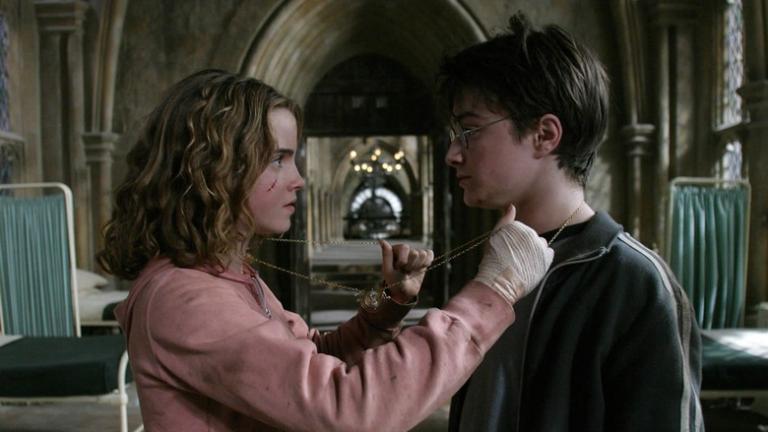 The children, they grow so fast. Harry Potter and the Prisoner of Azkaban is the tale in which J.K. Rowling’s young orphan wizard becomes a teenager, and the first thing that strikes you about the new movie is how much more mature its protagonists have become, at least on the outside; the boys’ faces are leaner, longer, a bit more rugged, definitely free of baby fat, while it seems Hermione Granger (played by Emma Watson), the one girl of any import, is about to blossom into an adolescent beauty.
This physical maturity is matched by a darker thematic and artistic sensibility. Unlike the first two films, which were directed in a typically clunky, treacly fashion by Chris Columbus, The Prisoner of Azkaban is the work of Alfonso Cuarón, a Mexican whose eclectic portfolio covers everything from the cute-as-a-button kids’ flick A Little Princess to the sexually provocative Y Tu Mama Tambien. Cuarón brings darker colors and bolder, more imaginative visuals to this entry in the series, and for once, it can be said that a Harry Potter film has been made with something resembling a genuine artistic vision.
And just in the nick of time, too. The Prisoner of Azkaban is perhaps the most emotionally complex of the Harry Potter stories to date; it is here that Harry (Daniel Radcliffe) first encounters the Dementors, fearsome creatures which can suck the joy out of anyone who crosses their path, and it is here that he wrestles with his darkest, most murderous impulses. As the story begins, Harry is staying with his mean, muggle (i.e. non-magical) relatives, Uncle Vernon (Richard Griffiths) and Aunt Petunia (Fiona Shaw), and they are visited by the even meaner Aunt Marge (Pam Ferris), whose insulting remarks about Harry’s parents prompt him to retaliate by making her puff up and float away like a balloon. Knowing that his unauthorized use of magic during the holidays ought to get him expelled from the Hogwarts School of Witchcraft and Wizardry, Harry runs away from home and is picked up by a magical double-decker bus that drops him off in the wizarding district. There, he is brought to the Minister of Magic, Cornelius Fudge (Robert Hardy), who surprisingly does not punish Harry but, instead, gives him a place to stay until school begins.
It turns out the authorities are concerned for everyone’s safety — but especially Harry’s — because a criminal named Sirius Black (Gary Oldman), who was sentenced to the maximum-security prison Azkaban 12 years ago for betraying Harry’s parents to the Dark Lord Voldemort, has escaped and is thought to be heading for Hogwarts. The Dementors, who ordinarily guard Azkaban, now patrol the school grounds in seach of Sirius — and while Harry expresses a vengeful desire to kill Sirius himself, he is, if anything, even more terrified of the Dementors. Enter Professor Lupin (David Thewlis), the new Defense Against the Dark Arts teacher, who teaches Harry how to face his fears and resist the Dementors. Lupin, it turns out, is another former classmate of Harry’s father, and in their moments together, Harry begins to form his first meaningful friendship with a grown-up. (The burly giant Hagrid may technically be an adult, but in many ways he’s still a kid at heart.)
The Harry Potter novels have caused a great deal of concern for Christian parents and others who wonder if these books might get children interested in the occult, and of all the stories Rowling has written to date, The Prisoner of Azkaban may supply the strongest evidence for both sides of that debate. Many Christians — and I am one of them — defend the books on the basis that the “magic” contained within them serves the exact same purpose as the improbably high-tech devices that allow sci-fi characters to fly through space, shape-shift, teleport from one spot to another, and so on; as Charles Colson has put it, the magic in these books is “mechanical,” not “occultic.” Within Rowling’s sub-creation (to borrow a term from J.R.R. Tolkien), Harry Potter is not a regular child who dabbles in supernatural powers forbidden to him by God, but rather, he is a child born with an unusual set of natural abilities, and like the mutants who study under Professor Xavier in the X-Men movies, he attends a special school to learn how to master his skills and use them wisely. And nothing has convinced me of the link between Harry Potter’s “magic” and the high-tech wizardry of science fiction more than this story’s introduction of time travel — yes, time travel. Somehow I doubt that’s the sort of thing Wiccans practice in real life, and I suspect most children are smart enough to recognize that that sort of thing is pure make-believe.
But Rowling introduces another concept in The Prisoner of Azkaban that might not be so easy to explain away. In this story, Harry and his friends attend a course in divination taught by the loopy Professor Trelawney (Emma Thompson); exercises include gazing into crystal balls, reading palms, and studying tea leaves. For the most part, Trelawney and her lessons are held up to ridicule — Hermione, the most intellectual of Harry’s friends, dismisses divination as a “woolly discipline.” But the mere existence of this class at Hogwarts, combined with the fact that one of Trelawney’s prophecies is uttered under eerie circumstances and does come true, may be enough to convince some Christians that the Harry Potter stories are up to no good. Spoilers prohibit me from saying more about this, but suffice it to say that Christian interpretations of the Trelawney scenes range from those who think they provide the clearest evidence of demonic activity in Rowling’s world, despite the fact that Rowling has never made demons a part of her sub-creation (see Richard Abane’s Harry Potter and the Bible), to those who think they expose the folly of superstitious beliefs (see Connie Neal’s The Gospel According to Harry Potter).
The deeper problem with these books is their questionable, and highly subjective, morality. The Prisoner of Azkaban does contain at least one noteworthy object lesson in the difference between humility and arrogance, when Hagrid (Robbie Coltrane), the newly appointed professor in charge of magical beasts, introduces his students to a hippogriff (a creature that is half-horse, half-eagle) and tells them they must respect its “pride” if they want to go for a ride on its back; Harry approaches the hippogriff humbly, his neck bowed, and is rewarded with a fantastic flight over the school grounds, while Draco Malfoy (Tom Felton), the school bully, swaggers right up to the creature and is promptly attacked. But Harry’s virtues are lacking in other areas. He exhibits a flagrant disregard for the rules, even when they have been put there for his own safety, and nearly always seems to get away with it; it is also particularly disturbing to see the “heroes” of this story, including Harry himself, so eager to kill the man who betrayed Harry’s parents. Harry manages to exchange his anger for mercy at the last possible moment, but his change of heart seems more like a passing whim than the result of a deeper transformation in the way he thinks and feels.
That change may yet come. The Prisoner of Azkaban is the third in a projected seven-part series, and it is too early to say where this character’s arc will take him in the end. What we can say at this point is that Cuarón has produced the most terrifying and darkly humorous movie adaptation of Rowling’s stories to date — his use of the Whomping Willow to convey the passing of the seasons is especially amusing — and he has given it a visual flair that was sorely missing in the previous installments. The Dementors are especially creepy — not quite as frightening as the Nazgul at their worst in Peter Jackson’s Lord of the Rings films, but more consistently scary than Jackson’s creations, which occasionally seemed like the actors in costumes that they were. Most remarkably, despite the fact that he was adapting the longest of the first three books, Cuarón has turned out the shortest and most briskly paced film of the lot. If anything, the film may be too brisk — it leaves out a fair bit of material, particularly regarding Harry’s father and his friends, that could have clarified the connections between certain characters and objects. But overall, this film is perhaps the most entertaining opportunity that children and adults have had yet to practice their gifts of discernment in all things Potter.
3 stars (out of 4)
–
Talk About It
Discussion starters
1. What do you think of the “magic” in these stories? How is it similar to, or different from, the sort of “magic” that some people try to practice in the real world? How is it similar to, or different from, technology? Why do you think people like to imagine doing impossible things? What sorts of powers do you wish you had?
2. Are Harry Potter and his friends receiving the sort of moral instruction they need to guide them as they apply their lessons in “magic”? What sort of classes would you like to see Harry and his friends take, which (so far) have not been seen at Hogwarts?
3. If you could go back in time, would you? To when? What would you do? What implications do time travel and prophecies like Trelawney’s have for free will? Does knowing the future limit Harry’s choices, or expand them?
4. Does the movie criticize or support superstitious beliefs? Is it possible to mock an activity and encourage it at the same time? Does the movie itself do this?
5. Who do you think would make the best father figure for Harry? Why? Professor Lupin tells Harry that his father, James Potter, broke a lot of rules, too. What kind of father do you think James would have been to Harry? Do you think anyone ever disciplines Harry properly or effectively? Who does Harry respect in this story? Why does he respect them?
The Family Corner
For parents to consider
The film is rated PG for “frightening moments, creature violence and mild language.” The Harry Potter stories have been the focus of debate because they are about children who are born with “magical” powers — some of which, such as the ability to ride broomsticks, are clearly just make-believe, though others, such as the ability to predict the future, may resemble forms of divination that the Bible forbids in real life. The threat of violence also looms large over these stories — Harry’s parents were killed when he was one year old, and both he and a couple of adults express a desire to get revenge against the person who betrayed his parents. In addition, the Dementors are very creepy creatures that try to suck out the souls of a couple characters. The characters also occasionally use words like “bloody” and “damn.”
— A version of this review was first published at Christianity Today Movies.
harry potter and the prisoner of azkaban
Previous Post

May 14, 2004
Review: Troy (dir. Wolfgag Petersen, 2004)
Next Post
June 11, 2004 Review: The Stepford Wives (dir. Frank Oz, 2004)
Browse Our Archives
Select a Category Anglican Planet Articles BC Christian News BC Report Bible Movies Bible Review Blog Books & Culture Campus Times CBC Radio Christianity Today ChristianWeek Essays Faith Today Festival Cinemas Guide Film Journals Georgia Straight Interviews MB Herald National Catholic Register Salvationist Today's Christian Two Chairs Ubyssey Uncategorized Vancouver Courier Vancouver Sun
Select a Month August 2025 April 2025 January 2025 December 2024 November 2024 May 2024 February 2024 December 2023 May 2023 March 2023 November 2022 July 2022 June 2022 May 2022 April 2022 February 2022 January 2022 December 2021 November 2021 October 2021 September 2021 August 2021 July 2021 June 2021 April 2021 March 2021 February 2021 January 2021 December 2020 November 2020 October 2020 August 2020 July 2020 June 2020 May 2020 March 2020 February 2020 January 2020 December 2019 November 2019 September 2019 July 2019 May 2019 April 2019 March 2019 February 2019 January 2019 December 2018 November 2018 October 2018 September 2018 July 2018 June 2018 May 2018 April 2018 March 2018 February 2018 January 2018 December 2017 November 2017 October 2017 September 2017 August 2017 July 2017 June 2017 May 2017 April 2017 March 2017 February 2017 January 2017 December 2016 November 2016 October 2016 September 2016 August 2016 July 2016 June 2016 May 2016 April 2016 March 2016 February 2016 January 2016 December 2015 November 2015 October 2015 September 2015 August 2015 July 2015 June 2015 May 2015 April 2015 March 2015 February 2015 January 2015 December 2014 November 2014 October 2014 September 2014 August 2014 July 2014 June 2014 May 2014 April 2014 March 2014 February 2014 January 2014 December 2013 November 2013 October 2013 September 2013 August 2013 July 2013 June 2013 May 2013 April 2013 March 2013 February 2013 January 2013 December 2012 November 2012 October 2012 September 2012 August 2012 July 2012 June 2012 April 2012 January 2012 January 2011 December 2010 November 2010 October 2010 September 2010 August 2010 July 2010 June 2010 May 2010 April 2010 March 2010 February 2010 January 2010 December 2009 November 2009 October 2009 September 2009 August 2009 July 2009 June 2009 May 2009 April 2009 March 2009 February 2009 January 2009 December 2008 November 2008 October 2008 September 2008 August 2008 July 2008 June 2008 May 2008 April 2008 March 2008 February 2008 January 2008 December 2007 November 2007 October 2007 September 2007 August 2007 July 2007 June 2007 May 2007 April 2007 March 2007 February 2007 January 2007 December 2006 November 2006 October 2006 September 2006 August 2006 July 2006 June 2006 May 2006 April 2006 March 2006 February 2006 January 2006 December 2005 November 2005 October 2005 September 2005 August 2005 July 2005 June 2005 May 2005 April 2005 March 2005 January 2005 December 2004 November 2004 October 2004 September 2004 August 2004 July 2004 June 2004 May 2004 April 2004 March 2004 February 2004 January 2004 November 2003 October 2003 August 2003 July 2003 June 2003 May 2003 January 2003 December 2002 November 2002 August 2002 July 2002 June 2002 May 2002 March 2002 January 2002 December 2001 November 2001 September 2001 August 2001 July 2001 June 2001 April 2001 March 2001 February 2001 December 2000 November 2000 October 2000 September 2000 August 2000 July 2000 June 2000 May 2000 April 2000 March 2000 January 2000 October 1999 August 1999 May 1999 April 1999 February 1999 January 1999 December 1998 November 1998 October 1998 August 1998 July 1998 June 1998 April 1998 March 1998 January 1998 November 1997 September 1997 July 1997 June 1997 April 1997 March 1997 February 1997 January 1997 December 1996 October 1996 September 1996 June 1996 March 1996 February 1996 January 1996 April 1995 November 1994 September 1994 September 1991
Follow Us!
TAKE THE
Religious Wisdom Quiz
What does the name "Isaac" mean?
Select your answer to see how you score.
He prays He rules He fights He laughs
Related posts from FilmChat
Review: Fantastic Beasts: The Secrets of Dumbledore (dir....
Box office: Beauty and the Beast has the...

Box office: Fantastic Beasts underperforms Harry Potter in...

Review: Stay (dir. Marc Forster, 2005)
TRENDING AT PATHEOS Religious Music & Entertainment

"Les Diabolique" and Transgression
Alongside something like Arrival, Vertigo, or Charade, Les Diaboliques is a...

"The Plague Dogs" and Mortality
So, flashback to the late 70s, early 80s. Walt Disney Studios is...

With the recent and highly successful release of Christopher Nolan’s epic film,...

"L'avventura" and Human Weakness
Today's piece is going to be a little different for a few...

I first want to apologize for not posting or writing anything. I'm...

I've engaged in the multi-year project of reading through the Church Fathers,...
view all Religious Music & Entertainment blogs
Ad-Free & Subscriber Log-In Subscription Support
- About Us
- 2026 Calendar
- Videos
- Podcasts
- Library of World Religions
- Faith In Media Tracker
- Advertise With Us
- Write for Us
- Privacy Policy
- Terms of Service
- Do Not Sell My Data
- Contact Us
- Radiant Digital
- Manage Newsletter Subscriptions
- Unsubscribe From Notifications
- Sitemap
Copyright 2008-2026, Patheos. All rights reserved.
Subscription Support Ad-Free & Subscriber Log-In
Follow Patheos