
BuddhistCatholicContemplativeEvangelicalGeneral ChristianHinduJewishLatter-day SaintMuslimNew VisionsProgressive Christian
Beliefs
- Buddhist
- Catholic
- Contemplative
- Evangelical
- General Christian
- Hindu
- Jewish
- Latter-day Saint
- More Voices
- Muslim
- New Visions
- Pagan
- Progressive Christian
Topics
- Religion News
- Food and Religion
- Sports and Religion
- Religious Art
- Religious Music and Entertainment
- Religious Events
- History and Religion
- Style and Religion
- Politics and Religion
- Women in Religion
- Recreation Outdoors and Religion
- Business Finance and Religion
- Careers Workplace and Religion
- Education and Religion
- Family Parenting and Religion
- Health Fitness and Religion
- Home and Religion
- Relationships and Religion
- Technology and Religion
- Travel and Religion
Columnists
- Buddhist Columnists
- Business Finance and Religion Columnists
- Careers Workplace and Religion Columnists
- Catholic Columnists
- Contemplative Columnists
- Education and Religion Columnists
- Evangelists Columnists
- Family Parenting and Religion Columnists
- General Christian Columnists
- Health Fitness and Religion Columnists
- Hindu Columnists
- History and Religion Columnists
- Home and Religion Columnists
- Jewish Columnists
- More Voices Columnists
- Latter Day Columnists
- Muslim Columnists
- New Visions Columnists
- Nonreligious Columnists
- Pagan Columnists
- Politics and Religion Columnists
- Progressive Columnists
- Recreation Outdoors and Religion Columnists
- Relationships and Religion Columnists
- Religion News Columnists
- Religious Art Columnists
- Religious Events Columnists
- Religious Music and Entertainment Columnists
- Sports and Religion Columnists
- Style and Religion Columnists
- Technology and Religion Columnists
- Travel and Religion Columnists
- Women in Religion Columnists
Resource Library
- 2026 Calendar
- Library of World Religions
- The 100 Most Holy Places on Earth
- Patheos Answers
- Podcasts
- Videos
- Faith Leaders Database
- Anglican Episcopalian
- Bahai
- Baptist
- Buddhism
- Christianity
- Confucianism
- Eastern Orthodoxy
- Hinduism
- Holiness and Pentecostal
- ISKCON
- Islam
- Judaism
- Lutheran
- Methodist
- The Church of Jesus Christ of Latter-day Saints
- New Age
- Paganism
- Presbytarian and Reformed
- Protestantism
- Religion Behind the Scenes
- Roman Catholic
- Scientology
- Shia Islam
- Sikhism
- Sufism
- Sunni Islam
- Taoism
- Zen
- See all religions
Research Tools
 Ad-Free & Subscriber Log-In Subscription Support
Ad-Free & Subscriber Log-In Subscription Support
Follow Patheos 

- Trending:
- Forgiveness
- |
- Marriage
- |
- Consciousness
- |
- Death Penalty
- |
- Election
- |
- Halloween

-
Articles
- Home
- Religious Music & Entertainment
- Review: The Passion of the Christ (dir. Mel Gibson, 2004)
Review: The Passion of the Christ (dir. Mel Gibson, 2004)
Last updated on: February 1, 2014 at 12:35 pm by Peter T. Chattaway
Review: The Passion of the Christ (dir. Mel Gibson, 2004) 2014-02-01T12:35:02-08:00 Peter T. Chattaway
Patheos Explore the world's faith through different perspectives on religion and spirituality! Patheos has the views of the prevalent religions and spiritualities of the world.
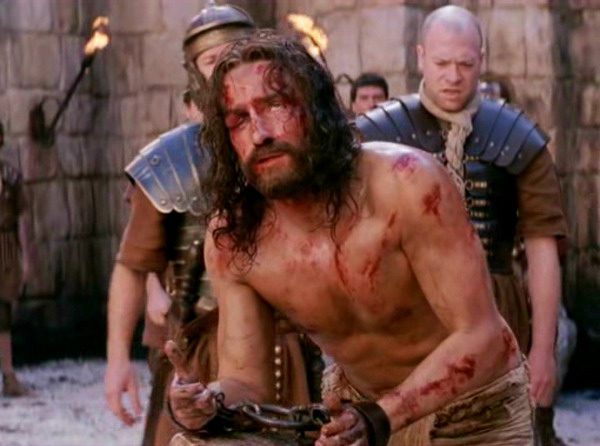 The Passion of The Christ may be the most artistically and commercially ambitious feature film about Jesus to come out of Hollywood since the 1960s. It is certainly the most devout, though at first it seems odd that Mel Gibson should be the one to produce, write, and direct a film about the Prince of Peace.
From the buddy-cop Lethal Weapon franchise to revisionist epics like The Patriot, Gibson has specialized in playing violent action heroes who take bloody revenge for the deaths of their wives, children, and girlfriends. In Braveheart, the 1995 film for which he won the Best Director Oscar, Gibson kept the fatal wounds inflicted on William Wallace and his wife just out of frame, to spare his audience the full brutality suffered by these heroes, but he reveled in the gory details with which Wallace executed his personal enemies.
In some ways, The Passion seems like a repudiation of much of his career to date: last year, Gibson, a traditionalist Catholic whose faith has surfaced in recent films like Signs and We Were Soldiers, told Fox News’s Bill O’Reilly he wanted to promote faith, hope, love, and especially forgiveness through this film. But The Passion also dwells, at considerable length, on the physical pain inflicted on Jesus. Has Gibson found a way to baptize, as it were, the sadistic or masochistic impulses of his other films? Is it possible he is indulging himself under the cover of religious piety?
At times it does seem so. Much has been made of The Passion’s adherence to Scripture, but in the rough cut shown to pastors and ministry leaders a month before the film’s release, it was clear that Gibson often goes beyond the text. Jesus, played with inspiring sincerity by James Caviezel (Frequency, The Thin Red Line), is not even out of Gethsemane yet when the Temple guards knock him about and hang him over a bridge by his chains, swelling shut his right eye. During scenes like this, you cannot help wondering whether Gibson, as the one who conceived and directed all this simulated torture, is more complicit in the horrors on display than he would like to admit.
Yet Gibson does exercise restraint at crucial moments. The flogging of Jesus may go on and on — and Jesus himself seems to encourage it when he pulls himself up and stands defiantly erect after the first round of beatings — but as several characters begin to find the violence so unbearable that they have to look away, so does Gibson: His camera follows Jesus’ mother Mary (Maia Morgenstern) as she retreats to another room, where she tries to cope with the cries of pain that she can still hear.
The film’s violence has been defended as a sign of its historical realism and biblical accuracy, but one of the more striking and impressive things about The Passion is just how much artistic license it takes with its source material. Gibson erroneously identifies Mary Magdalene (The Matrix Reloaded’s Monica Bellucci) with the woman caught in adultery, and his depiction of the Crucifixion owes more to medieval art than modern scholarship. Taking their cue from historians and archaeologists, nearly every film and miniseries produced since the 1970s — including Campus Crusade’s Jesus film and The Visual Bible’s recent Gospel of John — has depicted Jesus carrying only a crossbeam, being nailed through his wrists, being crucified naked, or some combination thereof. Gibson rejects all of these details, though he does, oddly, have the thieves carry crossbeams, while Jesus carries his full cross.
Gibson does embrace at least one welcome form of realism by emphasizing the Jewishness of Jesus and his followers. Caviezel has been made up to look more Semitic, and the first time we see Mary, as she senses that something terrible is about to happen to her son, she recites a line that comes straight from the Passover seder: “Why is this night different from every other night?”
In addition, when Simon of Cyrene (Jarreth Merz) — who becomes a significant supporting character deeply moved by his contact with Jesus — is forced to carry the cross, one of the soldiers practically spits the word Jew at him, thus stirring our sympathies for this oppressed people.
Details like these may not satisfy some of the film’s critics, who have said, with some justification, that it tends to divide the Jewish people into those who follow Christ and those who have him killed, with only the briefest of nods to those who might be neutral. And while the Roman soldiers may be unrelenting brutes, Gibson does cast a positive light on the Roman authorities, who chastise both the Jews and their own soldiers for their bloodlust. Pontius Pilate (Hristo Shopov), whose brutality and religious insensitivity are mentioned not only by secular historians but also in Luke’s gospel, is virtually let off the hook. He comes off as an innocent pawn who tries to do the right thing until the mob forces his hand.
The real villain in Gibson’s film, however, is no mere human. Satan (Rosalinda Celentano) is depicted here as a bald, pale, androgynous figure who lurks in the crowds and taunts Jesus at every turn — and it is in his bold, haunting, and audacious depiction of Satan that Gibson’s vision turns truly surreal.
In Gethsemane, Satan prods Jesus to doubt his Father and sends a snake slithering his way, which Jesus quickly crushes underfoot. Later, Satan mocks Jesus’ mother in a bizarre parody of Marian iconography that could have come from David Lynch; Satan is also absolutely ruthless with Judas (Luca Lionello), who is driven to suicide by seemingly demonic beasts and children. And — who knows — Satan may even be behind the crow that pecks out the eyes of the crucified thief who mocks Jesus.
But Gibson’s creativity is not limited to graphic depictions of evil; he also makes brilliant use of flashbacks to draw us into the mind of Christ.
Most movies about Jesus have protected his divinity by treating him objectively, as someone to be observed and talked about, but not as someone with whom we can identify. More recent productions like Martin Scorsese’s Last Temptation of Christ and the CBS miniseries Jesus have tried to humanize Jesus by treating him more subjectively — we see his dreams, we hear his thoughts in voiceover, and we get inside his head the same way we do with many other movie characters.
Where those films failed, partly because they demystified Jesus so thoroughly that he seemed to lose his divine authority, Gibson succeeds, by shooting much of the film from Jesus’ own point of view and by using flashbacks to create the impression that we are being drawn into the flow of Jesus’ own memories. When Jesus sees a man with carpentry tools, he thinks of his days as a carpenter; when he sees the street filled with people shouting at him, he thinks of his Triumphal Entry a few days before; when he sees Golgotha, he thinks of the sermon he gave on another mountain in which he told his followers to love their enemies.
By giving us the feeling of experiencing Jesus’ thoughts, and by making us privy to the prayers Jesus offers up as he submits to the will of his Father, The Passion draws us toward Christ’s full humanity like no film before.
For all that is praiseworthy in this film, it is still somewhat unsatisfying. Indeed, the flashback structure itself is part of the problem. In Scripture and in much of Christian tradition, the death of Christ is placed within the context of his life and Resurrection, but Gibson’s film reverses that by placing small bits of Jesus’ life within the overwhelming context of his death. As full of faith as The Passion is, it never gets beyond its raw and prolonged depiction of human and demonic cruelty; after vividly depicting the suffering and grief and despair of Jesus’ followers for two hours, the film forgets all about them, while reducing the Resurrection to a couple of special effects tacked on to the end.
Watching The Passion is like experiencing a woman’s labor pains — but never witnessing the joy that makes the pain worth it all.
2.5 stars (out of 4)
–
Talk About It
Discussion starters
1. Many say the film might be anti-Semitic. Which scenes might be especially disturbing to a Jewish viewer, and why? How does the film address the Jewishness of Jesus and his followers?
2. Why is Satan portrayed so prominently? Why is he (or she) portrayed as an androgynous figure? How is Satan portrayed in Scripture? Why do you think the film shows demons but no angels (see Luke 22:43 and Matthew 28:2)?
3. How does the violence in the film compare to the violence described in the Gospels? Does the film go too far? Not far enough? What do we learn by seeing the violence in such graphic detail? How does it compare to the violence in, say, war movies like Saving Private Ryan?
4. Jesus tells Peter that those who live by the sword will die by the sword. Is it always wrong to fight back? Can you believe in forgiveness and still enjoy movies about revenge, including earlier Mel Gibson movies like Braveheart and The Patriot? How?
The Family Corner
For parents to consider
The film is rated R for its graphic violence. This is not a film for children, and parents should probably see it first even before taking teens. Jesus is beaten by the Temple guards while leaving Gethsemane, and his eye is swollen shut for most of the rest of the film. The scourging sequence — in which sadistic Roman soldiers first strike Jesus with canes, then rip out chunks of his flesh with their cat-o’-nine-tails — is especially long and brutal, and very difficult to watch. The soldiers also flog Jesus and Simon of Cyrene repeatedly as they carry the cross to Golgotha. Satan and a number of demons make several grotesque appearances, and a crow pecks out the eye of one of the thieves crucified next to Jesus.
— A version of this review was first published in Christianity Today*.*
Next Post

March 1, 2004 Commentary: Evil, violence and The Passion of the Christ
Browse Our Archives
Select a Category Anglican Planet Articles BC Christian News BC Report Bible Movies Bible Review Blog Books & Culture Campus Times CBC Radio Christianity Today ChristianWeek Essays Faith Today Festival Cinemas Guide Film Journals Georgia Straight Interviews MB Herald National Catholic Register Salvationist Today's Christian Two Chairs Ubyssey Uncategorized Vancouver Courier Vancouver Sun
Select a Month August 2025 April 2025 January 2025 December 2024 November 2024 May 2024 February 2024 December 2023 May 2023 March 2023 November 2022 July 2022 June 2022 May 2022 April 2022 February 2022 January 2022 December 2021 November 2021 October 2021 September 2021 August 2021 July 2021 June 2021 April 2021 March 2021 February 2021 January 2021 December 2020 November 2020 October 2020 August 2020 July 2020 June 2020 May 2020 March 2020 February 2020 January 2020 December 2019 November 2019 September 2019 July 2019 May 2019 April 2019 March 2019 February 2019 January 2019 December 2018 November 2018 October 2018 September 2018 July 2018 June 2018 May 2018 April 2018 March 2018 February 2018 January 2018 December 2017 November 2017 October 2017 September 2017 August 2017 July 2017 June 2017 May 2017 April 2017 March 2017 February 2017 January 2017 December 2016 November 2016 October 2016 September 2016 August 2016 July 2016 June 2016 May 2016 April 2016 March 2016 February 2016 January 2016 December 2015 November 2015 October 2015 September 2015 August 2015 July 2015 June 2015 May 2015 April 2015 March 2015 February 2015 January 2015 December 2014 November 2014 October 2014 September 2014 August 2014 July 2014 June 2014 May 2014 April 2014 March 2014 February 2014 January 2014 December 2013 November 2013 October 2013 September 2013 August 2013 July 2013 June 2013 May 2013 April 2013 March 2013 February 2013 January 2013 December 2012 November 2012 October 2012 September 2012 August 2012 July 2012 June 2012 April 2012 January 2012 January 2011 December 2010 November 2010 October 2010 September 2010 August 2010 July 2010 June 2010 May 2010 April 2010 March 2010 February 2010 January 2010 December 2009 November 2009 October 2009 September 2009 August 2009 July 2009 June 2009 May 2009 April 2009 March 2009 February 2009 January 2009 December 2008 November 2008 October 2008 September 2008 August 2008 July 2008 June 2008 May 2008 April 2008 March 2008 February 2008 January 2008 December 2007 November 2007 October 2007 September 2007 August 2007 July 2007 June 2007 May 2007 April 2007 March 2007 February 2007 January 2007 December 2006 November 2006 October 2006 September 2006 August 2006 July 2006 June 2006 May 2006 April 2006 March 2006 February 2006 January 2006 December 2005 November 2005 October 2005 September 2005 August 2005 July 2005 June 2005 May 2005 April 2005 March 2005 January 2005 December 2004 November 2004 October 2004 September 2004 August 2004 July 2004 June 2004 May 2004 April 2004 March 2004 February 2004 January 2004 November 2003 October 2003 August 2003 July 2003 June 2003 May 2003 January 2003 December 2002 November 2002 August 2002 July 2002 June 2002 May 2002 March 2002 January 2002 December 2001 November 2001 September 2001 August 2001 July 2001 June 2001 April 2001 March 2001 February 2001 December 2000 November 2000 October 2000 September 2000 August 2000 July 2000 June 2000 May 2000 April 2000 March 2000 January 2000 October 1999 August 1999 May 1999 April 1999 February 1999 January 1999 December 1998 November 1998 October 1998 August 1998 July 1998 June 1998 April 1998 March 1998 January 1998 November 1997 September 1997 July 1997 June 1997 April 1997 March 1997 February 1997 January 1997 December 1996 October 1996 September 1996 June 1996 March 1996 February 1996 January 1996 April 1995 November 1994 September 1994 September 1991
Follow Us!
TAKE THE
Religious Wisdom Quiz
What is the name of the tree whose fruit Adam and Eve were forbidden to eat?
Select your answer to see how you score.
Tree of the Knowledge of Good and Evil Olive Tree Tree of Life Fig Tree
Related posts from FilmChat

Exclusive: A clip from Angel Studios' The King...
Oscar Isaac, Forest Whitaker join animated Jesus movie

Watch: The Chosen's creators on Season 4's big...
Which Bible movies are getting the most views...
TRENDING AT PATHEOS Religious Music & Entertainment

"Les Diabolique" and Transgression
Alongside something like Arrival, Vertigo, or Charade, Les Diaboliques is a...

"The Plague Dogs" and Mortality
So, flashback to the late 70s, early 80s. Walt Disney Studios is...

With the recent and highly successful release of Christopher Nolan’s epic film,...

"L'avventura" and Human Weakness
Today's piece is going to be a little different for a few...

I first want to apologize for not posting or writing anything. I'm...

I've engaged in the multi-year project of reading through the Church Fathers,...
view all Religious Music & Entertainment blogs
Ad-Free & Subscriber Log-In Subscription Support
- About Us
- 2026 Calendar
- Videos
- Podcasts
- Library of World Religions
- Faith In Media Tracker
- Advertise With Us
- Write for Us
- Privacy Policy
- Terms of Service
- Do Not Sell My Data
- Contact Us
- Radiant Digital
- Manage Newsletter Subscriptions
- Unsubscribe From Notifications
- Sitemap
Copyright 2008-2026, Patheos. All rights reserved.
Subscription Support Ad-Free & Subscriber Log-In
Follow Patheos