
BuddhistCatholicContemplativeEvangelicalGeneral ChristianHinduJewishLatter-day SaintMuslimNew VisionsProgressive Christian
Beliefs
- Buddhist
- Catholic
- Contemplative
- Evangelical
- General Christian
- Hindu
- Jewish
- Latter-day Saint
- More Voices
- Muslim
- New Visions
- Pagan
- Progressive Christian
Topics
- Religion News
- Food and Religion
- Sports and Religion
- Religious Art
- Religious Music and Entertainment
- Religious Events
- History and Religion
- Style and Religion
- Politics and Religion
- Women in Religion
- Recreation Outdoors and Religion
- Business Finance and Religion
- Careers Workplace and Religion
- Education and Religion
- Family Parenting and Religion
- Health Fitness and Religion
- Home and Religion
- Relationships and Religion
- Technology and Religion
- Travel and Religion
Columnists
- Buddhist Columnists
- Business Finance and Religion Columnists
- Careers Workplace and Religion Columnists
- Catholic Columnists
- Contemplative Columnists
- Education and Religion Columnists
- Evangelists Columnists
- Family Parenting and Religion Columnists
- General Christian Columnists
- Health Fitness and Religion Columnists
- Hindu Columnists
- History and Religion Columnists
- Home and Religion Columnists
- Jewish Columnists
- More Voices Columnists
- Latter Day Columnists
- Muslim Columnists
- New Visions Columnists
- Nonreligious Columnists
- Pagan Columnists
- Politics and Religion Columnists
- Progressive Columnists
- Recreation Outdoors and Religion Columnists
- Relationships and Religion Columnists
- Religion News Columnists
- Religious Art Columnists
- Religious Events Columnists
- Religious Music and Entertainment Columnists
- Sports and Religion Columnists
- Style and Religion Columnists
- Technology and Religion Columnists
- Travel and Religion Columnists
- Women in Religion Columnists
Resource Library
- 2026 Calendar
- Library of World Religions
- The 100 Most Holy Places on Earth
- Patheos Answers
- Podcasts
- Videos
- Faith Leaders Database
- Anglican Episcopalian
- Bahai
- Baptist
- Buddhism
- Christianity
- Confucianism
- Eastern Orthodoxy
- Hinduism
- Holiness and Pentecostal
- ISKCON
- Islam
- Judaism
- Lutheran
- Methodist
- The Church of Jesus Christ of Latter-day Saints
- New Age
- Paganism
- Presbytarian and Reformed
- Protestantism
- Religion Behind the Scenes
- Roman Catholic
- Scientology
- Shia Islam
- Sikhism
- Sufism
- Sunni Islam
- Taoism
- Zen
- See all religions
Research Tools
 Ad-Free & Subscriber Log-In Subscription Support
Ad-Free & Subscriber Log-In Subscription Support
Follow Patheos 

- Trending:
- Forgiveness
- |
- Marriage
- |
- Consciousness
- |
- Death Penalty
- |
- Election
- |
- Halloween

-
Articles
- Home
- Religious Music & Entertainment
- Star Trek V: The Final Frontier: the two-disc DVD
Star Trek V: The Final Frontier: the two-disc DVD
Last updated on: May 15, 2013 at 10:32 am by Peter T. Chattaway
Star Trek V: The Final Frontier: the two-disc DVD 2013-05-15T10:32:20-07:00 Peter T. Chattaway
Patheos Explore the world's faith through different perspectives on religion and spirituality! Patheos has the views of the prevalent religions and spiritualities of the world.
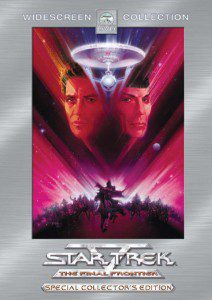 Artistically and financially, Star Trek V: The Final Frontier (hereafter known as ST5:TFF) has long been widely regarded as the least successful film in the Star Trek franchise, at least until Star Trek: Nemesis came out last year. So of course, I approached the “collector’s edition” two-disc DVD set — which came out yesterday, 14 years and a few months after the film came out in theatres — curious to see whether the film’s low reputation would be acknowledged in the extras. And it is, sorta.
In one featurette, sci-fi author David Brin calls the film an under-rated entry in the series. In another, executive producer Ralph Winter says he and the rest of the production team may have tackled the film with too much exuberance and confidence, without stopping to think about the film the way they should have, following the success of ST4:TVH (which remains, to this day and despite the rise in ticket prices since 1986, the only Star Trek film to break the $100 million barrier at the box office). In another, both Winter and one of the other creative types grumble that the special effects really failed to serve the film (I believe this may be the only Star Trek movie, apart from the very first one, that turned to some company other than George Lucas’s Industrial Light & Magic for its effects, and yeah, the effects here ARE tacky). And William Shatner himself, in the making-of featurette, concludes by saying that he has a tremendous capacity for “denial”, so as far as he’s concerned, he had a great experience directing the film, and that’s what matters to him.
Seen in this light, the archival footage of producer Harve Bennett making his pitch to the film’s promotors — giving them the Vulcan salute and saying it is impossible to lie while making this salute and saying the upcoming ST5:TFF will, no lie, be a “blockbuster” and possibly even bigger than ST4:TVH — is a bit awkward and embarrassing. But hey, you gotta admire the guts of whoever made the DVD for putting that on there, too.
I have always thought ST5:TFF was something of a wasted opportunity. It is the ONLY film in the entire series that feels like it could have been an episode of the original show. The other films all put new major characters on the bridge (Decker and Ilia in ST:TMP, Saavik in ST2:TWOK), or they take major characters off the bridge (Chekov is first officer on the Reliant in ST2:TWOK, Sulu is captain of the Excelsior in ST6:TUC, and of course Spock is virtually absent from ST3:TSFS altogether), or they don’t take place on a proper bridge in the first place (the Enterprise is a trainee ship filled with youngsters in ST2:TWOK, Kirk shanghais an automated Enterprise in ST3:TSFS, then uses a stolen Klingon Bird of Prey in ST4:TVH) — and that’s before we deal with the major life-and-death issues that pre-occupied the other films (major threats to the Earth in ST:TMP and ST4:TVH, Spock’s death and resurrection in ST2:TWOK and ST3:TSFS, ending the Cold War with the Klingons in ST6:TUC). ST5:TFF is the only film in which Kirk is captain of the Enterprise from beginning to end, with the same crew under him that he had in the series, and in which the story ends as it began, thus leaving the way for future episodes.
And they blew it.
The film was basically written and directed by Shatner for contractual reasons — going back to the days of the series, he and Leonard Nimoy had a deal where they would take turns negotiating their contracts, and whatever one person got, the other person got too. So after Nimoy had directed ST3:TSFS and ST4:TVH to great success (and then gone on to have non-Trek success with 1987’s Three Men and a Baby), Shatner figured it was his turn to direct a Trek movie, and everybody let him do it.
For whatever reason, Shatner wanted to make a story about a man who looks for God, finds the Devil, “and by extension, God exists.” Right away, there should have been obvious problems with this premise. First, this is the kind of story you can tell very well with supernatural thrillers like The Exorcist, but how can you deal with this in a space-adventure franchise like Star Trek? The “God” creature that Kirk meets and defeats at the end of the film is, as far as I can tell, just another in a long line of super-powered aliens that the various Enterprise crews have had to deal with — how does finding (and defeating!) this alien prove that the Devil exists, let alone that God exists? Second, there is nobody in the Star Trek franchise who would be likely to go on this quest … so Shatner had to come up with a storyline in which someone (who turns out to be Spock’s half-brother Sybok) hijacks the Enterprise and Kirk is basically just along for the ride, thus turning our normally dynamic hero into a rather passive bystander. (Who was it who said the main problem with the film could be summed up by the scene in which an exasperated Kirk says to Sybok, “Let me do something!“?) Third — and bringing the two other objections together — there is the fact that the film’s message is pretty much tacked onto the rest of the story and does not grow out of it. The quest to find God in outer space is Sybok’s quest, not Kirk’s; yet, after Sybok’s death, it is Kirk who gives us the moral of the story (“Maybe God isn’t out there, Bones; maybe he’s right here, in the human heart”).
It’s amazing to hear on the featurettes that many people — including producer Bennett, who had revitalized the franchise with ST2:TWOK and had been involved in all the films since — had qualms with Shatner’s story and didn’t want to work on the film. But they did. And the studio, despite its nervousness, green-lit the project and then began to force Shatner to drop various things along the way. So it’s not just a badly written movie, but a half-heartedly executed badly-written movie.
Shatner and his daughter Liz, who wrote the making-of book back when this movie came out, provide an audio commentary on the DVD, and one of the things they address is the fact that Shatner wanted Kirk’s team-mates to turn against him and side with Sybok, but Nimoy and DeForest Kelley both nixed this idea, at least insofar as it related to their characters. (I have read Shatner’s Star Trek novels, and I must say, yes, Shatner does love to pit Kirk against his friends whenever he can — I guess he finds it extra dramatic or something.) This behind-the-scenes disagreement becomes especially interesting during my favorite scene in the film, in which Sybok tries to “heal” the pain of Spock and McCoy. First we learn that McCoy pulled the plug on his father or, more likely, actively euthanized him when his father was suffering from an incurable disease (it’s not entirely clear, because he does it with some futuristic gizmo), only to find out shortly afterwards that a cure had been found. Shatner says Kelley really, really resisted playing this scene and had to be argued into it because of his “convictions”; Shatner then mentions that his own conviction is that, when dignity is gone, people should pull the plug, and this prompts a “Hmmmm” from his daughter. (As one who opposes euthanasia myself, I have to say I have no problem with the scene in its present form — McCoy’s “pain” stems from the fact that if he had waited just a little bit longer, his father might still be alive today, which would support the idea that McCoy should NOT have killed him — and besides, I think there is a world of moral difference between “pulling the plug” and letting nature take its course on the one hand, and doing something that actively kills someone who might have lived longer.)
Then comes the bit where Sybok tries to “heal” Spock, but this part of the scene never worked for me, because it harps on the fact that Spock is half-human and had let his father down, and this theme had been harped on to death on the original series; what’s more, Spock had actually resolved many of these issues in the previous films. This scene tells us absolutely nothing “new” about Spock, the way the other scene told us something “new” about McCoy, so there is no suspense, really, over how Spock will react to Sybok’s attempt to “heal” him. Interestingly enough, though, one of the deleted scenes on the bonus DVD reveals that there was, at one point, a second element to this scene, in which Sybok and Spock re-create the moment when they last saw one another, back when Spock was just a boy; Nimoy even delivers his lines like an anxious child. That might have told us something “new” about the character, but the scene doesn’t quite work as well as it should have — it doesn’t have the theatricality, the visual creativity, of the McCoy scene.
Curiously, we never get even a hint of what Kirk’s “secret pain” might be — Sybok is interrupted before he can force himself on Kirk. But I do like the way Kirk says “I need my pain.” I would never accuse Shatner of trying to preach a Christian message, but I think this film was one of the first things that got me to think about the positive value of pain, the way that suffering helps to shape us as people, and so on.
Just a few more comments. In the commentary, Shatner says that the scene where Sybok realizes the “God” he has been following is actually a more devil-ish creature was inspired by the disillusionment that many Communists felt when it was revealed that, well gosh, Stalin really WAS a murdering tyrant, despite all those years they defended him. Shatner and his daughter make an ill-advised attempt to give the film new, modern relevance when she suggests there is something “weirdly prophetic” about the fact that this film begins with a religious zealot who gathers followers in a desert landscape, and Shatner replies that the film might have done better at the box office if it had been released now. Shatner says the opening and closing scenes in Yosemite are meant to show that God can be found in nature, rather than something outside of ourselves (which reminds me, it always did seem a little odd that the “God planet”, which one character calls “Eden” and which looks from space like a big blue ball of gas, would be pretty much a barren desert on the surface).
And the featurette on religion is, well, disappointing of course — especially considering how short it is and how many people they seem to have interviewed for it. Executive producer Ralph Winter, who is well-known in Christian circles (and who I met when he spoke at Regent College’s faith-and-film conference last year), makes one very quick reference to his “relationship with God” and then they cut away to someone else. I would have liked to hear him talk a little more about that. The rest of the featurette features things like Gene Roddenberry’s son saying Star Trek isn’t anti-religion, it just “believes in humanity as much as religion”, or some SETI guy saying that our religions will be “improved” if we ever come into contact with aliens, etc. David Brin also makes some perceptive comments (e.g., Star Trek stories don’t mind the transcendent, so long as it “leaves us alone”), though a few of his comments (especially about the contrast between ST2:TWOK and ST3:TSFS re: “playing God”) do seem to be recycled from comments he made on the ST3:TSFS DVD last year.
Oh, two final observations. First, the DVD only barely acknowledges the fact that ST5:TFF was the first Trek film to be produced after the premiere of Star Trek: The Next Generation in the fall of 1987; at the time, producer Harve Bennett blamed the existence of the TV show for the poor box-office performance of the film (of course everyone shows up for the feast when there’s two years of famine between feasts, but when you give people turkey sandwiches every week… or so his argument went). ST5:TFF came out after ST:TNG finished its second season, but I believe common wisdom has it that ST:TNG didn’t really get good until its third season, so I wonder what the fans were making of the franchise at the time. (I didn’t start watching ST:TNG for another couple years, myself.)
Second — and this will show how truly geeky I can be — I cannot believe that the DVD makes no reference to the fact that the actor who plays Captain Klaa, the token Klingon of this film, was an extra on ST2:TWOK, as one of the engineering trainees; he’s the one standing next to Scotty’s nephew when Kirk and Peter Preston have their little exchange. (He might even be the one who clears his throat when Preston has his little outburst, but it could also be Scotty, who is off-screen at that point.) The way the actor describes his audition before Shatner, you would think it was the first time the two of them had been in the same room.
— A version of this post was first posted to the OnFilm discussion group.
star trek v the final frontier
Previous Post

August 28, 2003
Comment: Passion 'softened', and John comes to the screen
Next Post
November 5, 2003 Review: The Matrix Revolutions (dir. the Wachowskis, 2003)
Browse Our Archives
Select a Category Anglican Planet Articles BC Christian News BC Report Bible Movies Bible Review Blog Books & Culture Campus Times CBC Radio Christianity Today ChristianWeek Essays Faith Today Festival Cinemas Guide Film Journals Georgia Straight Interviews MB Herald National Catholic Register Salvationist Today's Christian Two Chairs Ubyssey Uncategorized Vancouver Courier Vancouver Sun
Select a Month August 2025 April 2025 January 2025 December 2024 November 2024 May 2024 February 2024 December 2023 May 2023 March 2023 November 2022 July 2022 June 2022 May 2022 April 2022 February 2022 January 2022 December 2021 November 2021 October 2021 September 2021 August 2021 July 2021 June 2021 April 2021 March 2021 February 2021 January 2021 December 2020 November 2020 October 2020 August 2020 July 2020 June 2020 May 2020 March 2020 February 2020 January 2020 December 2019 November 2019 September 2019 July 2019 May 2019 April 2019 March 2019 February 2019 January 2019 December 2018 November 2018 October 2018 September 2018 July 2018 June 2018 May 2018 April 2018 March 2018 February 2018 January 2018 December 2017 November 2017 October 2017 September 2017 August 2017 July 2017 June 2017 May 2017 April 2017 March 2017 February 2017 January 2017 December 2016 November 2016 October 2016 September 2016 August 2016 July 2016 June 2016 May 2016 April 2016 March 2016 February 2016 January 2016 December 2015 November 2015 October 2015 September 2015 August 2015 July 2015 June 2015 May 2015 April 2015 March 2015 February 2015 January 2015 December 2014 November 2014 October 2014 September 2014 August 2014 July 2014 June 2014 May 2014 April 2014 March 2014 February 2014 January 2014 December 2013 November 2013 October 2013 September 2013 August 2013 July 2013 June 2013 May 2013 April 2013 March 2013 February 2013 January 2013 December 2012 November 2012 October 2012 September 2012 August 2012 July 2012 June 2012 April 2012 January 2012 January 2011 December 2010 November 2010 October 2010 September 2010 August 2010 July 2010 June 2010 May 2010 April 2010 March 2010 February 2010 January 2010 December 2009 November 2009 October 2009 September 2009 August 2009 July 2009 June 2009 May 2009 April 2009 March 2009 February 2009 January 2009 December 2008 November 2008 October 2008 September 2008 August 2008 July 2008 June 2008 May 2008 April 2008 March 2008 February 2008 January 2008 December 2007 November 2007 October 2007 September 2007 August 2007 July 2007 June 2007 May 2007 April 2007 March 2007 February 2007 January 2007 December 2006 November 2006 October 2006 September 2006 August 2006 July 2006 June 2006 May 2006 April 2006 March 2006 February 2006 January 2006 December 2005 November 2005 October 2005 September 2005 August 2005 July 2005 June 2005 May 2005 April 2005 March 2005 January 2005 December 2004 November 2004 October 2004 September 2004 August 2004 July 2004 June 2004 May 2004 April 2004 March 2004 February 2004 January 2004 November 2003 October 2003 August 2003 July 2003 June 2003 May 2003 January 2003 December 2002 November 2002 August 2002 July 2002 June 2002 May 2002 March 2002 January 2002 December 2001 November 2001 September 2001 August 2001 July 2001 June 2001 April 2001 March 2001 February 2001 December 2000 November 2000 October 2000 September 2000 August 2000 July 2000 June 2000 May 2000 April 2000 March 2000 January 2000 October 1999 August 1999 May 1999 April 1999 February 1999 January 1999 December 1998 November 1998 October 1998 August 1998 July 1998 June 1998 April 1998 March 1998 January 1998 November 1997 September 1997 July 1997 June 1997 April 1997 March 1997 February 1997 January 1997 December 1996 October 1996 September 1996 June 1996 March 1996 February 1996 January 1996 April 1995 November 1994 September 1994 September 1991
Follow Us!
TAKE THE
Religious Wisdom Quiz
Who was swallowed by a whale (great fish)?
Select your answer to see how you score.
Job Noah Jonah Abel
Related posts from FilmChat

Joseph of Egypt – the Chosen spin-off announces...

Exclusive: A clip from Angel Studios' The King...

Exclusive: Watch a clip from Angel Studios' Brave...

Exclusive: Watch a clip from Angel Studios' Homestead
TRENDING AT PATHEOS Religious Music & Entertainment

"Les Diabolique" and Transgression
Alongside something like Arrival, Vertigo, or Charade, Les Diaboliques is a...

"The Plague Dogs" and Mortality
So, flashback to the late 70s, early 80s. Walt Disney Studios is...

With the recent and highly successful release of Christopher Nolan’s epic film,...

"L'avventura" and Human Weakness
Today's piece is going to be a little different for a few...

I first want to apologize for not posting or writing anything. I'm...

I've engaged in the multi-year project of reading through the Church Fathers,...
view all Religious Music & Entertainment blogs
Ad-Free & Subscriber Log-In Subscription Support
- About Us
- 2026 Calendar
- Videos
- Podcasts
- Library of World Religions
- Faith In Media Tracker
- Advertise With Us
- Write for Us
- Privacy Policy
- Terms of Service
- Do Not Sell My Data
- Contact Us
- Radiant Digital
- Manage Newsletter Subscriptions
- Unsubscribe From Notifications
- Sitemap
Copyright 2008-2026, Patheos. All rights reserved.
Subscription Support Ad-Free & Subscriber Log-In
Follow Patheos