
BuddhistCatholicContemplativeEvangelicalGeneral ChristianHinduJewishLatter-day SaintMuslimNew VisionsProgressive Christian
Beliefs
- Buddhist
- Catholic
- Contemplative
- Evangelical
- General Christian
- Hindu
- Jewish
- Latter-day Saint
- More Voices
- Muslim
- New Visions
- Pagan
- Progressive Christian
Topics
- Religion News
- Food and Religion
- Sports and Religion
- Religious Art
- Religious Music and Entertainment
- Religious Events
- History and Religion
- Style and Religion
- Politics and Religion
- Women in Religion
- Recreation Outdoors and Religion
- Business Finance and Religion
- Careers Workplace and Religion
- Education and Religion
- Family Parenting and Religion
- Health Fitness and Religion
- Home and Religion
- Relationships and Religion
- Technology and Religion
- Travel and Religion
Columnists
- Buddhist Columnists
- Business Finance and Religion Columnists
- Careers Workplace and Religion Columnists
- Catholic Columnists
- Contemplative Columnists
- Education and Religion Columnists
- Evangelists Columnists
- Family Parenting and Religion Columnists
- General Christian Columnists
- Health Fitness and Religion Columnists
- Hindu Columnists
- History and Religion Columnists
- Home and Religion Columnists
- Jewish Columnists
- More Voices Columnists
- Latter Day Columnists
- Muslim Columnists
- New Visions Columnists
- Nonreligious Columnists
- Pagan Columnists
- Politics and Religion Columnists
- Progressive Columnists
- Recreation Outdoors and Religion Columnists
- Relationships and Religion Columnists
- Religion News Columnists
- Religious Art Columnists
- Religious Events Columnists
- Religious Music and Entertainment Columnists
- Sports and Religion Columnists
- Style and Religion Columnists
- Technology and Religion Columnists
- Travel and Religion Columnists
- Women in Religion Columnists
Resource Library
- 2026 Calendar
- Library of World Religions
- The 100 Most Holy Places on Earth
- Patheos Answers
- Podcasts
- Videos
- Faith Leaders Database
- Anglican Episcopalian
- Bahai
- Baptist
- Buddhism
- Christianity
- Confucianism
- Eastern Orthodoxy
- Hinduism
- Holiness and Pentecostal
- ISKCON
- Islam
- Judaism
- Lutheran
- Methodist
- The Church of Jesus Christ of Latter-day Saints
- New Age
- Paganism
- Presbytarian and Reformed
- Protestantism
- Religion Behind the Scenes
- Roman Catholic
- Scientology
- Shia Islam
- Sikhism
- Sufism
- Sunni Islam
- Taoism
- Zen
- See all religions
Research Tools
 Ad-Free & Subscriber Log-In Subscription Support
Ad-Free & Subscriber Log-In Subscription Support
Follow Patheos 

- Trending:
- Forgiveness
- |
- Marriage
- |
- Consciousness
- |
- Death Penalty
- |
- Election
- |
- Halloween

-
Articles
- Home
- Religious Music & Entertainment
- Random Wrath of Khan thought.
Random Wrath of Khan thought.
Last updated on: May 15, 2013 at 10:06 am by Peter T. Chattaway
Random Wrath of Khan thought. 2013-05-15T10:06:52-07:00 Peter T. Chattaway
Patheos Explore the world's faith through different perspectives on religion and spirituality! Patheos has the views of the prevalent religions and spiritualities of the world.
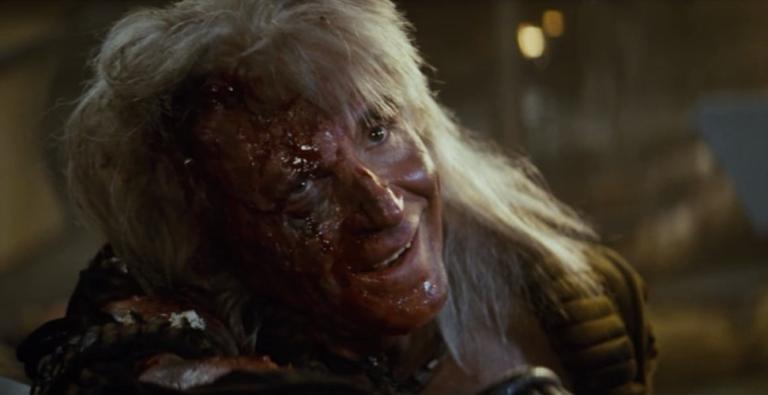 I recently made mp3s of a few James Horner tunes so people could compare and contrast his soundtracks to Star Trek II: The Wrath of Khan (1982) and Aliens (1986) — they’re very similar. As a result, I have had the ‘Genesis Countdown’ tune running through my head a fair bit lately, and today, during a moment of boredom, I found myself thinking about the climax to this film, and what makes it so interesting and distinctive.
There is a cliché that runs through many, many, many movies in which the hero defeats the villain, and then, just when you think everything’s safe, the villain rises up again and lunges at the hero, only to be destroyed immediately by the hero or one of the hero’s friends. The first examples of this sort of thing that come to my mind are in Scream, Red Dragon and Fatal Attraction. Even Aliens plugs into this cliché, sort of — instead of an alien lying on the floor, presumably dead, and then suddenly jumping up and lunging at our heroes, the film shows the aliens’ lair being destroyed in a nuclear explosion, and then settles into a lull as our heroes return to their spaceship, safe and sound … and then, suddenly, oh no! the tranquility is shattered when one of them is ripped in two by the Queen Alien, who snuck onto the ship as a stowaway on the heroes’ shuttle! This shocking discovery is then followed by a fairly extensive one-to-one battle between the Queen Alien and Sigourney Weaver. In this regard, Aliens is quite different from the typical film, where the villain is killed as soon as he or she jumps up. But the basic paradigm is still there — the villain is presumed dead, is then shockingly discovered to be alive, and is then really put to death.
ST2:TWOK is quite different. Yes, on one level, it presents a defeated villain who makes one last stab at killing our heroes. But he does this in a rather unique way, and the heroes survive in a rather unique way. Instead of the villain directing all his energy at the hero, and instead of the hero shooting back — that is, instead of a villain and a hero who both seek victory by trying to destroy the other — ST2:TWOK presents a hero and a villain who both seek victory by destroying themselves.
The moment when the villain first seems to be defeated takes place inside the Mutara Nebula, where Kirk’s ship has been badly damaged but has managed to do even more damage to Khan’s ship. At this point, Khan seems to be the only one left alive on his ship — he is, at any rate, the only person conscious on the bridge, and he is badly wounded. Kirk, rather than go in for the kill (and who could blame him if he wanted to? — this is not a regular war, where soldiers are relatively innocent tools of their states and Geneva Code-type rules apply, but a personal war that Khan launched against Kirk without any warning whatsoever, a personal battle that has claimed the lives of many of Kirk’s young crew), tells his crew to prepare to help the survivors that may be on that ship.
And then Khan activates the Genesis device. In just a few minutes, the entire Mutara Nebula, and everything within it, will be destroyed. Khan, rather than face the shame of defeat, rather than protect his own crew, rather than put the needs of his many against the needs of himself, decides to go out in a blaze of glory. He will destroy himself and take Kirk with him, along with all the other friends and foes who might stand in his way. And killing Khan won’t stop him from doing what he wants — he has already accepted death and decided to make the most of it.
How is Khan thwarted in the end? Spock, too, recognizes what needs to be done — the Enterprise’s engines need to be repaired so it can escape from the Nebula, but repairing the engines means entering a section of the engineering room filled with lethal radiation — and he rushes to do it, knowing that he will die. Spock, too, has accepted death and decided to make the most of it. But whereas Khan’s final act is a cataclysmic extension of his ego, an act of massive destruction that ripples out and consumes everyone in its path, Spock’s final act is almost an act of humility — he draws as much of the destruction as possible onto himself, in order to spare the lives of as many other people as possible.
Some of this is obvious from watching the film, and I have discussed this movie with lots of friends over the years, but it was only today that I thought to compare the climax to ST2:TWOK to all those other films where villains are not defeated as easily as we might expect them to be. I think this is yet one more reason why I really, really like this film.
(Side note, though I may have said it here before: I have always liked the fact that ST2:TWOK never lets us know whether Khan knew that his final effort to kill Kirk had failed in the end. The very last time we see Khan, he is spitting hateful quotes from classic literature in Kirk’s direction, and that’s it; in Vonda McIntyre’s novelization, Khan actually dies of his wounds before Kirk escapes — so he dies thinking he won. I much prefer the film’s ambiguity on this point to the sort of thing we see in all too many movies, where we get a good look at the villain’s face, usually just before he dies, when he realizes he has failed; I’m thinking especially of a shot near the end of Spider-Man, here. Too many films try to satisfy our need to shame or humiliate the villain, but ST2:TWOK avoids this gimmick — which is one more reason I love it so.)
— A version of this post was first posted to the OnFilm discussion group.
star trek ii the wrath of khan
Next Post

December 14, 2002 Star Trek: Nemesis (no spoilers, just a lot of grousing)
Browse Our Archives
Select a Category Anglican Planet Articles BC Christian News BC Report Bible Movies Bible Review Blog Books & Culture Campus Times CBC Radio Christianity Today ChristianWeek Essays Faith Today Festival Cinemas Guide Film Journals Georgia Straight Interviews MB Herald National Catholic Register Salvationist Today's Christian Two Chairs Ubyssey Uncategorized Vancouver Courier Vancouver Sun
Select a Month August 2025 April 2025 January 2025 December 2024 November 2024 May 2024 February 2024 December 2023 May 2023 March 2023 November 2022 July 2022 June 2022 May 2022 April 2022 February 2022 January 2022 December 2021 November 2021 October 2021 September 2021 August 2021 July 2021 June 2021 April 2021 March 2021 February 2021 January 2021 December 2020 November 2020 October 2020 August 2020 July 2020 June 2020 May 2020 March 2020 February 2020 January 2020 December 2019 November 2019 September 2019 July 2019 May 2019 April 2019 March 2019 February 2019 January 2019 December 2018 November 2018 October 2018 September 2018 July 2018 June 2018 May 2018 April 2018 March 2018 February 2018 January 2018 December 2017 November 2017 October 2017 September 2017 August 2017 July 2017 June 2017 May 2017 April 2017 March 2017 February 2017 January 2017 December 2016 November 2016 October 2016 September 2016 August 2016 July 2016 June 2016 May 2016 April 2016 March 2016 February 2016 January 2016 December 2015 November 2015 October 2015 September 2015 August 2015 July 2015 June 2015 May 2015 April 2015 March 2015 February 2015 January 2015 December 2014 November 2014 October 2014 September 2014 August 2014 July 2014 June 2014 May 2014 April 2014 March 2014 February 2014 January 2014 December 2013 November 2013 October 2013 September 2013 August 2013 July 2013 June 2013 May 2013 April 2013 March 2013 February 2013 January 2013 December 2012 November 2012 October 2012 September 2012 August 2012 July 2012 June 2012 April 2012 January 2012 January 2011 December 2010 November 2010 October 2010 September 2010 August 2010 July 2010 June 2010 May 2010 April 2010 March 2010 February 2010 January 2010 December 2009 November 2009 October 2009 September 2009 August 2009 July 2009 June 2009 May 2009 April 2009 March 2009 February 2009 January 2009 December 2008 November 2008 October 2008 September 2008 August 2008 July 2008 June 2008 May 2008 April 2008 March 2008 February 2008 January 2008 December 2007 November 2007 October 2007 September 2007 August 2007 July 2007 June 2007 May 2007 April 2007 March 2007 February 2007 January 2007 December 2006 November 2006 October 2006 September 2006 August 2006 July 2006 June 2006 May 2006 April 2006 March 2006 February 2006 January 2006 December 2005 November 2005 October 2005 September 2005 August 2005 July 2005 June 2005 May 2005 April 2005 March 2005 January 2005 December 2004 November 2004 October 2004 September 2004 August 2004 July 2004 June 2004 May 2004 April 2004 March 2004 February 2004 January 2004 November 2003 October 2003 August 2003 July 2003 June 2003 May 2003 January 2003 December 2002 November 2002 August 2002 July 2002 June 2002 May 2002 March 2002 January 2002 December 2001 November 2001 September 2001 August 2001 July 2001 June 2001 April 2001 March 2001 February 2001 December 2000 November 2000 October 2000 September 2000 August 2000 July 2000 June 2000 May 2000 April 2000 March 2000 January 2000 October 1999 August 1999 May 1999 April 1999 February 1999 January 1999 December 1998 November 1998 October 1998 August 1998 July 1998 June 1998 April 1998 March 1998 January 1998 November 1997 September 1997 July 1997 June 1997 April 1997 March 1997 February 1997 January 1997 December 1996 October 1996 September 1996 June 1996 March 1996 February 1996 January 1996 April 1995 November 1994 September 1994 September 1991
Follow Us!
TAKE THE
Religious Wisdom Quiz
Who lived in Ur of the Chaldeans before God called him?
Select your answer to see how you score.
Jacob Isaac Abram Lot
Related posts from FilmChat

Joseph of Egypt – the Chosen spin-off announces...

Exclusive: A clip from Angel Studios' The King...

Exclusive: Watch a clip from Angel Studios' Brave...

Exclusive: Watch a clip from Angel Studios' Homestead
TRENDING AT PATHEOS Religious Music & Entertainment

"Les Diabolique" and Transgression
Alongside something like Arrival, Vertigo, or Charade, Les Diaboliques is a...

"The Plague Dogs" and Mortality
So, flashback to the late 70s, early 80s. Walt Disney Studios is...

With the recent and highly successful release of Christopher Nolan’s epic film,...

"L'avventura" and Human Weakness
Today's piece is going to be a little different for a few...

I first want to apologize for not posting or writing anything. I'm...

I've engaged in the multi-year project of reading through the Church Fathers,...
view all Religious Music & Entertainment blogs
Ad-Free & Subscriber Log-In Subscription Support
- About Us
- 2026 Calendar
- Videos
- Podcasts
- Library of World Religions
- Faith In Media Tracker
- Advertise With Us
- Write for Us
- Privacy Policy
- Terms of Service
- Do Not Sell My Data
- Contact Us
- Radiant Digital
- Manage Newsletter Subscriptions
- Unsubscribe From Notifications
- Sitemap
Copyright 2008-2026, Patheos. All rights reserved.
Subscription Support Ad-Free & Subscriber Log-In
Follow Patheos