
BuddhistCatholicContemplativeEvangelicalGeneral ChristianHinduJewishLatter-day SaintMuslimNew VisionsProgressive Christian
Beliefs
- Buddhist
- Catholic
- Contemplative
- Evangelical
- General Christian
- Hindu
- Jewish
- Latter-day Saint
- More Voices
- Muslim
- New Visions
- Pagan
- Progressive Christian
Topics
- Religion News
- Food and Religion
- Sports and Religion
- Religious Art
- Religious Music and Entertainment
- Religious Events
- History and Religion
- Style and Religion
- Politics and Religion
- Women in Religion
- Recreation Outdoors and Religion
- Business Finance and Religion
- Careers Workplace and Religion
- Education and Religion
- Family Parenting and Religion
- Health Fitness and Religion
- Home and Religion
- Relationships and Religion
- Technology and Religion
- Travel and Religion
Columnists
- Buddhist Columnists
- Business Finance and Religion Columnists
- Careers Workplace and Religion Columnists
- Catholic Columnists
- Contemplative Columnists
- Education and Religion Columnists
- Evangelists Columnists
- Family Parenting and Religion Columnists
- General Christian Columnists
- Health Fitness and Religion Columnists
- Hindu Columnists
- History and Religion Columnists
- Home and Religion Columnists
- Jewish Columnists
- More Voices Columnists
- Latter Day Columnists
- Muslim Columnists
- New Visions Columnists
- Nonreligious Columnists
- Pagan Columnists
- Politics and Religion Columnists
- Progressive Columnists
- Recreation Outdoors and Religion Columnists
- Relationships and Religion Columnists
- Religion News Columnists
- Religious Art Columnists
- Religious Events Columnists
- Religious Music and Entertainment Columnists
- Sports and Religion Columnists
- Style and Religion Columnists
- Technology and Religion Columnists
- Travel and Religion Columnists
- Women in Religion Columnists
Resource Library
- 2026 Calendar
- Library of World Religions
- The 100 Most Holy Places on Earth
- Patheos Answers
- Podcasts
- Videos
- Faith Leaders Database
- Anglican Episcopalian
- Bahai
- Baptist
- Buddhism
- Christianity
- Confucianism
- Eastern Orthodoxy
- Hinduism
- Holiness and Pentecostal
- ISKCON
- Islam
- Judaism
- Lutheran
- Methodist
- The Church of Jesus Christ of Latter-day Saints
- New Age
- Paganism
- Presbytarian and Reformed
- Protestantism
- Religion Behind the Scenes
- Roman Catholic
- Scientology
- Shia Islam
- Sikhism
- Sufism
- Sunni Islam
- Taoism
- Zen
- See all religions
Research Tools
 Ad-Free & Subscriber Log-In Subscription Support
Ad-Free & Subscriber Log-In Subscription Support
Follow Patheos 

- Trending:
- Forgiveness
- |
- Marriage
- |
- Consciousness
- |
- Death Penalty
- |
- Election
- |
- Halloween

-
Articles
- Home
- Religious Music & Entertainment
- Faith treated with respect amid Simpsons‘ satire
Faith treated with respect amid Simpsons‘ satire
Last updated on: December 17, 2014 at 6:44 pm by Peter T. Chattaway
Faith treated with respect amid Simpsons‘ satire 2014-12-17T18:44:30-08:00 Peter T. Chattaway
Patheos Explore the world's faith through different perspectives on religion and spirituality! Patheos has the views of the prevalent religions and spiritualities of the world.
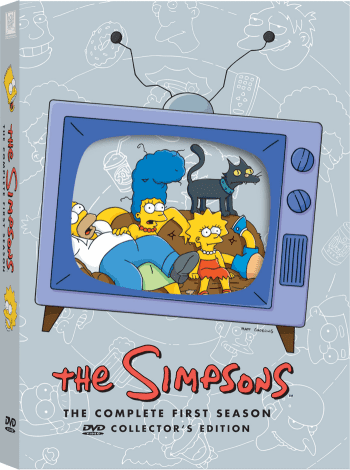 • The Simpsons: The Complete First Season, Fox Video, 2001.
• William Irwin, Mark T. Conard, and Aeon J. Skoble, eds.: The Simpsons and Philosophy: The D’oh! of Homer, Open Court, 2001.
• Mark I. Pinsky: The Gospel According to the Simpsons, Westminster John Knox, 2001.
I DON’T watch a lot of television, but I have always been a fan of The Simpsons.
Homer, Marge, Bart, Lisa and Maggie made their debut in the late 1980s, in a series of short animated sketches that played between skits on The Tracey Ullman Show. These shorts — which poked fun at typical family activities like going to zoos and funerals and singing creepy bedtime lullabies — were a hit on the animation-festival circuit, and it wasn’t long before this wonderfully dysfunctional family was given its own half-hour show, beginning with a Christmas special in 1989. That special, and the rest of the show’s first season, are now available on DVD.
It is fascinating to see how much of the show’s irreverent yet fundamentally affectionate sense of humour was there from the start. Homer is a terribly anxious father — at one point, worried that his family might make a bad impression on his boss, he chases his children around a company picnic and yells “Be normal!” — but his anxieties stem, in part, from the fact that he does care deeply about his family. When the show was just a few weeks old, I happened to join a Bible study that was led by a couple of Simpsons fans, and we agreed that it was the most realistic sitcom on TV, in contrast to relentlessly sunny fare like The Cosby Show.
Many of our fellow believers saw things differently, though, and criticized the show for allegedly subverting family values. They especially objected to Bart, a fourth-grade ‘underachiever’ who disrespected his father, ran naked through the house, and peppered his speech with words like ‘hell.’
But a funny thing happened over the show’s first few years. As time went by, Bart’s in-your-face catchphrases (“Eat my shorts,” etc.) fell out of fashion, and people began to use one of Homer’s favorite expressions (“D’oh!”) whenever they made some sort of mistake. Audiences no longer merely laughed at the Simpson family or indulged in some of the characters’ ruder habits; they identified with the characters and, through them, laughed at their own foibles.
Along the way, The Simpsons became one of the most culturally diverse shows on television. Its surreal and thoroughly postmodern sense of humour incorporates both broad farce and sharp intellectual satire, and it appeals to highbrows and lowbrows alike — architect Frank Lloyd Wright and castrati singers are as good for a laugh as Saturday morning cartoons and the latest pop songs. Because it is animated, the few actors who work on The Simpsons can provide voices for dozens of characters, and this has created a thriving sense of community among the residents of Springfield.
Most remarkably, The Simpsons is one of the few shows that treats faith seriously as an active part of the average North American’s life. All the Simpsons go to church, and for Marge and Lisa, at least, it is more than just a habit. The show has also been quite sympathetic to Ned Flanders, the Simpsons’ ultra-evangelical next-door neighbour. Ned is a caricature, true — but then, so is everyone else on the show. When Homer sneers at Ned’s faith, we are no more meant to agree with Homer’s bigotry than we were meant to agree with Archie Bunker’s racism. Ned wrestles with doubt and anger, but he does try to love his neighbour, and he’s one of the few people in Springfield who doesn’t reek of hypocrisy. As even Homer admits, in one of his rare insightful moments: “If everyone here were like Ned Flanders, there’d be no need for heaven. We’d already be there.”
 These days, it is difficult to find people who openly admit to hating the show; indeed, many people now take it very seriously, and use it as a springboard for discussing larger issues. Two such books have come out this year, and, fittingly, they both pay homage to previous books in their genre. The Simpsons and Philosophy: The D’oh! of Homer, a collection of 18 essays, cleverly alludes to Benjamin Hoff’s The Tao of Pooh; while Mark I. Pinsky admits that his book, The Gospel According to the Simpsons, was inspired by Robert Short’s classic, The Gospel According to Peanuts.
The Simpsons and Philosophy is not all that concerned with religious matters, per se, but in addition to the essays that compare Homer to Aristotle and Bart to Nietzsche — in both cases, the Simpson in question is found wanting — there are some that ask important questions about the relationship between morality and faith. Gerald J. Erion and Joseph A. Zeccardi observe that, although Marge is a religious person, she will follow her conscience and try to do the decent thing, even when it means ignoring the advice of religious authorities. And David Vessey, with a little help from Kant, explores how it is possible for Ned to love his neighbour without imposing his beliefs on them.
Other contributors argue over whether the show has a moral agenda. In a somewhat cynical essay, Carl Matheson claims that The Simpsons has no message beyond “hyper-irony,” and that the show is intended “primarily as a theatre of cruelty”; any positive elements are there, he says, just to make it easier for the audience to come back week after week. Paul A. Cantor, however, says the show affirms the value of the nuclear family within a larger community, and thus makes a “profound comment” that stands in stark contrast to the many TV shows that have focused on the lives of isolated individuals or questioned the need for two parents.
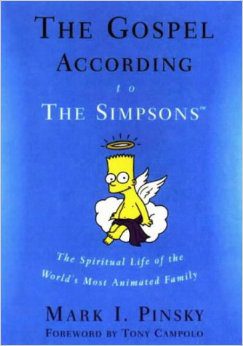 Pinsky shares this positive appraisal of the show, for the most part, in The Gospel According to the Simpsons. Pinsky, who is Jewish, is a religion reporter for the Orlando Sentinel in Florida, and his book summarizes the main spiritual themes that have been addressed by The Simpsons, focusing on its treatment of mainline Protestants, evangelicals, Catholics, Jews, Hindus and assorted subjects such as the Bible, morality and prayer. Along the way, Pinsky makes several astute observations, noting that there is a curious lack of Muslim characters on the show, and that there is no real discussion of the Protestant belief in salvation by grace through faith; instead, everyone on the show seems to believe they can earn God’s favour through their works.
Pinsky also probes the minds behind the show, interviewing several of its writers and producers, a few of whom are Christian. Series creator Matt Groening declined to be interviewed for the book, so Pinsky relies on other sources to flesh out Groening’s own religious influences. Among other things, he finds that Groening’s father came from a Mennonite family, and that Krusty the Clown, an abrasive children’s entertainer, was inspired by a Christian clown from Portland named Rusty Nails. “I couldn’t get past the idea that this was a nice clown with the scariest name possible,” Groening once told TV Guide.
The Gospel According to the Simpsons sometimes reads more like a collection of facts and episode synopses than an engagement with ideas — like a journalist, Pinsky lets his sources do the interpreting — but it’s a must-read for anyone who wants to keep tabs on the relationship between faith and popular culture. And since the show is embarking on its 13th season, starting November 11, it’s safe to say The Simpsons will give us plenty more to think about in months to come.
— A version of this article was first published in BC Christian News*.*
Previous Post

September 26, 2001
Review: Ten Commandments documentary series (dir. various, 2001)
Browse Our Archives
Select a Category Anglican Planet Articles BC Christian News BC Report Bible Movies Bible Review Blog Books & Culture Campus Times CBC Radio Christianity Today ChristianWeek Essays Faith Today Festival Cinemas Guide Film Journals Georgia Straight Interviews MB Herald National Catholic Register Salvationist Today's Christian Two Chairs Ubyssey Uncategorized Vancouver Courier Vancouver Sun
Select a Month August 2025 April 2025 January 2025 December 2024 November 2024 May 2024 February 2024 December 2023 May 2023 March 2023 November 2022 July 2022 June 2022 May 2022 April 2022 February 2022 January 2022 December 2021 November 2021 October 2021 September 2021 August 2021 July 2021 June 2021 April 2021 March 2021 February 2021 January 2021 December 2020 November 2020 October 2020 August 2020 July 2020 June 2020 May 2020 March 2020 February 2020 January 2020 December 2019 November 2019 September 2019 July 2019 May 2019 April 2019 March 2019 February 2019 January 2019 December 2018 November 2018 October 2018 September 2018 July 2018 June 2018 May 2018 April 2018 March 2018 February 2018 January 2018 December 2017 November 2017 October 2017 September 2017 August 2017 July 2017 June 2017 May 2017 April 2017 March 2017 February 2017 January 2017 December 2016 November 2016 October 2016 September 2016 August 2016 July 2016 June 2016 May 2016 April 2016 March 2016 February 2016 January 2016 December 2015 November 2015 October 2015 September 2015 August 2015 July 2015 June 2015 May 2015 April 2015 March 2015 February 2015 January 2015 December 2014 November 2014 October 2014 September 2014 August 2014 July 2014 June 2014 May 2014 April 2014 March 2014 February 2014 January 2014 December 2013 November 2013 October 2013 September 2013 August 2013 July 2013 June 2013 May 2013 April 2013 March 2013 February 2013 January 2013 December 2012 November 2012 October 2012 September 2012 August 2012 July 2012 June 2012 April 2012 January 2012 January 2011 December 2010 November 2010 October 2010 September 2010 August 2010 July 2010 June 2010 May 2010 April 2010 March 2010 February 2010 January 2010 December 2009 November 2009 October 2009 September 2009 August 2009 July 2009 June 2009 May 2009 April 2009 March 2009 February 2009 January 2009 December 2008 November 2008 October 2008 September 2008 August 2008 July 2008 June 2008 May 2008 April 2008 March 2008 February 2008 January 2008 December 2007 November 2007 October 2007 September 2007 August 2007 July 2007 June 2007 May 2007 April 2007 March 2007 February 2007 January 2007 December 2006 November 2006 October 2006 September 2006 August 2006 July 2006 June 2006 May 2006 April 2006 March 2006 February 2006 January 2006 December 2005 November 2005 October 2005 September 2005 August 2005 July 2005 June 2005 May 2005 April 2005 March 2005 January 2005 December 2004 November 2004 October 2004 September 2004 August 2004 July 2004 June 2004 May 2004 April 2004 March 2004 February 2004 January 2004 November 2003 October 2003 August 2003 July 2003 June 2003 May 2003 January 2003 December 2002 November 2002 August 2002 July 2002 June 2002 May 2002 March 2002 January 2002 December 2001 November 2001 September 2001 August 2001 July 2001 June 2001 April 2001 March 2001 February 2001 December 2000 November 2000 October 2000 September 2000 August 2000 July 2000 June 2000 May 2000 April 2000 March 2000 January 2000 October 1999 August 1999 May 1999 April 1999 February 1999 January 1999 December 1998 November 1998 October 1998 August 1998 July 1998 June 1998 April 1998 March 1998 January 1998 November 1997 September 1997 July 1997 June 1997 April 1997 March 1997 February 1997 January 1997 December 1996 October 1996 September 1996 June 1996 March 1996 February 1996 January 1996 April 1995 November 1994 September 1994 September 1991
Follow Us!
TAKE THE
Religious Wisdom Quiz
Which book of the Bible has a talking tree?
Select your answer to see how you score.
Proverbs Judges Ezekiel Genesis
Related posts from FilmChat

The New World a feast for the senses...

Review: Revelation (dir. André van Heerden, 1999)
Review: The Chronicles of Narnia: The Lion, the...

Review: Avatar (dir. James Cameron, 2009)
TRENDING AT PATHEOS Religious Music & Entertainment

"Les Diabolique" and Transgression
Alongside something like Arrival, Vertigo, or Charade, Les Diaboliques is a...

"The Plague Dogs" and Mortality
So, flashback to the late 70s, early 80s. Walt Disney Studios is...

With the recent and highly successful release of Christopher Nolan’s epic film,...

"L'avventura" and Human Weakness
Today's piece is going to be a little different for a few...

I first want to apologize for not posting or writing anything. I'm...

I've engaged in the multi-year project of reading through the Church Fathers,...
view all Religious Music & Entertainment blogs
Ad-Free & Subscriber Log-In Subscription Support
- About Us
- 2026 Calendar
- Videos
- Podcasts
- Library of World Religions
- Faith In Media Tracker
- Advertise With Us
- Write for Us
- Privacy Policy
- Terms of Service
- Do Not Sell My Data
- Contact Us
- Radiant Digital
- Manage Newsletter Subscriptions
- Unsubscribe From Notifications
- Sitemap
Copyright 2008-2026, Patheos. All rights reserved.
Subscription Support Ad-Free & Subscriber Log-In
Follow Patheos