
BuddhistCatholicContemplativeEvangelicalGeneral ChristianHinduJewishLatter-day SaintMuslimNew VisionsProgressive Christian
Beliefs
- Buddhist
- Catholic
- Contemplative
- Evangelical
- General Christian
- Hindu
- Jewish
- Latter-day Saint
- More Voices
- Muslim
- New Visions
- Pagan
- Progressive Christian
Topics
- Religion News
- Food and Religion
- Sports and Religion
- Religious Art
- Religious Music and Entertainment
- Religious Events
- History and Religion
- Style and Religion
- Politics and Religion
- Women in Religion
- Recreation Outdoors and Religion
- Business Finance and Religion
- Careers Workplace and Religion
- Education and Religion
- Family Parenting and Religion
- Health Fitness and Religion
- Home and Religion
- Relationships and Religion
- Technology and Religion
- Travel and Religion
Columnists
- Buddhist Columnists
- Business Finance and Religion Columnists
- Careers Workplace and Religion Columnists
- Catholic Columnists
- Contemplative Columnists
- Education and Religion Columnists
- Evangelists Columnists
- Family Parenting and Religion Columnists
- General Christian Columnists
- Health Fitness and Religion Columnists
- Hindu Columnists
- History and Religion Columnists
- Home and Religion Columnists
- Jewish Columnists
- More Voices Columnists
- Latter Day Columnists
- Muslim Columnists
- New Visions Columnists
- Nonreligious Columnists
- Pagan Columnists
- Politics and Religion Columnists
- Progressive Columnists
- Recreation Outdoors and Religion Columnists
- Relationships and Religion Columnists
- Religion News Columnists
- Religious Art Columnists
- Religious Events Columnists
- Religious Music and Entertainment Columnists
- Sports and Religion Columnists
- Style and Religion Columnists
- Technology and Religion Columnists
- Travel and Religion Columnists
- Women in Religion Columnists
Resource Library
- 2026 Calendar
- Library of World Religions
- The 100 Most Holy Places on Earth
- Patheos Answers
- Podcasts
- Videos
- Faith Leaders Database
- Anglican Episcopalian
- Bahai
- Baptist
- Buddhism
- Christianity
- Confucianism
- Eastern Orthodoxy
- Hinduism
- Holiness and Pentecostal
- ISKCON
- Islam
- Judaism
- Lutheran
- Methodist
- The Church of Jesus Christ of Latter-day Saints
- New Age
- Paganism
- Presbytarian and Reformed
- Protestantism
- Religion Behind the Scenes
- Roman Catholic
- Scientology
- Shia Islam
- Sikhism
- Sufism
- Sunni Islam
- Taoism
- Zen
- See all religions
Research Tools
 Ad-Free & Subscriber Log-In Subscription Support
Ad-Free & Subscriber Log-In Subscription Support
Follow Patheos 

- Trending:
- Forgiveness
- |
- Marriage
- |
- Consciousness
- |
- Death Penalty
- |
- Election
- |
- Halloween

-
Articles
- Home
- Religious Music & Entertainment
- The What-If Game
The What-If Game
Last updated on: December 8, 2015 at 7:28 pm by Peter T. Chattaway
The What-If Game 2015-12-08T19:28:24-08:00 Peter T. Chattaway
Patheos Explore the world's faith through different perspectives on religion and spirituality! Patheos has the views of the prevalent religions and spiritualities of the world.
 Most people play the what-if game at some point or other. Many of us look back on a specific moment when we made a decision that had ramifications far beyond our own lives, and we wonder if we did the right thing. For example, what if I had not skipped grades when I was 12 years old? I came to regret that decision frequently during my high school years, and if I could revisit any moment in my past, that would probably be it.
But I was not the only person affected by my choice. Had I not skipped grades, I would probably not have gone to Bible school, and I would not have become friends with a couple of fellows who ended up moving to Vancouver and becoming my first roommates. Two of my roommates went on to marry women who lived in the suite below our own, and one of these couples already has children. There are times when I wonder if those kids will ever know that they owe their existence, in part, to the fact that I said “yes” and not “no” when I was offered a chance to accelerate my education.
If my actions affect the lives of others in ways that cannot be foreseen, then the decisions of others have affected my life, too. And all of our decisions are made in the context of seemingly random events, which provide yet another opportunity to play the what-if game.
Several films have been playing that game lately. Last year, in Sliding Doors, Gwyneth Paltrow played a woman named Helen whose life goes in two separate directions following a fateful run through a train station. In one timeline, Helen catches the train and arrives home in time to discover that her boyfriend has been cheating on her. In the other, Helen misses the train, and in the extra time it takes her to get home, her boyfriend’s lover leaves the apartment undetected. Through a combination of chance and choice, the Helen who discovers her boyfriend’s infidelity meets a fate very different from that of the Helen who doesn’t.
Run Lola Run, an energetic German film released in North America several months later, ups the stakes by diverting our attention away from the protagonists every now and then. Lola (Franka Potente) gets a phone call from her boyfriend Manni (Moritz Bleibtreu), who has just lost a bag containing 100,000 deutsche marks that he is supposed to deliver to a gangster he’s meeting in 20 minutes. In desperation, Manni decides to rob a store. Lola, hoping to stop him, runs out the door, down the stairs, and out into the streets, in search of money. She does this not once, but three times, in three different timelines, each the result of an encounter with a bully and a dog in the stairwell. And as Lola passes people on the street, director Tom Tykwer gives us flash-forward glimpses of the lives they will go on to live. The person who meets a spouse or experiences a religious conversion in one timeline might die a horrible death in another.
More recently, the Australian comedy Me Myself I stars Rachel Griffiths as Pamela, a lonely single woman who wonders if she made a mistake by turning down a marriage proposal from an old flame named Robert (David Roberts) 13 years before. One day Pamela, while fleeing a street evangelist, is hit by a car, and the driver turns out to be an alternate version of herself who accepted Robert’s proposal and went on to have three children with him. Married Pamela takes Single Pamela home, then mysteriously disappears, leaving Single Pamela to figure out the exhausting intricacies of motherhood. Still, marriage has its benefits, and Single Pamela comes to enjoy her sex life with Robert. But as time goes on, she discovers that Married Pamela’s life wasn’t all that perfect either; in fact, the marriage had been on the verge of collapse. In the end, we learn that, just as Single Pamela has been living Married Pamela’s life, Married Pamela has been living in Single Pamela’s world; both women needed to see how things would have been if they had made a different choice. And, now that they know, both return to their original lives.
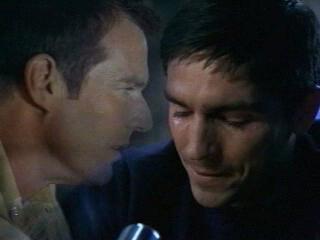
All three films hinge on a single happenstance or a single moment of decision. But life is made up of lots of little moments when things could have gone one way or the other. Enter Frequency. In this imaginative but very convoluted film, a Brooklyn firefighter named Frank Sullivan (Dennis Quaid), fiddling with his ham radio in October 1969, makes contact with his son John (Jim Caviezel), a cop who is fiddling with the same ham radio exactly 30 years in the future. It turns out Frank has hooked up with his son the day before Frank was fated to die in a warehouse fire. John, who is still suffering the trauma of growing up without a father, gives Frank a crucial piece of information that ends up saving Frank’s life, at least temporarily. (Instead of dying 30 years ago in the fire, we are told that Frank died from lung cancer just a few years ago, thus keeping him conveniently out of the 1999 portion of the story.)
But then John discovers that his father, by surviving, has inadvertently saved the life of a serial killer. The killer originally died in 1969 without ever being identified, but now that he lives, he is destined to kill several more women, including Frank’s wife. His identity remains a mystery, even in John’s day, so father and son join forces, across the decades, to track the killer down and stop him before he can commit his murders. They do this not only because they can do it, but because they believe they ought to do it. “Those other women were not supposed to die!” says John, but it never occurs to him that, by the same logic, his father was not “supposed” to live.
Frequency strikes a compromise between two competing understandings of the world and our place in it. In the traditional Christian view, history is linear and moves toward a point; God knows the future because he stands outside time. Modernity, with its emphasis on progress, preserved some sense of linearity but was more open-ended; no matter how good things got, they could always get better, and probably would. Both views assume a basic direction in which the world is (or ought to be) moving.
But postmodernity has challenged all that. According to the “many worlds” interpretation of quantum mechanics, the universe is constantly branching off into many different universes, in which all possible outcomes ultimately come to be. Toss a coin, says this theory, and it will come up both heads and tails, but in separate worlds.
There is a hint of this openness in Frequency; Frank is free to go left even though his son remembers him going right. But Frank does not create a new universe; instead, his decisions have tangible ramifications in John’s world. The timeline, however wrinkled it may get, is essentially a closed system.
The other films in this genre put their various timelines on roughly equal footing. Sliding Doors and Run Lola Run end on an upbeat, audience-pleasing note, but the parallel timelines could have been presented in any order, and the theological implications are mind-boggling. If each person “is destined to die once, and after that to face judgment” (Hebrews 9:27), what are we to make of a theory which says that, every time I have the choice to do good or evil, I do both, but in different worlds? Even if we don’t accept the “many worlds” theory, these films confront us with the possibility that our lives, and even to some extent our identities, are the result of blind chance.
Me Myself I, which grants a happy ending to both of its worlds, points in a hopeful direction. In that film, each version of Pamela comes to accept the life that she has made for herself. Similarly, with God’s help, we can learn to accept the curveballs the world throws our way, to live with the consequences of our own decisions, pro and con, and to find new opportunities for growth. Indeed, as Frequency demonstrates, attempts to fix the past could conceivably make matters worse. Jesus tells us not to worry about tomorrow; he might also tell us not to worry about yesterday. Each day has enough trouble, and enough joy, of its own.
— A version of this article was first published in Books & Culture*.*
Previous Post

June 27, 2000
Review: The Patriot (dir. Roland Emmerich, 2000)
Next Post
August 4, 2000 Review: Chuck & Buck (dir. Miguel Arteta, 2000)
Browse Our Archives
Select a Category Anglican Planet Articles BC Christian News BC Report Bible Movies Bible Review Blog Books & Culture Campus Times CBC Radio Christianity Today ChristianWeek Essays Faith Today Festival Cinemas Guide Film Journals Georgia Straight Interviews MB Herald National Catholic Register Salvationist Today's Christian Two Chairs Ubyssey Uncategorized Vancouver Courier Vancouver Sun
Select a Month August 2025 April 2025 January 2025 December 2024 November 2024 May 2024 February 2024 December 2023 May 2023 March 2023 November 2022 July 2022 June 2022 May 2022 April 2022 February 2022 January 2022 December 2021 November 2021 October 2021 September 2021 August 2021 July 2021 June 2021 April 2021 March 2021 February 2021 January 2021 December 2020 November 2020 October 2020 August 2020 July 2020 June 2020 May 2020 March 2020 February 2020 January 2020 December 2019 November 2019 September 2019 July 2019 May 2019 April 2019 March 2019 February 2019 January 2019 December 2018 November 2018 October 2018 September 2018 July 2018 June 2018 May 2018 April 2018 March 2018 February 2018 January 2018 December 2017 November 2017 October 2017 September 2017 August 2017 July 2017 June 2017 May 2017 April 2017 March 2017 February 2017 January 2017 December 2016 November 2016 October 2016 September 2016 August 2016 July 2016 June 2016 May 2016 April 2016 March 2016 February 2016 January 2016 December 2015 November 2015 October 2015 September 2015 August 2015 July 2015 June 2015 May 2015 April 2015 March 2015 February 2015 January 2015 December 2014 November 2014 October 2014 September 2014 August 2014 July 2014 June 2014 May 2014 April 2014 March 2014 February 2014 January 2014 December 2013 November 2013 October 2013 September 2013 August 2013 July 2013 June 2013 May 2013 April 2013 March 2013 February 2013 January 2013 December 2012 November 2012 October 2012 September 2012 August 2012 July 2012 June 2012 April 2012 January 2012 January 2011 December 2010 November 2010 October 2010 September 2010 August 2010 July 2010 June 2010 May 2010 April 2010 March 2010 February 2010 January 2010 December 2009 November 2009 October 2009 September 2009 August 2009 July 2009 June 2009 May 2009 April 2009 March 2009 February 2009 January 2009 December 2008 November 2008 October 2008 September 2008 August 2008 July 2008 June 2008 May 2008 April 2008 March 2008 February 2008 January 2008 December 2007 November 2007 October 2007 September 2007 August 2007 July 2007 June 2007 May 2007 April 2007 March 2007 February 2007 January 2007 December 2006 November 2006 October 2006 September 2006 August 2006 July 2006 June 2006 May 2006 April 2006 March 2006 February 2006 January 2006 December 2005 November 2005 October 2005 September 2005 August 2005 July 2005 June 2005 May 2005 April 2005 March 2005 January 2005 December 2004 November 2004 October 2004 September 2004 August 2004 July 2004 June 2004 May 2004 April 2004 March 2004 February 2004 January 2004 November 2003 October 2003 August 2003 July 2003 June 2003 May 2003 January 2003 December 2002 November 2002 August 2002 July 2002 June 2002 May 2002 March 2002 January 2002 December 2001 November 2001 September 2001 August 2001 July 2001 June 2001 April 2001 March 2001 February 2001 December 2000 November 2000 October 2000 September 2000 August 2000 July 2000 June 2000 May 2000 April 2000 March 2000 January 2000 October 1999 August 1999 May 1999 April 1999 February 1999 January 1999 December 1998 November 1998 October 1998 August 1998 July 1998 June 1998 April 1998 March 1998 January 1998 November 1997 September 1997 July 1997 June 1997 April 1997 March 1997 February 1997 January 1997 December 1996 October 1996 September 1996 June 1996 March 1996 February 1996 January 1996 April 1995 November 1994 September 1994 September 1991
Follow Us!
TAKE THE
Religious Wisdom Quiz
In 1 John, how do we know what love is?
Select your answer to see how you score.
The Holy Spirit teaches us God first loved us Jesus Christ laid down his life for us God sent his Son
Related posts from FilmChat
An African Jesus / Reimagined as a political...

Review: Frequency (dir. Gregory Hoblit, 2000)

Your Chip Is Showing / Four recent films...
TRENDING AT PATHEOS Religious Music & Entertainment

"Les Diabolique" and Transgression
Alongside something like Arrival, Vertigo, or Charade, Les Diaboliques is a...

"The Plague Dogs" and Mortality
So, flashback to the late 70s, early 80s. Walt Disney Studios is...

With the recent and highly successful release of Christopher Nolan’s epic film,...

"L'avventura" and Human Weakness
Today's piece is going to be a little different for a few...

I first want to apologize for not posting or writing anything. I'm...

I've engaged in the multi-year project of reading through the Church Fathers,...
view all Religious Music & Entertainment blogs
Ad-Free & Subscriber Log-In Subscription Support
- About Us
- 2026 Calendar
- Videos
- Podcasts
- Library of World Religions
- Faith In Media Tracker
- Advertise With Us
- Write for Us
- Privacy Policy
- Terms of Service
- Do Not Sell My Data
- Contact Us
- Radiant Digital
- Manage Newsletter Subscriptions
- Unsubscribe From Notifications
- Sitemap
Copyright 2008-2026, Patheos. All rights reserved.
Subscription Support Ad-Free & Subscriber Log-In
Follow Patheos