
BuddhistCatholicContemplativeEvangelicalGeneral ChristianHinduJewishLatter-day SaintMuslimNew VisionsProgressive Christian
Beliefs
- Buddhist
- Catholic
- Contemplative
- Evangelical
- General Christian
- Hindu
- Jewish
- Latter-day Saint
- More Voices
- Muslim
- New Visions
- Pagan
- Progressive Christian
Topics
- Religion News
- Food and Religion
- Sports and Religion
- Religious Art
- Religious Music and Entertainment
- Religious Events
- History and Religion
- Style and Religion
- Politics and Religion
- Women in Religion
- Recreation Outdoors and Religion
- Business Finance and Religion
- Careers Workplace and Religion
- Education and Religion
- Family Parenting and Religion
- Health Fitness and Religion
- Home and Religion
- Relationships and Religion
- Technology and Religion
- Travel and Religion
Columnists
- Buddhist Columnists
- Business Finance and Religion Columnists
- Careers Workplace and Religion Columnists
- Catholic Columnists
- Contemplative Columnists
- Education and Religion Columnists
- Evangelists Columnists
- Family Parenting and Religion Columnists
- General Christian Columnists
- Health Fitness and Religion Columnists
- Hindu Columnists
- History and Religion Columnists
- Home and Religion Columnists
- Jewish Columnists
- More Voices Columnists
- Latter Day Columnists
- Muslim Columnists
- New Visions Columnists
- Nonreligious Columnists
- Pagan Columnists
- Politics and Religion Columnists
- Progressive Columnists
- Recreation Outdoors and Religion Columnists
- Relationships and Religion Columnists
- Religion News Columnists
- Religious Art Columnists
- Religious Events Columnists
- Religious Music and Entertainment Columnists
- Sports and Religion Columnists
- Style and Religion Columnists
- Technology and Religion Columnists
- Travel and Religion Columnists
- Women in Religion Columnists
Resource Library
- 2026 Calendar
- Library of World Religions
- The 100 Most Holy Places on Earth
- Patheos Answers
- Podcasts
- Videos
- Faith Leaders Database
- Anglican Episcopalian
- Bahai
- Baptist
- Buddhism
- Christianity
- Confucianism
- Eastern Orthodoxy
- Hinduism
- Holiness and Pentecostal
- ISKCON
- Islam
- Judaism
- Lutheran
- Methodist
- The Church of Jesus Christ of Latter-day Saints
- New Age
- Paganism
- Presbytarian and Reformed
- Protestantism
- Religion Behind the Scenes
- Roman Catholic
- Scientology
- Shia Islam
- Sikhism
- Sufism
- Sunni Islam
- Taoism
- Zen
- See all religions
Research Tools
 Ad-Free & Subscriber Log-In Subscription Support
Ad-Free & Subscriber Log-In Subscription Support
Follow Patheos 

- Trending:
- Forgiveness
- |
- Marriage
- |
- Consciousness
- |
- Death Penalty
- |
- Election
- |
- Halloween

-
Articles
- Home
- Religious Music & Entertainment
- Jesus at the Movies
Jesus at the Movies
Last updated on: November 28, 2013 at 9:54 am by Peter T. Chattaway
Jesus at the Movies 2013-11-28T09:54:08-08:00 Peter T. Chattaway
Patheos Explore the world's faith through different perspectives on religion and spirituality! Patheos has the views of the prevalent religions and spiritualities of the world.
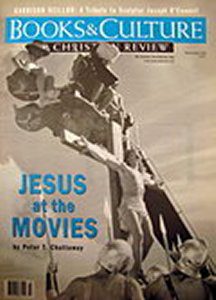 In Jesus of Montreal, Denys Arcand’s witty satire about a group of actors who put on a revisionist Passion play, the church sponsoring the play sends in some security guards to call off the production in mid-performance. The actors have tinkered with the Gospels too much; their reconstruction of the historical Jesus challenges church tradition at nearly every point, so out it must go. But the audience objects; one woman says she wants to see the end, and the head of security replies, impatiently, “Look, he dies on the cross and is resurrected. No big deal. Talk about slow!”
The scene neatly sums up one of the main challenges faced by films about the life of Jesus: namely, overfamiliarity. Jesus has been represented in paintings, sculptures, and stained-glass windows for centuries; since the invention of moving pictures in the 1890s, he has also been a perennial subject in films and television. All these portrayals tend to fuse together in the popular imagination; audiences think they’ve seen it all before, and they can remain blind to the unique perspective each film sheds on the life of Jesus and his relationship to modern moviegoers.
But there is a second challenge faced by films about Jesus, which is also addressed in that scene from Jesus of Montreal: hostility. Directors who put too unique a spin on the life of Jesus are met with controversy, much of it loud and unthinking, and the debates that swirl around their films tend to fall along a predictable faultline, pitting repressive authority against artistic freedom. The deeper issues raised by such films get lost in all the sound and fury.
Fortunately, in the past decade, the biblical epic in general, and the Jesus movie in particular, have begun to attract a more positive sort of criticism. Three of the most recent books that have come out — W. Barnes Tatum’s Jesus at the Movies: A Guide to the First Hundred Years, Lloyd Baugh’s Imaging the Divine: Jesus and Christ-Figures in Film, and Savior on the Silver Screen, by Richard C. Stern, Clayton N. Jefford and Guerric Debona — are very helpful in identifying the specific concerns of each director and the challenges each film poses to the church. And the discussion isn’t likely to end there; Hollywood is presently doing its part to provide more films for our consideration. This season, the “big three” American networks all slotted brand-new films about Jesus into their schedules. Last November, NBC aired Mary, Mother of Jesus, which was produced by members of the Kennedy clan. This spring, ABC will show The Miracle Maker, an animated film produced in Russia and Great Britain, and CBS will broadcast Jesus, a two-part movie from the producers of “The Bible Collection,” in May.
These films are just the latest entries in a genre that dates back to the very beginning of the medium. The earliest Jesus movies were short, simple Passion plays recorded on film. The first of these was La Passion (1897), a five-minute filmstrip shot in Paris by a Frenchman named Lear. It was followed by The Horitz Passion Play (1897), a slightly longer film produced by the Lumiere brothers, two French entrepreneurs who had opened the first movie theater in December 1895. The first American film about Jesus was The Passion Play of Oberammergau (1898); despite its title, it was filmed on a rooftop in Manhattan. Nevertheless, audiences flocked to the film for weeks; one Protestant minister even bought a copy for use at revival meetings.1
From the beginning, tensions surrounded these films. Guardians of high culture were deeply concerned that Jesus had been turned into a commodity, into a gimmick for lowbrow consumption. Most early films were shown in Nickelodeons or in other venues aimed at the working class, and one early critic, reviewing From the Manger to the Cross (1912), complained that it would be “both bad taste and artistically ineffective to sandwich the picture between a juggler’s act and a Broadway song and dance.”2 When Hollywood mogul Adolph Zukor tried to secure the distribution rights to an early Passion film, he met with resistance from priests who claimed that Christ belonged in the cathedral, not the theatre.3
But filmmakers, in their bid for respectability — and for stories that would have a wide appeal — continued to churn out biblical movies. Several dozen were produced during the silent era, many of them adaptations of popular nineteenth-century plays and novels such as Oscar Wilde’s Salome and Henryk Sienkiewicz’s Quo Vadis? The Kalem Company’s adaptation of Lew Wallace’s Ben-Hur (1907) earned a footnote in film history as the first movie to prompt a copyright infringement lawsuit.
Filmmakers loved biblical movies because they could attract a crowd of paying customers; audiences loved biblical movies because they brought the Bible to life, and also because they sometimes made it possible for audience members to embark on virtual pilgrimages to the Holy Land. From the Manger to the Cross, the first feature-length film about the life of Jesus, was the most financially successful film in the Kalem Company’s history, partly because it was filmed in Egypt and Palestine; one famous image showed Mary and Joseph resting near the Sphinx.4
Some directors used the biblical past to address the social concerns of the present. Perhaps the most spectacular proponent of this approach was D.W. Griffith. Griffith is, alas, best known for his Civil War epic, Birth of a Nation (1915), which had the unfortunate effect of reviving the Ku Klux Klan. But his ambitious follow-up, Intolerance (1916), jumped back and forth between four different stories — the fall of Babylon, the life of Jesus, the St. Bartholomew’s Day massacre, and a fictitious “modern” story — to show how intolerance had harmed societies throughout the ages.
Griffith’s immediate agenda, in those last days before the Prohibition era, was to warn his audience against the Temperance movement. This agenda shapes Griffith’s treatment of the Jesus story, which focuses on three episodes from the Gospels: the wedding at Cana, where Jesus turns water into wine (John 2); the woman caught in adultery, who is forgiven by Jesus (John 8:1-11); and the crucifixion. Griffith shows that Jesus himself was unjustly accused of being “a man gluttonous and a winebibber” (Matt. 11:19), and he makes an explicit link between the gossips of the first century and the moralists of his own day.
Griffith also addressed another form of intolerance: anti-Semitism. Protestants, fearful of the impact that movies were having on American culture, directed much of their paranoia at Jewish studio heads. Griffith hoped to rectify that by placing Jesus in a Jewish context and underscoring his Jewish identity. A rabbi directed the details of the wedding at Cana, and Griffith hired “real, old-time orthodox Jews” to play Jesus’ fellow party-goers.5 The film is also clear that the gossips outside do not represent Pharisees as a whole; an onscreen footnote explains that the Pharisees were “a learned Jewish party, the name possibly brought into disrepute later by hypocrites among them.”
Legendary director Cecil B. DeMille followed Griffith’s lead when he produced The King of Kings (1927). De Mille pinned the blame for Jesus’ death on a single individual, implicitly exonerating the Jewish people as a whole. When Pilate expresses his desire to release Jesus, the high priest tells him, “If thou, imperial Pilate, wouldst wash thy hands of this man’s death, then let it be on me — and me alone!” When Jesus dies and Jerusalem is hit by a storm and an earthquake — in typically grand De Mille fashion, a crevice opens up and swallows the tree on which Judas has hanged himself — the high priest shouts into the wind, “Visit not thy wrath on thy people Israel — I alone am guilty!”
The King of Kings was released just as the silent era was coming to an end; in the 1930s, it was one of a few silent Jesus movies to be reissued with music and sound effects. Although a few new films about Jesus were produced in Europe — including Julien Duvivier’s Ecce Homo (1935), probably the first “talkie” in the genre — none was produced in the United States until Cathedral Films, a church-sponsored company, released Day of Triumph in 1954. Several reasons have been offered for the long gap, including the popularity of DeMille’s film and the increasing conservatism that took hold of the movie industry during the period in question.
When Jesus did return to the big screen, it was as a soundbite without a face or, alternatively, as an icon with nothing to say. Quo Vadis? (1951), which covered the martyrdom of Peter and other early Christians, showed Jesus in a virtually motionless flashback patterned after Da Vinci’s The Last Supper. Salome (1953) and The Robe (1953) kept Jesus out of plain sight but allowed his voice to be heard for a sentence or two: a teaching from the Sermon on the Mount, perhaps, or the famous cry, “My God, my God, why hast thou forsaken me?”
Biblical blockbusters were all the rage in the 1950s; movie studios found themselves competing with television and, to lure audiences away from their homes, began to insist on bigger screens, bigger sounds, and splashier sets, costumes, and special effects. Moreover, religion became an increasingly major factor in American political life — it was during this period that American paper money first proclaimed “In God We Trust” — and biblical themes did well at the box office. The genre peaked with William Wyler’s Ben Hur (1959), an award-winning film that avoided any direct portrayal of Jesus and distilled his message into an essentially humanist one of peace and brotherhood.
Indeed, after DeMille’s The King of Kings no film about Jesus himself was produced by a major Hollywood studio until the 1960s. By then, the ancient epic, as a genre, was floundering, and when Jesus did finally take center stage, he was overwhelmed by the scenery. Nicholas Ray’s King of Kings (1961) teems with distracting subplots; the film seems more interested in battle scenes between Jewish rebels and Roman soldiers than in the person of Jesus himself. Stranger still, at times Jesus seems almost unaware of his own divine purpose. In one scene before he goes to Jerusalem for the Passover, he idly suggests that he might mend a chair once he returns; only his mother seems to know that he won’t be coming back.
George Stevens’s The Greatest Story Ever Told (1965) is perhaps the most elaborate film about Jesus ever made, but here, too, Jesus (played by the then relatively unknown Swedish actor Max von Sydow) gets lost in a sea of distractions. Stevens shot the film in Utah, and the lush American backdrops gave the film the feel of a Western — a genre in which heroes often blend in with their scenery. More distracting still is the parade of Hollywood stars who drop in out of the blue for a few moments, then disappear: the woman who touches Jesus’ garment is Shelley Winters; the angel at the tomb is Pat Boone; the soldier at the cross is John Wayne. Audiences weren’t intrigued; the film was a box-office dud.
The pious pretenses of such “bathrobe dramas” were blown away by The Gospel According to St. Matthew (1964), a stark Italian film in the neorealist tradition that was released in North America in 1966. Interestingly, director Pier Paolo Pasolini was an avowed Marxist who did not particularly care for orthodox Christianity. But he was the first director to base his film entirely on a single gospel; he did not try to harmonize it with the other gospels or embellish it with extra narrative and historical details. Pasolini later told one interviewer that he actually preferred the “mysticism” of John’s gospel, but he chose to film Matthew because it conveyed the “passionate violence of [Jesus’] politics.” Matthew, he said, was “the most earthly of the evangelists” and “the most revolutionary; he is the nearest to the real problems of an historical epoch.”6
But more recent critics, such as Tatum, have noted that Pasolini’s film omits some of the text’s more explicitly political elements; for example, Pilate never asks Jesus if he is the “King of the Jews.”7 Moreover, Pasolini pins the blame for Jesus’ death squarely on the Jewish religious authorities while neglecting to emphasize the Jewishness of Jesus himself. Stern and company note, in Savior on the Silver Screen, that many of the things Jesus says and does in Matthew’s gospel are set in synagogues, but synagogues are never a factor in the ministry of Pasolini’s Jesus. This film’s Jesus, they argue, is an individualist who “works from a perspective of personal devotion and piety that has no need of traditional Jewish structures of community and worship.”8
Pasolini wanted to subvert the church’s self-understanding by actualizing its own texts. He noted that the film met with some hostility in his native Italy, where the primarily Catholic audience was unfamiliar with Scripture: “It was a disconcerting and scandalous novelty, because no one expected a Christ like that, because no one had read Matthew’s Gospel.” He admitted that his film would not appear half as subversive in England and America, where audiences were already familiar with the Bible. In these countries, he observed, the film “confirmed people’s viewpoint” and was not seen as the threat to religious complacency that it was meant to be.9
That threat would come, though. In 1968, the Motion Picture Association of America abolished the Production Code of the 1930s and replaced it with the ratings system that, with minor modifications, remains in place to this day. American audiences were also increasingly exposed to films from abroad, which came from countries that had never been subject to the Production Code in the first place. Popular culture turned increasingly rebellious and anti-authoritarian, and images of Jesus were bandied about by filmmakers of all stripes. He was dropped into flashbacks and dream sequences in A Clockwork Orange (1971) and Johnny Got His Gun (1971); he was satirized in The Ruling Class (1972) and Greaser’s Palace (1972); he was even featured in the porn film Him (1974).
But if Jesus became a target of social unrest, he was also increasingly portrayed as a political activist in his own right. Norman Jewison’s Jesus Christ Superstar (1973) is particularly interesting in this regard, as it plays both of these angles at the same time. The film, a rock-and-roll musical composed by Andrew Lloyd Webber and Tim Rice, invited the youth of the Woodstock generation to see in Jesus an enemy of the establishment not unlike themselves. But it also takes aim at the belief that Jesus was more than “just a man”; Jesus, in this film, becomes a celebrity who gets swept away by his own fame. The film uses the Jesus story to critique celebrity culture, and vice versa.
Jesus Christ Superstar is also noteworthy for being the first film to inject a clearly postmodern sensibility into its rendition of the Gospels. Pilate not only asks, “What is truth?” He also goes on to say, “We both have truths. / Are mine the same as yours?” For the title song, Judas comes down from heaven and asks Jesus how he would rate himself next to Buddha and Mohammed. The film begins with actors arriving by bus at a desert locale, where they proceed to perform the musical — a play within the play, as it were — and it ends with these same actors getting back on the bus and leaving; even Judas, the one who killed himself, is accounted for. But the actor who played Jesus is nowhere to be seen; he is neither on the cross nor among the cast. Has he transcended the play, somehow?
The anti-institutionalism of the period was also reflected in Godspell (1973), a musical written by Stephen Schwartz, in which Jesus is portrayed as a counter-cultural clown, and The Gospel Road (1973), yet another musical, this time produced by Johnny Cash. (Jesus was no longer sandwiched between a juggler’s act and a Broadway song and dance; now, he was the juggler, he was the singer and the dancer.) When church officials protested that the disciples in The Gospel Road bore too close a resemblance to hippies, Cash replied, “I guess that’s because Christ was sort of a hippie in his day.”10
By this time, the biblical epic had long since vanished from the big screen. But the genre found new life on television, where feature-length films and mini-series based on the lives of Jacob, Joseph, Moses, and David played to relatively high ratings in the early 1970s. Unlike older films, which were shot on studio lots and in picture-perfect outdoor settings, these new films generally went for a more naturalistic look; they were typically shot on location in the rugged countryside of Israel or in some other country close to the Holy Land, such as Egypt or Tunisia.
It was in this context that Italian director Franco Zeffirelli created perhaps the most successful Jesus film to date. Because it was a mini-series spread out over two evenings, Jesus of Nazareth (1977) was able to explore more biblical and historical material than any previous film; even without commercial interruptions, the film is over six hours long. And because the film was made for television, its focus is not on spectacular visuals but on intimate human drama. It was also the last major film — not counting this year’s TV specials — that attempted to harmonize all four Gospels into one grand, epic story.
Zeffirelli pays special attention in his film to the cultural and historical context of the early Jesus movement, setting much of the film in Galilean synagogues and the Jerusalem Temple. Even when Jesus chases the moneychangers out of the Temple, Zeffirelli accentuates the awe and respect with which Jesus esteems this central symbol of the Jewish faith. Several Jewish characters, including rabbis, are portrayed as sympathetic to Jesus even though they do not side with him completely, and the responsibility for Jesus’ death rests largely on a fictitious character named Zerah, who is more of a scheming politician than a religious Jew. Clearly, he does not represent the Jews as a whole.
Jesus of Nazareth has been praised for telling the story of Jesus “tastefully”; it has also been criticized for the same. Some have noted that the film omits the more radical and subversive characteristics of Jesus’ ministry, portraying Jesus as an otherworldly figure whose spiritual message remains untouched by his earthly context. Baugh says the film “thoroughly banalized” the story of Jesus by packaging it in such a way that the people who watched it no longer needed to make the effort to understand Jesus’ message for themselves.11 Stern and company also note that Zeffirelli, in casting the blue-eyed, fair-skinned, Oxbridge-accented actor Robert Powell in the lead role, seemed to make an equation between aesthetic beauty and divine wisdom. How, they ask, would audiences respond to a Jesus who did not look attractive?12
Zeffirelli’s film marked the last time, until recently at least, that filmmakers who tackled the subject of the life of Jesus tried to appeal to as broad a mass audience as possible. In the postmodern popular culture of the past two decades, films about Jesus have generally fallen into one of two categories: those that are produced for a church-based audience, and thus make no pretense of entertaining non-Christians; and those that are produced by (for lack of a better word) secular filmmakers, usually on shoestring budgets and for small, limited audiences. Films in the former group lean heavily on their audience’s familiarity with the biblical story; films in the latter group often tweak conventional beliefs about Jesus and his ministry, so they tend to provoke controversy and hostility.
There is, however, one emphasis that distinguishes films in both camps from the films that came before them, and that is a renewed emphasis on Jesus’ humanity. From the silent era to Zeffirelli, the Jesus of mainstream films was, depending on the director, paternalistic, austere, or just a little too detached. But the Jesus of more recent church-based efforts is more down-to-earth. Even in church-based productions such as Jesus (1979), The Judas Project (1992), and The Revolutionary (1996), there is a conscious effort to portray Jesus as someone who laughs, dances at wedding parties, and enjoys working the fishing nets with his disciples. The church-based films have underscored the humanity of Jesus without compromising his divinity or even, in some cases, the exact wording of the text. Jesus, for example, was condensed from a longer adaptation of Luke’s Gospel produced by the Genesis Project.
More recently, South African director Reghardt Van den Bergh produced The Gospel According to Matthew (1994), the first installment in “The Visual Bible,” a series that uses the New International Version of the Bible as if it were a film script; so exact is this film’s adherence to Scripture, that the actors even pause every now and then so the narrator can interrupt with a “he said” or “they asked.” Van den Bergh’s film is marked by an almost charming, but potentially dangerous, naivete. He wants his audience to believe that it is seeing events unfold the way they actually happened in the first century; but the audience’s familiarity with the text can blind it to the way in which Van den Bergh incorporates non-biblical elements.
The film’s press kit declares in bold, colored letters that it adheres to nothing but the Bible: “No scriptwriter’s liberties. No interpretations. No dramatic license.” But every performance is, by definition, an interpretation, and this is doubly true for film: every camera angle, every cut, every bit of music or art direction is an interpretation of some sort. This is particularly obvious when one compares Van den Bergh’s adaptation of Matthew’s Gospel to Pasolini’s, produced 30 years before. Pasolini’s Jesus often seems quite angry, but Van den Bergh’s Jesus is overflowing with joy and he even breaks into a smile during one of the “Woe to you!” passages. The text is the same; the interpretations are different.
The secular Jesus films of the past two decades have generally — and unsurprisingly — been critical of the church and of the tradition behind the Gospels, but they have also displayed a remarkable sympathy for Jesus as a character, or they have kept their hands off him altogether. One of the most fascinating films, in this regard, is Monty Python’s Life of Brian (1979), an erudite send-up of Bible epics and first-century Palestinian politics that, frustratingly, continues to attract little serious attention from Jesus-movie scholars.13
Life of Brian, written, directed, and performed almost entirely by the six members of the British comedy troupe Monty Python, exhibits much of the vulgar and irreverent humor that is the group’s trademark. It also spices the religious satire with four-letter words and, in one scene, full frontal nudity. Not surprisingly, the film was banned in towns across Great Britain and the United States during its release. But it is not nearly as blasphemous as some people suppose. In fact, it captures aspects of the Gospels that other films miss. Life of Brian avoids mocking Jesus himself, and satirizes instead the sorts of crowds that went looking for messiahs all over Palestine; the title refers to a Jewish revolutionary who is mistaken for a prophet.
Hence the focus of the film is on rival misunderstandings of Jesus’ teachings and on the absurdity of those groups that fight amongst themselves over trivial issues. There is even a reference to the ungrateful lepers that Jesus healed (Luke 17:11-19). In one scene, an “ex-leper” begs Brian for alms and complains that Jesus took away his one sure source of income; when Brian grumbles that there’s no pleasing some people, the ex-leper replies, “That’s just what Jesus said, sir!”
Brian’s frustrations, at times, echo those of the biblical Jesus. Jesus provoked his own listeners to think for themselves (Matt. 18:12) and he complained on occasion that his followers’ minds were too dull (Mark 7:18). But where Jesus taught with compassion, Brian is as neurotic as the eccentrics who follow him. In addition, the cult that builds up around Brian has nothing to do with the man himself. Like Jesus Christ Superstar, Life of Brian suggests, albeit indirectly, that the church is founded on a lot of misdirected hype. Although Jesus himself is left untouched, the film raises the possibility that his followers, like Brian’s, got it all wrong.
Subsequent films explored the tension between the natural and the supernatural, and they were met with furious protests. Jean-Luc Godard’s Hail Mary (1985) and Martin Scorsese’s The Last Temptation of Christ (1988) are not particularly well-made or entertaining, but they raised important questions that got lost in the hue-and-cry over their use of nudity and sexuality.
Godard, setting his film in the present, grappled with the implications of the incarnation at a very basic level: a teenage girl who has never experienced sexual intercourse suddenly finds herself pregnant with the Son of God, and she obsesses over the changes to her body like the bewildered protagonist of a Judy Blume novel. Godard took the virgin birth seriously, but he was accused of blasphemy.
Scorsese, working from a novel by Nikos Kazantzakis, probed the “battle between the spirit and flesh,” as it is described in the opening credits. There was much in his film that one could question from a theological point of view, but the protests focused on a scene in which Jesus, after stepping down from the cross, has sex with Mary Magdalene, to whom he is now married. (In the end, Jesus repents, goes back in time, and returns to the cross; whether the events in between “really” happened or were just a hallucination is never addressed.) The debate was deeply ironic, because both Scorsese and the protestors agreed on the basic point: namely, that sexuality and spirituality, at least in its purest form, are somehow incompatible.14
Scorsese’s film was followed immediately by Denys Arcand’s Jesus of Montreal, a rare, sensitive departure from Arcand’s other films, which tend to be indiscriminately satirical. Arcand avoided the fierce controversy that surrounded Godard and Scorsese, in part perhaps because his film openly acknowledged the fact that it was primarily allegorical. Jesus of Montreal was the second of two internationally successful films that Arcand directed in the 1980s. In the first, The Decline of the American Empire (1986), he compares the moral decadence of the United States to that of the Roman Empire. Canada, and Quebec within it, exist somewhere on the fringe of America, just as Palestine, and ancient Galilee within it, were on the fringe of the Roman Empire. Thus Arcand draws a parallel between Daniel Coulombe, the actor who creates the passion play at the heart of Jesus of Montreal, and Jesus of Nazareth.15
Arcand’s films work under the assumption that history repeats itself, and without any sign of resolution. Coulombe, like Jesus, is surrounded by charlatans who tempt him with worldly success, by adoring fans who spread inaccurate reports about his play, and by angry authorities who want to silence him and censor his work. (Arcand, a trained historian himself, ran into similar problems when he made documentaries about Quebecois politics earlier in his career.) Near the end of the film, a mortally wounded Coulombe stumbles through a subway station and predicts its demise in words that echo Jesus’ prediction of the Temple’s destruction. But there is no eschatological urgency behind Coulombe’s rambling; rather, he despairs that all human endeavors will prove impermanent in the end.
The past decade has been a fairly inactive one for films about Jesus, but at the turn of the century that has changed, whether due to millennial fever or the fact that, when one network gets an idea, the other networks tend to follow suit.
So far, it seems that these films are taking relatively few risks. Mary, Mother of Jesus includes some of the more familiar elements from the Gospels, but it transfers many of the words and deeds of Jesus to his mother. Mary seems to be more in tune with her son’s destiny than Jesus himself. There is no indication here, as there is in Mark’s Gospel, that Mary and her other sons thought that Jesus was crazy to embark on his messianic mission (Mark 3:21, 31).
The Miracle Maker, which is scheduled to be broadcast on ABC this spring, also toes a fairly conventional line, but as it is the first major film to tell the story of Jesus through animation, it is an exciting addition to the Jesus-movie canon. Like Testament: The Bible in Animation, a nine-part mini-series that preceded it, it combines several animation techniques: stop-motion puppets signify the “real” world inhabited by the film’s characters, and hand-drawn animation is used for the flashbacks, the parables told by Jesus, and similar scenes.
Surprisingly, The Miracle Maker is one of the very few films to get Mary Magdalene right. In most films, Mary is made out to be a prostitute, and at times an absurdly wealthy one; some films also confuse her with the woman caught in adultery in John’s Gospel. But the Bible tells us nothing about Mary’s life before she joined Jesus’ movement, except that Jesus cast seven demons out of her (Luke 8:2). DeMille alludes to this in The King of Kings; there, Mary is still a courtesan, but when Jesus meets her, he casts the seven deadly sins out of her. In The Miracle Maker, before Mary is healed, we see the world from her point of view: distorted and filled with terrifying faces. But when Jesus heals her, these images, all hand-drawn, calm down and are ultimately replaced by the “realistic” puppets.
It remains to be seen how Jesus, the CBS film, will handle its subject material. (A preview copy of the American version of the film was not yet available when this magazine went to press.) According to reports in the trade journals, Jesus was originally developed for TNT, but when executives there asked if they could throw some gratuitous special effects into the film, the producers moved their project to CBS. Meanwhile, The Sunday Times reports that an early version of Jesus, which was broadcast in Italy late last year after it received the Vatican’s approval, includes a scene in which Jesus admits that he loves Mary, the sister of Martha and Lazarus, but tells her he cannot marry her. If these reports are accurate, they suggest that Jesus will treat the Gospels seriously, while exploring issues that are sometimes raised by modern readers but are never considered by the Gospels themselves.
And this is precisely what films should do. Filmmakers ought to have the opportunity to nudge viewers out of their comfortable, conventional ways of reciting the story of how God became man and lived among us; they can do this by portraying elements in the Gospels that previous films have suppressed, and by fleshing out those elements which the Gospels don’t address. Audiences, meanwhile, need to respond to these films more cautiously, and to think about them more critically. If we don’t, we run the risk of seeing but never perceiving, and hearing but never understanding.
Peter T. Chattaway writes regularly about movies for a number of publications. A list of his favorite films for last year can be found at ChristianityToday.com.
1. Lloyd Baugh, Imaging the Divine: Jesus and Christ-Figures in Film, (Sheed & Ward, 1997), pp. 8-9, 239.
2. The New York Dramatic Mirror, Oct. 23, 1912, quoted in W. Barnes Tatum, Jesus at the Movies: A Guide to the First Hundred Years (Polebridge, 1997), pp. 29-30.
3. Les and Barbara Keyser, Hollywood and the Catholic Church (Loyola Univ. Press, 1984), p. 36.
4. Roy Kinnard and Tim Davis, Divine Images: A History of Jesus on the Screen (Citadel, 1992), p. 22.
5. Karl Brown, Adventures with D. W. Griffith (Farrar, Straus and Giroux, 1973), p. 137.
6. Oswald Stack, ed., Pasolini on Pasolini (Thames & Hudson, 1969), pp. 14, 87, 94-5.
7. Tatum, pp. 110-12.
8. Richard C. Stern, Clayton N. Jefford, and Guerric Debona, Savior on the Silver Screen (Paulist Press, 1999), pp. 105-8.
9. Stack, p. 79.
10. Quoted in Harry and Michael Medved, The Golden Turkey Awards (Berkley Books, 1981), p. 127.
11. Baugh, pp. 74, 79.
12. Stern et al., pp. 225-8.
13. Tatum, pp. 131-32, gives Life of Brian only two paragraphs and lumps it with Greaser’s Palace, Robert Downey Sr.’s much more obscure (and much less funny) satire. Baugh, pp. 48-51, includes Life of Brian in a chapter on the “scandal films” but gives it only three pages while devoting 21 pages to The Last Temptation of Christ. Stern et al., pp. 231-63, on the other hand, devote an entire chapter to the film.
14. See Margaret R. Miles, Seeing and Believing: Religion and Values in the Movies (Beacon Press, 1996), pp. 33-40, for a discussion of how Scorsese’s overemphasis on sex, in addition to his rejection of politics, reflects the “fundamental conservatism” of his film.
15. For a thorough and fascinating study of Arcand’s use of allegory throughout Jesus of Montreal, see Bart Testa, “Arcand’s Double-twist Allegory: Jesus of Montreal,” in Auteur-Provocateur: The Film of Denys Arcand, edited by Andre Loiselle and Brian McIlroy (Praeger, 1995), pp. 90-112.
— A version of this article was first published in Books & Culture*.*
decline of the american empire
gospel according to st matthew
passion play of oberammergau 1898
testament the bible in animation
Previous Post

January 28, 2000
Review: Topsy-Turvy (dir. Mike Leigh, 1999)
Next Post
April 28, 2000 Review: Frequency (dir. Gregory Hoblit, 2000)
Browse Our Archives
Select a Category Anglican Planet Articles BC Christian News BC Report Bible Movies Bible Review Blog Books & Culture Campus Times CBC Radio Christianity Today ChristianWeek Essays Faith Today Festival Cinemas Guide Film Journals Georgia Straight Interviews MB Herald National Catholic Register Salvationist Today's Christian Two Chairs Ubyssey Uncategorized Vancouver Courier Vancouver Sun
Select a Month August 2025 April 2025 January 2025 December 2024 November 2024 May 2024 February 2024 December 2023 May 2023 March 2023 November 2022 July 2022 June 2022 May 2022 April 2022 February 2022 January 2022 December 2021 November 2021 October 2021 September 2021 August 2021 July 2021 June 2021 April 2021 March 2021 February 2021 January 2021 December 2020 November 2020 October 2020 August 2020 July 2020 June 2020 May 2020 March 2020 February 2020 January 2020 December 2019 November 2019 September 2019 July 2019 May 2019 April 2019 March 2019 February 2019 January 2019 December 2018 November 2018 October 2018 September 2018 July 2018 June 2018 May 2018 April 2018 March 2018 February 2018 January 2018 December 2017 November 2017 October 2017 September 2017 August 2017 July 2017 June 2017 May 2017 April 2017 March 2017 February 2017 January 2017 December 2016 November 2016 October 2016 September 2016 August 2016 July 2016 June 2016 May 2016 April 2016 March 2016 February 2016 January 2016 December 2015 November 2015 October 2015 September 2015 August 2015 July 2015 June 2015 May 2015 April 2015 March 2015 February 2015 January 2015 December 2014 November 2014 October 2014 September 2014 August 2014 July 2014 June 2014 May 2014 April 2014 March 2014 February 2014 January 2014 December 2013 November 2013 October 2013 September 2013 August 2013 July 2013 June 2013 May 2013 April 2013 March 2013 February 2013 January 2013 December 2012 November 2012 October 2012 September 2012 August 2012 July 2012 June 2012 April 2012 January 2012 January 2011 December 2010 November 2010 October 2010 September 2010 August 2010 July 2010 June 2010 May 2010 April 2010 March 2010 February 2010 January 2010 December 2009 November 2009 October 2009 September 2009 August 2009 July 2009 June 2009 May 2009 April 2009 March 2009 February 2009 January 2009 December 2008 November 2008 October 2008 September 2008 August 2008 July 2008 June 2008 May 2008 April 2008 March 2008 February 2008 January 2008 December 2007 November 2007 October 2007 September 2007 August 2007 July 2007 June 2007 May 2007 April 2007 March 2007 February 2007 January 2007 December 2006 November 2006 October 2006 September 2006 August 2006 July 2006 June 2006 May 2006 April 2006 March 2006 February 2006 January 2006 December 2005 November 2005 October 2005 September 2005 August 2005 July 2005 June 2005 May 2005 April 2005 March 2005 January 2005 December 2004 November 2004 October 2004 September 2004 August 2004 July 2004 June 2004 May 2004 April 2004 March 2004 February 2004 January 2004 November 2003 October 2003 August 2003 July 2003 June 2003 May 2003 January 2003 December 2002 November 2002 August 2002 July 2002 June 2002 May 2002 March 2002 January 2002 December 2001 November 2001 September 2001 August 2001 July 2001 June 2001 April 2001 March 2001 February 2001 December 2000 November 2000 October 2000 September 2000 August 2000 July 2000 June 2000 May 2000 April 2000 March 2000 January 2000 October 1999 August 1999 May 1999 April 1999 February 1999 January 1999 December 1998 November 1998 October 1998 August 1998 July 1998 June 1998 April 1998 March 1998 January 1998 November 1997 September 1997 July 1997 June 1997 April 1997 March 1997 February 1997 January 1997 December 1996 October 1996 September 1996 June 1996 March 1996 February 1996 January 1996 April 1995 November 1994 September 1994 September 1991
Follow Us!
TAKE THE
Religious Wisdom Quiz
What happened when the Philistines captured the Ark of the Covenant?
Select your answer to see how you score.
Dagon's idol fell Fire rained from heaven The Jordan parted The sun stood still
Related posts from FilmChat

Exclusive: A clip from Angel Studios' The King...
Oscar Isaac, Forest Whitaker join animated Jesus movie

Watch: The Chosen's creators on Season 4's big...

Which Bible movies are getting the most views...
TRENDING AT PATHEOS Religious Music & Entertainment

"Les Diabolique" and Transgression
Alongside something like Arrival, Vertigo, or Charade, Les Diaboliques is a...

"The Plague Dogs" and Mortality
So, flashback to the late 70s, early 80s. Walt Disney Studios is...

With the recent and highly successful release of Christopher Nolan’s epic film,...

"L'avventura" and Human Weakness
Today's piece is going to be a little different for a few...

I first want to apologize for not posting or writing anything. I'm...

I've engaged in the multi-year project of reading through the Church Fathers,...
view all Religious Music & Entertainment blogs
Ad-Free & Subscriber Log-In Subscription Support
- About Us
- 2026 Calendar
- Videos
- Podcasts
- Library of World Religions
- Faith In Media Tracker
- Advertise With Us
- Write for Us
- Privacy Policy
- Terms of Service
- Do Not Sell My Data
- Contact Us
- Radiant Digital
- Manage Newsletter Subscriptions
- Unsubscribe From Notifications
- Sitemap
Copyright 2008-2026, Patheos. All rights reserved.
Subscription Support Ad-Free & Subscriber Log-In
Follow Patheos