
BuddhistCatholicContemplativeEvangelicalGeneral ChristianHinduJewishLatter-day SaintMuslimNew VisionsProgressive Christian
Beliefs
- Buddhist
- Catholic
- Contemplative
- Evangelical
- General Christian
- Hindu
- Jewish
- Latter-day Saint
- More Voices
- Muslim
- New Visions
- Pagan
- Progressive Christian
Topics
- Religion News
- Food and Religion
- Sports and Religion
- Religious Art
- Religious Music and Entertainment
- Religious Events
- History and Religion
- Style and Religion
- Politics and Religion
- Women in Religion
- Recreation Outdoors and Religion
- Business Finance and Religion
- Careers Workplace and Religion
- Education and Religion
- Family Parenting and Religion
- Health Fitness and Religion
- Home and Religion
- Relationships and Religion
- Technology and Religion
- Travel and Religion
Columnists
- Buddhist Columnists
- Business Finance and Religion Columnists
- Careers Workplace and Religion Columnists
- Catholic Columnists
- Contemplative Columnists
- Education and Religion Columnists
- Evangelists Columnists
- Family Parenting and Religion Columnists
- General Christian Columnists
- Health Fitness and Religion Columnists
- Hindu Columnists
- History and Religion Columnists
- Home and Religion Columnists
- Jewish Columnists
- More Voices Columnists
- Latter Day Columnists
- Muslim Columnists
- New Visions Columnists
- Nonreligious Columnists
- Pagan Columnists
- Politics and Religion Columnists
- Progressive Columnists
- Recreation Outdoors and Religion Columnists
- Relationships and Religion Columnists
- Religion News Columnists
- Religious Art Columnists
- Religious Events Columnists
- Religious Music and Entertainment Columnists
- Sports and Religion Columnists
- Style and Religion Columnists
- Technology and Religion Columnists
- Travel and Religion Columnists
- Women in Religion Columnists
Resource Library
- 2026 Calendar
- Library of World Religions
- The 100 Most Holy Places on Earth
- Patheos Answers
- Podcasts
- Videos
- Faith Leaders Database
- Anglican Episcopalian
- Bahai
- Baptist
- Buddhism
- Christianity
- Confucianism
- Eastern Orthodoxy
- Hinduism
- Holiness and Pentecostal
- ISKCON
- Islam
- Judaism
- Lutheran
- Methodist
- The Church of Jesus Christ of Latter-day Saints
- New Age
- Paganism
- Presbytarian and Reformed
- Protestantism
- Religion Behind the Scenes
- Roman Catholic
- Scientology
- Shia Islam
- Sikhism
- Sufism
- Sunni Islam
- Taoism
- Zen
- See all religions
Research Tools
 Ad-Free & Subscriber Log-In Subscription Support
Ad-Free & Subscriber Log-In Subscription Support
Follow Patheos 

- Trending:
- Forgiveness
- |
- Marriage
- |
- Consciousness
- |
- Death Penalty
- |
- Election
- |
- Halloween

-
Articles
- Home
- Religious Music & Entertainment
- The Self-Deception of Mr. Death / Errol Morris’s new film peers into the mind of a Holocaust denier.
The Self-Deception of Mr. Death / Errol Morris’s new film peers into the mind of a Holocaust denier.
Last updated on: February 5, 2013 at 11:33 am by Peter T. Chattaway
The Self-Deception of Mr. Death / Errol Morris’s new film peers into the mind of a Holocaust denier. 2013-02-05T11:33:22-08:00 Peter T. Chattaway
Patheos Explore the world's faith through different perspectives on religion and spirituality! Patheos has the views of the prevalent religions and spiritualities of the world.
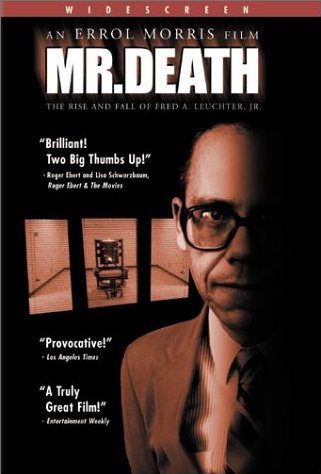 “Have you ever seen a man’s brains?” That question is asked by one of several old eccentrics who populate Vernon, Florida, the town after which Errol Morris named his second documentary feature in 1981. It is a question that has been at the heart of just about every film Morris has made; he seems fascinated, even haunted, by the question of how the mind works. He explored that theme in his recent docu-poem Fast, Cheap & Out of Control (1997). It also provides the key to what seems at first like a meandering digression in Morris’s most celebrated film, The Thin Blue Line (1988). Near the end of that documentary, about an innocent man who was sent to prison and almost executed for a murder he didn’t commit, Morris lets another man, David Harris, talk about his own childhood. It was Harris’s accusations that prompted the police to arrest the innocent man in the first place; now that Harris himself is on death row for another murder, he all but admits to Morris that he committed the original crime himself. For most viewers, the case is closed, the story told. Yet Morris lets Harris go on and trace his reckless behavior back to his youth. “I wasn’t doing nothing but hurting myself,” Harris concludes.
This “tangent” begins to make sense when you realize that Morris is interested not only in objective knowledge — knowledge of what has transpired in the outside world — but also in what we might call subjective knowledge, or knowledge about oneself. When I interviewed Morris for this magazine two years ago, he called Harris’s epiphany “one of the most ironic lines I’ve ever put on film, and people never comment on it. . . . Whenever I hear the line, I think, ‘Not quite, David. Others as well.’ This moment of self-knowledge seems to be a moment of self-deception.”
Self-knowledge and self-deception, and the ways in which they intersect with one’s objective knowledge, are the subjects of Morris’s newest film, Mr. Death: The Rise and Fall of Fred A. Leuchter Jr. Leuchter wrote the infamous “Leuchter Report,” a document widely cited by Holocaust deniers, in which he argued that the gas chambers at Auschwitz, Birkenau, and Majdanek were not in fact used for that purpose. Morris provides plenty of evidence to refute Leuchter’s conclusions, but he is more interested in the character of Leuchter himself, and in the workings of Leuchter’s mind — which, when all is said and done, remain as mysterious as they ever were.
Leuchter first made a name for himself as an expert on electric chairs, gallows, and other capital-punishment devices. Leuchter’s father was the superintendent of transportation for a couple of prisons in Massachusetts, and Leuchter grew up visiting the guards and the inmates in those prisons as he accompanied his father to work. The inmates taught him how to pick locks and crack safes; the guards let him sit in the electric chair. By the time he was an adult, Leuchter became concerned with what he calls the “deplorable condition” of execution equipment, and he designed and built a chair for the state of Tennessee which, he says with professional pride, respected the human dignity of executioner and “executee” alike. He went on to design not only lethal-injection machines (commissioned by the state of New Jersey) but gallows and gas chambers as well.
It was Leuchter’s familiarity with gas chambers that caught the attention of Ernst Zundel, a Canadian Holocaust denier who hired Leuchter to go to Poland and study the gas chambers at Auschwitz and Birkenau. Leuchter did this, apparently, by covertly chipping off bits of wall and floor and placing them in tagged plastic bags. He then sent these samples to labs in the States, with instructions to test them for cyanide residue; when the tests came back negative, Leuchter decided that no executions had taken place in the concentration camps, and, in 1988, he wrote his now-notorious report.
The public reaction to Leuchter’s report is one of the film’s most instructive aspects. Consider, for example, the response of Robert-Jan Van Pelt, an expert on the Holocaust and one of the film’s other interviewees. “Auschwitz is like the Holy of Holies,” he says. “I prepared years to go there, and to have a fool come in, come in completely unprepared — it’s sacrilege. Somebody who walks into the Holy of Holies and doesn’t give a damn.” Fortunately, Van Pelt does not leave it at that; he presents a good deal of evidence that Leuchter, who knows no German and little history, apparently overlooked, including Nazi blueprints that clearly indicate that the gas chambers were, indeed, instruments of mass execution.1
But I must confess there is something about Van Pelt’s statement that rubs me the wrong way. In history, as in other scientific pursuits, nothing is inherently sacred: every theory is open to revision, provided that the revision accounts for all the available evidence and explains it better than all other theories. I believe in the resurrection of Jesus, for example, not because people have invested a great deal of religious sentiment in it, but because I believe the historical evidence points in that direction. Leuchter’s problem is not that he “doesn’t give a damn” about “the Holy of Holies,” but that he never pays adequate attention to the evidence.
Ironically, the doubters who trouble us most can, in the end, play a part in confirming our beliefs. In an impassioned essay for Harper’s magazine, “In Defense of Prejudice,” Jonathan Rauch went so far as to suggest that Leuchter and his associates did our collective memory of the Holocaust a favor. “I know of no modern idea more ugly and stupid than that the Holocaust never happened, nor any idea more viciously motivated,” Rauch wrote. “Yet the deniers’ claims that the Auschwitz gas chambers could not have worked led to closer study and, in 1993, research showing, at last, how they actually did work. Thanks to prejudice and stupidity, another opening for doubt has been shut.”2
That’s all very well and good for society as a whole, but we are still left with the nagging question of how we should regard those people who do not see the evidence as we do. Leuchter appears sincere in his beliefs, though they have cost him both his marriage and his livelihood. In one of the film’s several morbidly funny asides, Leuchter says he’s still looking for a buyer to take half of a lethal-injection machine off of his hands; he was repairing it for the state of Delaware when they cut off all contact with him. (This sort of ostracism may have driven Leuchter even deeper into the bosom of the Holocaust deniers.)
Morris ends the film on a familiar note, letting his protagonist discuss his childhood in a way that hints at the depth of his own self-deception. Leuchter tells the story of a boy who, like Leuchter, visited the prison with his father and sat in the electric chair; some years later, the boy, now a man, was convicted of murder and executed in that same chair. Legend had it that there was now a curse on boys who sat in the chair. But Leuchter, instead of becoming one of the chair’s victims, ended up making the chairs himself. “So maybe the legend got turned around,” he says, “and maybe we created a new legend, and some good came out of it after all.”
Is Leuchter a self-deluded simpleton who hungers for the spotlight? Is he an honest truth-seeker with a very big blind spot? Is he the deserving victim of his own hubris? Were his views determined, as Van Pelt suggests, by his poor choice of friends? In the end, it’s impossible to say for sure.
Peter T. Chattaway writes about movies for a number of American and Canadian publications.
1. In addition to the evidence compiled by Van Pelt, Morris interviews Jim Roth, one of the scientists at the lab that tested Leuchter’s samples for cyanide residue. Roth reveals that the tests do not support Leuchter’s report: unaware of Leuchter’s intentions, the lab did not look for cyanide on the surface of the bricks, as it should have, but in the samples as a whole, crushing them and diluting any potential surface residue by a factor of 10,000 or more.
2. Harper’s, May 1995, p. 39.
— A version of this article first appeared in Books & Culture*.*
Next Post

January 28, 2000 Review: Topsy-Turvy (dir. Mike Leigh, 1999)
Browse Our Archives
Select a Category Anglican Planet Articles BC Christian News BC Report Bible Movies Bible Review Blog Books & Culture Campus Times CBC Radio Christianity Today ChristianWeek Essays Faith Today Festival Cinemas Guide Film Journals Georgia Straight Interviews MB Herald National Catholic Register Salvationist Today's Christian Two Chairs Ubyssey Uncategorized Vancouver Courier Vancouver Sun
Select a Month August 2025 April 2025 January 2025 December 2024 November 2024 May 2024 February 2024 December 2023 May 2023 March 2023 November 2022 July 2022 June 2022 May 2022 April 2022 February 2022 January 2022 December 2021 November 2021 October 2021 September 2021 August 2021 July 2021 June 2021 April 2021 March 2021 February 2021 January 2021 December 2020 November 2020 October 2020 August 2020 July 2020 June 2020 May 2020 March 2020 February 2020 January 2020 December 2019 November 2019 September 2019 July 2019 May 2019 April 2019 March 2019 February 2019 January 2019 December 2018 November 2018 October 2018 September 2018 July 2018 June 2018 May 2018 April 2018 March 2018 February 2018 January 2018 December 2017 November 2017 October 2017 September 2017 August 2017 July 2017 June 2017 May 2017 April 2017 March 2017 February 2017 January 2017 December 2016 November 2016 October 2016 September 2016 August 2016 July 2016 June 2016 May 2016 April 2016 March 2016 February 2016 January 2016 December 2015 November 2015 October 2015 September 2015 August 2015 July 2015 June 2015 May 2015 April 2015 March 2015 February 2015 January 2015 December 2014 November 2014 October 2014 September 2014 August 2014 July 2014 June 2014 May 2014 April 2014 March 2014 February 2014 January 2014 December 2013 November 2013 October 2013 September 2013 August 2013 July 2013 June 2013 May 2013 April 2013 March 2013 February 2013 January 2013 December 2012 November 2012 October 2012 September 2012 August 2012 July 2012 June 2012 April 2012 January 2012 January 2011 December 2010 November 2010 October 2010 September 2010 August 2010 July 2010 June 2010 May 2010 April 2010 March 2010 February 2010 January 2010 December 2009 November 2009 October 2009 September 2009 August 2009 July 2009 June 2009 May 2009 April 2009 March 2009 February 2009 January 2009 December 2008 November 2008 October 2008 September 2008 August 2008 July 2008 June 2008 May 2008 April 2008 March 2008 February 2008 January 2008 December 2007 November 2007 October 2007 September 2007 August 2007 July 2007 June 2007 May 2007 April 2007 March 2007 February 2007 January 2007 December 2006 November 2006 October 2006 September 2006 August 2006 July 2006 June 2006 May 2006 April 2006 March 2006 February 2006 January 2006 December 2005 November 2005 October 2005 September 2005 August 2005 July 2005 June 2005 May 2005 April 2005 March 2005 January 2005 December 2004 November 2004 October 2004 September 2004 August 2004 July 2004 June 2004 May 2004 April 2004 March 2004 February 2004 January 2004 November 2003 October 2003 August 2003 July 2003 June 2003 May 2003 January 2003 December 2002 November 2002 August 2002 July 2002 June 2002 May 2002 March 2002 January 2002 December 2001 November 2001 September 2001 August 2001 July 2001 June 2001 April 2001 March 2001 February 2001 December 2000 November 2000 October 2000 September 2000 August 2000 July 2000 June 2000 May 2000 April 2000 March 2000 January 2000 October 1999 August 1999 May 1999 April 1999 February 1999 January 1999 December 1998 November 1998 October 1998 August 1998 July 1998 June 1998 April 1998 March 1998 January 1998 November 1997 September 1997 July 1997 June 1997 April 1997 March 1997 February 1997 January 1997 December 1996 October 1996 September 1996 June 1996 March 1996 February 1996 January 1996 April 1995 November 1994 September 1994 September 1991
Follow Us!
TAKE THE
Religious Wisdom Quiz
What nation conquered the Northern Kingdom of Israel?
Select your answer to see how you score.
Assyria Babylon Philistia Egypt
Related posts from FilmChat


An African Jesus / Reimagined as a political...

The Arts & Faith Top 25 Films on...

TRENDING AT PATHEOS Religious Music & Entertainment

"Les Diabolique" and Transgression
Alongside something like Arrival, Vertigo, or Charade, Les Diaboliques is a...

"The Plague Dogs" and Mortality
So, flashback to the late 70s, early 80s. Walt Disney Studios is...

With the recent and highly successful release of Christopher Nolan’s epic film,...

"L'avventura" and Human Weakness
Today's piece is going to be a little different for a few...

I first want to apologize for not posting or writing anything. I'm...

I've engaged in the multi-year project of reading through the Church Fathers,...
view all Religious Music & Entertainment blogs
Ad-Free & Subscriber Log-In Subscription Support
- About Us
- 2026 Calendar
- Videos
- Podcasts
- Library of World Religions
- Faith In Media Tracker
- Advertise With Us
- Write for Us
- Privacy Policy
- Terms of Service
- Do Not Sell My Data
- Contact Us
- Radiant Digital
- Manage Newsletter Subscriptions
- Unsubscribe From Notifications
- Sitemap
Copyright 2008-2026, Patheos. All rights reserved.
Subscription Support Ad-Free & Subscriber Log-In
Follow Patheos