
BuddhistCatholicContemplativeEvangelicalGeneral ChristianHinduJewishLatter-day SaintMuslimNew VisionsProgressive Christian
Beliefs
- Buddhist
- Catholic
- Contemplative
- Evangelical
- General Christian
- Hindu
- Jewish
- Latter-day Saint
- More Voices
- Muslim
- New Visions
- Pagan
- Progressive Christian
Topics
- Religion News
- Food and Religion
- Sports and Religion
- Religious Art
- Religious Music and Entertainment
- Religious Events
- History and Religion
- Style and Religion
- Politics and Religion
- Women in Religion
- Recreation Outdoors and Religion
- Business Finance and Religion
- Careers Workplace and Religion
- Education and Religion
- Family Parenting and Religion
- Health Fitness and Religion
- Home and Religion
- Relationships and Religion
- Technology and Religion
- Travel and Religion
Columnists
- Buddhist Columnists
- Business Finance and Religion Columnists
- Careers Workplace and Religion Columnists
- Catholic Columnists
- Contemplative Columnists
- Education and Religion Columnists
- Evangelists Columnists
- Family Parenting and Religion Columnists
- General Christian Columnists
- Health Fitness and Religion Columnists
- Hindu Columnists
- History and Religion Columnists
- Home and Religion Columnists
- Jewish Columnists
- More Voices Columnists
- Latter Day Columnists
- Muslim Columnists
- New Visions Columnists
- Nonreligious Columnists
- Pagan Columnists
- Politics and Religion Columnists
- Progressive Columnists
- Recreation Outdoors and Religion Columnists
- Relationships and Religion Columnists
- Religion News Columnists
- Religious Art Columnists
- Religious Events Columnists
- Religious Music and Entertainment Columnists
- Sports and Religion Columnists
- Style and Religion Columnists
- Technology and Religion Columnists
- Travel and Religion Columnists
- Women in Religion Columnists
Resource Library
- 2026 Calendar
- Library of World Religions
- The 100 Most Holy Places on Earth
- Patheos Answers
- Podcasts
- Videos
- Faith Leaders Database
- Anglican Episcopalian
- Bahai
- Baptist
- Buddhism
- Christianity
- Confucianism
- Eastern Orthodoxy
- Hinduism
- Holiness and Pentecostal
- ISKCON
- Islam
- Judaism
- Lutheran
- Methodist
- The Church of Jesus Christ of Latter-day Saints
- New Age
- Paganism
- Presbytarian and Reformed
- Protestantism
- Religion Behind the Scenes
- Roman Catholic
- Scientology
- Shia Islam
- Sikhism
- Sufism
- Sunni Islam
- Taoism
- Zen
- See all religions
Research Tools
 Ad-Free & Subscriber Log-In Subscription Support
Ad-Free & Subscriber Log-In Subscription Support
Follow Patheos 

- Trending:
- Forgiveness
- |
- Marriage
- |
- Consciousness
- |
- Death Penalty
- |
- Election
- |
- Halloween

-
Articles
- Home
- Religious Music & Entertainment
- Review: The Matrix (dir. the Wachowskis, 1999)
Review: The Matrix (dir. the Wachowskis, 1999)
Last updated on: April 2, 2014 at 6:57 pm by Peter T. Chattaway
Review: The Matrix (dir. the Wachowskis, 1999) 2014-04-02T18:57:45-07:00 Peter T. Chattaway
Patheos Explore the world's faith through different perspectives on religion and spirituality! Patheos has the views of the prevalent religions and spiritualities of the world.
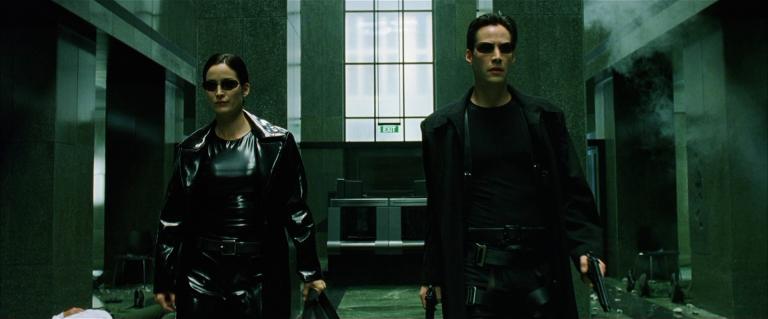 REALITY ISN’T what it used to be. For whatever reason — premillennial anxiety, post-modern rootlessness, the increasing verisimilitude of special effects — filmmakers are increasingly obsessed with the notion that the real world is, in fact, unreal. Last year gave us The Truman Show and Dark City, in which human protagonists awoke to discover they were trapped in cages under someone else’s watchful eye. Similar themes may surface next month in The Thirteenth Floor.
The Matrix is one of the more visually inventive entries in this genre, and it is already the year’s biggest success story, having raked in over $120 million in just a few weeks. (Like Payback and Analyze This, the next-biggest hits of the year, The Matrix is rated R, which would seem to put the lie to conservative claims that PG-rated fare does best at the box office.)
Moreover, people are not only seeing this film, and seeing it more than once; they are talking about it, and about the ideas it explores. For all its comic-book action, The Matrix also comes closer than its implicitly Gnostic predecessors to espousing an explicit theology of sorts, and it even throws in a few biblical references for good measure.
In fact, I can’t remember the last time I saw a Christ figure as fully developed as Neo (Keanu Reeves), the hacker with a regular office job who gets into trouble with some suspiciously lifeless government agents. Help comes in the form of shadowy figures with names like Morpheus (Laurence Fishburne) and Trinity (Carrie-Anne Moss), who tell Neo that he’s living inside something called “the matrix” — a world in which work, church and other alleged avenues of conformity have conspired to hide from him the fact that he was “born a slave.”
Morpheus offers Neo the chance to learn the truth about his world, and Neo accepts — discovering, in one of the most unexpectedly freaky sequences in recent memory, that he is one of billions of people trapped in gooey, amniotic pods and attached, through cables that plug into their bodies at nearly every joint, to a global computer network.
Humanity, it turns out, faced a crisis in the 21st century when its machines became too intelligent; humans “scorched the sky” to deprive the machines of their solar power, and in return the machines decided to feed off of the human body’s bio-electricity, effectively turning people into batteries. And, to keep their subjects distracted, the machines have programmed an artificial shared reality into everybody’s minds.
Morpheus is the leader of a real-world resistance group stationed aboard a hovercraft named the Nebuchadnezzar, with ties to a humans-only refuge called Zion. He suspects that Neo may be “the one,” the person who, it was foretold, would have an innate ability to manipulate the artificial universe from within, provided that he knew how to harness his own powers. And so Neo’s training begins.
The Wachowski brothers are certainly a stylish pair of directors. Nearly every shot is a carefully composed, digitally enhanced, cyberpunk labor of love. Indeed, the film’s flashy artificiality threatens at times to overwhelm whatever substance the film does have. But ultimately, it points to a higher reality, albeit one with questionable elements.
Early on, Morpheus asks Neo if he believes in fate. Neo says no, because he doesn’t like the idea that he is not in control of his life. But even after Neo leaves “the matrix” behind and enters the so-called real world, he finds there are still forces beyond his control, guiding his every move with, perhaps, the help of a miracle or two.
Unfortunately, the real world also turns out to be a rather depressing place: if you’re not on the run from killer robots, you’re eating bland, tasteless food. One character cuts a deal with the machines, offering to betray his comrades in exchange for a cushy life back in “the matrix.” He argues, not unreasonably, that if life is nothing more than a series of sensory experiences — if, as Pink Floyd put it, all you touch and all you see is all your life will ever be — then the relatively consistent pleasures of “the matrix” are preferable to real life.
The film, however, ultimately casts its lot with the real world, and largely because its heroes are in touch with an even higher reality. But they face a different sort of temptation, namely the smug superiority that comes with their special form of knowledge. The liberated humans aren’t all that fond of their captive brethren — one refers to them, derisively, as “coppertops” — and the film climaxes with a series of over-the-top battle scenes in which Neo kills dozens of his fellow humans without giving the moral implications of his actions any real thought. (Even Terminator 2 took time to assert that killing people is wrong.)
Moreover, one resistance fighter espouses the view, common to other neo-Gnostic films, that spontaneity is the key to freedom: “To deny our own impulses is to deny the thing that makes us human,” he says. The film ends by laying its philosophical cards on the table: the ideal world, we are told, is one “without rules or controls, without borders or boundaries.”
But this is inadequate, to say the least; without borders, how can we know which impulses are right and which are wrong?
Morpheus is right in one respect: we are born slaves, but we are slaves to our own sinful nature, and without a savior — preferably one who’s got better things on his mind than blowing us away — no amount of self-indulgence can set us free.
— A version of this article was first published in BC Christian News*.*
Previous Post

May 1, 1999
Review: The Meaning of Jesus: Two Visions
Next Post
May 11, 1999 Review: The Dreamlife of Angels (dir. Erick Zonca, 1998)
Browse Our Archives
Select a Category Anglican Planet Articles BC Christian News BC Report Bible Movies Bible Review Blog Books & Culture Campus Times CBC Radio Christianity Today ChristianWeek Essays Faith Today Festival Cinemas Guide Film Journals Georgia Straight Interviews MB Herald National Catholic Register Salvationist Today's Christian Two Chairs Ubyssey Uncategorized Vancouver Courier Vancouver Sun
Select a Month August 2025 April 2025 January 2025 December 2024 November 2024 May 2024 February 2024 December 2023 May 2023 March 2023 November 2022 July 2022 June 2022 May 2022 April 2022 February 2022 January 2022 December 2021 November 2021 October 2021 September 2021 August 2021 July 2021 June 2021 April 2021 March 2021 February 2021 January 2021 December 2020 November 2020 October 2020 August 2020 July 2020 June 2020 May 2020 March 2020 February 2020 January 2020 December 2019 November 2019 September 2019 July 2019 May 2019 April 2019 March 2019 February 2019 January 2019 December 2018 November 2018 October 2018 September 2018 July 2018 June 2018 May 2018 April 2018 March 2018 February 2018 January 2018 December 2017 November 2017 October 2017 September 2017 August 2017 July 2017 June 2017 May 2017 April 2017 March 2017 February 2017 January 2017 December 2016 November 2016 October 2016 September 2016 August 2016 July 2016 June 2016 May 2016 April 2016 March 2016 February 2016 January 2016 December 2015 November 2015 October 2015 September 2015 August 2015 July 2015 June 2015 May 2015 April 2015 March 2015 February 2015 January 2015 December 2014 November 2014 October 2014 September 2014 August 2014 July 2014 June 2014 May 2014 April 2014 March 2014 February 2014 January 2014 December 2013 November 2013 October 2013 September 2013 August 2013 July 2013 June 2013 May 2013 April 2013 March 2013 February 2013 January 2013 December 2012 November 2012 October 2012 September 2012 August 2012 July 2012 June 2012 April 2012 January 2012 January 2011 December 2010 November 2010 October 2010 September 2010 August 2010 July 2010 June 2010 May 2010 April 2010 March 2010 February 2010 January 2010 December 2009 November 2009 October 2009 September 2009 August 2009 July 2009 June 2009 May 2009 April 2009 March 2009 February 2009 January 2009 December 2008 November 2008 October 2008 September 2008 August 2008 July 2008 June 2008 May 2008 April 2008 March 2008 February 2008 January 2008 December 2007 November 2007 October 2007 September 2007 August 2007 July 2007 June 2007 May 2007 April 2007 March 2007 February 2007 January 2007 December 2006 November 2006 October 2006 September 2006 August 2006 July 2006 June 2006 May 2006 April 2006 March 2006 February 2006 January 2006 December 2005 November 2005 October 2005 September 2005 August 2005 July 2005 June 2005 May 2005 April 2005 March 2005 January 2005 December 2004 November 2004 October 2004 September 2004 August 2004 July 2004 June 2004 May 2004 April 2004 March 2004 February 2004 January 2004 November 2003 October 2003 August 2003 July 2003 June 2003 May 2003 January 2003 December 2002 November 2002 August 2002 July 2002 June 2002 May 2002 March 2002 January 2002 December 2001 November 2001 September 2001 August 2001 July 2001 June 2001 April 2001 March 2001 February 2001 December 2000 November 2000 October 2000 September 2000 August 2000 July 2000 June 2000 May 2000 April 2000 March 2000 January 2000 October 1999 August 1999 May 1999 April 1999 February 1999 January 1999 December 1998 November 1998 October 1998 August 1998 July 1998 June 1998 April 1998 March 1998 January 1998 November 1997 September 1997 July 1997 June 1997 April 1997 March 1997 February 1997 January 1997 December 1996 October 1996 September 1996 June 1996 March 1996 February 1996 January 1996 April 1995 November 1994 September 1994 September 1991
Follow Us!
TAKE THE
Religious Wisdom Quiz
Who said, "Let not your hearts be troubled"?
Select your answer to see how you score.
Jesus Peter John Paul
Related posts from FilmChat

Sidney Poitier marathon: Ghost Dad (1990) - Separate...

The New World a feast for the senses...

Review: Revelation (dir. André van Heerden, 1999)
Review: The Chronicles of Narnia: The Lion, the...
TRENDING AT PATHEOS Religious Music & Entertainment

"Les Diabolique" and Transgression
Alongside something like Arrival, Vertigo, or Charade, Les Diaboliques is a...

"The Plague Dogs" and Mortality
So, flashback to the late 70s, early 80s. Walt Disney Studios is...

With the recent and highly successful release of Christopher Nolan’s epic film,...

"L'avventura" and Human Weakness
Today's piece is going to be a little different for a few...

I first want to apologize for not posting or writing anything. I'm...

I've engaged in the multi-year project of reading through the Church Fathers,...
view all Religious Music & Entertainment blogs
Ad-Free & Subscriber Log-In Subscription Support
- About Us
- 2026 Calendar
- Videos
- Podcasts
- Library of World Religions
- Faith In Media Tracker
- Advertise With Us
- Write for Us
- Privacy Policy
- Terms of Service
- Do Not Sell My Data
- Contact Us
- Radiant Digital
- Manage Newsletter Subscriptions
- Unsubscribe From Notifications
- Sitemap
Copyright 2008-2026, Patheos. All rights reserved.
Subscription Support Ad-Free & Subscriber Log-In
Follow Patheos