
BuddhistCatholicContemplativeEvangelicalGeneral ChristianHinduJewishLatter-day SaintMuslimNew VisionsProgressive Christian
Beliefs
- Buddhist
- Catholic
- Contemplative
- Evangelical
- General Christian
- Hindu
- Jewish
- Latter-day Saint
- More Voices
- Muslim
- New Visions
- Pagan
- Progressive Christian
Topics
- Religion News
- Food and Religion
- Sports and Religion
- Religious Art
- Religious Music and Entertainment
- Religious Events
- History and Religion
- Style and Religion
- Politics and Religion
- Women in Religion
- Recreation Outdoors and Religion
- Business Finance and Religion
- Careers Workplace and Religion
- Education and Religion
- Family Parenting and Religion
- Health Fitness and Religion
- Home and Religion
- Relationships and Religion
- Technology and Religion
- Travel and Religion
Columnists
- Buddhist Columnists
- Business Finance and Religion Columnists
- Careers Workplace and Religion Columnists
- Catholic Columnists
- Contemplative Columnists
- Education and Religion Columnists
- Evangelists Columnists
- Family Parenting and Religion Columnists
- General Christian Columnists
- Health Fitness and Religion Columnists
- Hindu Columnists
- History and Religion Columnists
- Home and Religion Columnists
- Jewish Columnists
- More Voices Columnists
- Latter Day Columnists
- Muslim Columnists
- New Visions Columnists
- Nonreligious Columnists
- Pagan Columnists
- Politics and Religion Columnists
- Progressive Columnists
- Recreation Outdoors and Religion Columnists
- Relationships and Religion Columnists
- Religion News Columnists
- Religious Art Columnists
- Religious Events Columnists
- Religious Music and Entertainment Columnists
- Sports and Religion Columnists
- Style and Religion Columnists
- Technology and Religion Columnists
- Travel and Religion Columnists
- Women in Religion Columnists
Resource Library
- 2026 Calendar
- Library of World Religions
- The 100 Most Holy Places on Earth
- Patheos Answers
- Podcasts
- Videos
- Faith Leaders Database
- Anglican Episcopalian
- Bahai
- Baptist
- Buddhism
- Christianity
- Confucianism
- Eastern Orthodoxy
- Hinduism
- Holiness and Pentecostal
- ISKCON
- Islam
- Judaism
- Lutheran
- Methodist
- The Church of Jesus Christ of Latter-day Saints
- New Age
- Paganism
- Presbytarian and Reformed
- Protestantism
- Religion Behind the Scenes
- Roman Catholic
- Scientology
- Shia Islam
- Sikhism
- Sufism
- Sunni Islam
- Taoism
- Zen
- See all religions
Research Tools
 Ad-Free & Subscriber Log-In Subscription Support
Ad-Free & Subscriber Log-In Subscription Support
Follow Patheos 

- Trending:
- Forgiveness
- |
- Marriage
- |
- Consciousness
- |
- Death Penalty
- |
- Election
- |
- Halloween

-
Articles
- Home
- Religious Music & Entertainment
- Artificial Life
Artificial Life
Last updated on: February 5, 2013 at 10:38 am by Peter T. Chattaway
Artificial Life 2013-02-05T10:38:23-08:00 Peter T. Chattaway
Patheos Explore the world's faith through different perspectives on religion and spirituality! Patheos has the views of the prevalent religions and spiritualities of the world.
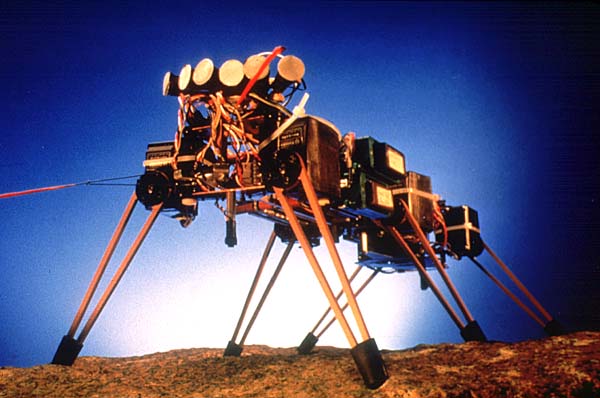 Human beings, as C. S. Lewis once put it, are amphibious creatures. We are both creations and creators; we follow instincts and hungers we cannot control, one of which is the impulse to make things in our image just as God made us in his. And so we feel a kinship with nature, as well as a pride of sorts in the things we create, yet they fill us with anxiety too.
Filmmaker Errol Morris, in a small but impressive body of work, has spent the past two decades exploring these issues, and his latest film, Fast, Cheap & Out of Control, is perhaps his most intricate and stimulating yet. In the film, Morris considers the worlds of animals and robots and asks how different we are from either of them. Are we, as computer scientist Marvin Minsky has said, simply machines made of meat?
This theme can be traced through Morris’s films back to his earliest works. In his first documentary, Gates of Heaven (1978) — dubbed by Roger Ebert one of the ten best films of all time — an offbeat look at the pet cemetery business becomes a melancholy study of, among other things, the relationship between humans and animals and the loss of one’s dreams. Scottie Harbert, co-owner of the Bubbling Well Pet Memorial Park in California, gives the film its title when she declares that an all-compassionate God would never deny dogs and cats access to the heavenly rewards of their masters. Vernon, Florida (1981) ventures into even more explicitly, if increasingly eccentric, theological territory. One elderly man looks forward to the day when Christ will return to end the world — the world of politicians, that is, who ought to be tarred and feathered and run out of town!
The Thin Blue Line (1988), arguably Morris’s masterpiece, is perhaps his least typical work inasmuch as it follows an unusually strong narrative with nary a trace of religious or metaphysical content. Nevertheless, The Thin Blue Line is ultimately of a piece with Morris’s other epistemological inquiries; indeed, in its own way it is the most urgent of them, for it demonstrates that an innocent man (Randall Adams) was sent to prison and almost executed for a murder he did not commit. (After the film’s release, Adams was released and his conviction overturned.) Morris was not simply content to prove Adams’s innocence; he was equally interested in why everyone fingered the wrong man, and so his interviews probed the dreams and aspirations that motivated the witnesses, police officers, lawyers, and judges who were involved in the original case.
In The Thin Blue Line, Morris also introduced a few new elements to his filmmaking palette: dramatic recreations, highly stylized cinematography, footage from cheesy adventure movies, and a mesmerizing soundtrack, in this case courtesy of Philip Glass. Morris developed these techniques further in A Brief History of Time (1992), punching up an otherwise standard adaptation of Stephen Hawking’s book, and in Fast, Cheap & Out of Control, they take on a life of their own, thanks in part to the wildly experimental cinematography (by Robert Richardson, a regular on Oliver Stone’s films) and a quizzical musical score (by the Alloy Orchestra’s Caleb Sampson).
Unlike Morris’s other films, which were held together by at least a nominal subject (a cemetery, a town, a murder, a book), Fast, Cheap & Out of Control is divided between four interviewees who at first glance would appear to have nothing in common, apart from an interest in animals: Dave Hoover, a lion tamer; George Mendonça, a topiary gardener who shapes fauna out of flora; Ray Mendez, a photographer obsessed with naked mole rats; and Rodney Brooks, a scientist at MIT who programs robots according to principles he observes in insect behavior and then studies how the robots interact with each other socially. The links Morris builds between these men are, at times, somewhat tenuous, but a complicated pattern of sorts does emerge.
As noted, Morris has long been fascinated by the blurring of traditional distinctions between humans on the one hand and animals and robots on the other. In Gates of Heaven, Scottie Harbert moves in that direction and appears to take comfort in it when she grants immortal souls to domestic pets; her son Philip, a former insurance salesman who espouses the teachings of motivational counselors, remarks with equanimity that the mind is just like a computer.
But for Rodney Brooks, the robotics expert, such thoughts become cause for despair. Just as Hawking asked what place there was for God in his model of the universe, Brooks suspects that his model for studying the mind may leave no room for the soul (though he does not use the word). Marveling at how closely his robots, acting on the feedback loops he has programmed into them, resemble the insects that inspired him, Brooks remarks, “Maybe that’s all there is.”
And so Brooks, like the other interviewees, seeks to create meaning through his work. For Brooks, that means creating “silicon-based life,” forms of intelligence that will outlive the human race but never quite experience the “embodied” intelligence of humans and animals. Hoover, who dabbles in animal psychology himself, dreams of becoming a hero like Clyde Beatty, a famed lion tamer who starred in matinee serials and was himself a throwback to the days of romanticized European explorers. Mendonça, the least self-conscious of the talking heads, finds his pearl of great price in the bushes and hedges he clips and shears year after year, though he knows there will be no one to tend to them when he dies. And Mendez, easily the funniest of the bunch, says that his obsession with naked mole rats is both a quest for “self-knowledge” and a search for “the other,” for a form of consciousness both similar to and different from his own. Looking straight into the camera, Mendez defines his relationship with the hairless rodents in almost Buberesque terms: “[It’s] that feeling that you are in the presence of life that exists irrelevant of yourself…. The animal is actually looking at you, and you feel that there is a moment of contact: I know you are. You know I am.”
In an interview with Books & Culture, Morris said he was inclined to agree with Brooks and to regard traditional notions of self-knowledge as a form of “illusion” and “self-deception.” Pointing to instances of this theme in his previous films, Morris also cited a scene in Fast, Cheap & Out of Control in which Hoover explains how his wild animals stay content behind their bars: “They don’t really consider themselves caged. Outside the cage is the cage. Inside is their world.”
“That’s one of my favorite lines in the movie,” Morris said, and he suggested that we humans live in cages of our own as well:
Inside is our world, in Rodney’s musings, of mind and soul and intentionality, where outside the cage is maybe this kind of cruel reality of simple feedback loops. One of the reasons I like some of the shots in the circus is that that world does look robotic in nature, or the insect world looks robotic in nature, or the mole rat world looks robotic in nature. But even if the world were meaningless in that sense, if we were all robots, then there’s something deeply mysterious about each one of us in the process of trying to replicate and create life, as if there’s some kind of progress into the future, as if it’s our destiny to be a kind of Doctor Frankenstein, collectively.
Morris prefers not to speculate as to what the answer to that mystery might be, though he readily acknowledges the parallel between his obsessive interviewees and his own drive to make films that explore these issues. And although he himself may doubt it, the very existence of a film such as Fast, Cheap & Out of Control may offer a partial answer. The questions asked here are religious in nature, and Morris sinks his teeth into them with artistic enthusiasm. And, at the risk of anthropocentric snobbery, it is precisely this passion to understand and to create that distinctively characterizes human intelligence.
Peter T. Chattaway reviews films regularly for several Canadian publications.
— A version of this article first appeared in Books & Culture*.*
Previous Post

November 30, 1997
Review: Fast, Cheap & Out of Control (dir. Errol Morris, 1997)
Next Post
January 16, 1998 Review: Fallen (dir. Gregory Hoblit, 1998)
Browse Our Archives
Select a Category Anglican Planet Articles BC Christian News BC Report Bible Movies Bible Review Blog Books & Culture Campus Times CBC Radio Christianity Today ChristianWeek Essays Faith Today Festival Cinemas Guide Film Journals Georgia Straight Interviews MB Herald National Catholic Register Salvationist Today's Christian Two Chairs Ubyssey Uncategorized Vancouver Courier Vancouver Sun
Select a Month August 2025 April 2025 January 2025 December 2024 November 2024 May 2024 February 2024 December 2023 May 2023 March 2023 November 2022 July 2022 June 2022 May 2022 April 2022 February 2022 January 2022 December 2021 November 2021 October 2021 September 2021 August 2021 July 2021 June 2021 April 2021 March 2021 February 2021 January 2021 December 2020 November 2020 October 2020 August 2020 July 2020 June 2020 May 2020 March 2020 February 2020 January 2020 December 2019 November 2019 September 2019 July 2019 May 2019 April 2019 March 2019 February 2019 January 2019 December 2018 November 2018 October 2018 September 2018 July 2018 June 2018 May 2018 April 2018 March 2018 February 2018 January 2018 December 2017 November 2017 October 2017 September 2017 August 2017 July 2017 June 2017 May 2017 April 2017 March 2017 February 2017 January 2017 December 2016 November 2016 October 2016 September 2016 August 2016 July 2016 June 2016 May 2016 April 2016 March 2016 February 2016 January 2016 December 2015 November 2015 October 2015 September 2015 August 2015 July 2015 June 2015 May 2015 April 2015 March 2015 February 2015 January 2015 December 2014 November 2014 October 2014 September 2014 August 2014 July 2014 June 2014 May 2014 April 2014 March 2014 February 2014 January 2014 December 2013 November 2013 October 2013 September 2013 August 2013 July 2013 June 2013 May 2013 April 2013 March 2013 February 2013 January 2013 December 2012 November 2012 October 2012 September 2012 August 2012 July 2012 June 2012 April 2012 January 2012 January 2011 December 2010 November 2010 October 2010 September 2010 August 2010 July 2010 June 2010 May 2010 April 2010 March 2010 February 2010 January 2010 December 2009 November 2009 October 2009 September 2009 August 2009 July 2009 June 2009 May 2009 April 2009 March 2009 February 2009 January 2009 December 2008 November 2008 October 2008 September 2008 August 2008 July 2008 June 2008 May 2008 April 2008 March 2008 February 2008 January 2008 December 2007 November 2007 October 2007 September 2007 August 2007 July 2007 June 2007 May 2007 April 2007 March 2007 February 2007 January 2007 December 2006 November 2006 October 2006 September 2006 August 2006 July 2006 June 2006 May 2006 April 2006 March 2006 February 2006 January 2006 December 2005 November 2005 October 2005 September 2005 August 2005 July 2005 June 2005 May 2005 April 2005 March 2005 January 2005 December 2004 November 2004 October 2004 September 2004 August 2004 July 2004 June 2004 May 2004 April 2004 March 2004 February 2004 January 2004 November 2003 October 2003 August 2003 July 2003 June 2003 May 2003 January 2003 December 2002 November 2002 August 2002 July 2002 June 2002 May 2002 March 2002 January 2002 December 2001 November 2001 September 2001 August 2001 July 2001 June 2001 April 2001 March 2001 February 2001 December 2000 November 2000 October 2000 September 2000 August 2000 July 2000 June 2000 May 2000 April 2000 March 2000 January 2000 October 1999 August 1999 May 1999 April 1999 February 1999 January 1999 December 1998 November 1998 October 1998 August 1998 July 1998 June 1998 April 1998 March 1998 January 1998 November 1997 September 1997 July 1997 June 1997 April 1997 March 1997 February 1997 January 1997 December 1996 October 1996 September 1996 June 1996 March 1996 February 1996 January 1996 April 1995 November 1994 September 1994 September 1991
Follow Us!
TAKE THE
Religious Wisdom Quiz
Where in the Bible can we find the phrase "a time to be born and a time to die"?
Select your answer to see how you score.
Matthew Genesis Ecclesiastes Job
Related posts from FilmChat

An African Jesus / Reimagined as a political...


Your Chip Is Showing / Four recent films...
TRENDING AT PATHEOS Religious Music & Entertainment

"Les Diabolique" and Transgression
Alongside something like Arrival, Vertigo, or Charade, Les Diaboliques is a...

"The Plague Dogs" and Mortality
So, flashback to the late 70s, early 80s. Walt Disney Studios is...

With the recent and highly successful release of Christopher Nolan’s epic film,...

"L'avventura" and Human Weakness
Today's piece is going to be a little different for a few...

I first want to apologize for not posting or writing anything. I'm...

I've engaged in the multi-year project of reading through the Church Fathers,...
view all Religious Music & Entertainment blogs
Ad-Free & Subscriber Log-In Subscription Support
- About Us
- 2026 Calendar
- Videos
- Podcasts
- Library of World Religions
- Faith In Media Tracker
- Advertise With Us
- Write for Us
- Privacy Policy
- Terms of Service
- Do Not Sell My Data
- Contact Us
- Radiant Digital
- Manage Newsletter Subscriptions
- Unsubscribe From Notifications
- Sitemap
Copyright 2008-2026, Patheos. All rights reserved.
Subscription Support Ad-Free & Subscriber Log-In
Follow Patheos