
BuddhistCatholicContemplativeEvangelicalGeneral ChristianHinduJewishLatter-day SaintMuslimNew VisionsProgressive Christian
Beliefs
- Buddhist
- Catholic
- Contemplative
- Evangelical
- General Christian
- Hindu
- Jewish
- Latter-day Saint
- More Voices
- Muslim
- New Visions
- Pagan
- Progressive Christian
Topics
- Religion News
- Food and Religion
- Sports and Religion
- Religious Art
- Religious Music and Entertainment
- Religious Events
- History and Religion
- Style and Religion
- Politics and Religion
- Women in Religion
- Recreation Outdoors and Religion
- Business Finance and Religion
- Careers Workplace and Religion
- Education and Religion
- Family Parenting and Religion
- Health Fitness and Religion
- Home and Religion
- Relationships and Religion
- Technology and Religion
- Travel and Religion
Columnists
- Buddhist Columnists
- Business Finance and Religion Columnists
- Careers Workplace and Religion Columnists
- Catholic Columnists
- Contemplative Columnists
- Education and Religion Columnists
- Evangelists Columnists
- Family Parenting and Religion Columnists
- General Christian Columnists
- Health Fitness and Religion Columnists
- Hindu Columnists
- History and Religion Columnists
- Home and Religion Columnists
- Jewish Columnists
- More Voices Columnists
- Latter Day Columnists
- Muslim Columnists
- New Visions Columnists
- Nonreligious Columnists
- Pagan Columnists
- Politics and Religion Columnists
- Progressive Columnists
- Recreation Outdoors and Religion Columnists
- Relationships and Religion Columnists
- Religion News Columnists
- Religious Art Columnists
- Religious Events Columnists
- Religious Music and Entertainment Columnists
- Sports and Religion Columnists
- Style and Religion Columnists
- Technology and Religion Columnists
- Travel and Religion Columnists
- Women in Religion Columnists
Resource Library
- 2026 Calendar
- Library of World Religions
- The 100 Most Holy Places on Earth
- Patheos Answers
- Podcasts
- Videos
- Faith Leaders Database
- Anglican Episcopalian
- Bahai
- Baptist
- Buddhism
- Christianity
- Confucianism
- Eastern Orthodoxy
- Hinduism
- Holiness and Pentecostal
- ISKCON
- Islam
- Judaism
- Lutheran
- Methodist
- The Church of Jesus Christ of Latter-day Saints
- New Age
- Paganism
- Presbytarian and Reformed
- Protestantism
- Religion Behind the Scenes
- Roman Catholic
- Scientology
- Shia Islam
- Sikhism
- Sufism
- Sunni Islam
- Taoism
- Zen
- See all religions
Research Tools
 Ad-Free & Subscriber Log-In Subscription Support
Ad-Free & Subscriber Log-In Subscription Support
Follow Patheos 

- Trending:
- Forgiveness
- |
- Marriage
- |
- Consciousness
- |
- Death Penalty
- |
- Election
- |
- Halloween

- Home
- New Visions
- The Highest Ethic
The Highest Ethic
Last updated on: October 19, 2020 at 2:13 pm by Mark Nepo
The Highest Ethic 2020-10-19T14:13:31-05:00 Mark Nepo
Patheos Explore the world's faith through different perspectives on religion and spirituality! Patheos has the views of the prevalent religions and spiritualities of the world.
Community is like a large mosaic… a fellowship of… people who together make God visible in the world.
—Henri Nouwen
I slept and dreamt that life was joy.
I awoke and saw that life was service.
I acted and behold, service is joy.
—Rabindranath Tagore
Shared values are not the same thing as shared humanity. Shared values are based on agreements that come from the head. They form the basis of culture. But it’s our shared humanity that is the basis of community. Our shared humanity is rooted in the honest and caring acknowledgment of our firsthand experience. In truth, the ways in which we meet without pretense are the ways we strengthen the bonds that hold us together.
For example, in the support rooms, and waiting rooms, and treatment rooms I was a part of during my cancer journey, we seldom spoke of our religious backgrounds or our politics or worldviews. We were only there to keep each other company, with sensitivity and honesty, so that as many of us as possible could make it through our world of treatments. The highest ethic has always been the courage to be with each other in our pain and to honor each other’s journey. This is what it means to stand in compassion.
During the recession of 2008, banks were foreclosing on homes nationwide, making thousands of families homeless. In Chicago, most of the people being evicted were diligent renters who had no knowledge that their landlords were delinquent with the banks.
In Chicago’s Cook County, law enforcement officers were scheduled to evict residents affected by more than 4,700 foreclosures. This was when Cook County sheriff Thomas Dart put a moratorium on all foreclosure evictions. Sheriff Dart couldn’t support taking the law into his own hands, but, at the same time, he couldn’t put innocent families on the street.
Sheriff Dart said, “It’s one of most gut-wrenching things we do, seeing little children put out on the street with their possessions. And the hard part is that these parents played by all the rules, and they’re being traumatized.”
In deciding not to evict these people, Sheriff Dart was using the power of his office compassionately rather than being blindly punitive. This is an example of shared humanity guiding an officer of the court, rather than a dispassionate obedience to arbitrary rules. Sheriff Dart reached a moral boundary he couldn’t in good conscience cross. This uncrossable moral boundary isn’t always definable though it’s always knowable. We know when we’re about to do harm, even under the guise of propriety. While ideas help us understand values, stories help us understand each other.
This leads to another story from modern-day Uganda. In 1996, in northern Uganda, the government placed 1.5 million Ugandans in “protective villages” which were really containment camps. Many Ugandans still live there in small huts about eight to ten feet apart with eight water holes per 30,000 people.
A painful part of their twelve-year civil war has been the massive abduction of children, turning little boys into young soldiers, in some cases sent to kill their own parents, and turning little girls into sex slaves. John Bryan is part of a refugee resettlement organization called Alliance for African Assistance*.* He’s met several times with the Ugandan elders who are restricted to these camps. Now that there’s a truce in Uganda, many young girls are returning with small children born during their ten years of abduction. On his last trip, John asked the elders, “What will happen to the young girls coming home?”
One elder quickly said that if a girl had run off and returned pregnant, she would be cast out of the village. This was their tribal law. But the question was put by one Ugandan elder wizened by his captivity: “And what will we do when ten thousand of our children, abducted and abused, return with a generation of our grandchildren fathered by our enemies?” One of the elders stared off, another cried. And in the incubation of that painful silence, a new form of thinking arose that would bring the children home. In this painful opening lies the hope of humanity.
Strangely, a decade of exhaustion from all the suffering has made the warring Ugandans one reluctant family. Mysteriously and painfully, when we deny that we’re of one human family, we’re forced in time to reconstruct our principles in order to embrace and love those who have suffered and survived. This is the bedrock of a shared humanity that places the care of each other as the highest ethic, no matter the hardships we encounter.
These aging chiefs have become reluctant pioneers, because they’ve been forced to widen centuries of tradition in order to welcome the unimagined offspring of a suffering no one thought possible. By facing this challenge, the northern Ugandans have added to the growing knowledge of truth and reconciliation explored by the ethical leaders in South Africa. The Ugandan elders serve as a profound example of the moral tension that can exist between our traditional values and our shared humanity.
When we eat of the heart’s fruit, we sweeten the world. When we do good, our capacity for connection reveals itself. When we endure others without subjugating ourselves to abuse or violence, we create a larger home in which all are welcome. Being wholehearted, we are strengthened by the mysterious fact that we are all that we touch and all that enters us, matured by each.
Questions to Walk With
- Bring four or five friends together. In conversation, have each of you describe something you have worked on and cared about that you had to build again. How did you face this? How did you do it? What did you learn from this experience? In the next three weeks, identify something in your community that needs to be built again. Encourage each person in your small group to convene a similar group on their own to explore the same questions.
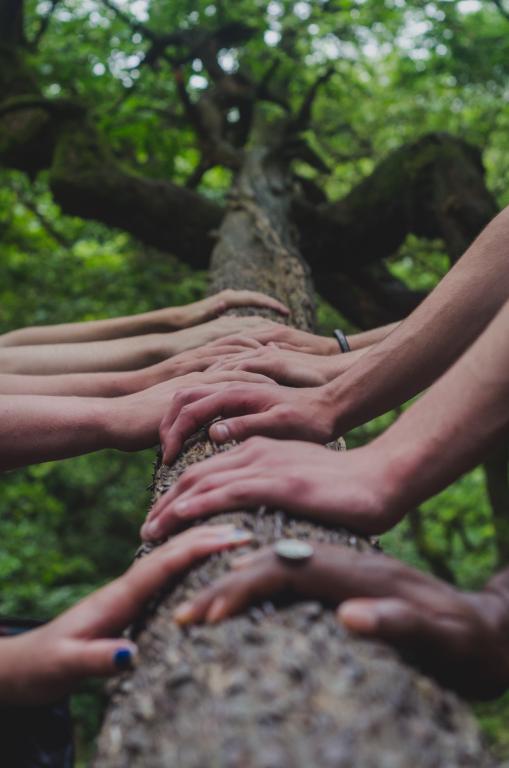
This excerpt is from More Together Than Alone: Discovering the Power and Spirit of Community in Our Lives and in the World (Atria).
Visit Live.MarkNepo.com for news on Mark’s upcoming 2021 webinar.
*Photo Credit: Shane Rounce
Previous Post

October 12, 2020
The Endless Invitation
Next Post
October 26, 2020 Germs
Browse Our Archives
Select a Category 3i projects current events emotional states Heart in the news Mark's weekly reflections Michele's vlogs poetry Three Intentions happenings Uncategorized writing/books
Select a Month November 2024 October 2024 September 2024 August 2024 July 2024 June 2024 May 2024 April 2024 March 2024 February 2024 January 2024 December 2023 November 2023 October 2023 September 2023 August 2023 July 2023 June 2023 May 2023 April 2023 March 2023 February 2023 January 2023 December 2022 November 2022 October 2022 September 2022 August 2022 July 2022 June 2022 May 2022 April 2022 March 2022 February 2022 January 2022 December 2021 November 2021 October 2021 September 2021 August 2021 July 2021 June 2021 May 2021 April 2021 March 2021 February 2021 January 2021 December 2020 November 2020 October 2020 September 2020 August 2020 July 2020 June 2020 May 2020 April 2020 March 2020 February 2020 January 2020 December 2019 November 2019 October 2019 September 2019 August 2019 July 2019 June 2019 May 2019 April 2019 March 2019 February 2019 January 2019 December 2018 November 2018 October 2018 September 2018 August 2018 July 2018 June 2018 May 2018 April 2018 March 2018 February 2018 January 2018 December 2017 November 2017 October 2017 September 2017 August 2017 July 2017 June 2017 May 2017 April 2017 March 2017 February 2017 January 2017 December 2016 November 2016 October 2016 September 2016 August 2016 July 2016 June 2016 May 2016 April 2016 March 2016 February 2016 January 2016 December 2015 November 2015 October 2015 September 2015 August 2015 July 2015 June 2015 May 2015 April 2015 March 2015 February 2015 January 2015 December 2014 November 2014 October 2014 September 2014 August 2014 July 2014 June 2014 May 2014 April 2014 March 2014 February 2014 January 2014 December 2013 November 2013 October 2013 September 2013 August 2013 July 2013 June 2013 May 2013 April 2013 March 2013 February 2013 January 2013 December 2012 November 2012 October 2012 September 2012 August 2012 July 2012 June 2012 May 2012 April 2012 March 2012 February 2012 January 2012 December 2011 November 2011 October 2011 September 2011 August 2011 July 2011 June 2011 May 2011 April 2011 March 2011 February 2011 January 2011 December 2010 November 2010 October 2010 September 2010 August 2010 July 2010 June 2010 May 2010 April 2010 March 2010 February 2010 January 2010 December 2009
Follow Us!
TAKE THE
Religious Wisdom Quiz
What happened to the prison doors when Paul and Silas were praying and singing hymns?
Select your answer to see how you score.
They miraculously unlocked An angel opened them An earthquake shook the prison and the doors flew open A guard opened them
Related posts from Field Notes on Living




TRENDING AT PATHEOS New Visions

Did Prayer Cure His Cancer? Or Was It...
At 4 AM one morning, Joshua W. Brown’s wife awoke to a...

8 Ways a Near-Death Experience Rewires the Soul
Does Consciousness Survive Physical Death? After 50 Years of Research, Dr. Raymond...

Holy Longing: What Our Restlessness Is Telling Us
“One can find so many pains when the rain is falling.” -John...

What this is NOT about. This blog is definitely not about...

Who said the Israelites were God’s chosen? That’s right, they did. Who...

The Spirit World Is the Real World: God...
A Monk’s Wisdom on Body and Spirit I sit with Brother Martin...
view all New Visions blogs
Ad-Free & Subscriber Log-In Subscription Support
- About Us
- 2026 Calendar
- Videos
- Podcasts
- Library of World Religions
- Faith In Media Tracker
- Advertise With Us
- Write for Us
- Privacy Policy
- Terms of Service
- Do Not Sell My Data
- Contact Us
- Radiant Digital
- Manage Newsletter Subscriptions
- Unsubscribe From Notifications
- Sitemap
Copyright 2008-2026, Patheos. All rights reserved.
Subscription Support Ad-Free & Subscriber Log-In
Follow Patheos