
BuddhistCatholicContemplativeEvangelicalGeneral ChristianHinduJewishLatter-day SaintMuslimNew VisionsProgressive Christian
Beliefs
- Buddhist
- Catholic
- Contemplative
- Evangelical
- General Christian
- Hindu
- Jewish
- Latter-day Saint
- More Voices
- Muslim
- New Visions
- Pagan
- Progressive Christian
Topics
- Religion News
- Food and Religion
- Sports and Religion
- Religious Art
- Religious Music and Entertainment
- Religious Events
- History and Religion
- Style and Religion
- Politics and Religion
- Women in Religion
- Recreation Outdoors and Religion
- Business Finance and Religion
- Careers Workplace and Religion
- Education and Religion
- Family Parenting and Religion
- Health Fitness and Religion
- Home and Religion
- Relationships and Religion
- Technology and Religion
- Travel and Religion
Columnists
- Buddhist Columnists
- Business Finance and Religion Columnists
- Careers Workplace and Religion Columnists
- Catholic Columnists
- Contemplative Columnists
- Education and Religion Columnists
- Evangelists Columnists
- Family Parenting and Religion Columnists
- General Christian Columnists
- Health Fitness and Religion Columnists
- Hindu Columnists
- History and Religion Columnists
- Home and Religion Columnists
- Jewish Columnists
- More Voices Columnists
- Latter Day Columnists
- Muslim Columnists
- New Visions Columnists
- Nonreligious Columnists
- Pagan Columnists
- Politics and Religion Columnists
- Progressive Columnists
- Recreation Outdoors and Religion Columnists
- Relationships and Religion Columnists
- Religion News Columnists
- Religious Art Columnists
- Religious Events Columnists
- Religious Music and Entertainment Columnists
- Sports and Religion Columnists
- Style and Religion Columnists
- Technology and Religion Columnists
- Travel and Religion Columnists
- Women in Religion Columnists
Resource Library
- 2026 Calendar
- Library of World Religions
- The 100 Most Holy Places on Earth
- Patheos Answers
- Podcasts
- Videos
- Faith Leaders Database
- Anglican Episcopalian
- Bahai
- Baptist
- Buddhism
- Christianity
- Confucianism
- Eastern Orthodoxy
- Hinduism
- Holiness and Pentecostal
- ISKCON
- Islam
- Judaism
- Lutheran
- Methodist
- The Church of Jesus Christ of Latter-day Saints
- New Age
- Paganism
- Presbytarian and Reformed
- Protestantism
- Religion Behind the Scenes
- Roman Catholic
- Scientology
- Shia Islam
- Sikhism
- Sufism
- Sunni Islam
- Taoism
- Zen
- See all religions
Research Tools
 Ad-Free & Subscriber Log-In Subscription Support
Ad-Free & Subscriber Log-In Subscription Support
Follow Patheos 

- Trending:
- Forgiveness
- |
- Marriage
- |
- Consciousness
- |
- Death Penalty
- |
- Election
- |
- Halloween

- Home
- General Christian
- History and Religion
- Killed For His Words – The Early Church’s Telemachus
Killed For His Words – The Early Church’s Telemachus
Last updated on: November 14, 2025 at 6:01 pm by Alice H. Murray
Killed For His Words – The Early Church’s Telemachus 2025-11-14T18:01:06-05:00 Alice H. Murray
Patheos Explore the world's faith through different perspectives on religion and spirituality! Patheos has the views of the prevalent religions and spiritualities of the world.

[Image from Wikimedia Commons]
A man stands before thousands of people. Many mock what he says, words springing from his strongly-held Christian beliefs. The scenario fails to end happily as this man is dies violently for what he said. While this description may call to mind Charlie Kirk’s shooting in September 2025, another believer’s death centuries ago was similar. A Roman gladiatorial arena provided the setting for the death of Telemachus. killed for his words which sought to end glorified violence disregarding the sanctity of life.
Telemachus – Man Killed For His Words
The names of Roman emperors will ring a bell to those who have studied history. Telemachus, however, is likely an unknown. Rather than a ruler, he was a lowly monk during Roman times. His name, meaning “far-away figether,” aptly fits him, but he did not fight with weapons. Instead, he fought with words against cultural activities inconsistent with his Christian faith.
Little is known about Telemachus’ origin. Historical records indicate he came from the eastern part of the Roman empire. Although not certain, he may have come from Turkey or Egypt. What is certain, however, is how and where Telemachus’ life ended. The monk traveled to Rome where he attended arena games, likely in the Colosseum on January 1, AD 400. Appalled by the senseless and violent taking of human life, he descended to the arena floor, stepped between two gladiators and implored, “In the name of Christ, stop!” The crowd, enraged at the interupption of the games, stoned Telemachus. The monk died on the arena floor, literally killed for his words.
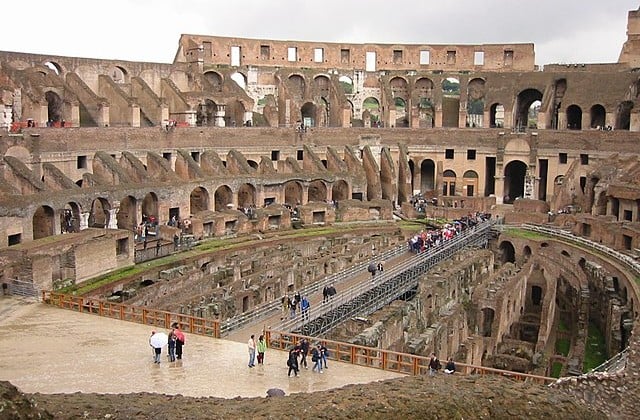
C,olosseum interior where Telemachus was likely killed for his words [Image from Wikimedia Commons]
Roman Spector Sports – Killing Events
Gladiatorial games arose as part of the funeral rites for wealthy Romans. Initially, these activities were meant to honor the dead with bloodshed and appeease the underworld gods. From this beginning, gladiatorial games grew to become a cornerstone of Roman culture, providing entertainment and displaying the power of the Roman Empire. Death permeated these games as contestants fought for their very lives. Even the name of the games raised the specter of death. Participants were known as gladiators which term drvies from the Latin root word “gladius” meaning sword. Wins gained them much celebrity with Spartacus probably the most well-known thanks to an epic Hollywood movie about him starring Kirk Douglas.
Duels between two gladiators offered only one of the deadly activities provided for spectators. However, they served as the main event, and occurred in the afternoon. Fans worked up to the gladiators facing off by viewing gladiators hunting wild animals such as lions, tigers, and elephants in the morning. Executions held center stage at midday. By the the afternoon’s main event, spectators had already witnessed the shedding of much blood and the loss of life. Thus, monk Telemachus had reached his limit of killing for entertainment by the time the gladiator duels began.
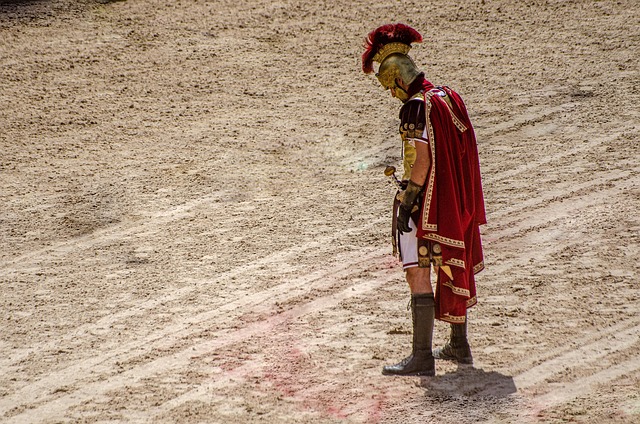
Sand covered the arena floor where gladiators dueled and Telemachus was killed for his words [Image by Franck Barske from Pixabay]
Venue Where Telemachus Killed For His Words
Telemachus being killed for his words was a huge public spectacle, one witnessed by thousands of people. Because of the popularity of gladitorial games, the venue shifted from the Forum, an enomrous rectangular shaped marketplace in the heart of Rome, to the larger Colosseum. This name for this bigger venue sprang from the Greek word “kolossos” meaning large statue or giant. In fact, the Colosseum is the largest ancient amphiteather ever built, holding between 60,000 to 80,000. Tiered seating inside preserved the social stratifcation of Roman society.
Action such as gladiatorial duels took place on the arena floor above which the tiered seating rose. The word “arena” meant sand in Latin. This term fittingly described the setting as sand covered the wooden arena floor to absorb blood. While the material absorbed shed blood, the red color nevertheless stained the sand where it ran.
Death of Telemachus And The Roman Gladiatorial Games
Telemachus being killed for his words led to another death, that of Roman gladiatorial games. When Christian Emperor Honorius learned of the circumstances of the monk’s death, he abolished the games. Previous emperors had made declarations of abolishment without success. This time, however, the ban held and no more such games took place.
Honorius recognized Telemachus as a martyr. Word of the monk’s bold action to preserve life by stepping between two gladiators before thousands of screaming spectators spread. The rise of Christianity in general contributed to the demise of the games as the faith condemned this violence and bloodshed. Nevertheless, the specific story of Telemachus’ death sparked widespread condemnation of the sport leading to its ultimate elimination.
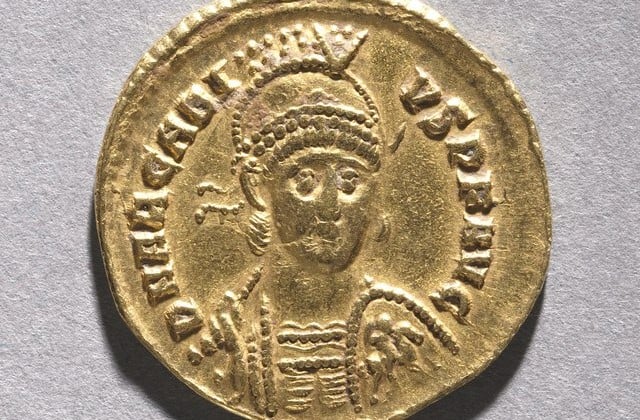
Emperor Honorius, depicted on an ancient gold coin, abolished gladiatorial games after Telemachus was killed for his words [Image from Wikimedia Commons]
Telemachus Remembered
While modern man iis less familiar with Telemachus, writings over time preserved the story of him being killed for his words. Church historian and Syrian bishop Theodoret first related the monk’s story in a 5th century ecclesiatical history book. The story later appeared in a 16th century book of martyrs written by John Foxe. During Queen Victoria’s reign, British poet Alfred Lord Tennyson recounted the monk’s death in verse. And, in modern times, President Ronald Reagan, a former actor, gave an inspiring recitation of the events of Telemachus’ death at the 1984 National Prayer Breakfast in Washington, D.C.

Pres. Ronald Reagan told the story of Telemachus’ death at a National Prayer Breakfast [Image Wikimedia Commons]
What can one lowly man do? Telemachus provides the example. He felt compelled to speak out against wrong because of his faith. The monk may have been one person in a sea of spectators in the Colosseum, but the words he spoke lit a spark and made a difference. He was killed for his words, but he helped take down the senseless loss of life condoned by the culture of his time.
The Story of Santi Telemachus’ Death
Evangelical
History and Religion

About Alice Murray
After 35 years as a Florida adoption attorney, Alice H. Murray now pursues a different path in the publishing industry. With a passion for writing, she is constantly creating with words. Her work includes contributions to several Short And Sweet books, The Upper Room, Chicken Soup For The Soul, Abba’s Lessons (from CrossRiver Media), and the Northwest Florida Literary Review. Alice is a regular contributor to GO!, a quarterly Christian magazine in the Florida Panhandle, and she has three devotions a month published online by Dynamic Women in Missions. Her devotions have also appeared in compilation devotionals such as Ordinary People Extraordinary God (July 2023) and Guideposts’ Pray A Word A Day, Vol. 2 (June 2023), pray a word for hope (September 2023), Too Amazing For Coincidence: Heavenly Interventions (August 2024), pray a word for strength (September 2024), and God’s Constant Presence: Held In His Hand, January 2025. Alice’s first book, The Secret of Chimneys, an annotated Agatha Christie mystery, was released in April 2023. Her second book, an adoption devotional, God Adopted Us First – Faith Lessons from an Adoption Attorney’s Adventures, was published in October 2025. On a weekly basis, Alice posts on her blog about current events with a humorous point of view at aliceinwonderingland.wordpress.com. You can read more about the author here.
Previous Post

October 1, 2025
Write What You See - Following John's Example
Next Post

November 21, 2025 Touched By Adoption - Adoption's Biblical Foundation
Recent Comments
"From Psalm, "Mercy and truth are met together; righteousness and peace have kissed each other." ..."
Biblical Kisses Not Chocolate Or Romantic
"The great cathedrals took centuries to complete, so quality cannot be rushed.The base also holds ..."
USAF Academy Cadet Chapel Is Still ..."
"not a bad list !"
6 Things You Won’t Hear In ..."
Browse Our Archives
Select a Category accountability archaeology architecture Art Bible Christian Living Christmas communication Easter education environment evangelism faith family finances First Amendment food friends giving government gratitude health history Israel law Lent living out your faith medicine military miracles mission missions movies music nature news olympics parenting patriotism peace politics Pope prayer relationships religious freedom royals science sharing your faith space sports stewardship thankfulness the Bible travel Uncategorized war women worship
Select a Month October 2026 September 2026 August 2026 July 2026 June 2026 May 2026 April 2026 March 2026 February 2026 January 2026 December 2025 November 2025 October 2025 September 2025 August 2025 July 2025 June 2025 May 2025 April 2025 March 2025 February 2025 January 2025 December 2024 November 2024 October 2024 September 2024 August 2024 July 2024 June 2024 May 2024 April 2024 March 2024 February 2024 January 2024 December 2023 November 2023 October 2023
Follow Us!
TAKE THE
Religious Wisdom Quiz
Who fell from a window and died while Paul was preaching, then was raised back to life?
Select your answer to see how you score.
Eutychus Tychicus Erastus Timothy
Related posts from Feet to Faith

General Christian
Mixing Tourism and Faith - The Monastic Site...
General Christian
Trump Nominates Billy Graham's Granddaughter as Faith Envoy

General Christian
The Sea of Galilee: Exploring the Lake of...

General Christian
Historic Mysterious Rosslyn Chapel
TRENDING AT PATHEOS General Christian

Mixing Tourism and Faith - The Monastic Site...
Traveling abroad offers the opportunity to multitask by combining tourism with learning...

Seventy and Five Years Old: God Still Starts...
There is a small detail tucked into Genesis 12 that I skipped...

A Biblical Vision of Success in Christian Life...
The Concern and Quest Recent trends and tendencies I note around me...

Indigenous Peoples’ Day and the Church
Indigenous' Peoples Day or Columbus Day? Depending on where you live...

When Spiritual Growth Looks Like Losing Ground
Four Passive Spiritual Disciplines: An Introduction When I was a college freshman,...

Faith and Finding Your Current Season
“To everything there is a season,” Ecclesiastes tells us, “and a time...
view all General Christian blogs
What Are Your Thoughts?leave a comment
Ad-Free & Subscriber Log-In Subscription Support
- About Us
- 2026 Calendar
- Videos
- Podcasts
- Library of World Religions
- Faith In Media Tracker
- Advertise With Us
- Write for Us
- Privacy Policy
- Terms of Service
- Do Not Sell My Data
- Contact Us
- Radiant Digital
- Manage Newsletter Subscriptions
- Unsubscribe From Notifications
- Sitemap
Copyright 2008-2026, Patheos. All rights reserved.
Subscription Support Ad-Free & Subscriber Log-In
Follow Patheos