
BuddhistCatholicContemplativeEvangelicalGeneral ChristianHinduJewishLatter-day SaintMuslimNew VisionsProgressive Christian
Beliefs
- Buddhist
- Catholic
- Contemplative
- Evangelical
- General Christian
- Hindu
- Jewish
- Latter-day Saint
- More Voices
- Muslim
- New Visions
- Pagan
- Progressive Christian
Topics
- Religion News
- Food and Religion
- Sports and Religion
- Religious Art
- Religious Music and Entertainment
- Religious Events
- History and Religion
- Style and Religion
- Politics and Religion
- Women in Religion
- Recreation Outdoors and Religion
- Business Finance and Religion
- Careers Workplace and Religion
- Education and Religion
- Family Parenting and Religion
- Health Fitness and Religion
- Home and Religion
- Relationships and Religion
- Technology and Religion
- Travel and Religion
Columnists
- Buddhist Columnists
- Business Finance and Religion Columnists
- Careers Workplace and Religion Columnists
- Catholic Columnists
- Contemplative Columnists
- Education and Religion Columnists
- Evangelists Columnists
- Family Parenting and Religion Columnists
- General Christian Columnists
- Health Fitness and Religion Columnists
- Hindu Columnists
- History and Religion Columnists
- Home and Religion Columnists
- Jewish Columnists
- More Voices Columnists
- Latter Day Columnists
- Muslim Columnists
- New Visions Columnists
- Nonreligious Columnists
- Pagan Columnists
- Politics and Religion Columnists
- Progressive Columnists
- Recreation Outdoors and Religion Columnists
- Relationships and Religion Columnists
- Religion News Columnists
- Religious Art Columnists
- Religious Events Columnists
- Religious Music and Entertainment Columnists
- Sports and Religion Columnists
- Style and Religion Columnists
- Technology and Religion Columnists
- Travel and Religion Columnists
- Women in Religion Columnists
Resource Library
- 2026 Calendar
- Library of World Religions
- The 100 Most Holy Places on Earth
- Patheos Answers
- Podcasts
- Videos
- Faith Leaders Database
- Anglican Episcopalian
- Bahai
- Baptist
- Buddhism
- Christianity
- Confucianism
- Eastern Orthodoxy
- Hinduism
- Holiness and Pentecostal
- ISKCON
- Islam
- Judaism
- Lutheran
- Methodist
- The Church of Jesus Christ of Latter-day Saints
- New Age
- Paganism
- Presbytarian and Reformed
- Protestantism
- Religion Behind the Scenes
- Roman Catholic
- Scientology
- Shia Islam
- Sikhism
- Sufism
- Sunni Islam
- Taoism
- Zen
- See all religions
Research Tools
 Ad-Free & Subscriber Log-In Subscription Support
Ad-Free & Subscriber Log-In Subscription Support
Follow Patheos 

- Trending:
- Forgiveness
- |
- Marriage
- |
- Consciousness
- |
- Death Penalty
- |
- Election
- |
- Halloween
 Feast of Eden
- Home
- Catholic
- Healing with Courage
Healing with Courage
Last updated on: September 14, 2013 at 2:14 am by Dawn Eden
Healing with Courage 2013-09-14T02:14:18-04:00 Dawn Eden
Patheos Explore the world's faith through different perspectives on religion and spirituality! Patheos has the views of the prevalent religions and spiritualities of the world.
Since returning last Sunday from the four-day Courage/EnCourage conference, where I spoke about healing sexual wounds with the help of the saints, I have wanted to write about what it was like for me to witness the vital work done by the Catholic apostolate that ministers to same-sex-attracted men and women as well as their relatives, spouses, and friends.
But I didn’t know what to say. There was something numinous about the experience. The deep devotion of the members of Courage (the branch of the apostolate encompassing same-sex-attracted men and women) and EnCourage (the branch encompassing family members and friends), the workings of grace in lives that were marked by a deep sharing in the mystery of the Cross—these things were humbling, awe-inspiring. Although my own cross is different, I myself was comforted and encouraged by my fellow attendees and speakers, including Father Emmerich Vogt, O.P., of the 12-Step Review (whose The Freedom to Love: Recovery and the Seven Deadly Sins is a valuable addition to the library of any Catholic seeking spiritual healing).
It wasn’t until yesterday, four days after returning from the conference, that I realized what I most wanted to share with you about it. The realization came during a conversation with a friend who is a recent convert to the Catholic faith.
My friend said that during the first year after her baptism, she began to experience healing from the emotional and spiritual wounds caused by childhood traumas—healing that she believed stemmed from baptismal grace.
But, she added, the healing was gradual and ongoing. On that point, she sounded strangely guilty, almost apologetic.
Hearing my friend’s guilty tone, it hit me how common it is for us Catholics to be embarrassed when we struggle with ongoing emotional and spiritual challenges. It’s as though we fear that, by admitting our struggles, we are admitting our own lack of faith, or even blaming God for our personal failings. On this line of thinking, if we were truly devout, we would not have as-yet-unhealed psychic wounds—or at least we wouldn’t complain about them.
It is, as I say, a common point of embarrassment for Catholics, at least in my experience. And yet, when you think about it, such an attitude is so, so…Protestant.
As I shared in my interview on EWTN’s “The Journey Home,” my first experience of Christianity was as an adult convert to a kind of Evangelical Protestantism. Although I realize that the numberless Protestant denominations’ beliefs vary, my experience of non-Catholic Christianity was that spiritual healing was generally understood to be dependent upon the believer’s faith: if you pray hard enough, are fully surrendered, and truly believe, then God will heal you in short order.
My own early experience of Christian faith seemed to validate the Protestant model. At the moment of my conversion, in October 1999, I was healed instantly of the temptation to suicide and self-harm. Those suicidal thoughts (which had plagued me since my early teens) were, I now know, the result of undiagnosed post-traumatic stress disorder. (As I note in My Peace I Give You, my book offering a Catholic spirituality of healing, it is unfortunately common for PTSD to be misdiagnosed, as mine was by numerous professionals until I got the right help from a board-certified Catholic psychiatrist in 2007.)
The dramatic healing enabled me to become firmly situated on the path of faith. However, I see now that the very nature of it, being instantaneous, has led to my taking it for granted. Every day of my life, I should prostrate myself and thank God for not having the desire to harm myself anymore—but all too often I don’t.
Yet, even with the self-destructive temptations long gone, I retain many other effects of PTSD, including emotional flashbacks, occasional anxiety, and other kinds of unwanted sensitivity. While my walk with the Lord deepened with my entering into full communion with the Catholic Church in 2006, God has not chosen to give me a complete healing from those effects at this time. Instead, He has enabled me to ask his grace, day by day, in dealing with them as they come up.
Although I am burdened by original sin and need to strive to remain in God’s grace, my Catholic faith does not tell me that my lack of complete healing is my own fault. Rather, the Church teaches that creation, even though fallen, maintains its own integrity (CCC 2415); the human person is “a being at once corporeal and spiritual” (CCC 362); “no one can escape the experience of suffering or the evils in nature which seem to be linked to the limitations proper to creatures” (CCC 385); and “grace does not destroy nature but perfects it” (St. Thomas Aquinas, Summa Theologiae I, q. 1, a. 8, ad 2). God’s grace therefore does not reveal itself only in my healed wounds; it can, and should, be revealed also in my as-yet-unhealed wounds. His strength is made perfect in my weakness (see 2 Cor 12:9).
Blessed (and soon-to-be Saint) John Paul II makes the point succintly in Salvifici Doloris 11, strongly refuting the idea that most suffering is due to spiritual root issues: “While it is true that suffering has a meaning as punishment, when it is connected with a fault, it is not true that all suffering is a consequence of a fault and has the nature of a punishment. The figure of the just man Job is a special proof of this in the Old Testament. …And if the Lord consents to test Job with suffering, he does it to demonstrate the latter’s righteousness. The suffering has the nature of a test.”
Seeing how the men and women of Courage recognize their dependence upon God’s grace helped me to see how God is every bit as present in the wounds he doesn’t instantly heal as He is in those he heals only over time. I see how, if God healed every one of my wounds as quickly as He healed my temptation to suicide and self-harm, I might have become a dangerously self-satisfied person. The painful interior things with which I struggle force me to recognize my dependence upon Him, so that I might remain (Deo volente) on the road to perfection.
Next Post

August 9, 2013 Happy feast of The Saint Formerly Known as Edith Stein!
Browse Our Archives
Select a Category Angels Blessed John Paul II Blessed Virgin Mary Caryll Houselander Catechesis on Human Love Chastity Conversion Human Sexuality John Henry Newman Jorge Mario Bergoglio Joseph Ratzinger Life in Eden My Peace I Give You Mystical Body of Christ New Evangelization Pope Benedict XVI Pope Francis Prayer Recovery from Abuse Redemptive Suffering Sacred Heart Saints Spiritual Healing St. Dominic Savio St. Ignatius Loyola St. John Bosco St. Kateri Tekakwitha St. Maximilian Kolbe St. Thomas Aquinas The Cross of Christ Theology of Wounds Uncategorized
Select a Month August 2014 July 2014 June 2014 May 2014 April 2014 February 2014 September 2013 August 2013 July 2013 June 2013 May 2013 April 2013 March 2013 February 2013 January 2013 December 2012 November 2012 October 2012 September 2012
Follow Us!
TAKE THE
Religious Wisdom Quiz
What is the main symbol of Christianity?
Select your answer to see how you score.
Olive branch The cross Lion Rainbow
Related posts from Feast of Eden

"Being hopeful doesn’t mean being 'Little Mary Sunshine'...

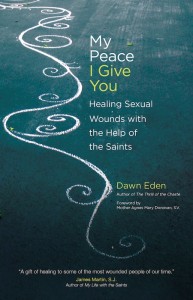
Editor of America's leading pastoral magazine endorses My...
TRENDING AT PATHEOS Catholic

Rejecting Doom: Christian Hope And Human Action
Christianity is a religion of hope. We are to have hope and...

It’s What Comes From Within Which Matters
One of the most difficult things for us to understand is why...

Why I Choose the Eucharist Over the Sermon
Choose the Eucharist, Not the Sermon What are we supposed to get...

5 Design Elements Found in Spiritually Rooted Homes
Putting Spirituality Into Home Decor Our homes are more than our living...

Credo: A Story of God Told with the...
About 10 years ago, I began to imagine a personal "Credo" that...

The Anatomy of Divine Revelation in Catholic Thought
The claim that God has made Himself known to human beings is...
view all Catholic blogs
Ad-Free & Subscriber Log-In Subscription Support
- About Us
- 2026 Calendar
- Videos
- Podcasts
- Library of World Religions
- Faith In Media Tracker
- Advertise With Us
- Write for Us
- Privacy Policy
- Terms of Service
- Do Not Sell My Data
- Contact Us
- Radiant Digital
- Manage Newsletter Subscriptions
- Unsubscribe From Notifications
- Sitemap
Copyright 2008-2026, Patheos. All rights reserved.
Subscription Support Ad-Free & Subscriber Log-In
Follow Patheos