
BuddhistCatholicContemplativeEvangelicalGeneral ChristianHinduJewishLatter-day SaintMuslimNew VisionsProgressive Christian
Beliefs
- Buddhist
- Catholic
- Contemplative
- Evangelical
- General Christian
- Hindu
- Jewish
- Latter-day Saint
- More Voices
- Muslim
- New Visions
- Pagan
- Progressive Christian
Topics
- Religion News
- Food and Religion
- Sports and Religion
- Religious Art
- Religious Music and Entertainment
- Religious Events
- History and Religion
- Style and Religion
- Politics and Religion
- Women in Religion
- Recreation Outdoors and Religion
- Business Finance and Religion
- Careers Workplace and Religion
- Education and Religion
- Family Parenting and Religion
- Health Fitness and Religion
- Home and Religion
- Relationships and Religion
- Technology and Religion
- Travel and Religion
Columnists
- Buddhist Columnists
- Business Finance and Religion Columnists
- Careers Workplace and Religion Columnists
- Catholic Columnists
- Contemplative Columnists
- Education and Religion Columnists
- Evangelists Columnists
- Family Parenting and Religion Columnists
- General Christian Columnists
- Health Fitness and Religion Columnists
- Hindu Columnists
- History and Religion Columnists
- Home and Religion Columnists
- Jewish Columnists
- More Voices Columnists
- Latter Day Columnists
- Muslim Columnists
- New Visions Columnists
- Nonreligious Columnists
- Pagan Columnists
- Politics and Religion Columnists
- Progressive Columnists
- Recreation Outdoors and Religion Columnists
- Relationships and Religion Columnists
- Religion News Columnists
- Religious Art Columnists
- Religious Events Columnists
- Religious Music and Entertainment Columnists
- Sports and Religion Columnists
- Style and Religion Columnists
- Technology and Religion Columnists
- Travel and Religion Columnists
- Women in Religion Columnists
Resource Library
- 2026 Calendar
- Library of World Religions
- The 100 Most Holy Places on Earth
- Patheos Answers
- Podcasts
- Videos
- Faith Leaders Database
- Anglican Episcopalian
- Bahai
- Baptist
- Buddhism
- Christianity
- Confucianism
- Eastern Orthodoxy
- Hinduism
- Holiness and Pentecostal
- ISKCON
- Islam
- Judaism
- Lutheran
- Methodist
- The Church of Jesus Christ of Latter-day Saints
- New Age
- Paganism
- Presbytarian and Reformed
- Protestantism
- Religion Behind the Scenes
- Roman Catholic
- Scientology
- Shia Islam
- Sikhism
- Sufism
- Sunni Islam
- Taoism
- Zen
- See all religions
Research Tools
 Ad-Free & Subscriber Log-In Subscription Support
Follow Patheos 

- Trending:
- Advent
- |
- Forgiveness
- |
- Thanksgiving
- |
- Election
- |
- Seasonal Holidays
- |
- Marriage
 Feast of Eden
- Home
- Catholic
- Message to Matt McGuiness and Catholic News Agency: Sexual victimization is no laughing matter
Message to Matt McGuiness and Catholic News Agency: Sexual victimization is no laughing matter
Last updated on: January 17, 2013 at 2:14 pm by Dawn Eden
Message to Matt McGuiness and Catholic News Agency: Sexual victimization is no laughing matter 2013-01-17T14:14:57-05:00 Dawn Eden
Patheos Explore the world's faith through different perspectives on religion and spirituality! Patheos has the views of the prevalent religions and spiritualities of the world.
I was viscerally distressed reading “A Second Look at Porn” by Matt McGuiness, a new columnist for Catholic News Agency.
The column begins with a laugh line from a Hollywood movie that makes light of a teenage girl’s being sodomized. We are supposed to find it funny that a boy “used her body.” Mr. McGuiness likes this ironic brand of humor because it serves his purpose, which is to shock the reader into thinking about how the desire for pornography is really a desire for God.
He goes on to propose a thought experiment: “If you are already an amateur pornographer, why not consider taking it up ‘professionally’ as it were and see how that makes you happy (or fails to)?”
In times past, I have responded to arguments such as these with articles, blog posts, and even a master’s thesis. I am not going to grace McGuiness’s column with such a carefully crafted theological response.
Instead, I would like to say to Mr. McGuiness, as well as his editors at Catholic News Agency that, being that I am a victim of childhood sexual abuse (which began a year before this photo of me was taken), his column took me back to past pain. It reminded me of when I grew up in a sexually porous environment, not protected from adult nudity, pornography, or graphic sex talk. The kind of household where my mother and her bohemian hipster friends played the original cast album of “Hair” and thought it was hilarious when eight-year-old me sang along with lyrics that went, “sodomy, fellatio … pederasty … Father, why do these words sound so nasty.” The kind of household where there were no boundaries. The kind of household where I was sneered at for being “modest” if I did not want to see a grown-up walk around naked. The kind of household where, at the age of nine, I was taken to see “Pretty Baby,” in which Brooke Shields played a prostitute three years older than I was. The kind of household where I was not treated with the reverence due a human being, let alone the reverence due a child.
As an adult, Mr. McGuiness, like many (though certainly not all) victims of childhood sexual abuse, I suffered from dissociation that led me to act out sexually in ways that harmed my own dignity and that of others. Although not a model or actress, I was immersed in a world in which people made both “amateur” and “professional” pornography. It was not a laughing matter.
I thought, upon receiving the gift of Catholic faith, that the Church would be a safe place, where people would treat me with the reverence I did not receive as a child. Instead, Mr. McGuiness, I encounter writers such as yourself and Christopher West, who, in straining to use language and imagery relevant to those embedded in the pornographic culture, aggravate the very real wounds left in me by that same culture.
It doesn’t have to be that way, Mr. McGuiness. You can reach secularists without treating the topic of human sexuality as cavalierly as they do. But it takes time, thought, effort, and sensitivity. Most of all, it takes learning what the Catholic Church has said, both about human sexuality and about the right ways of speaking about human sexuality (including the advice and admonitions in section 22 of Humanae Vitae).
Rather than join Father Angelo Mary Geiger and Kevin O’Brien in pointing out the flaws in your theological arguments, I will leave you with some quotations from Blessed John Paul II’s pontificate on things you won’t find in the article: the objective sinfulness of pornography, the dangers of desensitization to sin, the need to avoid occasions of sin, the grace offered to us when we encounter Christ in the Sacrament of Penance, and the necessity of growing in virtue.
The Catechism of the Catholic Church:
Pornography consists in removing real or simulated sexual acts from the intimacy of the partners, in order to display them deliberately to third parties. It offends against chastity because it perverts the conjugal act, the intimate giving of spouses to each other. It does grave injury to the dignity of its participants (actors, vendors, the public), since each one becomes an object of base pleasure and illicit profit for others. It immerses all who are involved in the illusion of a fantasy world. It is a grave offense. Civil authorities should prevent the production and distribution of pornographic materials.
Pontifical Council for Social Communications, “Pornography and Violence in the Communications Media: A Pastoral Response“:
[One] of the clear effects of pornography is sin. Willing participation in the production or dissemination of these noxious products can only be judged a serious moral evil. Likewise, production and dissemination of these materials could not continue if there were not a market for them, so those who use such materials not only do moral harm to themselves but contribute to the continuation of a nefarious trade. …
Even so called “soft core” pornography can have a progressively desensitizing effect, gradually rendering individuals morally numb and personally insensitive to the rights and dignity of others. Exposure to pornography can also be – like exposure to narcotics – habit-forming and can lead individuals to seek increasingly “hard core” and perverse material.
Pontifical Council for the Family, “The Truth and Meaning of Human Sexuality“:
“Chastity includes an apprenticeship in self-mastery which is a training in human freedom. The alternative is clear: either man governs his passions and finds peace, or he lets himself be dominated by them and becomes unhappy”. Every person knows, by experience, that chastity requires rejecting certain thoughts, words and sinful actions, as Saint Paul was careful to clarify and point out (cf. Romans 1:18; 6: 12-14; 1 Corinthians 6: 9-11; 2 Corinthians 7: 1; Galatians 5: 16-23; Ephesians 4: 17-24; 5: 3-13; Colossians 3: 5-8; 1 Thessalonians 4: 1-18; 1 Timothy 1: 8-11; 4: 12). To achieve this requires ability and an attitude of self-mastery which are signs of inner freedom, of responsibility towards oneself and others. At the same time, these signs bear witness to a faithful conscience. Such self-mastery involves both avoiding occasions which might provoke or encourage sin as well as knowing how to overcome one’s own natural instinctive impulses.
Blessed John Paul II, “Reconciliation and Penance”:
From the very beginning, in fact, the church has recognized and used many and varying forms of penance. Some are liturgical or paraliturgical and include the penitential act in the Mass, services of atonement and pilgrimages; others are of an ascetical character, such as fasting. But of all such acts none is more significant, more divinely efficacious or more lofty and at the same time easily accessible as a rite than the sacrament of penance. …
But as it reflects on the function of this sacrament, the church’s consciousness discerns in it, over and above the character of judgment in the sense just mentioned, a healing of a medicinal character. And this is linked to the fact that the Gospel frequently presents Christ as healer, while his redemptive work is often called, from Christian antiquity, medicina salutis. “I wish to heal, not accuse,” St. Augustine said, referring to the exercise of the pastoral activity regarding penance.
Catechism of the Catholic Church:
The moral virtues are acquired by human effort. They are the fruit and seed of morally good acts; they dispose all the powers of the human being for communion with divine love.
* * *
I discuss my journey of healing from childhood sexual abuse on EWTN’s “The Journey Home” and in my book My Peace I Give You: Healing Sexual Wounds with the Help of the Saints.
Next Post

January 17, 2013 Welcome, "Morning Air" listeners!
Browse Our Archives
Select a Category Angels Blessed John Paul II Blessed Virgin Mary Caryll Houselander Catechesis on Human Love Chastity Conversion Human Sexuality John Henry Newman Jorge Mario Bergoglio Joseph Ratzinger Life in Eden My Peace I Give You Mystical Body of Christ New Evangelization Pope Benedict XVI Pope Francis Prayer Recovery from Abuse Redemptive Suffering Sacred Heart Saints Spiritual Healing St. Dominic Savio St. Ignatius Loyola St. John Bosco St. Kateri Tekakwitha St. Maximilian Kolbe St. Thomas Aquinas The Cross of Christ Theology of Wounds Uncategorized
Select a Month August 2014 July 2014 June 2014 May 2014 April 2014 February 2014 September 2013 August 2013 July 2013 June 2013 May 2013 April 2013 March 2013 February 2013 January 2013 December 2012 November 2012 October 2012 September 2012
Follow Us!
TAKE THE
Religious Wisdom Quiz
True or False: Mark's Gospel is the shortest of the four Gospels.
Select your answer to see how you score.
TRUE FALSE
Related posts from Feast of Eden
"Being hopeful doesn’t mean being 'Little Mary Sunshine'...
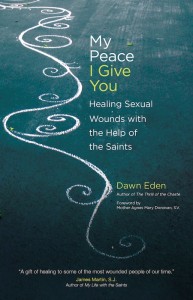
Editor of America's leading pastoral magazine endorses My...

"This is the night": A Holy Saturday reflection
TRENDING AT PATHEOS Catholic

Bad Survey Questions Distort Eucharistic Theology
It seems to be the newest thing: someone conducts a bad survey...

If Baptism Washes Away Sin, Why Do Catholics...
The seven sacraments stand as the foundation of Catholic ecclesial life. The...

Far from promoting indifference, inaction, or quietism, Paul consistently tells us to...

The Power of Setting a Good Example
Remember last August when the Chicago White Sox hosted a "Pope Hat...

A Catholic Critique of Biblical Unitarianism
If the statistics are to be believed, Unitarianism is rising worldwide. Although...

How Grandma Tourism Helps Grandparents Live Their Vocation
Grandma, The New Travel Influencer What started as a nostalgia-inspired social media...
view all Catholic blogs
Ad-Free & Subscriber Log-In Subscription Support
- About Us
- 2026 Calendar
- Videos
- Podcasts
- Library of World Religions
- Faith In Media Tracker
- Advertise With Us
- Write for Us
- Privacy Policy
- Terms of Service
- Do Not Sell My Data
- Contact Us
- Radiant Digital
- Manage Newsletter Subscriptions
- Unsubscribe From Notifications
- Sitemap
Copyright 2008-2026, Patheos. All rights reserved.
Subscription Support Ad-Free & Subscriber Log-In
Follow Patheos