
BuddhistCatholicContemplativeEvangelicalGeneral ChristianHinduJewishLatter-day SaintMuslimNew VisionsProgressive Christian
Beliefs
- Buddhist
- Catholic
- Contemplative
- Evangelical
- General Christian
- Hindu
- Jewish
- Latter-day Saint
- More Voices
- Muslim
- New Visions
- Pagan
- Progressive Christian
Topics
- Religion News
- Food and Religion
- Sports and Religion
- Religious Art
- Religious Music and Entertainment
- Religious Events
- History and Religion
- Style and Religion
- Politics and Religion
- Women in Religion
- Recreation Outdoors and Religion
- Business Finance and Religion
- Careers Workplace and Religion
- Education and Religion
- Family Parenting and Religion
- Health Fitness and Religion
- Home and Religion
- Relationships and Religion
- Technology and Religion
- Travel and Religion
Columnists
- Buddhist Columnists
- Business Finance and Religion Columnists
- Careers Workplace and Religion Columnists
- Catholic Columnists
- Contemplative Columnists
- Education and Religion Columnists
- Evangelists Columnists
- Family Parenting and Religion Columnists
- General Christian Columnists
- Health Fitness and Religion Columnists
- Hindu Columnists
- History and Religion Columnists
- Home and Religion Columnists
- Jewish Columnists
- More Voices Columnists
- Latter Day Columnists
- Muslim Columnists
- New Visions Columnists
- Nonreligious Columnists
- Pagan Columnists
- Politics and Religion Columnists
- Progressive Columnists
- Recreation Outdoors and Religion Columnists
- Relationships and Religion Columnists
- Religion News Columnists
- Religious Art Columnists
- Religious Events Columnists
- Religious Music and Entertainment Columnists
- Sports and Religion Columnists
- Style and Religion Columnists
- Technology and Religion Columnists
- Travel and Religion Columnists
- Women in Religion Columnists
Resource Library
- 2026 Calendar
- Library of World Religions
- The 100 Most Holy Places on Earth
- Patheos Answers
- Podcasts
- Videos
- Faith Leaders Database
- Anglican Episcopalian
- Bahai
- Baptist
- Buddhism
- Christianity
- Confucianism
- Eastern Orthodoxy
- Hinduism
- Holiness and Pentecostal
- ISKCON
- Islam
- Judaism
- Lutheran
- Methodist
- The Church of Jesus Christ of Latter-day Saints
- New Age
- Paganism
- Presbytarian and Reformed
- Protestantism
- Religion Behind the Scenes
- Roman Catholic
- Scientology
- Shia Islam
- Sikhism
- Sufism
- Sunni Islam
- Taoism
- Zen
- See all religions
Research Tools
 Ad-Free & Subscriber Log-In Subscription Support
Follow Patheos 

- Trending:
- Advent
- |
- Forgiveness
- |
- Thanksgiving
- |
- Election
- |
- Seasonal Holidays
- |
- Marriage
 Feast of Eden
- Home
- Catholic
- Caryll Houselander: “Sin tried to batter life out of the innocent son of God … just as it has done to the bodies of innocence ever since”
Caryll Houselander: “Sin tried to batter life out of the innocent son of God … just as it has done to the bodies of innocence ever since”
Last updated on: December 24, 2012 at 10:58 pm by Dawn Eden
Caryll Houselander: “Sin tried to batter life out of the innocent son of God … just as it has done to the bodies of innocence ever since” 2012-12-24T22:58:19-05:00 Dawn Eden
Patheos Explore the world's faith through different perspectives on religion and spirituality! Patheos has the views of the prevalent religions and spiritualities of the world.
I am reading the 1947 novel The Dry Wood by English Catholic mystic (and so-called “original Bond girl”) Caryll Houselander, and am struck by a profoundly prophetic passage that seems particularly meaningful in the wake of the Newtown slaughter.
The scene begins as first-time father Art Jewel witnesses hospital staff treat his deformed newborn son, Willie, with bone-chilling disgust. This provides Houselander with an opportunity for an extended meditation on secular civilization’s hatred of innocence:
When at last Willie was born, Dr. Moncrieff hoped that he would die, and hinted that it would be a mercy. This was not within Art’s hearing, but nevertheless there was a terrible moment in which he thought that there was an unspoken agreement between them to let his child die. People had told him of such things. Stories that they had got from nurses, of malformed infants left exposed to cold, that they might not live.
They had put Art’s misshapen infant into his own hands to hold, and he felt sure that they would not have done that if they meant him to live. It was only for a moment, however, and then the nurse took him. That was a black, agonized moment for Art Jewel. In it something fierce and primitive awoke in him which afterwards never died. He desired his son’s live as a thirsting man desires water.
And that son’s life was a tiny atom, a spark against which the whole force of what we call civilization conspired, the whole force of it, past, present, and future. Out of the past a towering mass of evil cast long shadows across him—the greed, the selfishness, the cruelty, the lust, the infidelities, of generations of human beings. A multitudinous procession of murder and innocence cast its fire and shadow on the wizened little face, as on the face of all children born into our world.
First of all, as if they swept past the Christ Child sleeping in the stone manger, the flock of Holy Innocents with jubilant cries like wild birds migrating, wild birds winging to the sun of the eternal light: the first martyrs, baptized only with the baptism of blood, with crimson stars tangled in their burning hair. After them, all through the ages, came the martyrs whose death and resurrection seem the inevitable co-incidence of Christ’s birth, of the birth of life into the valley of the shadow of death. And always dark on the burning brilliance of martyrdom, the shadow of murder, of the sevenfold evil that is death in man’s heart fighting against life.
The shadow of Herod’s swung sword; the shadow of Tyburn tree; of man’s hand black over the golden pyx in the act of sacrilege, desecrating the body of Christ, violating the sanctuary of his own ancient faith; shadow of man’s hand first striking down the Virgin Mother of God with her child of snow upon her heart. Shadow of factories growing higher than cathedrals. Of tall chimneys, encircling towns that fall into slums. Shadows of cities growing larger and larger, and obliterating the cottages that once were homes. Shadow of machines stretching up nearly to the stars, nearly to the star of Bethlehem. And where before, in this procession, there had been the Holy Innocents, flashing through the arch of Herod’s swords, there was now a multitude of wizened, twisted children, with no gateway even of swords to go through, moving slowly, mechanically, blindly, through a bewildering labyrinth of shadows of machines, like a shot in a modern film of Frankenstein horror. From the beautiful swift bodies of the first little martyrs in their swallow flight to the sun, the bodies of children had changed to bowed grotesque gnomes.
Death had ceased to be swift and clean like a flash of silver as murder itself had ceased to be open and instantaneous, evil but an evil of crimson and steel. Now it had become something so furtive that it hid, not only from its victims, but from itself, covering its face with a mask of benignity, its stench with cheap scent, so that at length it could look into the mirror unabashed—whether it looked into the mirror of the heavy overmantel of an Edwardian drawing-room and saw itself masked in the expensive mask of complacency, or whether it stared back from the dingy mirrors of tawdry seaside hotels and saw itself in the mask of cheap vanity that has frittered away the power to love by lust.
Shadows of swords and fists, of chimneys and machines. Shadow of fear, of murder grown timid, grown sentimental and righteous, disgusted and hidden, until at last evil is seen only as a projected thing, projected on the bodies of the innocents to cry to heaven for vengeance, as the death wounds of the first born of Bethlehem cried out in scarlet.
And all the time against this weight of death, life fought and prevailed, from generation to generation, because love is stronger than death, and love and life are the seal and sign of God in man. And the battle was fought all through the centuries by those who dared to love. By the boys and girls who faced the immense ardours and endurances of purity, who wrestled with their own flesh and blood and would not fritter away the capacity for passion, who dared to suffer the withering thirst of heart and mind, body and soul, that they might ultimately drink the water of life from the source, who defied misery, oppression, and tyranny, whom the machines could not crush and the wheels could not grind, who were not overcome by poverty, by hunger and cold, who were not afraid of hard work, who were not abject before the herd, who in the multitude remained themselves, two who could carry the world’s burden and stand upright and say, “I love.” Who in the midst of death gave life from generation to generation, in a kiss.
There is a likeness, even in outward things, between the unconquerable life in broken humanity, and that in Christ’s Body. For sin tried to batter life out of the innocent son of God just as it tries to batter it out of the world, taking that perfection, that flawless beauty, and scourging it, and driving it with thorns and spears, bruising it, overloading it, bending it double under the load, pushing it down in the dust and spitting on it and crucifying it, just as it has done to the bodies of innocence ever since. Pitting itself against love, against the likeness of God in the heart of man. Crying out, against the primal instincts that waken like dawn even in a twisted humanity, that life must be extinguished in the forms that evil has forced upon it, because man must not be asked to look upon what he has done. Yet it is in the poorest, the weakest, the frailest, that life triumphs, for when sin had disfigured even the immaculate body of Christ beyond recognition—so that it was said, even of Him, He has no comeliness whereby He shall be known—it was in that same Body, no other, that He rose. In that same Body, with those same wounds, that the risen life began. [From “A Son Is Born,” chapter V of The Dry Wood, by Caryll Houselander]
Image of Caryll Houselander via CatholicAuthors.com.
* * *
If you would like to read more on how the risen begins in our own wounded bodies through the wounded and resurrected Body of Christ, I talk about the spirituality of wounds in this interview, and it is central to my book My Peace I Give You: Healing Sexual Wounds with the Help of the Saints.

Browse Our Archives
Select a Category Angels Blessed John Paul II Blessed Virgin Mary Caryll Houselander Catechesis on Human Love Chastity Conversion Human Sexuality John Henry Newman Jorge Mario Bergoglio Joseph Ratzinger Life in Eden My Peace I Give You Mystical Body of Christ New Evangelization Pope Benedict XVI Pope Francis Prayer Recovery from Abuse Redemptive Suffering Sacred Heart Saints Spiritual Healing St. Dominic Savio St. Ignatius Loyola St. John Bosco St. Kateri Tekakwitha St. Maximilian Kolbe St. Thomas Aquinas The Cross of Christ Theology of Wounds Uncategorized
Select a Month August 2014 July 2014 June 2014 May 2014 April 2014 February 2014 September 2013 August 2013 July 2013 June 2013 May 2013 April 2013 March 2013 February 2013 January 2013 December 2012 November 2012 October 2012 September 2012
Follow Us!
TAKE THE
Religious Wisdom Quiz
True or False: Mark's Gospel is the shortest of the four Gospels.
Select your answer to see how you score.
TRUE FALSE
Related posts from Feast of Eden
"Being hopeful doesn’t mean being 'Little Mary Sunshine'...

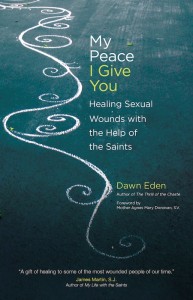
Editor of America's leading pastoral magazine endorses My...

"This is the night": A Holy Saturday reflection
TRENDING AT PATHEOS Catholic

Bad Survey Questions Distort Eucharistic Theology
It seems to be the newest thing: someone conducts a bad survey...

If Baptism Washes Away Sin, Why Do Catholics...
The seven sacraments stand as the foundation of Catholic ecclesial life. The...

Far from promoting indifference, inaction, or quietism, Paul consistently tells us to...

The Power of Setting a Good Example
Remember last August when the Chicago White Sox hosted a "Pope Hat...

A Catholic Critique of Biblical Unitarianism
If the statistics are to be believed, Unitarianism is rising worldwide. Although...

How Grandma Tourism Helps Grandparents Live Their Vocation
Grandma, The New Travel Influencer What started as a nostalgia-inspired social media...
view all Catholic blogs
Ad-Free & Subscriber Log-In Subscription Support
- About Us
- 2026 Calendar
- Videos
- Podcasts
- Library of World Religions
- Faith In Media Tracker
- Advertise With Us
- Write for Us
- Privacy Policy
- Terms of Service
- Do Not Sell My Data
- Contact Us
- Radiant Digital
- Manage Newsletter Subscriptions
- Unsubscribe From Notifications
- Sitemap
Copyright 2008-2026, Patheos. All rights reserved.
Subscription Support Ad-Free & Subscriber Log-In
Follow Patheos