
BuddhistCatholicContemplativeEvangelicalGeneral ChristianHinduJewishLatter-day SaintMuslimNew VisionsProgressive Christian
Beliefs
- Buddhist
- Catholic
- Contemplative
- Evangelical
- General Christian
- Hindu
- Jewish
- Latter-day Saint
- More Voices
- Muslim
- New Visions
- Pagan
- Progressive Christian
Topics
- Religion News
- Food and Religion
- Sports and Religion
- Religious Art
- Religious Music and Entertainment
- Religious Events
- History and Religion
- Style and Religion
- Politics and Religion
- Women in Religion
- Recreation Outdoors and Religion
- Business Finance and Religion
- Careers Workplace and Religion
- Education and Religion
- Family Parenting and Religion
- Health Fitness and Religion
- Home and Religion
- Relationships and Religion
- Technology and Religion
- Travel and Religion
Columnists
- Buddhist Columnists
- Business Finance and Religion Columnists
- Careers Workplace and Religion Columnists
- Catholic Columnists
- Contemplative Columnists
- Education and Religion Columnists
- Evangelists Columnists
- Family Parenting and Religion Columnists
- General Christian Columnists
- Health Fitness and Religion Columnists
- Hindu Columnists
- History and Religion Columnists
- Home and Religion Columnists
- Jewish Columnists
- More Voices Columnists
- Latter Day Columnists
- Muslim Columnists
- New Visions Columnists
- Nonreligious Columnists
- Pagan Columnists
- Politics and Religion Columnists
- Progressive Columnists
- Recreation Outdoors and Religion Columnists
- Relationships and Religion Columnists
- Religion News Columnists
- Religious Art Columnists
- Religious Events Columnists
- Religious Music and Entertainment Columnists
- Sports and Religion Columnists
- Style and Religion Columnists
- Technology and Religion Columnists
- Travel and Religion Columnists
- Women in Religion Columnists
Resource Library
- 2026 Calendar
- Library of World Religions
- The 100 Most Holy Places on Earth
- Patheos Answers
- Podcasts
- Videos
- Faith Leaders Database
- Anglican Episcopalian
- Bahai
- Baptist
- Buddhism
- Christianity
- Confucianism
- Eastern Orthodoxy
- Hinduism
- Holiness and Pentecostal
- ISKCON
- Islam
- Judaism
- Lutheran
- Methodist
- The Church of Jesus Christ of Latter-day Saints
- New Age
- Paganism
- Presbytarian and Reformed
- Protestantism
- Religion Behind the Scenes
- Roman Catholic
- Scientology
- Shia Islam
- Sikhism
- Sufism
- Sunni Islam
- Taoism
- Zen
- See all religions
Research Tools
 Ad-Free & Subscriber Log-In Subscription Support
Ad-Free & Subscriber Log-In Subscription Support
Follow Patheos 

- Trending:
- Forgiveness
- |
- Marriage
- |
- Consciousness
- |
- Death Penalty
- |
- Election
- |
- Halloween
 Fare Forward
- Home
- Evangelical
- When My Brother Was an Aztec
When My Brother Was an Aztec
Last updated on: April 21, 2014 at 9:17 am by Inez Tan
When My Brother Was an Aztec 2014-04-21T09:17:38-04:00 Inez Tan
Patheos Explore the world's faith through different perspectives on religion and spirituality! Patheos has the views of the prevalent religions and spiritualities of the world.
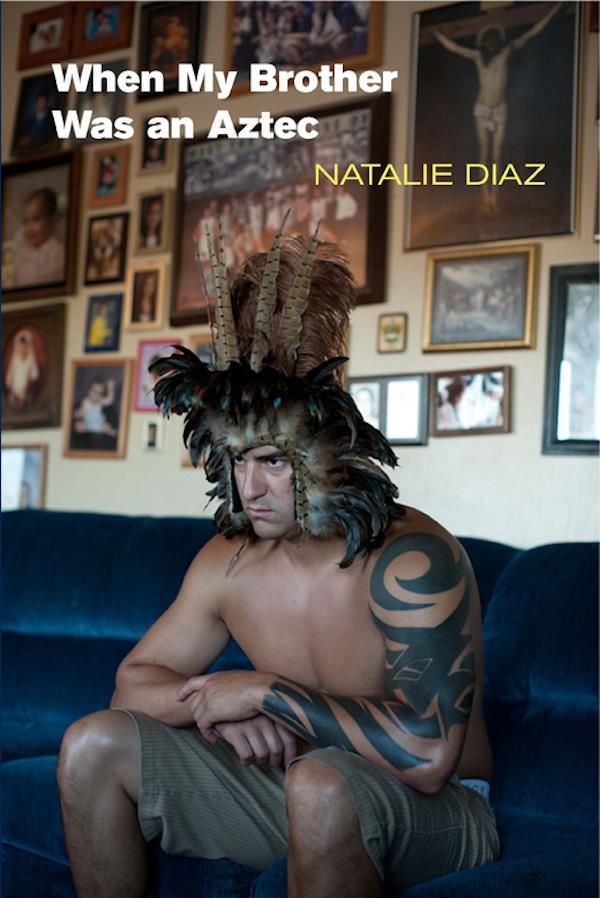
The title poem of Natalie Diaz’s first collection, When My Brother Was an Aztec, introduces the book’s biggest subject: her eldest brother’s meth addiction and its impact on the family. “He lived in our basement and sacrificed my parents/every morning,” writes Diaz. “Neighbors were amazed my parents’ hearts kept/growing back – It said a lot about my parents, or parents’ hearts.”
While some of Diaz’s poems confront their subjects straightforwardly, it’s her extended metaphors – which prompt us to see one thing as another – that throw her material wide open. Of the Aztecs, she said in an interview, “Some Aztec practices can be interpreted as violent, but that doesn’t mean they were less human. They wrestled fear, absence, and loss like the rest of us. … One reason why the rituals and beliefs of the Aztecs lure me [is that] they made light from violence, or found light despite violence, which doesn’t happen if you close your eyes.”
*
Diaz’s poems take her subjects seriously, but they’re not afraid to have a little fun. In “The Last Mojave Indian Barbie,” Diaz offers wry critique, “Mojave Barbie repeatedly drank Ken and Skipper under their pink plastic patio table sets. Skipper said she drank like a boy.” And in “When the Beloved Asks, ‘What Would You Do if You Woke Up and I Was a Shark?’” she shows us beauty where you don’t expect to find it: “I’d place my head onto that dark altar of jaws, prostrated/pilgrim at Melville’s glittering gates, climb into that mysterious/window starred with teeth – the one lit room in the charnel house.”
Born to a Native American mother and Spanish father, Diaz was raised with eight siblings in the Fort Mojave Indian Village on the border of California, Arizona, and Nevada. Of her upbringing, she’s said, “In my house, there is enough room for all of those cultures, for all of our religious beliefs, for all of our different kinds of expressions of faith, and so for me that’s exactly the way I write. I can mix images from my reservation with images from my Catholic faith, with words in Spanish, with words in my Mojave language and other influences. It’s given me the okay to go anywhere I want to and to consume whatever I need to along the way to get to what it is that I’m questioning.” She makes it look – and sound – easy. In “How to Go to Dinner with a Brother on Drugs” (a slightly longer prose version available at here), the range of language and imagery is by turns funny and sobering:
“Holler upstairs to your brother to hurry.
He won’t come right away.
Remember how long it took the Minotaur
to escape the labyrinth.”
These metaphors are about making room: for mythology and pop culture, and ultimately for her brother and herself:
“Your brother is a beat-down, dubbed Bruce Lee –
his words do not match his mouth, which is moving
faster and faster. You have the fastest
brother alive.”
For better and worse, the poem’s central metaphor is its most unstable. The brother finally goes to dinner provocatively “dressed as a Judas effigy,” complete with “[a] lamp cord knotted at his neck.” But at the end of the poem, it is the speaker who says of herself, “You will pour your thirty pieces of silver/onto the table and ask, What can I get for this?” Now Judas – the betrayer – is not only the brother who wears the family down, but also the poet who exposes the family to her readers.
The multiple interpretations of Judas may sit uneasily with some, as they seem to with Diaz. In a recent blog post for Poetry Foundation, she writes with some ambivalence, “Maybe the answer is that Jesus asked Judas to betray him, needed Judas to betray him. Doesn’t this answer transform my betrayal of my brother into my devotion of him? … I lead you to my brother again and again. But don’t I also love him? Don’t I also kiss him on the cheek?”
*
Did Jesus ‘need’ Judas to betray him? One answer is that logically speaking, if Jesus was betrayed by Judas, then yes, Judas necessarily betrayed Jesus. But it’s beyond me – or anyone – to speculate on Judas’ motives, and perhaps that sense of futility is what Diaz is driving at. With every iteration, the speaker never fully makes sense of why her brother puts her family through such agony, and why they allow it to happen.
*
The gospels report that Jesus did not resist Judas and the armed crowd who came to capture him in Gethsemane. Nor did he defend himself before the religious or political authorities. Before how he rose again, triumphing over death, he was first spat upon, beaten, whipped, and crucified.
I hear an echo of parents and parents’ hearts this Easter season, one that Diaz has taught me to listen for. As she writes in her title poem of what her parents endured, “It was awful. Unforgiveable. But they kept coming/back for more. They loved him, was all they could say.”
(I didn’t get to touch on my three favorite poems by Diaz: “No More Cake Here”, “Hand-Me-Down Halloween”, and “Top Ten Reasons Why Indians are Good at Basketball”. Her short story “The Hooferman” won the Tobias Wolff Fiction Award. Diaz is currently working to preserve the Mohave language in her home reservation (“It’s bridging gaps between youth and their parents,” she said in an interview with Indian Country), which you can learn more about from this PBS documentary. And if that wasn’t enough, Diaz used to be a professional basketball player. If that’s more your scene, here’s a terrific interview she gave in college.)
Previous Post

April 17, 2014
The Doomsday Machine
Next Post
April 23, 2014 Un-sandwiching Holy Saturday: Reclaiming the Discipline of Waiting
Browse Our Archives
Select a Category ambition art beauty bible bios body Book Review cheap grace church community consumer church cultural liturgy culture deep practice desire dualisms economics education evangelicalism events faith family fare forward Film Review friendship games Gospel happiness hipster Christianity humility identity institutions irony issue previews Jesus just church justice Lent Letters to the Editor liberal arts liberal christianity literature liturgy love march madness mental health metaphysics misotheism moralism morality Movie Review music narrative naturalism new atheism passions philosophy place political theology Pope Francis power prayer privilege providence reading reason relationship remembering self resurrection science secular faiths secularism sexuality sin Social Media spirituality Sport suburbs suffering table of contents technology the future of faith the new apologetic the virtues theology thick doctrine transcendence Trinity truth tv Uncategorized violence Virtue vocation war work
Select a Month August 2014 July 2014 June 2014 May 2014 April 2014 March 2014 February 2014 January 2014 December 2013 November 2013 October 2013 September 2013 August 2013 July 2013 June 2013 May 2013 April 2013 March 2013 February 2013
Follow Us!
TAKE THE
Religious Wisdom Quiz
What does the name "Jesus" mean?
Select your answer to see how you score.
Teacher God is with us The Lord saves Prince of peace
Related posts from Fare Forward
Playing God: Redeeming the Gift of Power

The End of Night: Searching for Natural Darkness...
TRENDING AT PATHEOS Evangelical

The REST of Your Life: A Creative Wrestles...
This week I had a conversation with a good friend from church....

How the author of the world's best hymn...
I've been working with John Newton for a while now. This makes...

Long before this Lectio Divina, Psalm 130 - the song - started...

What About the Trees? Another Living Parable
After I finished writing the last article about falling leaves as a...

Why Classical Education Is a Conversation, Not a...
Come and Read: Joy in Classical Education When I was a little...

Cornell University has received a great deal of negative publicity and intense...
view all Evangelical blogs
Ad-Free & Subscriber Log-In Subscription Support
- About Us
- 2026 Calendar
- Videos
- Podcasts
- Library of World Religions
- Faith In Media Tracker
- Advertise With Us
- Write for Us
- Privacy Policy
- Terms of Service
- Do Not Sell My Data
- Contact Us
- Radiant Digital
- Manage Newsletter Subscriptions
- Unsubscribe From Notifications
- Sitemap
Copyright 2008-2026, Patheos. All rights reserved.
Subscription Support Ad-Free & Subscriber Log-In
Follow Patheos