
BuddhistCatholicContemplativeEvangelicalGeneral ChristianHinduJewishLatter-day SaintMuslimNew VisionsProgressive Christian
Beliefs
- Buddhist
- Catholic
- Contemplative
- Evangelical
- General Christian
- Hindu
- Jewish
- Latter-day Saint
- More Voices
- Muslim
- New Visions
- Pagan
- Progressive Christian
Topics
- Religion News
- Food and Religion
- Sports and Religion
- Religious Art
- Religious Music and Entertainment
- Religious Events
- History and Religion
- Style and Religion
- Politics and Religion
- Women in Religion
- Recreation Outdoors and Religion
- Business Finance and Religion
- Careers Workplace and Religion
- Education and Religion
- Family Parenting and Religion
- Health Fitness and Religion
- Home and Religion
- Relationships and Religion
- Technology and Religion
- Travel and Religion
Columnists
- Buddhist Columnists
- Business Finance and Religion Columnists
- Careers Workplace and Religion Columnists
- Catholic Columnists
- Contemplative Columnists
- Education and Religion Columnists
- Evangelists Columnists
- Family Parenting and Religion Columnists
- General Christian Columnists
- Health Fitness and Religion Columnists
- Hindu Columnists
- History and Religion Columnists
- Home and Religion Columnists
- Jewish Columnists
- More Voices Columnists
- Latter Day Columnists
- Muslim Columnists
- New Visions Columnists
- Nonreligious Columnists
- Pagan Columnists
- Politics and Religion Columnists
- Progressive Columnists
- Recreation Outdoors and Religion Columnists
- Relationships and Religion Columnists
- Religion News Columnists
- Religious Art Columnists
- Religious Events Columnists
- Religious Music and Entertainment Columnists
- Sports and Religion Columnists
- Style and Religion Columnists
- Technology and Religion Columnists
- Travel and Religion Columnists
- Women in Religion Columnists
Resource Library
- 2026 Calendar
- Library of World Religions
- The 100 Most Holy Places on Earth
- Patheos Answers
- Podcasts
- Videos
- Faith Leaders Database
- Anglican Episcopalian
- Bahai
- Baptist
- Buddhism
- Christianity
- Confucianism
- Eastern Orthodoxy
- Hinduism
- Holiness and Pentecostal
- ISKCON
- Islam
- Judaism
- Lutheran
- Methodist
- The Church of Jesus Christ of Latter-day Saints
- New Age
- Paganism
- Presbytarian and Reformed
- Protestantism
- Religion Behind the Scenes
- Roman Catholic
- Scientology
- Shia Islam
- Sikhism
- Sufism
- Sunni Islam
- Taoism
- Zen
- See all religions
Research Tools
 Ad-Free & Subscriber Log-In Subscription Support
Ad-Free & Subscriber Log-In Subscription Support
Follow Patheos 

- Trending:
- Forgiveness
- |
- Marriage
- |
- Consciousness
- |
- Death Penalty
- |
- Election
- |
- Halloween
 Fare Forward
- Home
- Evangelical
- In Defense of Distrusting Chickens
In Defense of Distrusting Chickens
Last updated on: March 12, 2014 at 9:49 am by David Clark
In Defense of Distrusting Chickens 2014-03-12T09:49:51-04:00 David Clark
Patheos Explore the world's faith through different perspectives on religion and spirituality! Patheos has the views of the prevalent religions and spiritualities of the world.
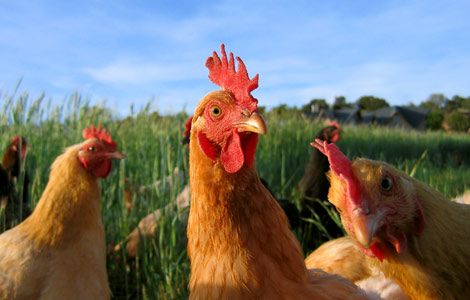
Not too long ago I was approached by a gentleman who had read something about my farm in a brochure. He was concerned, he told me. Concerned that my attitude towards my livestock was “overly anthropomorphic”. He didn’t like that I named my pigs, or spoke to my sheep about the weather, or talked about my chickens as though they were in the business of forming conspiracies against the rest of the barnyard. Perhaps, he told me, there was no harm done, since I certainly must know better than to think that sheep actually understand English or that chickens actually form conspiracies; but it wasn’t good to talk about animals this way in front of my children or my customers. I might lead them astray.
This charge caught me by surprise (and not just because of how stupid this gentleman must think children and rural Vermonters). I am very fond of naming pigs and talking to sheep and distrusting chickens, and I had never once considered the possibility that I might be engaged in a sort of dishonesty in doing so. But I did my best to take this gentleman’s words to heart and considered the possibility. What I found first, however, was that I just could not get my heart to take his words; I could not get myself to regard my animals as he regards animals — which is to regard them as no more and no less than what the biologist can tell us about them. I could not stop myself from getting chatty in the sheep pen or preparing for a coup d’etat from the chicken coop. It came too naturally.
The second thing I found was that I had no reason to think this instinct a sin; I had no reason to agree with the chastisement of my visitor. On the contrary, I found that I had good reason to disagree with my visitor, for it seemed to me that the voices of human nature and human tradition both spoke up against him: it would be the greater dishonesty, they said, to regard my animals as identical with the description of the biologist.
Human beings have always been, and always will be, in the business of anthropomorphizing animals. As wide as we travel geographically and as far back as we travel in recorded history, we find stories of animals who can, among other things, talk. And I do not expect these stories to disappear from human cultures in the future, no matter how many “enlightenments” come along to tell them to go. There are at least three reasons for this. (1) We are born into the belief that animals can talk (just today I watched my eight month old daughter get frustrated with the dog for refusing to engage her in conversation); (2) we are born into the desire for animals to talk (a desire Tolkien calls “as ancient as the Fall”); and (3) we are born into the conviction that the animal realm is cloaked in deep and insoluble mystery, that there is much about the nature of the beasts which lies hidden behind closed doors (and the sort of doors, moreover, which cannot be opened from our side). The universality (or very near-universality) of these primeval beliefs and emotions provides someone like me with a very strong reason to continue living as though there were something behind these beliefs and emotions. At the very least, they provide one with a reason not to take my visitor’s assumption as obvious to all rational adults: that an animal is nothing more and nothing less than what biology can tell us about it.
Now these “primeval beliefs and emotions” do more than justify farmyard behavior like mine; at least in my case, I think they also explain it. Especially in the case of what I called “the conviction that the animal realm is cloaked in deep and insoluble mystery”. This conviction makes a lot sense out of why I feel I must continue doing things like naming my animals and talking to my animals and, on occasion, reading to my animals (though I haven’t yet gone so far as St. Francis who would have preached to my animals). It is not because I expect my animals to gain an appreciation for the Great Books (and thank goodness — the pigs are pretentious enough already). It is, rather, because I must make an ode to their true nature, and sometimes I don’t know how to do so other than to treat them as though they were human. It is a sort of play acting. I am, in one sense, only pretending that they are human (for indeed part of the respect due to the animal is a respect for the uniqueness of his kind). But at the same time, I am not pretending at all. I think this paradox gets resolved once we notice that this “play-ascription” of human features upon animals is much less about actually ascribing features than it is about ascribing worth. We do not know the true nature of our animal friends, but we are quite sure that, whatever their veiled reality, they are far more dignified than they would appear. Homo Sapiens, chief amongst the creatures of this earth, extends a hand of blessing and camaraderie to the animal when he treats him as though he were human.
The Christian and the Jew must also reckon with the fact that, even less than we know what the true nature of the sheep or the goat is, do we know what the true nature of the sheep or the goat will be. For it belongs to the story of the Christian and the Jewish scriptures that God will one day renew the earth, and in that renewal the dynamic between man and animal will be radically and harmoniously altered. For all we know, our ancient desire to converse with the animals will be satisfied. But, then again, “all we know” is not very much. We are not told what we will be like in God’s new earth, much less what our fellow creatures will be like. All we are given is the assurance of a beautiful peace and communion between men and animals. But that is enough for us, in the present, to feel the burden of paying homage to our future communion together, and to the mystery of what the sheep and the goat will be…
I apologize for my brevity, but I must be off to the barn. I have a rebellion to suppress.
Previous Post

March 11, 2014
Jesus of Nazareth: A Savior with a Hometown
Next Post

March 14, 2014 Son of God
Browse Our Archives
Select a Category ambition art beauty bible bios body Book Review cheap grace church community consumer church cultural liturgy culture deep practice desire dualisms economics education evangelicalism events faith family fare forward Film Review friendship games Gospel happiness hipster Christianity humility identity institutions irony issue previews Jesus just church justice Lent Letters to the Editor liberal arts liberal christianity literature liturgy love march madness mental health metaphysics misotheism moralism morality Movie Review music narrative naturalism new atheism passions philosophy place political theology Pope Francis power prayer privilege providence reading reason relationship remembering self resurrection science secular faiths secularism sexuality sin Social Media spirituality Sport suburbs suffering table of contents technology the future of faith the new apologetic the virtues theology thick doctrine transcendence Trinity truth tv Uncategorized violence Virtue vocation war work
Select a Month August 2014 July 2014 June 2014 May 2014 April 2014 March 2014 February 2014 January 2014 December 2013 November 2013 October 2013 September 2013 August 2013 July 2013 June 2013 May 2013 April 2013 March 2013 February 2013
Follow Us!
TAKE THE
Religious Wisdom Quiz
I built a 75-foot gallows for my enemy, but I was hanged on it instead. Who am I?
Select your answer to see how you score.
Ahasuerus Haman Mordecai Bigthana
Related posts from Fare Forward

Kim Kierkegaardashian and the Culture of Nothingness

Finding Bigfoot and Losing Cynicism
TRENDING AT PATHEOS Evangelical

The REST of Your Life: A Creative Wrestles...
This week I had a conversation with a good friend from church....

How the author of the world's best hymn...
I've been working with John Newton for a while now. This makes...

Long before this Lectio Divina, Psalm 130 - the song - started...

What About the Trees? Another Living Parable
After I finished writing the last article about falling leaves as a...

Why Classical Education Is a Conversation, Not a...
Come and Read: Joy in Classical Education When I was a little...

Cornell University has received a great deal of negative publicity and intense...
view all Evangelical blogs
Ad-Free & Subscriber Log-In Subscription Support
- About Us
- 2026 Calendar
- Videos
- Podcasts
- Library of World Religions
- Faith In Media Tracker
- Advertise With Us
- Write for Us
- Privacy Policy
- Terms of Service
- Do Not Sell My Data
- Contact Us
- Radiant Digital
- Manage Newsletter Subscriptions
- Unsubscribe From Notifications
- Sitemap
Copyright 2008-2026, Patheos. All rights reserved.
Subscription Support Ad-Free & Subscriber Log-In
Follow Patheos