
BuddhistCatholicContemplativeEvangelicalGeneral ChristianHinduJewishLatter-day SaintMuslimNew VisionsProgressive Christian
Beliefs
- Buddhist
- Catholic
- Contemplative
- Evangelical
- General Christian
- Hindu
- Jewish
- Latter-day Saint
- More Voices
- Muslim
- New Visions
- Pagan
- Progressive Christian
Topics
- Religion News
- Food and Religion
- Sports and Religion
- Religious Art
- Religious Music and Entertainment
- Religious Events
- History and Religion
- Style and Religion
- Politics and Religion
- Women in Religion
- Recreation Outdoors and Religion
- Business Finance and Religion
- Careers Workplace and Religion
- Education and Religion
- Family Parenting and Religion
- Health Fitness and Religion
- Home and Religion
- Relationships and Religion
- Technology and Religion
- Travel and Religion
Columnists
- Buddhist Columnists
- Business Finance and Religion Columnists
- Careers Workplace and Religion Columnists
- Catholic Columnists
- Contemplative Columnists
- Education and Religion Columnists
- Evangelists Columnists
- Family Parenting and Religion Columnists
- General Christian Columnists
- Health Fitness and Religion Columnists
- Hindu Columnists
- History and Religion Columnists
- Home and Religion Columnists
- Jewish Columnists
- More Voices Columnists
- Latter Day Columnists
- Muslim Columnists
- New Visions Columnists
- Nonreligious Columnists
- Pagan Columnists
- Politics and Religion Columnists
- Progressive Columnists
- Recreation Outdoors and Religion Columnists
- Relationships and Religion Columnists
- Religion News Columnists
- Religious Art Columnists
- Religious Events Columnists
- Religious Music and Entertainment Columnists
- Sports and Religion Columnists
- Style and Religion Columnists
- Technology and Religion Columnists
- Travel and Religion Columnists
- Women in Religion Columnists
Resource Library
- 2026 Calendar
- Library of World Religions
- The 100 Most Holy Places on Earth
- Patheos Answers
- Podcasts
- Videos
- Faith Leaders Database
- Anglican Episcopalian
- Bahai
- Baptist
- Buddhism
- Christianity
- Confucianism
- Eastern Orthodoxy
- Hinduism
- Holiness and Pentecostal
- ISKCON
- Islam
- Judaism
- Lutheran
- Methodist
- The Church of Jesus Christ of Latter-day Saints
- New Age
- Paganism
- Presbytarian and Reformed
- Protestantism
- Religion Behind the Scenes
- Roman Catholic
- Scientology
- Shia Islam
- Sikhism
- Sufism
- Sunni Islam
- Taoism
- Zen
- See all religions
Research Tools
 Ad-Free & Subscriber Log-In Subscription Support
Ad-Free & Subscriber Log-In Subscription Support
Follow Patheos 

- Trending:
- Forgiveness
- |
- Marriage
- |
- Consciousness
- |
- Death Penalty
- |
- Election
- |
- Halloween
 Fare Forward
- Home
- Evangelical
- Is the Breaking Bad Finale Too Neat?
Is the Breaking Bad Finale Too Neat?
Last updated on: October 1, 2013 at 9:39 am by Jake Meador
Is the Breaking Bad Finale Too Neat? 2013-10-01T09:39:19-04:00 Jake Meador
Patheos Explore the world's faith through different perspectives on religion and spirituality! Patheos has the views of the prevalent religions and spiritualities of the world.
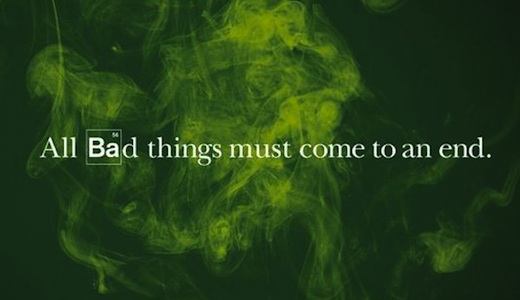
**Warning: Massive Spoilers**
Amidst the mostly unanimous praise for Breaking Bad’s finale this past Sunday there was one steady complaint from a fair share of critics: Was the finale too neat? Alan Sepinwall raised the point at HitFix but Matt Yglesias’s wooden criticism at Slate may have been the firmest on the point.
The trouble with the criticism (and to his credit, Yglesias himself acknowledges this) is that it represents a fundamental misunderstanding of what Breaking Bad was. The show was never about realism. The show gets the science wrong at a number of points, including the color of Heisenberg’s famed ultra pure meth–it wouldn’t have been sky blue. And it asks viewers to take several increasingly implausible leaps of faith throughout the series. We’re asked to believe that a cop as competent and skilled as Hank would never figure out that Heisenberg was his brother-in-law until a chance moment in the White bathroom when he stumbles across a book with a cryptic note on the inside page. The show does well to make this less absurd (through the joking way Walt relates to Hank–(hands up) “You got me,” and so on) but it’s still pushing the limits of plausibility. The plot to kill Gus was at least as complex as the plot to kill the neo-Nazis. If anything it was more complicated because it required getting Jesse back on his side through an extremely elaborate plot that involved poisoning a child he’d never met, getting Huell to lift Jesse’s cigarettes, convincing Jesse that Gus had poisoned Brock, and then bringing Jesse in on the plan. It also required getting Hector Salamanca to side with Walt–another leap, although a believable one given their mutual hatred for Gus. Speaking of whom, Gus’s plot to kill the Cartel wasn’t exactly simple–and the whole thing hinged on Jesse being able to cook Heisenberg-level meth in an extremely stressful environment with a group of assistants who didn’t speak English. Point being, if we stopped at any single pivotal point in the series and actually analyzed it for realism, it’s likely that the sequence would come up wanting.
But that’s because looking for realism is precisely the wrong way of looking at this story. At its heart, Breaking Bad is something of a Shakespearean morality play. As it ends, only one of the chief actors at the heart of the drama is still alive–and Jesse has arguably suffered more than any other character on the show. Every other person prominently involved in the manufacturing and sale of meth (or investigating said sale) is dead–Hank, Gomey, Walt, the neo-Nazis, Todd, Gus, Mike, the Cartel, the Cousins, Tuco, Krazy 8… no one is spared. And yet in the midst of the tragedy of the story, we also see how one comes to redemption.
Gilligan’s answer echoes the answer embraced by another great non-religious moralist who wrestled deeply with Christian faith, the great French-Algerian writer Albert Camus. Like Camus, Gilligan’s characters find consolation, if not outright redemption, through the act of confession. Jesse began the slow journey to redemption in season four after his assassination of Gale. He made efforts to talk about the things he had done with his support group, and yet it was a classic case of one step forward, two steps back as any progress Jesse made was more than compromised by his initial attempt to sell to the group members (though he did confess that sin as well) and his continued association with Gus and Mike. Jesse moves closer to consolation when he joins with Hank and Gomez, beginning with his filmed confession in Rabid Dog. There is still much that Jesse has to suffer, but the straightening of his crooked heart had begun in earnest with that confession.
But what of Walt? His restoration in the finale is not so straight-forward: One can argue, as NPR’s Linda Holmes did, that the powerplay with the Schwarz’s is one final way for Walt to stick it to his friends and exert control over Flynn. (Of course, such a claim is based on the questionable theory that a child should be utterly self-made and autonomous from their parents except to whatever extent they willingly embrace that relationship. To use Hauerwas’s phrase, it’s based on the idea that Flynn “has no story except the story he chose when he had no story.”) Likewise, one could see his confession to Skyler as one more powerplay, the only way to insure that she would not be suspicious of the Schwarz’s gift when Flynn turned 18. And surely it’s easy to see the killing of the neo-Nazis as Heisenberg’s last stand, when he settles all accounts like some modern day version of Michael Corleone.
Yet I think that fundamentally misunderstands what happens in the finale. In the early seasons of the show, Walt famously rejects any notion that there is something beyond the physical creation and individuals who have the power to exert their will upon it. He famously dismisses the notion of the soul in a first season flashback with Gretchen and angrily corrects a cancer patient who says that cancer has taught him how little control he really has over his life. At the time Walt heard the man and managed a sneering “that is such bullshit,” before launching into a soliloquy straight from the pages of Nietzsche.
But how does the finale begin? With Walt in a car praying–and praying a prayer that sounds like something from the imprecatory Psalms or, foreshadowing his end, the biblical hero Samson. What happens after he prays? He takes steps to provide for his family. He confesses his sins to his wife. He goes out of his way to make sure his family knows that the money did not come from him–a stunning move given his early-season obsession with making sure his family knew that he earned that money. (Remember the scene with baby Holly when Walt takes her to the garage and shows her all his money with the comment, “Look what daddy made.”) And finally he acts as a dispenser of justice, killing the neo-Nazis while simultaneously saving the life of his lost and desolated “son.”
To be sure, this isn’t a conversion to anything like confessional Christianity. And yet there is a kind of conversion that takes place–and one that strays dangerously close to something like Christianity. At the very least, it’s a conversion away from the Nietzschean materialism that characterized Heisenberg. And if we view it more sympathetically, we might even say that it’s a conversion away from the way of nature and to the way of grace, as described in Malick’s beautiful Tree of Life:
The nuns taught us there were two ways through life – the way of nature and the way of grace. You have to choose which one you’ll follow. Grace doesn’t try to please itself. Accepts being slighted, forgotten, disliked. Accepts insults and injuries. Nature only wants to please itself. Get others to please it too. Likes to lord it over them. To have its own way. It finds reasons to be unhappy when all the world is shining around it. And love is smiling through all things.
If that’s a true reading then the conclusion to the film’s opening monologue explains the Breaking Bad finale perfectly: “The nuns taught us that no one who loves the way of grace ever comes to a bad end.”
Previous Post
September 30, 2013
The Idolatry of Breaking Bad
Next Post

October 4, 2013 The Tallest Man on Earth
Browse Our Archives
Select a Category ambition art beauty bible bios body Book Review cheap grace church community consumer church cultural liturgy culture deep practice desire dualisms economics education evangelicalism events faith family fare forward Film Review friendship games Gospel happiness hipster Christianity humility identity institutions irony issue previews Jesus just church justice Lent Letters to the Editor liberal arts liberal christianity literature liturgy love march madness mental health metaphysics misotheism moralism morality Movie Review music narrative naturalism new atheism passions philosophy place political theology Pope Francis power prayer privilege providence reading reason relationship remembering self resurrection science secular faiths secularism sexuality sin Social Media spirituality Sport suburbs suffering table of contents technology the future of faith the new apologetic the virtues theology thick doctrine transcendence Trinity truth tv Uncategorized violence Virtue vocation war work
Select a Month August 2014 July 2014 June 2014 May 2014 April 2014 March 2014 February 2014 January 2014 December 2013 November 2013 October 2013 September 2013 August 2013 July 2013 June 2013 May 2013 April 2013 March 2013 February 2013
Follow Us!
TAKE THE
Religious Wisdom Quiz
Who found a wife for Isaac?
Select your answer to see how you score.
Lot Abraham's servant Ishmael Jacob
Related posts from Fare Forward



Kim Kierkegaardashian and the Culture of Nothingness

Sherwood Anderson and the Platonic Touch
TRENDING AT PATHEOS Evangelical

The REST of Your Life: A Creative Wrestles...
This week I had a conversation with a good friend from church....

How the author of the world's best hymn...
I've been working with John Newton for a while now. This makes...

Long before this Lectio Divina, Psalm 130 - the song - started...

What About the Trees? Another Living Parable
After I finished writing the last article about falling leaves as a...

Why Classical Education Is a Conversation, Not a...
Come and Read: Joy in Classical Education When I was a little...

Cornell University has received a great deal of negative publicity and intense...
view all Evangelical blogs
Ad-Free & Subscriber Log-In Subscription Support
- About Us
- 2026 Calendar
- Videos
- Podcasts
- Library of World Religions
- Faith In Media Tracker
- Advertise With Us
- Write for Us
- Privacy Policy
- Terms of Service
- Do Not Sell My Data
- Contact Us
- Radiant Digital
- Manage Newsletter Subscriptions
- Unsubscribe From Notifications
- Sitemap
Copyright 2008-2026, Patheos. All rights reserved.
Subscription Support Ad-Free & Subscriber Log-In
Follow Patheos