
BuddhistCatholicContemplativeEvangelicalGeneral ChristianHinduJewishLatter-day SaintMuslimNew VisionsProgressive Christian
Beliefs
- Buddhist
- Catholic
- Contemplative
- Evangelical
- General Christian
- Hindu
- Jewish
- Latter-day Saint
- More Voices
- Muslim
- New Visions
- Pagan
- Progressive Christian
Topics
- Religion News
- Food and Religion
- Sports and Religion
- Religious Art
- Religious Music and Entertainment
- Religious Events
- History and Religion
- Style and Religion
- Politics and Religion
- Women in Religion
- Recreation Outdoors and Religion
- Business Finance and Religion
- Careers Workplace and Religion
- Education and Religion
- Family Parenting and Religion
- Health Fitness and Religion
- Home and Religion
- Relationships and Religion
- Technology and Religion
- Travel and Religion
Columnists
- Buddhist Columnists
- Business Finance and Religion Columnists
- Careers Workplace and Religion Columnists
- Catholic Columnists
- Contemplative Columnists
- Education and Religion Columnists
- Evangelists Columnists
- Family Parenting and Religion Columnists
- General Christian Columnists
- Health Fitness and Religion Columnists
- Hindu Columnists
- History and Religion Columnists
- Home and Religion Columnists
- Jewish Columnists
- More Voices Columnists
- Latter Day Columnists
- Muslim Columnists
- New Visions Columnists
- Nonreligious Columnists
- Pagan Columnists
- Politics and Religion Columnists
- Progressive Columnists
- Recreation Outdoors and Religion Columnists
- Relationships and Religion Columnists
- Religion News Columnists
- Religious Art Columnists
- Religious Events Columnists
- Religious Music and Entertainment Columnists
- Sports and Religion Columnists
- Style and Religion Columnists
- Technology and Religion Columnists
- Travel and Religion Columnists
- Women in Religion Columnists
Resource Library
- 2026 Calendar
- Library of World Religions
- The 100 Most Holy Places on Earth
- Patheos Answers
- Podcasts
- Videos
- Faith Leaders Database
- Anglican Episcopalian
- Bahai
- Baptist
- Buddhism
- Christianity
- Confucianism
- Eastern Orthodoxy
- Hinduism
- Holiness and Pentecostal
- ISKCON
- Islam
- Judaism
- Lutheran
- Methodist
- The Church of Jesus Christ of Latter-day Saints
- New Age
- Paganism
- Presbytarian and Reformed
- Protestantism
- Religion Behind the Scenes
- Roman Catholic
- Scientology
- Shia Islam
- Sikhism
- Sufism
- Sunni Islam
- Taoism
- Zen
- See all religions
Research Tools
 Ad-Free & Subscriber Log-In Subscription Support
Ad-Free & Subscriber Log-In Subscription Support
Follow Patheos 

- Trending:
- Forgiveness
- |
- Marriage
- |
- Consciousness
- |
- Death Penalty
- |
- Election
- |
- Halloween
 Fare Forward
- Home
- Evangelical
- Public Christianity and Faithful Institutional Presence
Public Christianity and Faithful Institutional Presence
Last updated on: July 17, 2013 at 11:19 am by Emily DeBaun
Public Christianity and Faithful Institutional Presence 2013-07-17T11:19:32-04:00 Emily DeBaun
Patheos Explore the world's faith through different perspectives on religion and spirituality! Patheos has the views of the prevalent religions and spiritualities of the world.
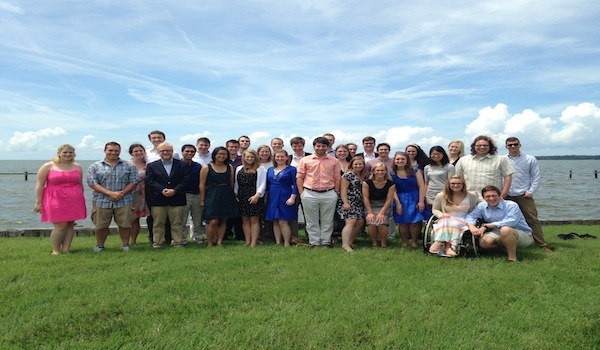
This weekend I had the privilege of gathering with a group of Fare Forward writers and readers on the (honest and truly) sublime Maryland coast to consider the subject of “Public Christianity in the 21st Century.” While the weekend’s conversations spanned topics from gender to post-modernism to Korean birthday customs, a thread that stood out to me was the concept of “institutional thinking” introduced to the group by Adam Myers, a current student at Yale Divinity School. His presentation focused on how we approach the institutions we are a part of, whether they be companies, universities, or churches. His talk exhorted us to be both “faithful” to and “present” in these institutions.
To Myers, a critical component of being “faithful” to our institutions is to understand their histories. Many of the presenters echoed this point over the course of the weekend—the notion that it is essential to comprehend the context of an institution, ideology, or even a person, in order to fully appreciate, engage with, and serve it/them. Understanding how a particular “tradition” has shaped an institution also allows us to identify how particular problems arose in the past, and to determine how those problems can be best addressed in the future. Understanding an institution’s history allows us to be faithful to its mission, experiences, and current status, and optimally positions us to contribute fully to it.
As Myers acknowledged, simply focusing on “faithfulness” to an institution doesn’t tell us how exactly we should operate within it. For this point, he introduced the concept of “presence.” To be “faithfully present” in an institution means to assume responsibility for upholding the institution’s mission. Assuming what Myers calls “the institutional stance” means that we strive to uphold the ideals of an institution, while respecting the forces that have shaped it, rather than simply taking from the institution for personal gain. This attitude can truly transform the way we view the structures and organizations we are a part of. In Myers’ case, this means investing in the life of the university, seeking to bolster its culture and well-being, rather than simply using it to improve personal credentials. This concept relates my own situation as a member of the workforce. My purpose as an employee is not simply to earn income for my own advancement, but to really invest in the day-to-day culture of the company while also contributing to its work for the greater good.
Institutional thinking is a refreshing outlook in a culture where individualism is so central and institutions are often seen as simply means to (or impediments of) personal advancement. Even the most mundane tasks gain new meaning when viewed in the larger institutional context, and at the same time, one’s personal perspective gets a healthy readjustment. Myers’ framework was clear and inspiring. However (and I’m certain I’m not doing justice to the research Adam has done beyond what he presented), I had a nagging feeling after the talk – what happens when this framework begins to break down? In the complexity of real life, we interface with imperfect institutions that have flawed ideals, inaccessible histories, and broken processes. While it may be reasonable to assume an institutional stance in a transparent and well-functioning organization, it becomes much more difficult to effect when we are a part of faulty institutions, particularly when we are not in a position to easily change them.
Providentially, the speaker following Myers began to acknowledge and address these points, albeit entirely unintentionally. Journalist Anne Snyder described her professional journey, centering around a particular dilemma she faced when she was asked to revise a piece to dramatically change both its voice and content. While edits are a natural part of the journalism process, and in general accepting modest changes to a piece would be part of maintaining an institutional stance towards a given publication, Snyder felt, in this case, that the integrity of her work would be compromised, were she to make the suggested changes. At that point, she took a significant professional risk and removed her piece from consideration by the publication. In this instance, she opted not to contribute to an institution in a case where she could not, in good faith, support what it required of her. However, she has remained able to interface effectively with the institution (particular publications as well as American journalism in general) with other pieces and in other capacities. Snyder gave an excellent case study of ways in which institutional thinking can be problematized, as well as an example of how personal integrity can be maintained, though temporarily dropping a strict institutional stance might be necessary, in cases where an institution’s values differ from one’s own.
The institutions we interact with on a regular basis are imperfect and likely to periodically conflict with our values system—a simple reality of a fallen world. However, dysfunction comes in degrees. In a best-case scenario, Myers’ framework clearly applies, but in other scenarios, it becomes more difficult to discerningly utilize. In Snyder’s case, the choice to refrain from publishing was obvious. But more often, a situation is painted some shade of gray. Do we have an obligation, at some point, to either reform or remove ourselves from institutions with ideals or practices we cannot fully support? It is likely that any institution will pose some personal conflicts. But where exactly is the breaking point? When do we let down our institutional stance? Unfortunately I am simply beginning to ask these questions and do not have much in the way of answers, but I would love to hear ideas or anecdotes, if readers have them, as these are issues we all encounter in the multitude of institutions that surround us.
Previous Post

July 17, 2013
Two Responses to Andy Crouch on Institutions
Next Post

July 22, 2013 Short-term Missions, Long-term Places
Browse Our Archives
Select a Category ambition art beauty bible bios body Book Review cheap grace church community consumer church cultural liturgy culture deep practice desire dualisms economics education evangelicalism events faith family fare forward Film Review friendship games Gospel happiness hipster Christianity humility identity institutions irony issue previews Jesus just church justice Lent Letters to the Editor liberal arts liberal christianity literature liturgy love march madness mental health metaphysics misotheism moralism morality Movie Review music narrative naturalism new atheism passions philosophy place political theology Pope Francis power prayer privilege providence reading reason relationship remembering self resurrection science secular faiths secularism sexuality sin Social Media spirituality Sport suburbs suffering table of contents technology the future of faith the new apologetic the virtues theology thick doctrine transcendence Trinity truth tv Uncategorized violence Virtue vocation war work
Select a Month August 2014 July 2014 June 2014 May 2014 April 2014 March 2014 February 2014 January 2014 December 2013 November 2013 October 2013 September 2013 August 2013 July 2013 June 2013 May 2013 April 2013 March 2013 February 2013
Follow Us!
TAKE THE
Religious Wisdom Quiz
What city did David capture and make the capital of Israel?
Select your answer to see how you score.
Samaria Hebron Jerusalem Bethlehem
Related posts from Fare Forward

Wrongful: A Story of Injustice Overturned


TRENDING AT PATHEOS Evangelical

The REST of Your Life: A Creative Wrestles...
This week I had a conversation with a good friend from church....

How the author of the world's best hymn...
I've been working with John Newton for a while now. This makes...

Long before this Lectio Divina, Psalm 130 - the song - started...

What About the Trees? Another Living Parable
After I finished writing the last article about falling leaves as a...

Why Classical Education Is a Conversation, Not a...
Come and Read: Joy in Classical Education When I was a little...

Cornell University has received a great deal of negative publicity and intense...
view all Evangelical blogs
Ad-Free & Subscriber Log-In Subscription Support
- About Us
- 2026 Calendar
- Videos
- Podcasts
- Library of World Religions
- Faith In Media Tracker
- Advertise With Us
- Write for Us
- Privacy Policy
- Terms of Service
- Do Not Sell My Data
- Contact Us
- Radiant Digital
- Manage Newsletter Subscriptions
- Unsubscribe From Notifications
- Sitemap
Copyright 2008-2026, Patheos. All rights reserved.
Subscription Support Ad-Free & Subscriber Log-In
Follow Patheos