
BuddhistCatholicContemplativeEvangelicalGeneral ChristianHinduJewishLatter-day SaintMuslimNew VisionsProgressive Christian
Beliefs
- Buddhist
- Catholic
- Contemplative
- Evangelical
- General Christian
- Hindu
- Jewish
- Latter-day Saint
- More Voices
- Muslim
- New Visions
- Pagan
- Progressive Christian
Topics
- Religion News
- Food and Religion
- Sports and Religion
- Religious Art
- Religious Music and Entertainment
- Religious Events
- History and Religion
- Style and Religion
- Politics and Religion
- Women in Religion
- Recreation Outdoors and Religion
- Business Finance and Religion
- Careers Workplace and Religion
- Education and Religion
- Family Parenting and Religion
- Health Fitness and Religion
- Home and Religion
- Relationships and Religion
- Technology and Religion
- Travel and Religion
Columnists
- Buddhist Columnists
- Business Finance and Religion Columnists
- Careers Workplace and Religion Columnists
- Catholic Columnists
- Contemplative Columnists
- Education and Religion Columnists
- Evangelists Columnists
- Family Parenting and Religion Columnists
- General Christian Columnists
- Health Fitness and Religion Columnists
- Hindu Columnists
- History and Religion Columnists
- Home and Religion Columnists
- Jewish Columnists
- More Voices Columnists
- Latter Day Columnists
- Muslim Columnists
- New Visions Columnists
- Nonreligious Columnists
- Pagan Columnists
- Politics and Religion Columnists
- Progressive Columnists
- Recreation Outdoors and Religion Columnists
- Relationships and Religion Columnists
- Religion News Columnists
- Religious Art Columnists
- Religious Events Columnists
- Religious Music and Entertainment Columnists
- Sports and Religion Columnists
- Style and Religion Columnists
- Technology and Religion Columnists
- Travel and Religion Columnists
- Women in Religion Columnists
Resource Library
- 2026 Calendar
- Library of World Religions
- The 100 Most Holy Places on Earth
- Patheos Answers
- Podcasts
- Videos
- Faith Leaders Database
- Anglican Episcopalian
- Bahai
- Baptist
- Buddhism
- Christianity
- Confucianism
- Eastern Orthodoxy
- Hinduism
- Holiness and Pentecostal
- ISKCON
- Islam
- Judaism
- Lutheran
- Methodist
- The Church of Jesus Christ of Latter-day Saints
- New Age
- Paganism
- Presbytarian and Reformed
- Protestantism
- Religion Behind the Scenes
- Roman Catholic
- Scientology
- Shia Islam
- Sikhism
- Sufism
- Sunni Islam
- Taoism
- Zen
- See all religions
Research Tools
 Ad-Free & Subscriber Log-In Subscription Support
Ad-Free & Subscriber Log-In Subscription Support
Follow Patheos 

- Trending:
- Forgiveness
- |
- Marriage
- |
- Consciousness
- |
- Death Penalty
- |
- Election
- |
- Halloween
 Fare Forward
- Home
- Evangelical
- A Utopian and an Acadian
A Utopian and an Acadian
Last updated on: July 29, 2013 at 9:05 am by Matt Mellema
A Utopian and an Acadian 2013-07-29T09:05:18-04:00 Matt Mellema
Patheos Explore the world's faith through different perspectives on religion and spirituality! Patheos has the views of the prevalent religions and spiritualities of the world.
I come from Colorado Springs, a conservative town. I go to school at a liberal law school in the northeast. As such, I get swamped with political rhetoric from the left and right, and much of it is seething. Like those around me, I often fall into the trap of partisanship. The self-congratulation that comes from condemning a political rival is delicious, but it has consequences, the worst of which is my assumption about people on the other side. I think of them not merely as stupid and ignorant, but also wicked. In addition to my being right and their being wrong, I’m also a better person than they are.
W.H. Auden offers a corrective to this view. In the “Vespers” section of his poem “Horae Canonicae,” he examines the two archetypal political temperaments. The first is the one Auden himself identifies with—the Arcadian. He gets the term from the region of Greece that inspired pastoral poetry yearning for the idealized past. The Arcadian respects the ancient wisdom, and is convinced that everything today is decaying. The Arcadian’s anti-type is the Utopian. He looks forward to the shining society of reason and virtue. He strives to move out of the shadows of past ignorance and into the dawn of a new world.
Like Auden, I’ve always identified with the Arcadian. Perhaps this has more to do with pessimism than politics, but I nonetheless view Utopians with suspicion. Don’t they realize that dreams of perfect societies are naïve? Are they really arrogant enough to brush away the past without learning from it?
Although Auden might agree with my sentiment, he avoids these petty prejudices in “Vespers.” The poem opens with Auden, representing Arcadia, meeting his anti-type. They have nothing in common, and it’s awkward: “Neither speaks. What experience could we possibly share?” Things don’t improve much when they walk through town and see a lamp in a storefront window: “I observe it is too hideous for anyone in their senses to buy: He observes it is too expensive for a peasant to buy.”
An Arcadian may defend this exchange—Auden upholds the finer things, and expects even simple objects to be well-made. The Utopian, on the other hand, views the lamp as a mere tool, and makes a self-righteous remark to brag about how much he empathizes with poor people. The next line, however, tips the scale the other way: “Passing a slum child with rickets, I look the other way: He looks the other way if he passes a chubby one.”
Rather than setting himself as the wiser of the two, Auden shows an area where the Utopian sees more clearly than he does. This pattern repeats throughout the poem. Each observes the same thing, and derives something different from it. At the end, Auden suggests this is not coincidence. Instead of being opponents who talk past each other, there is a kinship between them. Auden says that the meeting is a: “[R]endezvous between accomplices who, in spite of themselves, cannot resist meeting to remind the other (do both, at bottom, desire truth?) of that half of their secret which he would most like to forget.”
This has resonances with Christian thought, and our view of the cross. Christianity—which embraces both Eden and the New Jerusalem—needs the insight of both the Arcadian and the Utopian. Auden argues that bringing both sides together,
“[Forces] us both, for a fraction of a second, to remember our victim (but for him I could forget the blood, but for me he could forget the innocence)/
on whose immolation (call him Abel, Remus, whom you will, it is one Sin Offering) arcadias, utopias, our dear old bag of a democracy, are alike founded”
This robustly-realized faith, in turn, is necessary for society to operate. As Auden concludes: “[W]ithout a cement of blood (it must be human, it must be innocent) no secular wall will safely stand”
I don’t mean to say that political views don’t matter, or that everybody is equally right. But it is important to remember that both temperaments are necessary for a fully-formed Christianity. Rather than shunning these impulses in others, we should try to find the nugget of truth in them. We should all look back to Eden, and forward to New Jerusalem.
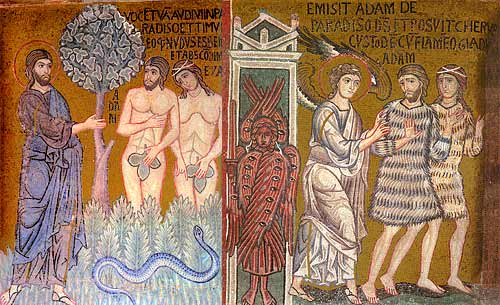
[Image of the Garden of Eden from Wikipedia]

Previous Post

July 24, 2013
On Honesty and Confession
Next Post

July 29, 2013 What the Church Can Learn from the Reza Aslan Affair
Browse Our Archives
Select a Category ambition art beauty bible bios body Book Review cheap grace church community consumer church cultural liturgy culture deep practice desire dualisms economics education evangelicalism events faith family fare forward Film Review friendship games Gospel happiness hipster Christianity humility identity institutions irony issue previews Jesus just church justice Lent Letters to the Editor liberal arts liberal christianity literature liturgy love march madness mental health metaphysics misotheism moralism morality Movie Review music narrative naturalism new atheism passions philosophy place political theology Pope Francis power prayer privilege providence reading reason relationship remembering self resurrection science secular faiths secularism sexuality sin Social Media spirituality Sport suburbs suffering table of contents technology the future of faith the new apologetic the virtues theology thick doctrine transcendence Trinity truth tv Uncategorized violence Virtue vocation war work
Select a Month August 2014 July 2014 June 2014 May 2014 April 2014 March 2014 February 2014 January 2014 December 2013 November 2013 October 2013 September 2013 August 2013 July 2013 June 2013 May 2013 April 2013 March 2013 February 2013
Follow Us!
TAKE THE
Religious Wisdom Quiz
Which Christian denomination is most associated with the Reformation led by Martin Luther?
Select your answer to see how you score.
Catholic Anglican Lutheran Orthodox
Related posts from Fare Forward



Compassion in the Face of Force

Short-term Missions, Long-term Places
TRENDING AT PATHEOS Evangelical

The REST of Your Life: A Creative Wrestles...
This week I had a conversation with a good friend from church....

How the author of the world's best hymn...
I've been working with John Newton for a while now. This makes...

Long before this Lectio Divina, Psalm 130 - the song - started...

What About the Trees? Another Living Parable
After I finished writing the last article about falling leaves as a...

Why Classical Education Is a Conversation, Not a...
Come and Read: Joy in Classical Education When I was a little...

Cornell University has received a great deal of negative publicity and intense...
view all Evangelical blogs
Ad-Free & Subscriber Log-In Subscription Support
- About Us
- 2026 Calendar
- Videos
- Podcasts
- Library of World Religions
- Faith In Media Tracker
- Advertise With Us
- Write for Us
- Privacy Policy
- Terms of Service
- Do Not Sell My Data
- Contact Us
- Radiant Digital
- Manage Newsletter Subscriptions
- Unsubscribe From Notifications
- Sitemap
Copyright 2008-2026, Patheos. All rights reserved.
Subscription Support Ad-Free & Subscriber Log-In
Follow Patheos