
BuddhistCatholicContemplativeEvangelicalGeneral ChristianHinduJewishLatter-day SaintMuslimNew VisionsProgressive Christian
Beliefs
- Buddhist
- Catholic
- Contemplative
- Evangelical
- General Christian
- Hindu
- Jewish
- Latter-day Saint
- More Voices
- Muslim
- New Visions
- Pagan
- Progressive Christian
Topics
- Religion News
- Food and Religion
- Sports and Religion
- Religious Art
- Religious Music and Entertainment
- Religious Events
- History and Religion
- Style and Religion
- Politics and Religion
- Women in Religion
- Recreation Outdoors and Religion
- Business Finance and Religion
- Careers Workplace and Religion
- Education and Religion
- Family Parenting and Religion
- Health Fitness and Religion
- Home and Religion
- Relationships and Religion
- Technology and Religion
- Travel and Religion
Columnists
- Buddhist Columnists
- Business Finance and Religion Columnists
- Careers Workplace and Religion Columnists
- Catholic Columnists
- Contemplative Columnists
- Education and Religion Columnists
- Evangelists Columnists
- Family Parenting and Religion Columnists
- General Christian Columnists
- Health Fitness and Religion Columnists
- Hindu Columnists
- History and Religion Columnists
- Home and Religion Columnists
- Jewish Columnists
- More Voices Columnists
- Latter Day Columnists
- Muslim Columnists
- New Visions Columnists
- Nonreligious Columnists
- Pagan Columnists
- Politics and Religion Columnists
- Progressive Columnists
- Recreation Outdoors and Religion Columnists
- Relationships and Religion Columnists
- Religion News Columnists
- Religious Art Columnists
- Religious Events Columnists
- Religious Music and Entertainment Columnists
- Sports and Religion Columnists
- Style and Religion Columnists
- Technology and Religion Columnists
- Travel and Religion Columnists
- Women in Religion Columnists
Resource Library
- 2026 Calendar
- Library of World Religions
- The 100 Most Holy Places on Earth
- Patheos Answers
- Podcasts
- Videos
- Faith Leaders Database
- Anglican Episcopalian
- Bahai
- Baptist
- Buddhism
- Christianity
- Confucianism
- Eastern Orthodoxy
- Hinduism
- Holiness and Pentecostal
- ISKCON
- Islam
- Judaism
- Lutheran
- Methodist
- The Church of Jesus Christ of Latter-day Saints
- New Age
- Paganism
- Presbytarian and Reformed
- Protestantism
- Religion Behind the Scenes
- Roman Catholic
- Scientology
- Shia Islam
- Sikhism
- Sufism
- Sunni Islam
- Taoism
- Zen
- See all religions
Research Tools
 Ad-Free & Subscriber Log-In Subscription Support
Ad-Free & Subscriber Log-In Subscription Support
Follow Patheos 

- Trending:
- Forgiveness
- |
- Marriage
- |
- Consciousness
- |
- Death Penalty
- |
- Election
- |
- Halloween
 Fare Forward
- Home
- Evangelical
- The Summer Pop Culture Found Religion
The Summer Pop Culture Found Religion
Last updated on: June 27, 2013 at 12:01 pm by Jonathan Askonas
The Summer Pop Culture Found Religion 2013-06-27T12:01:42-04:00 Jonathan Askonas
Patheos Explore the world's faith through different perspectives on religion and spirituality! Patheos has the views of the prevalent religions and spiritualities of the world.
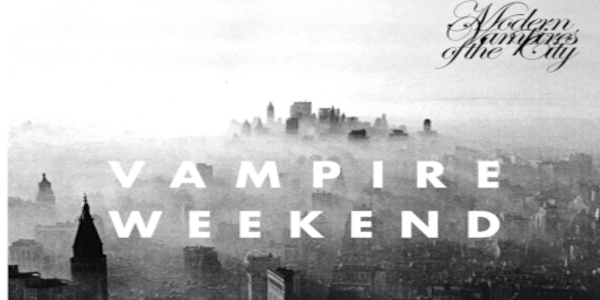
Behold the summer where pop culture (or at least its high priests) found religion. Two of the biggest, most influential albums to drop this summer place religious questions and symbols at their core. More importantly, both promise to be memorable works. One, Modern Vampires of the City, marks the critical and commercial highwater mark of indie-rock impresarios Vampire Weekend. The other, Kanye West’s Yeezus, has received rave reviews and, given the artist’s current pop culture ascendance (cf. “Kimye”), is already making quite the splash. While other reviewers have pointed out the religious nature of these works, few have addressed their specific theological contexts. You can’t really understand these albums apart from the experiences of American Judaism and African-American Christianity.
Vampire Weekend is hardly the first major band to raise Jewish religious questions through their music (Hasidic rapper Matisyahu comes to mind). But I can’t recall another recent artist wrestling with the Jewish experience in America. Much of the album is tinged with an ironic sense of isolation. Since their origins at Columbia University, Vampire Weekend has been seen as a preppy band with a WASPy aesthetic and has even been accused of cultural imperialism for popularizing distinctly African sounds. And yet neither of the band’s creative forces, vocalist Ezra Koenig and keyboardist Rostam Batmanglij, is Anglo-Saxon or Protestant, and neither would have been considered white even two generations ago. And so the band has managed quite a feat on Modern Vampires, communicating the uneasy ambiguity between the cultural centrality many ascribe to them (cardigans, Columbia, and other WASP credentials) and Koenig and Batmanglij’s actual experiences as secular Jewish and Persian musicians.
This isn’t to suggest that the two claim any sort of victimhood about their circumstances. They merely draw circumspect irony to the gap between their histories and the background noise of American culture. Thus, on the upbeat “Unbelievers,” Koenig refuses to let a Christian vision of damnation prevent him from having a good time, singing on the chorus that:
“We know the fire awaits unbelievers
All of the sinners the same
Girl, you and I will die unbelievers bound to the tracks of the train.”
But underneath the devil-may-care attitude is a touch of resentment stretching towards belief. In another verse, Koenig asks,
“I’m not excited but should I be?
Is this the fate that half of the world has planned for me?
I know I love you and you love the sea
But what Holy water contains a little drop, little drop for me?”
These themes continue and intensify throughout the album. While the themes of mortality and the Big Questions are obvious enough, underneath it lies the tension Koenig feels, on the one hand, between his chosen musical oeuvre and its presumed cultural Christianity and, on the other, between the aesthetic exercises of Upper West Side Judaism and the actual content of the faith. So, for example, on “Worship You,” the band sings:
“We worshipped you
Your red right hand
Won’t we see you once again?
In foreign soil, in foreign land
Who will guide us through the end?”
The description of God’s “red right hand” is borrowed from Paradise Lost via indie singer Nick Cage. This song epitomizes Vampire Weekend theology – a Jewish psalm or lamentation remixed with a catchy, upbeat tune and classical Western allusions mixed with pop culture references. But as with the rest of the album, God doesn’t get a pass for his treatment of his people. The song opens with Koenig cataloging God’s requirements for worship, so that his choral questions come across as requests for payment in turn. This theme comes across most clearly in my favorite song on the album, “Ya Hey.” The title comes from the eponymous chorus, a reversed and sped up sample of Outkast’s classic “Hey Ya”. Even here, the ambiguity that Vampire Weekend likes to play with comes across loud and clear. By using a sonically reconstructed sample instead of a straight-forward lyric, the band manages to reference “Yahweh” without taking the Lord’s name in vain. Are they being sincere or merely clever? We’ll never know. Their beef with the most High comes across clear in the chorus:
“You won’t even say your name
Only “I am that I am”
But who could ever live that way?”
In the end, the meta-allusion (the allusion to which all other allusions allude) behind the album is Job. But instead of God asking the questions of Job, Vampire Weekend is firmly in the driver’s seat. The album echoes of Charles Taylor’s central claim in A Sacred Age, that the possibility of unbelief has ballooned in a secular society until it is scarcely avoidable. As educated postmoderns, Vampire Weekend ask how they could believe in the God of Abraham, Isaac, and Jacob when they live in a time and place so alien to ancient Israel. Who could ever live that way? And whose fault is that?
Where Vampire Weekend is tentative and subtle, Kanye West’s Yeezus is nothing if not defiant. Now, bombastic identification with the suffering Christ is nothing new to hiphop. Neither is this Kanye’s first foray into the theme – his 2004 hit “Jesus Walks” indignantly asked the hip-hop world,
“They say you can rap about anything except for Jesus
That means guns, sex, lies, videotape
But if I talk about God my record won’t get played, huh?”
His album, The College Dropout, was a huge hit; it turns out that you can rap about Jesus. But, after that single on his debut album, Kanye mostly chose not to. Over the intervening decade, his rhymes have mostly addressed his fame, his struggles as an artist within the formulaic music establishment, and his many, many problems with women. It wouldn’t be correct to say that Yeezus really breaks this trend. In the church of Kanye, dopeness is next to godliness, and Kanye is the Vicar of Christ, bringing inspired beats and social awareness to the masses. As he raps on “I Am a God (feat. God)”:
“I am a god
Even though I’m a man of God
My whole life in the hands of God
So y’all better quit playing with God.”
Later:
“I know he the most high
But I am a close high.”
Kanye’s sense of mission comes across strongly in Yeezus (a development that attentive observers will also find in My Beautiful, Dark, Twisted Fantasy and Watch the Throne). Kanye sees himself as a uniquely gifted musical genius underappreciated by the music establishment and the culture that made him famous. While much has been made of the misogynistic and materialistic libretto of Yeezus, most serious fans will conclude that he’s not exactly playing it straight. Taken as a whole, the most controversial songs, the angriest songs, appear as the first “phase” of the album, chronicling how Yeezy sometimes feels and acts – as if he were God. There’s more than a little bit of self-aware absurdity to his demand that, as God, they should “hurry up with his damn croissants.” And can’t we sympathize with Yeezy? Imagine how easy it is to get indignant when the wireless is slow or when the barista messes up your drink. I applaud Kanye’s insight that slowness, the test of our patience, that reminds us that we are not gods. Having to wait is a palpable reminder that you’re not in control.
But Kanye has always claimed to be bigger than his personal troubles. He said in a much-discussed New York Times Magazine interview that he aspires to be a Steve Jobs, a Walt Disney, a Henry Ford – a visionary whose aesthetic tastes leave a generational impact. Along the way, he’s concerned with reminding Americans that, even as formal or legal racism becomes rarer and rarer, systemic racism is murdering or imprisoning young black men by greater and greater numbers every day. In this sense, Yeezus is best seen in the tradition of prophetic criticism often exemplified in African-American Christianity. West sees himself and his music as raising vital concerns of justice to greater and greater awareness. Arguably, West’s sense of justice is one of his most public qualities of character. Most of his most controversial actions – his calling out of President Bush after Hurricane Katrina, his 2009 Taylor Swift stagebomb, and his tantrums about being left out of the 2012 Album of the Year nominations – all come down to West’s sense that someone was being deprived what was their due.
And so, when the album’s first track (“On Sight”) samples a gospel choir singing:
“He’ll give us what we need
It may not be what we want,”
you know that he means it.
Even though Vampire Weekend and Kanye West take up very different religious mantles (Job for the former and Jeremiah or Hosea for the latter), my problem with the way that they wove God into both their albums is the same. They both act as if the God whom their music addresses could not or does not address them back. Vampire Weekend’s questioning is distinctly unidirectional; the Jesus who asks Yeezy, “whatup” bears little resemblance to the Jesus of the Gospels. Moreover, neither artist cares to address what such a God might demand of their lives. Their treatment of him is solipsistic. Hidden behind artistic genius is a refusal to engage with the God who is there. There are answers to Vampire Weekend’s questions; Jesus says to Kanye West, “Come follow me.” You can find excellent art on existential questions or social justice from secular musicians. But if you want a serious treatment of God in art, I think you have to look to the best Christian artists working today.
In some ways, this moment has been a long time coming. Following the slow and much deserved death of “Contemporary Christian Music” (I shudder to remember the emotionally drenched pop-lite and Jesus-is-my-boyfriend music popular in my adolescence, as mercilessly lampooned by South Park), Christians began making real music again. While Christians always need new hymns for worship, the newest trends in music by Christian artists return to the prophetic and evangelistic role of Christian art without sacrificing artistic quality. Reformed HipHop, spearheaded by artists like Lecrae or Shai Linne, is more lyrically inventive than most of the biggest names in the game. The recently retired David Crowder Band’s last two albums, Church Music and Give Us Rest, were as well produced and musically ingenious as any secular alt-rock or indie band I’m aware of. Let’s pray that, even as secular musicians express divine yearnings, Christian musicians continue to create aesthetically excellent, Gospel-centered music.
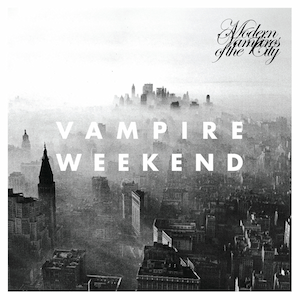
[Image of Vampire Weekend Album Cover from Wikipedia]
Previous Post

June 25, 2013
What Does It Mean to Be Successful?
Next Post

June 27, 2013 Faith, Fiction, and Reason
Browse Our Archives
Select a Category ambition art beauty bible bios body Book Review cheap grace church community consumer church cultural liturgy culture deep practice desire dualisms economics education evangelicalism events faith family fare forward Film Review friendship games Gospel happiness hipster Christianity humility identity institutions irony issue previews Jesus just church justice Lent Letters to the Editor liberal arts liberal christianity literature liturgy love march madness mental health metaphysics misotheism moralism morality Movie Review music narrative naturalism new atheism passions philosophy place political theology Pope Francis power prayer privilege providence reading reason relationship remembering self resurrection science secular faiths secularism sexuality sin Social Media spirituality Sport suburbs suffering table of contents technology the future of faith the new apologetic the virtues theology thick doctrine transcendence Trinity truth tv Uncategorized violence Virtue vocation war work
Select a Month August 2014 July 2014 June 2014 May 2014 April 2014 March 2014 February 2014 January 2014 December 2013 November 2013 October 2013 September 2013 August 2013 July 2013 June 2013 May 2013 April 2013 March 2013 February 2013
Follow Us!
TAKE THE
Religious Wisdom Quiz
My name is Amos, before God called me to prophesy against Israel what was my occupation?
Select your answer to see how you score.
Fisherman Shepherd and farmer Priest in the temple Spinner of cloth
Related posts from Fare Forward



Privilege, Repentance, Forgiveness
TRENDING AT PATHEOS Evangelical

The REST of Your Life: A Creative Wrestles...
This week I had a conversation with a good friend from church....

How the author of the world's best hymn...
I've been working with John Newton for a while now. This makes...

Long before this Lectio Divina, Psalm 130 - the song - started...

What About the Trees? Another Living Parable
After I finished writing the last article about falling leaves as a...

Why Classical Education Is a Conversation, Not a...
Come and Read: Joy in Classical Education When I was a little...

Cornell University has received a great deal of negative publicity and intense...
view all Evangelical blogs
Ad-Free & Subscriber Log-In Subscription Support
- About Us
- 2026 Calendar
- Videos
- Podcasts
- Library of World Religions
- Faith In Media Tracker
- Advertise With Us
- Write for Us
- Privacy Policy
- Terms of Service
- Do Not Sell My Data
- Contact Us
- Radiant Digital
- Manage Newsletter Subscriptions
- Unsubscribe From Notifications
- Sitemap
Copyright 2008-2026, Patheos. All rights reserved.
Subscription Support Ad-Free & Subscriber Log-In
Follow Patheos