
BuddhistCatholicContemplativeEvangelicalGeneral ChristianHinduJewishLatter-day SaintMuslimNew VisionsProgressive Christian
Beliefs
- Buddhist
- Catholic
- Contemplative
- Evangelical
- General Christian
- Hindu
- Jewish
- Latter-day Saint
- More Voices
- Muslim
- New Visions
- Pagan
- Progressive Christian
Topics
- Religion News
- Food and Religion
- Sports and Religion
- Religious Art
- Religious Music and Entertainment
- Religious Events
- History and Religion
- Style and Religion
- Politics and Religion
- Women in Religion
- Recreation Outdoors and Religion
- Business Finance and Religion
- Careers Workplace and Religion
- Education and Religion
- Family Parenting and Religion
- Health Fitness and Religion
- Home and Religion
- Relationships and Religion
- Technology and Religion
- Travel and Religion
Columnists
- Buddhist Columnists
- Business Finance and Religion Columnists
- Careers Workplace and Religion Columnists
- Catholic Columnists
- Contemplative Columnists
- Education and Religion Columnists
- Evangelists Columnists
- Family Parenting and Religion Columnists
- General Christian Columnists
- Health Fitness and Religion Columnists
- Hindu Columnists
- History and Religion Columnists
- Home and Religion Columnists
- Jewish Columnists
- More Voices Columnists
- Latter Day Columnists
- Muslim Columnists
- New Visions Columnists
- Nonreligious Columnists
- Pagan Columnists
- Politics and Religion Columnists
- Progressive Columnists
- Recreation Outdoors and Religion Columnists
- Relationships and Religion Columnists
- Religion News Columnists
- Religious Art Columnists
- Religious Events Columnists
- Religious Music and Entertainment Columnists
- Sports and Religion Columnists
- Style and Religion Columnists
- Technology and Religion Columnists
- Travel and Religion Columnists
- Women in Religion Columnists
Resource Library
- 2026 Calendar
- Library of World Religions
- The 100 Most Holy Places on Earth
- Patheos Answers
- Podcasts
- Videos
- Faith Leaders Database
- Anglican Episcopalian
- Bahai
- Baptist
- Buddhism
- Christianity
- Confucianism
- Eastern Orthodoxy
- Hinduism
- Holiness and Pentecostal
- ISKCON
- Islam
- Judaism
- Lutheran
- Methodist
- The Church of Jesus Christ of Latter-day Saints
- New Age
- Paganism
- Presbytarian and Reformed
- Protestantism
- Religion Behind the Scenes
- Roman Catholic
- Scientology
- Shia Islam
- Sikhism
- Sufism
- Sunni Islam
- Taoism
- Zen
- See all religions
Research Tools
 Ad-Free & Subscriber Log-In Subscription Support
Ad-Free & Subscriber Log-In Subscription Support
Follow Patheos 

- Trending:
- Forgiveness
- |
- Marriage
- |
- Consciousness
- |
- Death Penalty
- |
- Election
- |
- Halloween
 Fare Forward
- Home
- Evangelical
- On Gratitude and the Essayification of Life
On Gratitude and the Essayification of Life
Last updated on: June 4, 2013 at 11:36 am by Sarah Ngu
On Gratitude and the Essayification of Life 2013-06-04T11:36:13-04:00 Sarah Ngu
Patheos Explore the world's faith through different perspectives on religion and spirituality! Patheos has the views of the prevalent religions and spiritualities of the world.
“Tabbing” is what I call my daily practice of scrolling through emails, Facebook, and Twitter, clickling on any interesting links that pop out. It usually ends with an intimidating row of nearly twenty tabs of articles that I generally avoid but occasionally binge-read, plowing through multiple articles at once. The few articles that get me thinking I send off to friends via email or Facebook with a sentence or two of my thoughts.
There is nothing inherently wrong with “tabbing.” But, as a result of reading James K.A. Smith’s thoughts on how liturgies – secular and sacred – subconsciously shape us in profound ways, I have begun to unpack the driving values behind this practice of mine in order to see what kind of person it is shaping me into.
One of its driving values is that “plowing” through the stack is more important than “chewing” through” it. Productive tabbing is about the number of articles I can get through, not the quality of thoughts spurred from reading them.
One could apply “tabbing” to a whole host of other activities beyond reading online articles, because “tabbing” is about how we relate to our experiences. We absorb an experience (going to a concert, reading an article, etc), maybe post a sentence about it on Twitter or Facebook, and move on quickly to the next one. We effectively box up that experience, slap a label on it, and send it down the conveyor belt.
Christy Wampole, the writer behind “How to Live Without Irony,” might say that my practice is part of a superficial, essayist mode of living. The Italian word for essay is “saggio,” as she notes in a recent NY Times article, “The Essayification of Everything,” which contains the same root as “assaggiare,” which means to sample, taste or nibble food. In contrast to the certitude of company mission statements, political slogans, and even college papers, an essay is much more tentative, explicit about the fact that it is making a humble attempt and invites the reader into conversation. She defines the essay as a “short nonfiction prose with a meditative subject at its center and a tendency away from certitude.”
The sheer number of options before us – in reading, eating, dating, and so on – encourages noncommittal sampling and nibbling, enabling an “essayist” mode of living. At its worst, it is unreflective, as experiences are consumed and then abandoned, and “little time is spent interrogating things we’ve touched.”
At its best, it is meditative and cumulative, ruminating on experiences, storing them away, and retrieving them later to reflect on them in a new light:
Essayism consists in a self-absorbed subject feeling around life, exercising what Theodor Adorno called the “essay’s groping intention,” approaching everything tentatively and with short attention, drawing analogies between the particular and the universal. Banal, everyday phenomena — what we eat, things upon which we stumble, things that Pinterest us — rub elbows implicitly with the Big Questions: What are the implications of the human experience? What is the meaning of life? Why something rather than nothing? Like the Father of the Essay, [Montaigne], we let the mind and body flit from thing to thing, clicking around from mental hyperlink to mental hyperlink: if Montaigne were alive today, maybe he too would be diagnosed with A.D.H.D.
How do we prevent ourselves from flitting from thing to thing like gluttons at a buffet? We have heard the advice to “slow down a little,” “savor a bit more,” but those remarks tend to focus more on behavior modification rather than reassess the fundamentals of how we approach things.
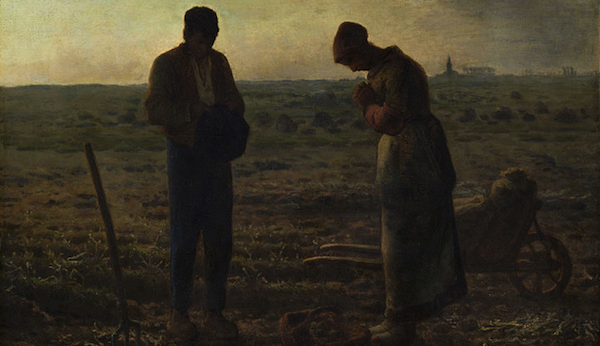
We tend to truly savor and chew on something if we receive it with a sense of wonder (e.g. the first time we stepped into a movie theater or a sports stadium) and gratitude (e.g. opening birthday gifts). The question then becomes, “How do we cultivate a sense of wondrous gratitude?” Most of us already have the habit of giving thanks before our meals. What if we extended that habit – and did it thoughtfully – before we embarked on other sorts of experiences, cultivating a counter-liturgy to our current liturgy of gluttonous tabbing?
[Image of the L’Angelus Prayer from Wikipedia]

Previous Post

June 1, 2013
The Bonobo and The Creator
Next Post

June 6, 2013 Doubting the Value of Doubt
Browse Our Archives
Select a Category ambition art beauty bible bios body Book Review cheap grace church community consumer church cultural liturgy culture deep practice desire dualisms economics education evangelicalism events faith family fare forward Film Review friendship games Gospel happiness hipster Christianity humility identity institutions irony issue previews Jesus just church justice Lent Letters to the Editor liberal arts liberal christianity literature liturgy love march madness mental health metaphysics misotheism moralism morality Movie Review music narrative naturalism new atheism passions philosophy place political theology Pope Francis power prayer privilege providence reading reason relationship remembering self resurrection science secular faiths secularism sexuality sin Social Media spirituality Sport suburbs suffering table of contents technology the future of faith the new apologetic the virtues theology thick doctrine transcendence Trinity truth tv Uncategorized violence Virtue vocation war work
Select a Month August 2014 July 2014 June 2014 May 2014 April 2014 March 2014 February 2014 January 2014 December 2013 November 2013 October 2013 September 2013 August 2013 July 2013 June 2013 May 2013 April 2013 March 2013 February 2013
Follow Us!
TAKE THE
Religious Wisdom Quiz
Who said, "It is finished"?
Select your answer to see how you score.
Paul Jesus John Peter
Related posts from Fare Forward



Kim Kierkegaardashian and the Culture of Nothingness

Sherwood Anderson and the Platonic Touch
TRENDING AT PATHEOS Evangelical

The REST of Your Life: A Creative Wrestles...
This week I had a conversation with a good friend from church....

How the author of the world's best hymn...
I've been working with John Newton for a while now. This makes...

Long before this Lectio Divina, Psalm 130 - the song - started...

What About the Trees? Another Living Parable
After I finished writing the last article about falling leaves as a...

Why Classical Education Is a Conversation, Not a...
Come and Read: Joy in Classical Education When I was a little...

Cornell University has received a great deal of negative publicity and intense...
view all Evangelical blogs
Ad-Free & Subscriber Log-In Subscription Support
- About Us
- 2026 Calendar
- Videos
- Podcasts
- Library of World Religions
- Faith In Media Tracker
- Advertise With Us
- Write for Us
- Privacy Policy
- Terms of Service
- Do Not Sell My Data
- Contact Us
- Radiant Digital
- Manage Newsletter Subscriptions
- Unsubscribe From Notifications
- Sitemap
Copyright 2008-2026, Patheos. All rights reserved.
Subscription Support Ad-Free & Subscriber Log-In
Follow Patheos